Red Balloon Aerospace’s Commercial Balloon Platform Is Drawing Attention Not Only For The Technology — But For What It Reveals About Investor Interest In India’s Emerging Aerospace Economy
India’s startup ecosystem has spent years attracting global capital into fintech, e-commerce, SaaS and consumer internet businesses because those sectors scaled quickly and produced visible market opportunities. Deep-science industries like aerospace, however, remained relatively niche because building advanced engineering systems required longer timelines, higher technical complexity and significantly more patient capital. Most investors traditionally preferred software-led businesses over experimental aerospace infrastructure.
That mindset is now slowly beginning to shift.
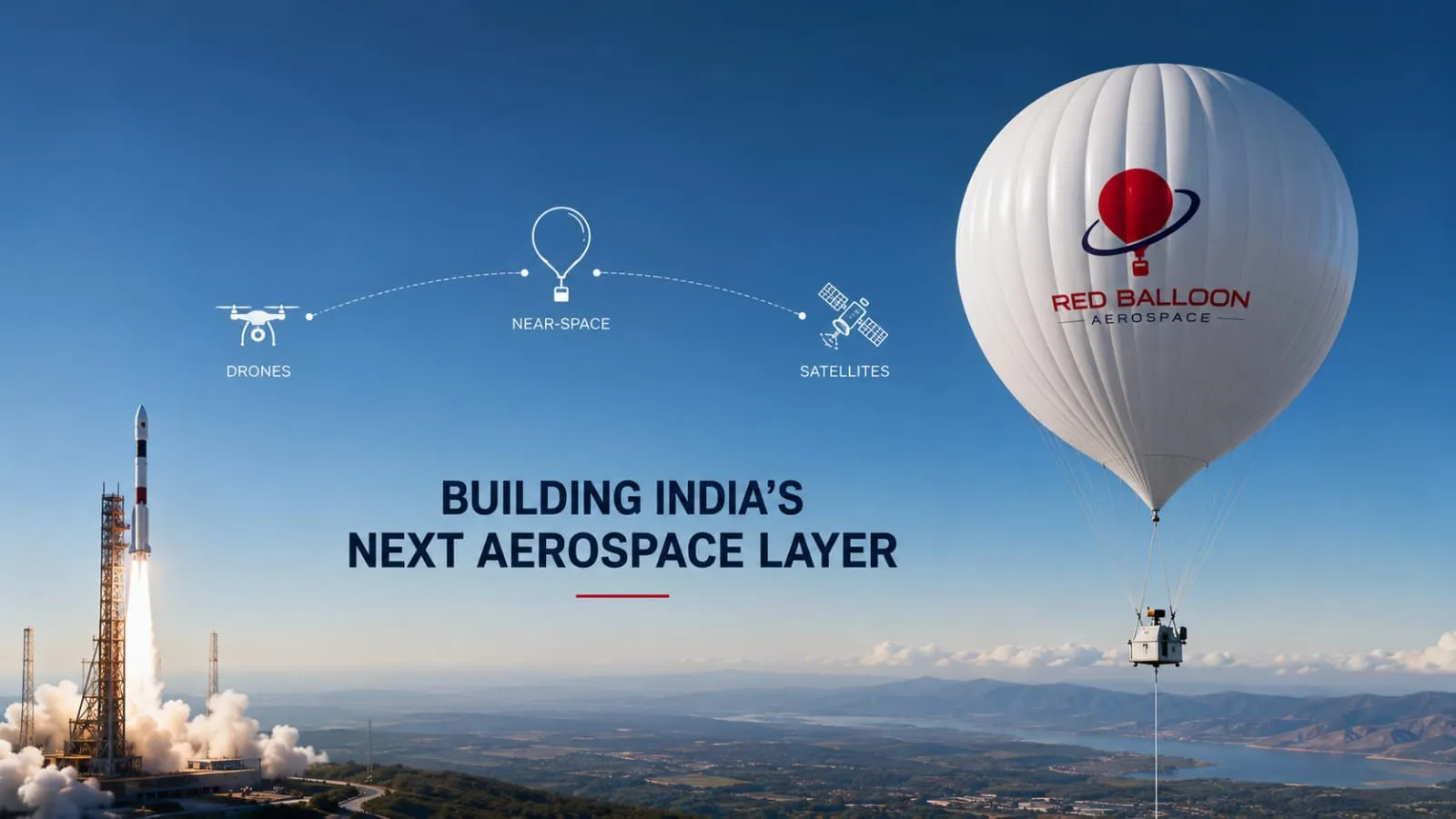
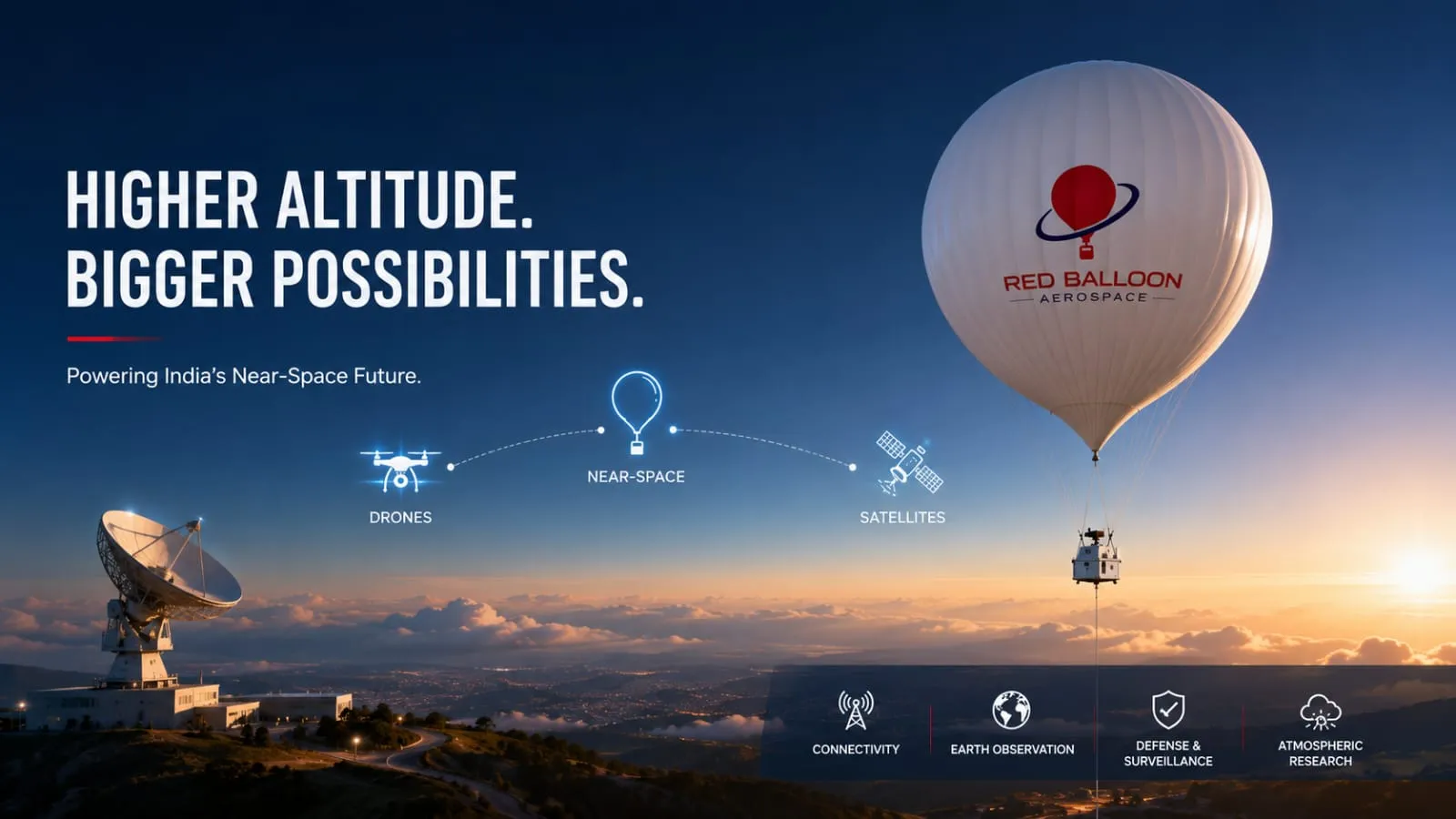
Red Balloon Aerospace, a startup based in Vijayawada, recently launched India’s first indigenous commercial near-space balloon platform, placing the company inside one of the country’s newest deep-tech categories. The development immediately attracted attention because it introduced a commercial layer between drones and satellites — a space with enormous future potential for communications, surveillance, atmospheric research and earth observation.
What makes the story especially interesting is that it is increasingly being discussed through a funding lens.
While Red Balloon Aerospace has not publicly disclosed a major institutional funding round yet, the startup’s emergence is already becoming part of larger investor conversations around India’s growing space-tech and aerospace economy. Venture capital firms globally are beginning to look beyond traditional software categories because sectors like aerospace, defense-tech, AI infrastructure and climate systems are increasingly viewed as long-term strategic industries capable of generating globally relevant technologies.
Near-space platforms fit naturally into that shift.
Unlike satellites, high-altitude balloon systems can be deployed at significantly lower costs while still offering persistent atmospheric operations across large geographic regions. Compared to drones, they can remain operational at much higher altitudes for longer durations. This creates commercial possibilities in telecommunications, environmental monitoring, defense observation and scientific payload testing because near-space systems operate in an atmospheric layer that has historically remained commercially underdeveloped.
For investors, this creates a compelling deep-tech narrative.
The global aerospace industry is expanding rapidly because governments and private companies are racing to develop cheaper, more flexible infrastructure for surveillance, connectivity and atmospheric intelligence. Startups operating in near-space technologies therefore represent early bets on an entirely new layer of aerospace infrastructure. India’s growing private-space ecosystem — supported by policy reforms and increasing public interest in space innovation — is making these opportunities even more attractive for future funding cycles.
Red Balloon Aerospace also reflects a broader transformation happening across Indian startup culture itself.
Earlier generations of Indian startups largely focused on digital convenience because internet penetration created immediate mass-market opportunities. Today a growing number of founders are entering technically difficult sectors involving aerospace systems, robotics, semiconductors and advanced manufacturing because India’s innovation ambitions are becoming more infrastructure-driven and globally competitive. Startups are increasingly attempting to build physical technologies rather than only digital platforms.
That transition changes how funding conversations operate.
Deep-tech aerospace companies often remain in stealth or low-visibility phases during early development because engineering-heavy businesses require testing, prototyping and regulatory validation before scaling commercially. Funding therefore tends to follow technical milestones rather than social-media hype or rapid user growth. Red Balloon Aerospace’s successful launch matters because it gives investors and industry observers a visible demonstration that indigenous near-space capability can be commercially developed inside India itself.
The timing is particularly important for India’s broader space economy.
Private space startups across launch systems, satellite manufacturing, earth observation and defense-tech are already attracting rising investor attention because India’s aerospace ecosystem is entering a major expansion phase. Companies like Skyroot Aerospace and Pixxel helped prove that Indian space-tech startups could attract serious institutional capital and global attention. Near-space infrastructure may now become the next category investors begin monitoring closely.
Of course, challenges remain substantial.
Aerospace startups require long development cycles, specialized talent and significant capital because atmospheric systems demand reliability, safety and advanced engineering precision. Commercial adoption for near-space infrastructure is also still emerging globally. Yet that is often how frontier industries begin — through early experimental platforms that initially appear niche before eventually becoming strategically important.
And that may be why Red Balloon Aerospace’s launch matters far beyond one balloon mission.It signals that India’s next deep-tech funding wave may increasingly move toward industries operating at the edge of science, infrastructure and aerospace innovation — sectors where the goal is not simply building apps for users, but building entirely new technological layers for the future economy itself.