Trade data rarely makes for exciting headlines, and India's first-quarter export figures for the current fiscal year are unlikely to break that pattern in any dramatic way. There is no single dramatic number, no record-breaking milestone, no crisis demanding immediate policy intervention. What the data does offer, for anyone willing to look past the absence of a punchy headline, is a genuinely useful snapshot of where Indian industry is actually gaining ground, where it continues to struggle, and what that mixed picture suggests about the broader trajectory of the country's economic development.
Four sectors emerged as the primary drivers of export growth during the quarter: engineering goods, gems and jewellery, electronics, and chemicals, each telling a somewhat different story about the state of Indian industry. At the same time, India's overall trade deficit widened, meaning imports grew even faster than the export gains in these leading categories. That combination — genuine sectoral export strength paired with a widening overall trade gap — is worth examining carefully, because it resists both the overly optimistic reading that would treat the export gains as unambiguous success and the overly pessimistic reading that would treat the widening deficit as evidence of failure.
Engineering Goods: The Clearest Sign of Industrial Maturation
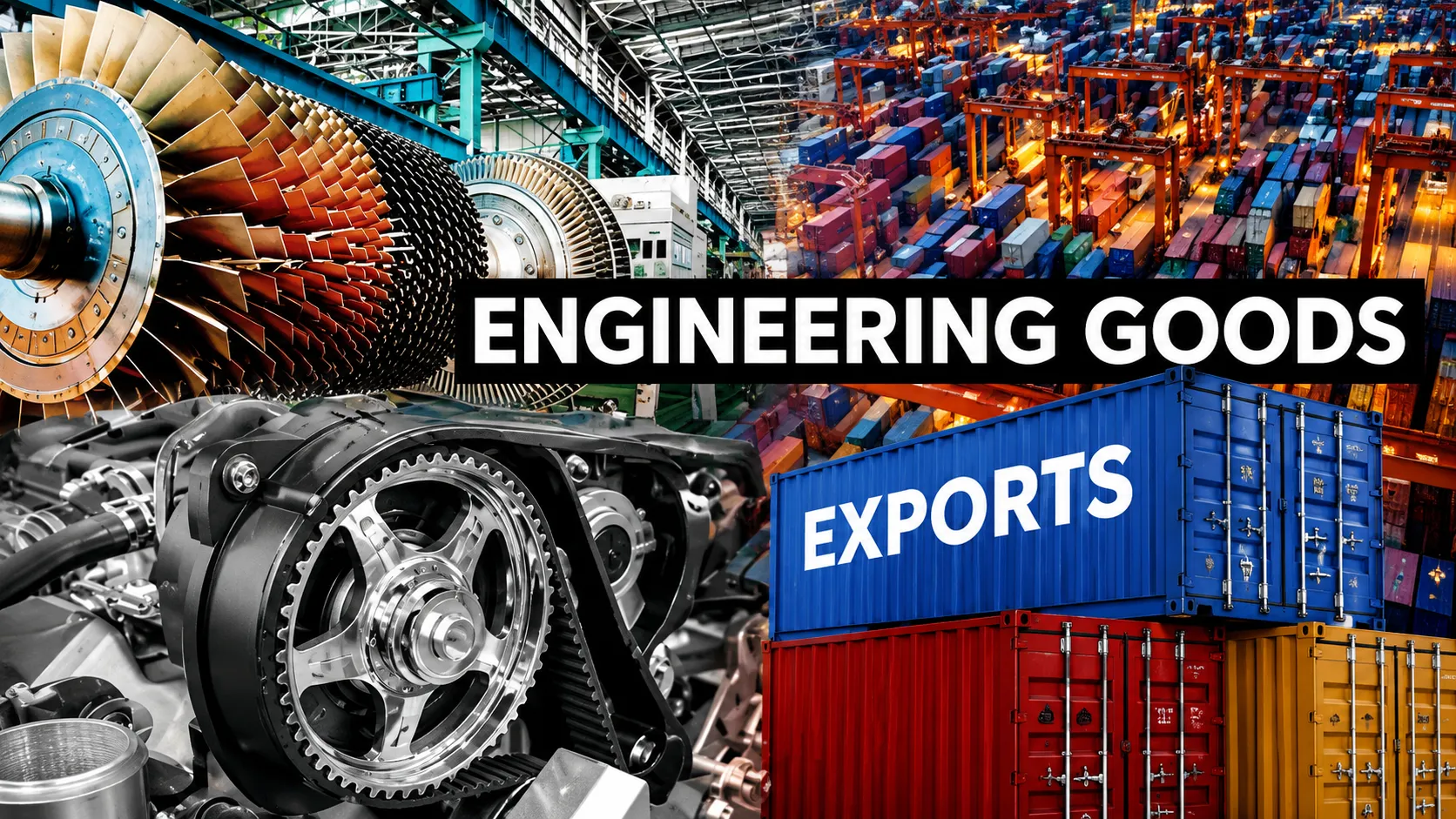
Engineering goods exports — a broad category spanning machinery, industrial equipment, automotive components, and a wide range of manufactured metal and mechanical products — represent perhaps the most encouraging single data point in this quarter's export figures, because they most directly reflect the kind of value-added manufacturing capacity that Indian industrial policy has explicitly targeted for years under various iterations of the Make in India initiative and its successor programs.
Unlike raw commodity exports, which primarily reflect natural resource endowment rather than industrial capability, engineering goods exports require sophisticated manufacturing processes, quality control systems capable of meeting the exacting standards of demanding international buyers, and supply chains sufficiently reliable to support consistent export commitments over time, quarter after quarter. Growth in this category strongly suggests Indian manufacturers are increasingly capable of competing on the combination of cost and quality that international buyers require, rather than competing purely on cost alone — a distinction that matters enormously for whether India's manufacturing sector can sustain export growth as labor costs rise over time, a challenge that has undermined export competitiveness in other developing economies once their initial cost advantage erodes and buyers look elsewhere for the next lower-cost alternative.
Gems and Jewellery: A Traditional Strength Holding Steady
Gems and jewellery exports occupy a different position in India's trade profile than engineering goods, representing a considerably more established export strength built over decades rather than a newer manufacturing capability still being developed. India has long held a globally significant and well-established position in diamond cutting and polishing specifically, processing a substantial share of the world's rough diamonds through specialized facilities, particularly concentrated in Surat, that combine decades of accumulated craft expertise with increasingly sophisticated automated processing technology.
That established strength means gems and jewellery exports tend to be somewhat less sensitive to the kind of industrial policy interventions that engineering goods and electronics exports respond to, instead moving more closely in line with global demand for luxury goods and jewellery, itself sensitive to broader economic conditions in key buyer markets like the United States, the Gulf states, and increasingly China's own growing luxury consumer base. Continued strength in this category during the current quarter suggests demand conditions in those key markets remained supportive, even as broader global economic uncertainty has weighed on discretionary consumer spending in some regions.
Electronics: The Sector Everyone Is Watching Most Closely
Of the four leading export categories, electronics arguably carries the greatest strategic significance for India's longer-term industrial ambitions, precisely because it represents the sector where India has most explicitly and publicly attempted to position itself as an alternative manufacturing base to China, particularly for companies seeking to diversify their supply chains following years of geopolitical tension and pandemic-era disruption to concentrated Chinese manufacturing capacity. Government incentive programs specifically targeting electronics manufacturing, including production-linked incentive schemes designed to attract both domestic and foreign investment into component and device assembly, have been central to that broader strategy.
Continued export growth in electronics during this quarter offers tangible evidence that those policy interventions are translating into actual export performance, rather than remaining purely aspirational rhetoric. That said, the composition of electronics exports matters considerably for how much genuine industrial capability the growth actually reflects: exports dominated by final assembly of components manufactured elsewhere represent a meaningfully different, and generally less valuable, form of industrial development than exports reflecting genuine component-level manufacturing and design capability built within India itself. Understanding which pattern is actually driving this quarter's growth requires a level of sectoral detail beyond the headline export figures, but the distinction matters enormously for assessing how durable this particular growth driver is likely to prove over time.
Chemicals: A Quieter Story of Industrial Depth
Chemical exports round out the quarter's four leading growth categories, reflecting a sector that combines long-established Indian industrial capacity with newer investment in specialty and pharmaceutical-adjacent chemical manufacturing. India's chemical industry has historically been anchored by bulk and commodity chemical production, but has increasingly diversified into higher-value specialty chemicals and active pharmaceutical ingredients, categories that command higher margins and depend more heavily on technical expertise and regulatory compliance capability than on simple scale of production alone, a shift that mirrors broader trends across India's manufacturing sector.
That diversification matters because it mirrors, on a smaller scale, the same broader shift toward higher-value-added production that engineering goods exports reflect: an economy gradually moving up the manufacturing value chain rather than remaining permanently anchored in lower-margin, more commoditized production categories that offer thinner profit margins and less resilience to cost competition from other developing economies. Whether that shift continues to accelerate, or whether India's chemical export growth remains concentrated in lower-value bulk categories, will likely become clearer as more granular sectoral data becomes available in subsequent quarters.
The Widening Trade Deficit: The Less Celebratory Half of the Story
None of this export growth, however encouraging, changes the fact that India's overall trade deficit widened during the same quarter, meaning the country's total import bill grew even faster than its export earnings. That combination is not, on its own, necessarily alarming — it is a pattern common among rapidly industrializing economies, which frequently need to import capital goods, intermediate components, and energy at a pace that outstrips even strong export performance, particularly during periods of significant new manufacturing capacity being brought online, since new factories and production lines typically require substantial imported machinery and components before domestic supply chains mature enough to substitute for them.
Energy imports, in particular, remain a persistent and significant contributor to India's trade deficit, given the country's continued heavy reliance on imported crude oil and natural gas to meet its growing energy needs. Fluctuations in global energy prices can meaningfully affect the overall trade deficit figure independent of any change in the underlying competitiveness of India's non-energy trade position, which is why economists analyzing this kind of data typically look beyond the headline deficit figure to examine the trade balance excluding energy imports, a metric that often tells a more encouraging story about India's underlying industrial competitiveness than the headline number alone suggests.
Why This Quarter's Data Matters for the Bigger Picture
Individual quarterly trade data releases rarely justify sweeping conclusions about an economy's trajectory on their own, and this quarter's figures are no exception to that general rule. What they do offer is a useful, if incomplete, data point in a longer-running story about whether India's industrial policy interventions of the past several years — the push toward manufacturing self-sufficiency, the production-linked incentive schemes targeting electronics and other strategic sectors, the broader Make in India agenda pursued across multiple government terms — are translating into the kind of genuine export competitiveness that would eventually allow India to narrow its persistent trade deficit rather than simply growing exports and imports in tandem indefinitely without ever closing the gap between them.
The specific combination visible in this quarter's data — engineering goods and electronics growth suggesting genuine manufacturing capability development, gems and jewellery strength reflecting an established traditional export sector holding steady, chemicals showing signs of gradual value-chain migration, and a widening deficit driven substantially by the imported inputs that new industrial capacity requires — describes an economy in the middle of a genuine, if incomplete, industrial transition. Whether that transition eventually produces the kind of export competitiveness capable of narrowing India's trade deficit on a sustained basis remains an open question that will take several more years, and several more quarters of data like this one, to answer with any real confidence.
For now, the most honest reading of this quarter's export data is neither pure celebration nor pure concern, but a recognition that India's economy is visibly in motion — gaining genuine ground in specific manufacturing categories that matter for its long-term development trajectory, while still carrying the structural trade imbalances that come with a large, rapidly industrializing economy still building out the domestic supply chains that would eventually reduce its dependence on imported inputs and energy.
How This Data Compares to Regional Peers
India's export performance this quarter is worth situating alongside the trajectories of other major exporting economies in Asia, many of which have pursued broadly similar strategies of leveraging manufacturing cost advantages and targeted industrial policy to build export-oriented growth. Vietnam, Bangladesh, and other Southeast and South Asian economies have each captured meaningful shares of global manufacturing supply chains over the past decade, often in direct competition with India for the same categories of investment and the same pool of companies looking to diversify manufacturing away from China. India's relative performance in electronics and engineering goods this quarter offers one data point in that ongoing regional competition, though a single quarter's figures are far too limited a sample to draw firm conclusions about India's competitive position relative to these regional peers over a longer horizon.
What does seem clear from the broader multi-year pattern, of which this quarter's data forms one part, is that India possesses certain structural advantages in this competition — a considerably larger domestic market that can support economies of scale unavailable to smaller regional economies, a deep and growing pool of technical and engineering talent, and increasingly sophisticated domestic capital markets capable of funding large-scale manufacturing investment — alongside certain structural disadvantages, including historically inconsistent infrastructure quality, land acquisition challenges that can slow large manufacturing project timelines considerably, and a regulatory environment that, despite years of reform efforts, remains more complex to navigate than some competing manufacturing destinations.
What Policymakers Will Be Watching Next
Indian trade and commerce policymakers will likely be parsing this quarter's data for signals about whether current industrial policy interventions need adjustment, expansion, or simply more time to demonstrate their full effect. Production-linked incentive schemes targeting electronics and other strategic manufacturing categories were designed with multi-year timelines in mind, reflecting an understanding that manufacturing capacity investment, supply chain development, and workforce training all take considerable time to mature into consistent export performance. A single quarter of encouraging data in electronics and engineering goods is unlikely to prompt any dramatic policy shift on its own, but sustained growth across several consecutive quarters would likely be read as validation that these interventions are working as intended, potentially supporting an argument for expanding similar incentive structures into additional manufacturing categories beyond those currently covered.
The widening trade deficit, meanwhile, will likely draw continued attention from policymakers concerned about India's broader macroeconomic stability, particularly given how sensitive the deficit remains to global energy price fluctuations largely outside India's direct control. Any sustained widening of the deficit beyond what can be explained by legitimate capital goods and energy imports supporting genuine industrial expansion would likely prompt closer scrutiny of whether specific import categories warrant policy attention, whether through tariff adjustments, import substitution incentives, or other trade policy tools available to the government.