China's Customs Administration released a set of trade figures on Tuesday that will make uncomfortable reading in New Delhi's policy circles, even as they confirm what economists tracking India-China trade flows have suspected for months: India's economic dependence on Chinese manufacturing, far from easing, has just hit a fresh all-time high. According to Chinese customs data, China's exports to India rose 21.8 percent in the first half of 2026 to reach $79.41 billion — a record for any six-month period on record — while India's exports to China, though growing at a considerably faster percentage rate of 37.2 percent, remained a fraction of the reverse flow at just $12.31 billion.
The resulting imbalance is stark. Total bilateral trade between the two countries rose 23.6 percent to $91.72 billion for the half-year period, but the trade deficit — the gap between what India buys from China and what it sells back — widened to $67.1 billion in just six months. To put that figure in perspective, it means India's trade shortfall with China alone this half-year is running at close to double the size of India's entire trade deficit with the rest of the world combined for the equivalent period, when measured against the broader national trade data released separately by India's own Commerce Ministry this month.
WHAT INDIA IS ACTUALLY BUYING FROM CHINA
The composition of China's exports to India offers a clear picture of exactly where this dependence is concentrated. According to the Chinese customs breakdown, the largest categories include electrical and electronic equipment — spanning telecom gear, smartphone and printed circuit board components, semiconductors, lithium-ion batteries and chargers — alongside servers, cables, industrial machinery, computers, organic chemicals, and plastics and polymers. This list reads, in effect, as a catalogue of the intermediate inputs that power much of India's own manufacturing and assembly ecosystem, from smartphone assembly lines to the renewable energy equipment increasingly central to India's clean energy push.
Separate data released by India's own Commerce Ministry, covering the first quarter of the current financial year (April-June 2026), corroborates the scale and direction of this trend from the Indian side of the ledger. India imported roughly $38.04 billion worth of goods from China during that quarter alone, up nearly 28 percent from approximately $29.73 billion in the same quarter last year — a growth rate even sharper than the half-year Chinese customs figures suggest, indicating the pace of import growth may have accelerated further as the quarter progressed. Electronic goods alone accounted for a striking $38.46 billion of India's total merchandise imports in the quarter, up 43.7 percent year-on-year, with a substantial share of that increase traceable directly to Chinese suppliers of components and finished electronics.
THE DEFICIT TRAJECTORY, YEAR OVER YEAR
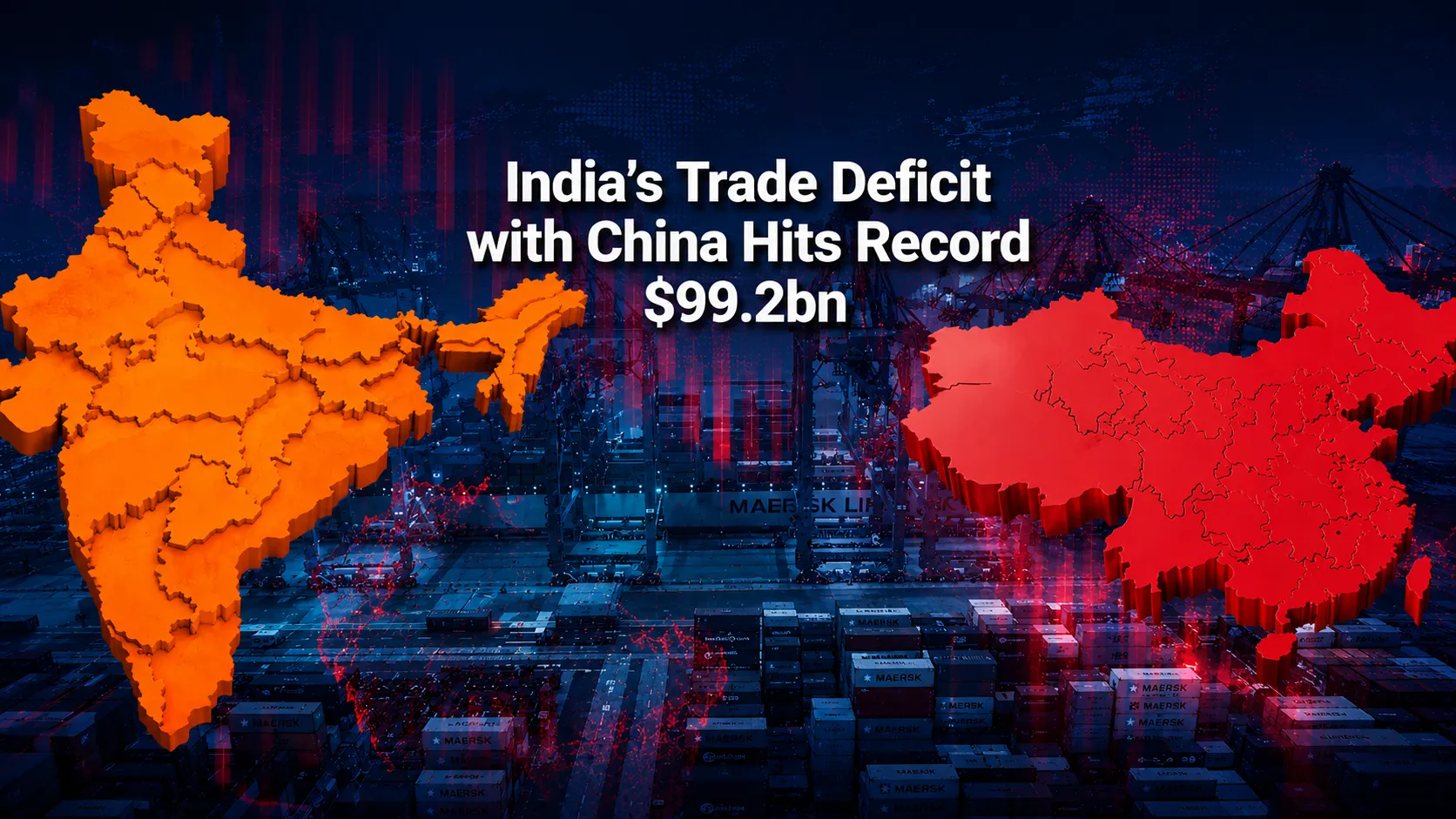
This half-year's record import figure is not an isolated spike but rather the continuation of a multi-year trend that shows little sign of reversing. India's full-year trade deficit with China widened to an all-time high of $112.6 billion in the 2025-26 fiscal year, up from $99.2 billion the year before. Over that same fiscal year, India's exports to China did grow at a healthy clip — up 36.66 percent to $19.47 billion — but imports from China grew as well, rising 16 percent to $131.63 billion, meaning the trade gap widened even as both sides of the ledger were expanding. Zooming out further, Indian imports from China have climbed from $76.3 billion in the 2017-18 fiscal year to $131.6 billion in 2025-26 — a near-doubling over roughly eight years, through a period during which successive Indian governments have repeatedly emphasised reducing strategic dependence on Chinese supply chains as a policy priority.
WHY "CHINA PLUS ONE" HASN'T YET DELIVERED
The persistence of this trend, even amid years of high-profile Indian government initiatives explicitly designed to counter it — Make in India, the Production Linked Incentive scheme, and a broader "China Plus One" diversification push encouraged by global companies looking to de-risk their supply chains away from overconcentration in China — raises an uncomfortable question that trade economists have increasingly been willing to state plainly: is India's manufacturing expansion, in its current form, actually reducing Chinese import dependence, or is it in some sectors deepening it?
The electronics sector offers perhaps the clearest illustration of this tension. India has, in recent years, become one of the world's fastest-growing hubs for smartphone assembly, with Apple in particular routing a rapidly growing share of its global iPhone production through Indian factories. That is, by any measure, a genuine manufacturing success story, and one that shows up prominently in India's own export data as a rapidly growing category. But the same assembly operations that make India an iPhone exporter also require enormous volumes of imported components — semiconductors, printed circuit boards, camera modules, battery cells and specialised machinery — much of which continues to be sourced from Chinese suppliers who retain dominant positions in these intermediate-goods categories. In other words, India's electronics export boom and its electronics import boom from China are, to a significant degree, two sides of the same underlying supply chain reality, rather than independent trends that policymakers can easily decouple from one another.
THE DIPLOMATIC AND POLICY BACKDROP
This trade data lands at a moment of gradually improving, if still cautious, high-level engagement between New Delhi and Beijing following a period of sharply strained relations in the years after the 2020 border clashes in the Galwan Valley. India has continued to press China to open its markets more meaningfully to sectors where Indian industry holds genuine competitive strength — pharmaceuticals, information technology services and agricultural products chief among them — but has achieved only limited success on this front to date, according to trade analysts tracking the relationship. That asymmetry, in which Indian policymakers see clear areas of comparative advantage that remain largely locked out of the Chinese market while Chinese manufactured goods flow into India with comparatively fewer structural barriers, is precisely what has kept the bilateral trade relationship so heavily tilted in China's favour even as overall trade volumes between the two countries continue to grow.
WHAT THIS MEANS AGAINST THE BACKDROP OF INDIA'S BROADER TRADE STORY
This week's China trade figures arrive alongside a notably different narrative in India's broader export data, which showed total exports reaching a record $232.73 billion for the April-June quarter, alongside 15.92 percent growth in merchandise exports overall. Reading the two data points together illustrates a nuanced and, in some ways, contradictory picture of India's position in global trade: India is genuinely diversifying its export destinations and growing its overall merchandise export base, even as its dependence on a single source — China — for critical manufacturing inputs continues to deepen in parallel. These are not necessarily contradictory trends economically; many fast-growing manufacturing economies, including China itself during its own earlier industrialisation phase, ran large deficits with more advanced supplier economies while their own manufacturing and export sectors were scaling up. But the persistence and scale of India's China-specific imbalance — now exceeding $112 billion annually and on pace to grow further based on this half-year's trajectory — is likely to keep the question of supply chain dependence, and how quickly it can realistically be reduced, near the top of India's economic policy agenda for the foreseeable future, particularly as global geopolitical tensions continue to make supply chain resilience a matter of strategic as well as economic concern.
THE ROAD AHEAD
Trade economists caution against expecting any rapid reversal in this trend. Building genuine domestic alternatives to Chinese-sourced semiconductors, specialised electronic components and precision industrial machinery requires years of sustained capital investment, technology transfer and skills development — precisely the kind of long-cycle industrial policy that India's semiconductor mission and expanded PLI schemes are attempting to deliver, but which will take considerably longer to show up meaningfully in the trade data than the pace at which China's export machine can continue supplying India's expanding manufacturing base in the interim. For now, the message from this week's data is unambiguous: even as India's overall trade profile diversifies and its export engine sets fresh records, its reliance on Chinese manufacturing inputs is deepening in lockstep, a structural reality that policymakers, industry and investors alike will need to reckon with as they assess the durability of India's broader manufacturing growth story.
THE SOLAR AND RENEWABLE ENERGY ANGLE
One category within China's export surge to India deserves particular attention given its intersection with a completely different area of Indian policy priority: renewable energy. Solar equipment features prominently among the categories driving this half-year's import growth, a dynamic that sits in some tension with India's own ambitions to build a domestic solar manufacturing base under schemes like the Production Linked Incentive programme for high-efficiency solar modules. India's renewable energy buildout has accelerated sharply in recent years as the country works toward its stated target of 500 gigawatts of non-fossil-fuel electricity generation capacity, and much of that expansion has, in the near term, relied on Chinese-manufactured solar panels, cells and inverters, which continue to offer a combination of scale, cost and technological maturity that domestic Indian manufacturers are still working to match. This creates a genuine policy tension: India's clean energy transition, an unambiguous long-term economic and environmental priority, is currently being built substantially on Chinese hardware, even as the country simultaneously tries to reduce its broader strategic dependence on Chinese supply chains.
A COMPARATIVE LENS: HOW INDIA'S CHINA DEFICIT STACKS UP GLOBALLY
Placing India's trade imbalance with China in a broader international context helps clarify just how significant this figure has become. India is far from alone in running a large trade deficit with China — the United States, the European Union and most of China's major trading partners record substantial deficits with Beijing, reflecting China's position as the world's dominant manufacturing hub across a wide range of intermediate and finished goods categories. What distinguishes India's situation, according to trade economists, is the trajectory: while several Western economies have seen their China deficits stabilise or even narrow in recent years amid tariff measures and supply chain diversification efforts, India's deficit with China has continued to widen steadily, suggesting that whatever diversification effect Indian policy has achieved in the manufacturing sector overall has not yet been sufficient to offset the underlying growth in Chinese-sourced intermediate goods demand created by India's own expanding industrial base.
THE PATH TOWARD GENUINE DIVERSIFICATION
Industry bodies and policymakers examining this trend have increasingly converged on a similar prescription: closing India's China trade gap in any meaningful way will require sustained, patient investment in upstream manufacturing capability — semiconductor fabrication, advanced electronics component manufacturing, specialised industrial machinery production — rather than incremental policy tweaks at the margins. India's semiconductor mission, which has attracted several major fabrication and assembly investment commitments over the past two years, represents precisely this kind of long-cycle bet, but industry executives caution that meaningful import substitution in categories like semiconductors and precision electronics components typically takes the better part of a decade to materialise at scale, given the capital intensity and technical complexity involved. Until that capacity comes fully online, India's expanding manufacturing and export base is likely to continue pulling in Chinese-sourced inputs at a pace that keeps the bilateral trade deficit on its current upward trajectory, making this week's record H1 2026 figures more a milestone along an ongoing trend than an aberration likely to reverse quickly.
WHAT INDIAN INDUSTRY BODIES ARE SAYING
Domestic industry associations representing sectors most exposed to Chinese import competition have grown increasingly vocal about the widening trade gap, with several manufacturers' groups calling in recent months for a more assertive trade policy stance, including calls for additional anti-dumping measures on specific categories where Chinese pricing is seen as undercutting domestic producers unfairly, and for accelerated approval timelines for domestic manufacturing investment proposals in strategic sectors like electronics components and specialty chemicals. The government, for its part, has continued to defend its broader trade and industrial policy approach, pointing to record overall export growth and a steadily expanding domestic manufacturing base as evidence that its strategy is working, even as it acknowledges the China-specific imbalance as an area requiring continued policy attention. This tension between celebrating aggregate export success and confronting a specific, deepening bilateral imbalance is likely to remain a recurring feature of India's trade policy discourse through the remainder of the fiscal year, particularly as more granular trade data from India's own Commerce Ministry continues to be released on a rolling basis alongside the periodic bilateral figures published by Chinese customs authorities.
---