FundingMarket Data Women9 MIN READ

India's Bond Market Flashes a Warning: Why the 10-Year Yield Just Jumped to a Three-Week High

India's 10-year government bond yield climbed to a three-week high of 6.79% as surging crude oil prices and an 18-month-high inflation print rattled the debt market.

By Shaym Kumar · Author15 July 2026
India's Bond Market Flashes a Warning: Why the 10-Year Yield Just Jumped to a Three-Week High

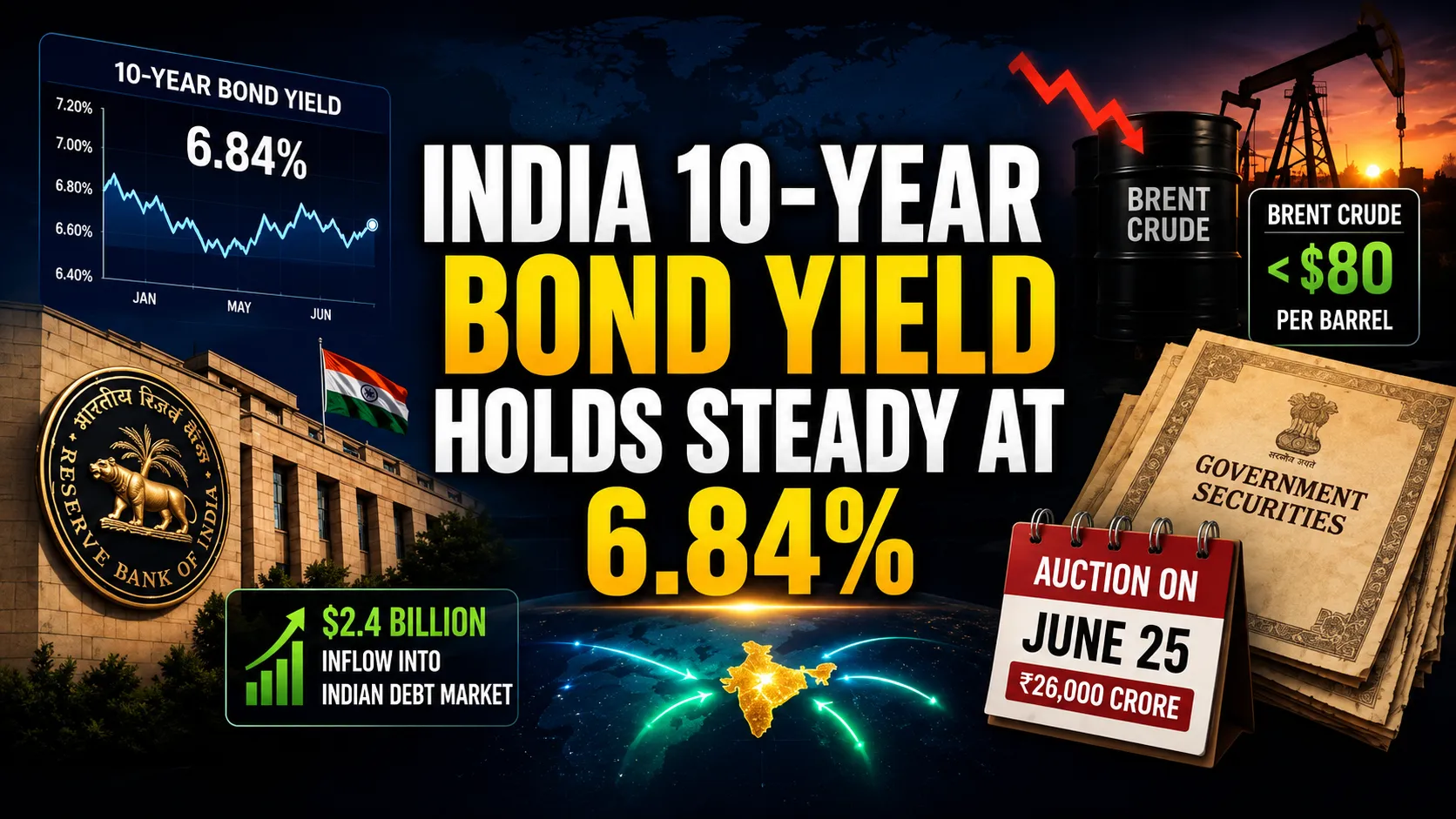
India's government bond market delivered a clear signal of investor unease this week, with the benchmark 10-year government security yield climbing 6 basis points to close at 6.79 percent on Tuesday, up from 6.73 percent the previous session — its highest level in roughly three weeks. For a market that had, just days earlier, been enjoying a stretch of relative calm on the back of steady foreign inflows, the sharpness of the reversal offers a useful case study in how quickly sentiment in India's debt markets can shift when multiple sources of pressure converge within the same trading week.

Bond yields, it is worth recalling for readers less familiar with fixed income markets, move inversely to bond prices: when a bond's yield rises, it means its price has fallen, typically because investors are demanding greater compensation to hold that debt, often reflecting rising concerns about future inflation eroding the real value of fixed interest payments, or simply reduced demand for the security relative to its supply. A rising 10-year yield, since it serves as a reference point for borrowing costs across large parts of the Indian financial system — from corporate bonds to, indirectly, home and auto loan pricing — is watched closely well beyond the confines of the bond trading desks themselves.

THE TRIGGER: OIL, INFLATION AND FED HAWKISHNESS, ALL AT ONCE

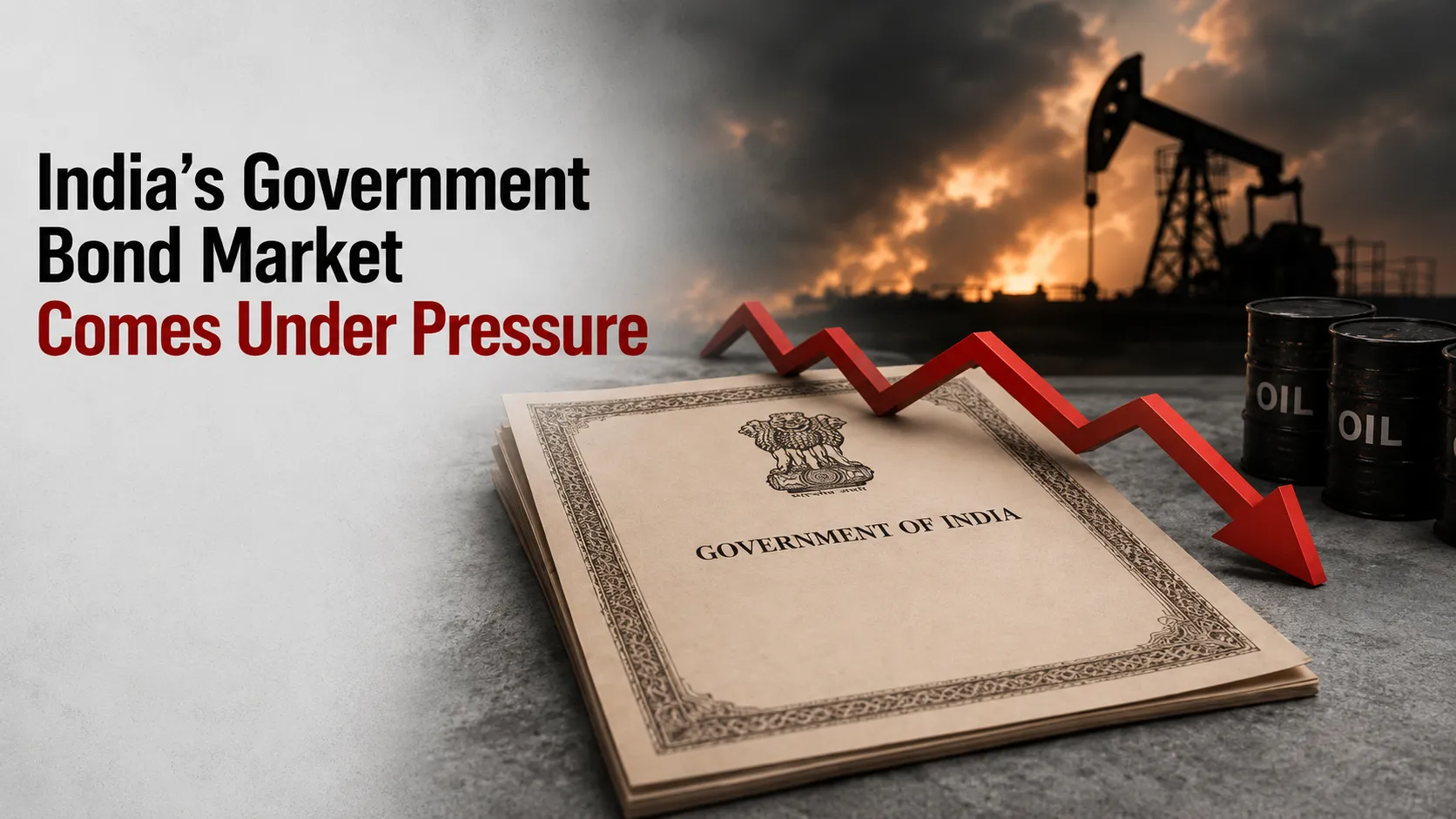
Tuesday's yield spike did not emerge from a single cause but rather from the convergence of three distinct pressures that bond traders would ordinarily prefer to see arrive separately, giving markets time to digest each one. The most immediate trigger was the same story rattling equity and currency markets this week: a sharp surge in crude oil prices tied to escalating tensions in the Middle East, after the United States moved to reinstate a naval blockade on Iranian vessels transiting the Strait of Hormuz and signalled it would seek payment from other cargo passing through the critical waterway. Brent crude, which had been trading in the mid-$70s per barrel just days earlier, spiked as high as $87 during the most acute phase of the escalation — its sharpest single-day jump in more than six years, according to trading desks tracking the move — before easing back somewhat as the week progressed.

For India, which imports close to 85 percent of its crude oil needs, any sustained rise in global oil prices translates fairly directly into higher imported inflation, a wider trade deficit, and pressure on the rupee — all factors that bond investors price directly into their inflation expectations and, by extension, into the yields they demand on government debt. Compounding the oil-driven anxiety, data released this week showed India's retail inflation, as measured by the Consumer Price Index, accelerated to 4.38 percent in June — its highest level in 18 months and a reading that came in slightly above what market economists had been forecasting. Wholesale price inflation told an even sharper story, climbing to 9.87 percent, its fastest pace since September 2022, driven by rising food, fuel and manufacturing costs. Both inflation prints breached, or moved uncomfortably close to breaching, the upper end of the Reserve Bank of India's medium-term inflation comfort zone, adding to the case for bond investors to demand higher compensation for holding long-duration government debt.

The third pressure came from outside India altogether. Comments from U.S. Federal Reserve Governor Christopher Waller, indicating that American interest rates could move higher still if inflation remains meaningfully above the Fed's 2 percent target, sent shockwaves through global bond markets, pushing short-term U.S. Treasury yields to their highest levels in 17 months. Rising U.S. Treasury yields tend to reduce the relative appeal of emerging market debt, including Indian government securities, by narrowing the yield premium international investors earn for taking on the additional currency and country risk associated with holding Indian bonds rather than U.S. Treasuries — a dynamic that added further modest upward pressure on Indian yields even as the primary driver remained domestic inflation concerns tied to the oil shock.
ChatGPT Image Jul 15, 2026, 04_11_57 PM.png

A MARKET THAT HAD, UNTIL RECENTLY, BEEN GOING THE OTHER WAY

What makes this week's yield spike particularly notable is how sharply it reverses the trend that had prevailed for much of the preceding month. Indian government bonds had been enjoying a genuinely constructive stretch through June and early July, supported by sustained foreign investor buying under the Reserve Bank's Fully Accessible Route, which permits non-resident investors to purchase specified government securities without the investment caps that apply elsewhere in India's debt market. International investors poured more than $3 billion into Indian government securities since June, with cumulative inflows reaching close to ₹38,000 crore by mid-July, helping push the 10-year yield as low as 6.72 percent in the days just before the latest reversal. Improving monsoon conditions, which had narrowed India's cumulative rainfall deficit sharply from over 40 percent in late June to roughly 24 percent by early July, had also been read by bond investors as a modestly disinflationary signal, since a healthy monsoon typically supports stronger agricultural output and helps keep food price inflation, a historically volatile component of India's overall CPI basket, in check.

That accumulated goodwill evaporated within the space of a few trading sessions once the oil price shock and inflation data landed in close succession. Some of the sharpest single-session moves came earlier in the week, with the 10-year yield rising as much as 7 basis points in one session — described by bond traders as the largest single-day move in over three months — as Brent crude extended its rally past $80 a barrel following President Trump's declaration that the ceasefire with Iran was "over," a comment that triggered fresh U.S. military strikes and dashed hopes for a swift reopening of full shipping capacity through the Strait of Hormuz.

WHY THE RBI IS UNLIKELY TO PANIC — FOR NOW

Despite the sharpness of this week's moves, several economists tracking the Reserve Bank of India's likely policy response have cautioned against reading too much into a short-term, geopolitically-driven inflation shock as a trigger for near-term monetary tightening. Madhavi Arora, an economist at Emkay Global, articulated a view shared by several other market economists in noting that the central bank is likely to look through what amounts to a supply-driven inflation shock, provided the pass-through to broader inflation expectations remains contained and anchored — a framing that suggests the RBI's base case remains a policy pause rather than a resumption of rate hikes, even against the backdrop of elevated headline inflation prints.

A bond market doesn't panic on a single data point — it panics when three unfavourable data points arrive in the same week, which is exactly what happened this time.
Impactful Global Indian Newsdesk

That view rests on a key distinction bond market participants draw between demand-driven inflation, which typically requires monetary tightening to cool, and supply-driven or cost-push inflation stemming from an external shock like a geopolitically-triggered oil price spike, which monetary policy is generally less effective at addressing directly and which central banks often prefer to accommodate through the shock's natural resolution rather than through aggressive rate action that could unnecessarily dampen domestic growth. Whether that framework holds will depend heavily on how long the current bout of oil-price volatility persists, and on how much of the imported inflation shock ultimately passes through to India's broader price level via higher transport, logistics and manufacturing input costs.

WHAT COMES NEXT FOR BOND INVESTORS

For bond market participants and everyday borrowers alike, the coming weeks will likely hinge on the same variable dominating virtually every other corner of India's financial markets this week: the trajectory of the Strait of Hormuz standoff and, by extension, global crude oil prices. A meaningful de-escalation and retracement in oil prices would likely allow Indian yields to retrace at least part of this week's spike, particularly if it is accompanied by continued foreign portfolio inflows into government securities under the Fully Accessible Route, which have shown resilience even through recent bouts of volatility. Conversely, a prolonged disruption to Gulf shipping routes, sustaining elevated oil prices over multiple months, would likely keep upward pressure on both inflation expectations and bond yields, complicating the calculus for both the Reserve Bank of India's rate path and the government's own borrowing costs at a time when a sizeable government securities auction calendar remains ahead for the current fiscal year. For now, bond traders describe the mood as watchful rather than alarmed — but unmistakably more cautious than it was just a week ago.

WHY THIS MATTERS BEYOND THE BOND DESK

For readers who don't trade government securities directly, it is worth spelling out exactly why a move from 6.73 percent to 6.79 percent on a single benchmark bond deserves attention. The 10-year government bond yield functions as a foundational reference rate across large parts of India's financial system. Banks use it, directly or indirectly, as a benchmark when pricing longer-tenure loans; corporate treasuries watch it closely when timing their own bond issuances, since a rising benchmark yield typically pushes up the coupon rates companies must offer investors on new corporate debt; and insurance companies and pension funds, which hold substantial government bond portfolios to match their long-duration liabilities, see the value of their existing holdings fluctuate directly with these yield movements. A sustained rise in the 10-year yield, if it persists rather than reversing quickly as this week's spike may yet do, would also complicate the government's own fiscal arithmetic, since New Delhi continues to rely on regular government securities auctions to fund its annual borrowing programme, and higher yields mean a higher effective cost of that borrowing over time.

ChatGPT Image Jul 15, 2026, 04_11_53 PM.png

THE GOVERNMENT'S BORROWING CALENDAR IN FOCUS

This week's yield spike arrives at a moment when the government's borrowing programme for the year remains very much in motion, with further tranches of government securities auctions scheduled across the coming weeks and months as part of the annual borrowing calendar the finance ministry sets out at the start of each fiscal year. A sustained period of elevated yields would mean the government pays a somewhat higher interest cost on the fresh debt it raises through these auctions, a dynamic that, while unlikely to be dramatic in scale for any single auction, compounds over the full borrowing programme and factors into the government's overall interest payment burden in future budgets. Bond market participants will be watching upcoming auction results closely for signs of how much demand, particularly from the foreign investors who have been active buyers under the Fully Accessible Route in recent weeks, persists even as yields tick higher — since strong auction demand despite rising yields would suggest the current bout of volatility reflects a temporary risk repricing rather than a more fundamental shift in investor appetite for Indian sovereign debt.

THE RUPEE-BOND FEEDBACK LOOP

Currency and bond markets in India rarely move in isolation from one another, and this week's episode illustrates that interdependence clearly. As the rupee weakened past 96 to the dollar, tracking the same crude oil-driven pressure that pushed bond yields higher, the two moves reinforced each other in ways that complicate the picture for policymakers. A weaker rupee makes India's fixed-income assets somewhat less attractive to foreign investors in dollar-adjusted return terms, even before accounting for the direct impact of rising yields on bond prices, potentially compounding any outflow pressure. At the same time, higher bond yields can, in some circumstances, help support a currency by offering foreign investors a more attractive interest rate return relative to comparable developed-market debt, partially offsetting the negative currency sentiment — though this dynamic works only if the yield increase is seen as compensating adequately for the perceived additional risk, rather than simply reflecting a broader deterioration in the macroeconomic outlook. Currency and bond desks at India's major banks were reportedly watching this interplay closely through the week, with several noting that the rupee's underperformance relative to other Asian currencies suggested markets were pricing in India-specific vulnerability to the oil shock, given the country's heavy reliance on imported crude, beyond what the broader emerging-market currency basket was experiencing. That reasoning underscores why India-focused fund managers tend to treat oil price shocks as a distinctly India-specific risk factor, warranting closer monitoring than a generic emerging-market sell-off might otherwise receive, and it is a large part of why this week's bond and currency moves have drawn as much analyst commentary as the more dramatic swings in equities.

---

TagsBondYieldsRBIIndianEconomyInflationIndiaGSecCrudeOilPricesInterestRatesDebtMarketRupeeVsDollarMonetaryPolicy

Reader reviews

Sign in to rate and review this article.
Loading reviews…