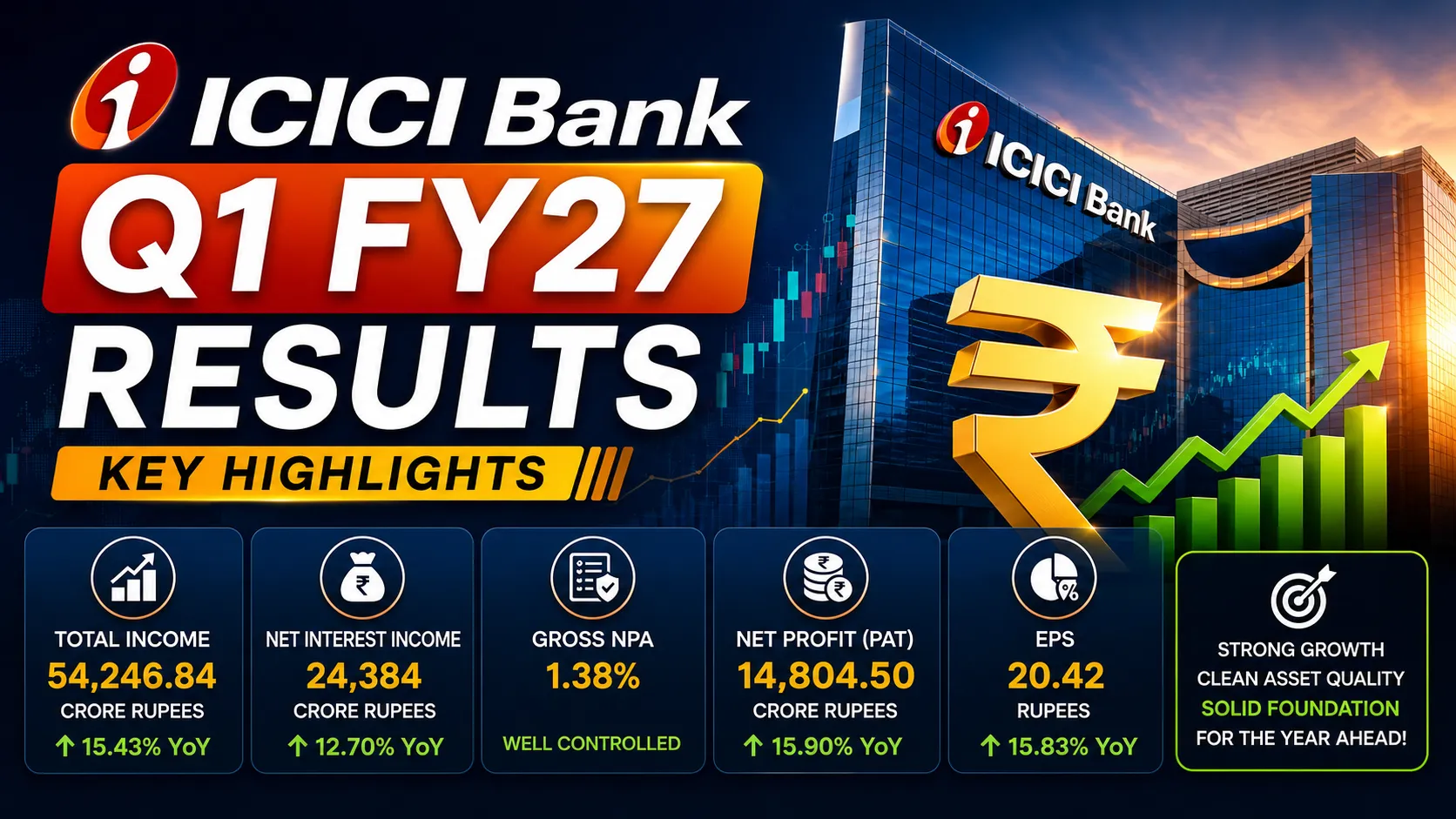
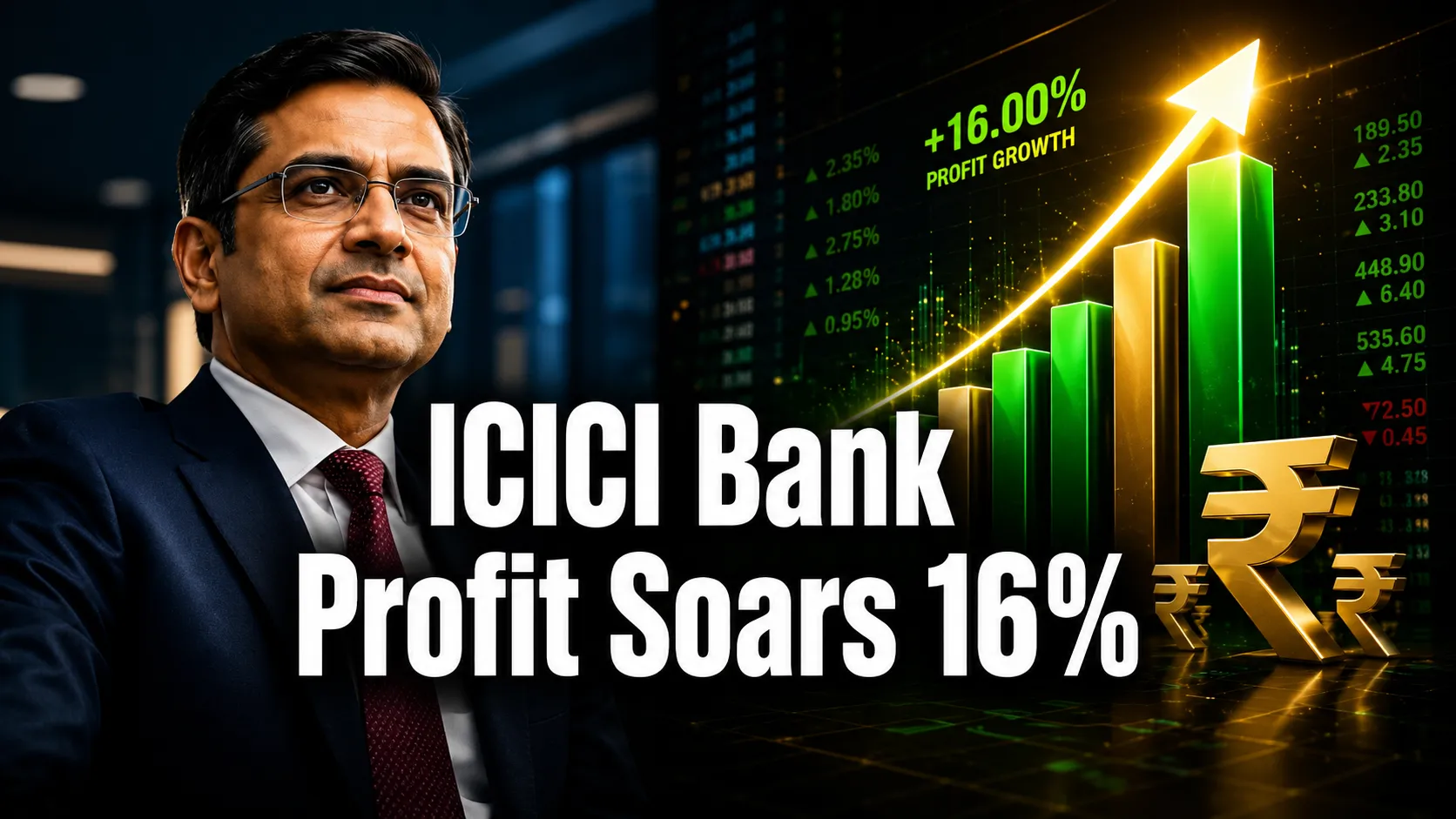
ICICI Bank, India's second-largest private sector lender by both balance sheet size and market capitalisation, reported one of the standout results of the current earnings season, with net profit for the first quarter of financial year 2027 rising 15.9 per cent year-on-year to ₹14,805 crore. The results, announced as part of a packed July 18 reporting day that also saw HDFC Bank, Axis Bank, Kotak Mahindra Bank and Yes Bank release their own June-quarter numbers, cemented ICICI Bank's position as one of the more consistent earnings performers among India's large private banks through a period of otherwise choppy market sentiment.
Perhaps more significant than the headline profit growth figure itself, from an investor confidence standpoint, was the bank's asset quality performance during the quarter, which analysts polled ahead of the results had specifically flagged as the metric most likely to determine how the market would react. ICICI Bank's asset quality remained stable through the quarter, a result that stood in contrast to the more cautious market mood surrounding banking stocks broadly, where rising credit costs across the sector had been a recurring theme of investor concern through much of July.
The scale of the reporting day itself is worth noting: with several of India's largest banks all releasing results within the same 24-hour window, analysts and financial media faced the challenging task of parsing and comparing an unusually dense flow of information in real time, a dynamic that likely amplified the market's tendency to focus disproportionately on the handful of headline metrics — profit growth and asset quality chief among them — that could be most readily compared across institutions, rather than engaging with the fuller nuance of each individual bank's results.
Breaking Down The Growth Drivers
ICICI Bank's earnings growth this quarter was underpinned by a combination of factors that analysts have, over recent quarters, come to associate with the bank's disciplined and increasingly technology-driven approach to retail and corporate lending. The bank has, over the past several years, invested heavily in its digital lending infrastructure, a strategy that management has repeatedly credited with improving both loan origination efficiency and, critically, the quality of underwriting decisions across its retail loan book — a factor that becomes especially important during periods, such as the present one, when broader economic headwinds are placing pressure on borrower repayment capacity across the sector.
Loan growth across both the retail and corporate segments continued at a healthy, broadly double-digit pace during the quarter, according to details shared alongside the results, with the bank's management specifically highlighting continued momentum in its mortgage and small business lending books as areas of particular strength. This diversified growth base — spanning secured retail lending, corporate credit and small business finance — has, analysts note, given ICICI Bank a more balanced risk profile relative to peers with a heavier concentration in any single lending category.
The bank's fee-income streams, spanning areas such as third-party product distribution, transaction banking services and trade finance, also contributed meaningfully to the quarter's overall profitability, according to analysts who reviewed the segmental breakdown accompanying the results. This diversification of revenue beyond pure interest income has, over recent years, become an increasingly important differentiator for large Indian banks seeking to reduce their dependence on net interest margin alone as a primary earnings driver, particularly during periods, like the present one, when margin expansion across the sector has been constrained by elevated deposit costs.
A Sector-Wide Comparison
ICICI Bank's 15.9 per cent profit growth places it comfortably ahead of several large-bank peers reporting in the same window. HDFC Bank, for comparison, reported a more modest 5 per cent rise in net profit for the same quarter, while smaller private lenders such as Yes Bank posted a 33 per cent jump off a considerably smaller base, and public-sector lender Punjab National Bank reported a dramatic 214 per cent surge in profit, also off a smaller and historically more volatile base given the sector's ongoing recovery from a multi-year non-performing asset cycle.
Set against this backdrop, ICICI Bank's results were read by several analysts as occupying something of a sweet spot: strong enough growth to clearly outpace the sector's largest player by scale, HDFC Bank, while being achieved off a large enough base that the growth rate carries genuine weight rather than reflecting an easy comparison against a depressed prior-year quarter, as was arguably the case for some smaller and public-sector peers reporting sharper percentage gains.
Axis Bank and Kotak Mahindra Bank, the two other major private lenders reporting results within the same window, delivered performances that fell somewhere between these two poles, according to analysts who reviewed the full slate of large-bank results, reinforcing a broader narrative taking shape this earnings season: India's private banking sector, while facing a genuinely challenging macro backdrop of rising credit costs and currency volatility, continues to exhibit meaningful dispersion in performance quality between individual institutions, rewarding those with the strongest underwriting discipline and most diversified earnings bases.
Margin And Provisioning Trends
Net interest margins across India's large private banks broadly held flat this quarter, as the cost of deposits continued to catch up with the cumulative effect of earlier repo rate movements, a trend that ICICI Bank's results were broadly consistent with according to analysts who reviewed the detailed disclosures. Provisioning levels, closely watched given the broader sector narrative around rising credit costs, remained within a range management characterised as comfortable, with the bank continuing to maintain what analysts describe as one of the stronger provision coverage ratios among large Indian banks — a buffer that gives it additional flexibility to absorb any future deterioration in specific loan segments without a dramatic impact on reported earnings.
This provisioning discipline has, over the past several years, become something of a hallmark of ICICI Bank's post-2018 turnaround story, following a period earlier in the past decade when the bank faced significant scrutiny over asset quality and governance issues. The bank's subsequent, sustained recovery — culminating in results like this quarter's — has been repeatedly cited by analysts as one of the more notable corporate turnaround stories within India's banking sector over the past several years.
The bank's gross and net non-performing asset ratios, both closely tracked quarter-over-quarter by analysts as the primary headline indicators of loan book health, were reported to have remained broadly stable, extending a now multi-year trend of steady, incremental asset quality improvement that has become a defining feature of ICICI Bank's investment narrative since the depths of its earlier asset quality challenges. Slippages — the rate at which previously performing loans move into non-performing status — were also reported within a range analysts characterised as manageable, offering further reassurance that the bank's underwriting standards have continued to hold up even as broader economic headwinds intensify.
How The Stock Responded
Despite delivering results that beat consensus expectations on several key metrics, ICICI Bank's stock, like much of the broader banking sector, was not immune to the macro-driven selling pressure that gripped Indian equity markets in the days immediately surrounding the results, as rising crude oil prices and a weakening rupee dominated investor attention across the market. Even so, sell-side commentary in the aftermath of the results was notably more constructive on ICICI Bank specifically than on several sector peers, with a number of brokerages reiterating positive ratings and, in some cases, nudging price targets modestly higher in recognition of the quarter's stronger-than-expected asset quality performance.
Analysts covering the stock have pointed to ICICI Bank's consistent execution over the past several years — a track record of delivering steady, predictable earnings growth while maintaining disciplined underwriting standards — as the primary reason the stock has, over time, come to command one of the premium valuations within India's banking sector, alongside HDFC Bank.
The Digital And Subsidiary Story
Beyond the core banking numbers, ICICI Bank's broader financial services ecosystem — spanning its life insurance, general insurance and asset management subsidiaries, each separately listed on Indian exchanges — continues to be viewed by analysts as an important, if sometimes underappreciated, source of overall group value. ICICI Prudential Life Insurance and ICICI Lombard General Insurance both released their own quarterly results within the same broader reporting window, and analysts tracking the wider ICICI group ecosystem have noted that cross-selling synergies between the bank's vast retail customer base and its insurance and asset management subsidiaries remain an important, structurally supportive growth lever across the group.
The bank's continued investment in digital banking infrastructure, including its widely used mobile banking application and a growing suite of API-driven banking services aimed at fintech and corporate partners, has also been repeatedly cited by management as a key differentiator supporting both customer acquisition and operating efficiency, themes that are likely to remain central to how the bank frames its growth story to investors in the quarters ahead.
Analysts covering the broader ICICI ecosystem have also pointed to the group's growing presence in payments infrastructure and merchant banking services as an additional, longer-term growth avenue, one that management has periodically highlighted in investor communications as an area of strategic investment even though its current contribution to group-wide profitability remains comparatively modest relative to the core lending business.
Retail Investor Interest In Banking Stocks
ICICI Bank has, over recent years, also become one of the more widely held stocks among India's rapidly growing base of retail equity investors, a trend that analysts attribute to the combination of the bank's consistent earnings track record, its relatively liquid trading volumes, and its status as a bellwether name frequently referenced in financial media coverage of the broader banking sector. This broad retail ownership base means that quarterly results of the kind delivered this period tend to generate outsized attention relative to companies of similar market capitalisation with a more institutionally concentrated shareholder base.
Systematic investment plan flows into banking-sector-focused and broader diversified equity mutual funds, many of which carry meaningful ICICI Bank exposure given the stock's substantial weight within the Nifty Bank and broader Nifty 50 indices, have continued at a steady pace through the current earnings season, according to data tracked by the mutual fund industry's trade body, suggesting that at least a portion of India's retail investor base continues to view banking sector fundamentals, ICICI Bank's in particular, as a source of relative stability amid the broader market's macro-driven volatility.
The Provisioning Cushion In Context
ICICI Bank's provisioning coverage ratio, one of the more closely watched risk-buffer metrics in Indian banking, has been built up steadily over several years of consistently strong earnings, giving the bank meaningfully more room to absorb any unexpected future stress in specific loan segments without a dramatic hit to reported profitability. Analysts specifically flagged this buffer as a key reason for the market's relatively constructive reception of the results, even amid a broader environment where rising credit costs have been a recurring source of investor anxiety across the banking sector as a whole.
This provisioning discipline stands in useful contrast to the experience of several Indian banks during the previous decade's asset quality crisis, when insufficient provisioning buffers left institutions poorly equipped to absorb a sudden wave of loan defaults, forcing sharp, market-rattling profit downgrades in the years that followed. ICICI Bank's current, considerably more conservative approach to provisioning is widely viewed by analysts as a direct, deliberate lesson learned from that earlier period, and one that continues to inform the bank's overall risk management culture today.
What Analysts Are Watching Next
Heading into the second quarter of FY27, analysts say the key metrics to watch for ICICI Bank include whether the bank can sustain its current pace of loan growth without any meaningful deterioration in asset quality, particularly given the broader macro headwinds — elevated crude prices, a weaker rupee, and the prospect of higher-for-longer global interest rates — that are weighing on the wider Indian banking sector's near-term outlook.
With ICICI Bank having now delivered several consecutive quarters of what analysts describe as clean, high-quality earnings growth, the bank's ability to continue outperforming sector peers on asset quality, even as broader credit-cost pressures build elsewhere in the system, is likely to remain the single most important factor determining whether the stock can continue commanding its current premium valuation relative to the rest of India's banking sector through the remainder of financial year 2027.