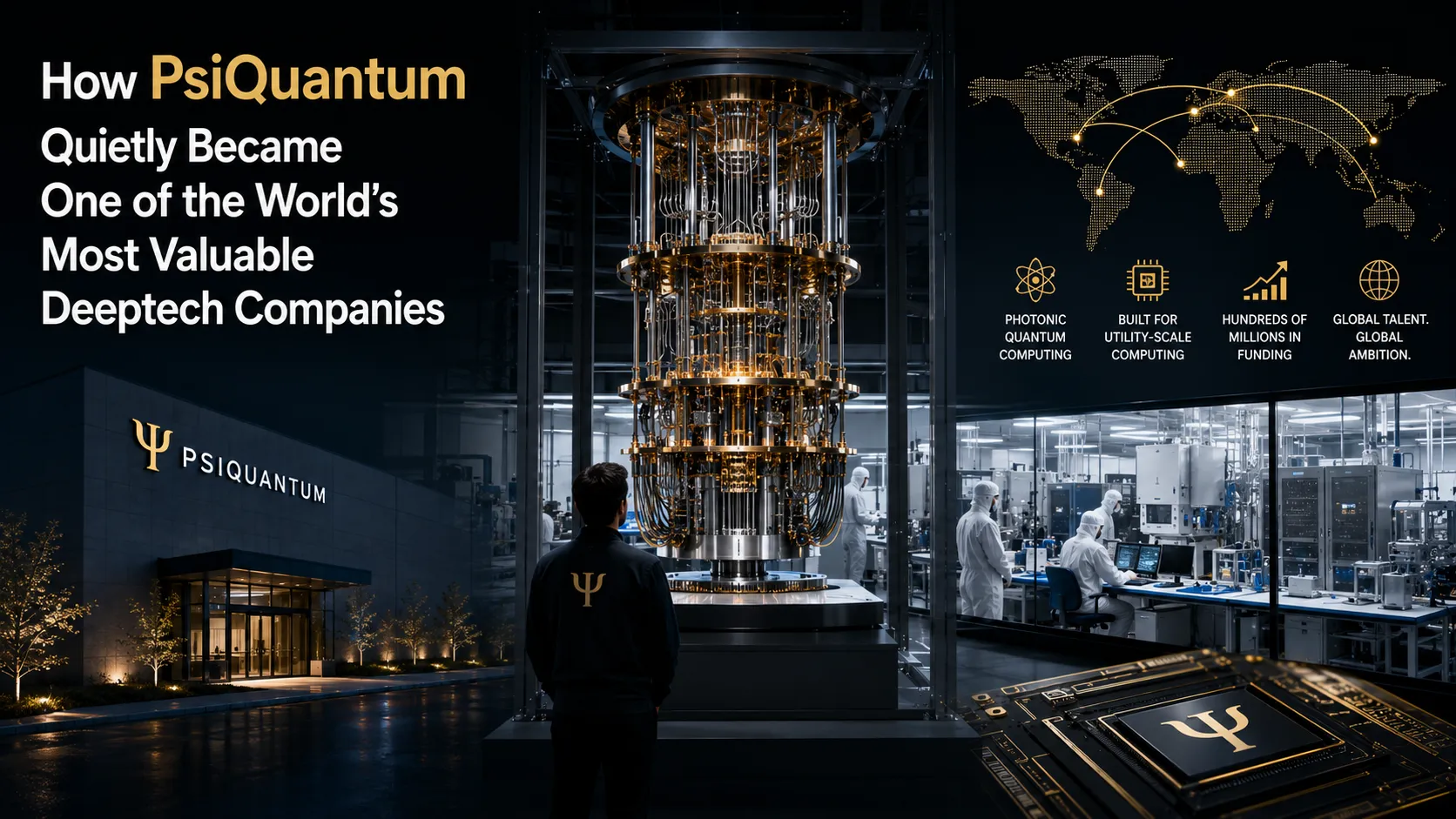
While The World Is Obsessed With Artificial Intelligence, Another Technology Race Is Unfolding In The Background. Investors Have Already Committed Billions Of Dollars To Quantum Computing, And PsiQuantum Has Emerged As One Of The Sector's Most Important Players.
Artificial intelligence dominates nearly every technology conversation today.
From boardrooms and venture-capital meetings to government policy discussions, AI has become the defining innovation story of the decade. Companies are spending billions on data centers, chips and software infrastructure while investors race to identify the next generation of AI winners. The excitement is understandable. AI is already changing how businesses operate, how consumers interact with technology and how information is created. Few technological revolutions have arrived with such speed or visibility.
Yet some of the world's most sophisticated investors are placing enormous bets on a different technology entirely.
Unlike AI, quantum computing remains largely invisible to the public. There are no viral quantum applications, consumer products or everyday use cases generating headlines. The technology is still experimental, highly complex and years away from widespread commercialization. Despite those realities, governments, corporations and investors continue allocating vast amounts of capital to the sector. Their reasoning is simple. If quantum computing achieves its long-promised potential, it could solve problems that even the most advanced AI systems and supercomputers cannot handle.
Few companies embody that belief more than PsiQuantum.
Founded by a team of physicists and quantum researchers, the company has quietly become one of the world's most valuable deeptech startups. Reports suggest PsiQuantum has raised well over $1.5 billion in funding and is pursuing valuations that place it among the most highly valued private companies in advanced computing. While many startups promise revolutionary technologies, PsiQuantum has attracted investors because it is attempting something unusually ambitious: building a commercially useful quantum computer capable of operating at a scale that many experts believe is necessary for real-world impact.
The Quantum Dream Has Always Been Bigger Than AI
One reason investors remain fascinated by quantum computing is the scale of the potential opportunity.
Artificial intelligence excels at recognizing patterns, generating content and making predictions based on enormous datasets. Quantum computing addresses a different category of problems altogether. The technology is designed to perform calculations that become effectively impossible for traditional computers as complexity increases. Researchers believe quantum systems could eventually transform fields ranging from drug discovery and materials science to logistics, finance and cryptography.
The implications are difficult to overstate.
Some of humanity's most challenging scientific problems involve calculations so large that even powerful supercomputers struggle to process them efficiently. Quantum computing theoretically offers a completely different approach. Instead of evaluating possibilities sequentially, quantum systems exploit the unique properties of quantum mechanics to examine multiple possibilities simultaneously. If successful, this could dramatically accelerate scientific discovery across multiple industries.
This is why investors continue funding the sector despite limited commercial revenue today.
They are not investing based on current demand. They are investing based on the possibility that quantum computing could eventually become one of the most important technological platforms ever created.
PsiQuantum Chose A Different Path
The company's rise is particularly interesting because it pursued a strategy that initially appeared riskier than many competitors.
Much of the quantum-computing industry focused on developing systems using superconducting circuits, trapped ions and other specialized architectures. PsiQuantum instead committed to a photonic approach, building quantum systems around particles of light. The decision was controversial because many experts questioned whether the technology could scale effectively enough to achieve the company's ambitious goals.
PsiQuantum remained committed to the approach.
The company's founders believed photonics offered advantages that would become increasingly important as quantum systems expanded. Instead of designing entirely new manufacturing processes, the company sought to leverage existing semiconductor production infrastructure. This strategy allowed PsiQuantum to work with established chip-manufacturing capabilities rather than building everything from scratch.
That decision has become one of the company's defining characteristics.
Rather than treating quantum computing as a laboratory experiment, PsiQuantum approached it as a manufacturing challenge. The company argued that scalable quantum computing would require industrial production methods rather than purely scientific breakthroughs.
Investors Are Funding Infrastructure, Not Products
One of the most remarkable aspects of PsiQuantum's story is the type of capital supporting it.
Many technology startups raise money to build software products, acquire customers and accelerate growth. PsiQuantum's funding requirements resemble those of major industrial projects. Building a useful quantum computer requires advanced facilities, specialized engineering teams, manufacturing partnerships and years of research. The costs involved are extraordinary, even by deeptech standards.
This has attracted a different class of investors.
Sovereign wealth funds, government-backed initiatives and large institutional investors have become increasingly important participants in the quantum ecosystem. These organizations often operate on longer time horizons than traditional venture-capital firms and are willing to support technologies that may take years or even decades to mature.
PsiQuantum has benefited significantly from this trend.
Governments increasingly view quantum computing as a strategic capability with implications for economic competitiveness, national security and scientific leadership. As a result, funding decisions are often influenced by considerations extending far beyond traditional financial returns.

The Global Quantum Race Is Intensifying
The company's growth is occurring within a broader geopolitical context.
Countries around the world are competing aggressively to establish leadership positions in quantum technologies. The United States, China, the United Kingdom, Canada, Australia and several European nations have all launched major initiatives aimed at accelerating quantum research and commercialization. Billions of dollars in public and private investment are flowing into the sector as governments attempt to avoid falling behind in a potentially transformative technological race.
This competition is influencing corporate strategy as well.
Large technology companies including Google, IBM and Microsoft continue investing heavily in quantum research. Startups such as PsiQuantum therefore operate within an environment where commercial, scientific and geopolitical interests increasingly overlap. Success is measured not only by technological progress but also by the ability to contribute to broader national and industrial objectives.
The result is one of the most intensely competitive deeptech sectors in the world.
While AI currently attracts more attention, quantum computing may ultimately prove just as strategically important.
Why Investors Keep Writing Bigger Checks
Skeptics often question why investors continue allocating capital to a technology that has yet to achieve widespread commercial adoption.
The answer lies in the magnitude of the potential outcome. Most startups aim to improve existing markets. Quantum computing has the potential to create entirely new categories of capability. If a company successfully develops a fault-tolerant, large-scale quantum computer, the economic value could extend across pharmaceuticals, energy, finance, manufacturing, logistics and numerous other industries.
Investors understand the risks involved.
Many quantum startups will fail. Timelines remain uncertain and technical challenges remain significant. Yet the potential rewards are so substantial that capital continues flowing into the sector. The logic resembles earlier investments in semiconductors, space exploration and the internet. Technologies capable of reshaping entire industries often appear speculative until they suddenly become essential.
PsiQuantum's valuation reflects that possibility.
Investors are not valuing the company based on current revenues. They are valuing it based on what quantum computing could become if the technology reaches commercial scale.
The Bigger Story Is About The Next Computing Revolution
Viewed narrowly, PsiQuantum is another heavily funded deeptech startup.
Viewed more broadly, it represents a growing belief that the future of computing extends beyond artificial intelligence. AI may dominate today's headlines, but many of tomorrow's breakthroughs could depend on entirely different technological foundations. Quantum computing promises capabilities that traditional systems cannot replicate, potentially opening doors to discoveries that remain impossible today.
That is why investors continue backing companies like PsiQuantum.
They are not simply funding a startup. They are funding the possibility of a new computing paradigm capable of transforming science, industry and global competitiveness. Whether that future arrives in five years, ten years or longer remains uncertain. What is clear is that some of the world's most sophisticated investors believe the opportunity is too large to ignore.
Because while everyone is watching AI reshape the present, companies like PsiQuantum are trying to build the technology that could define what comes next.