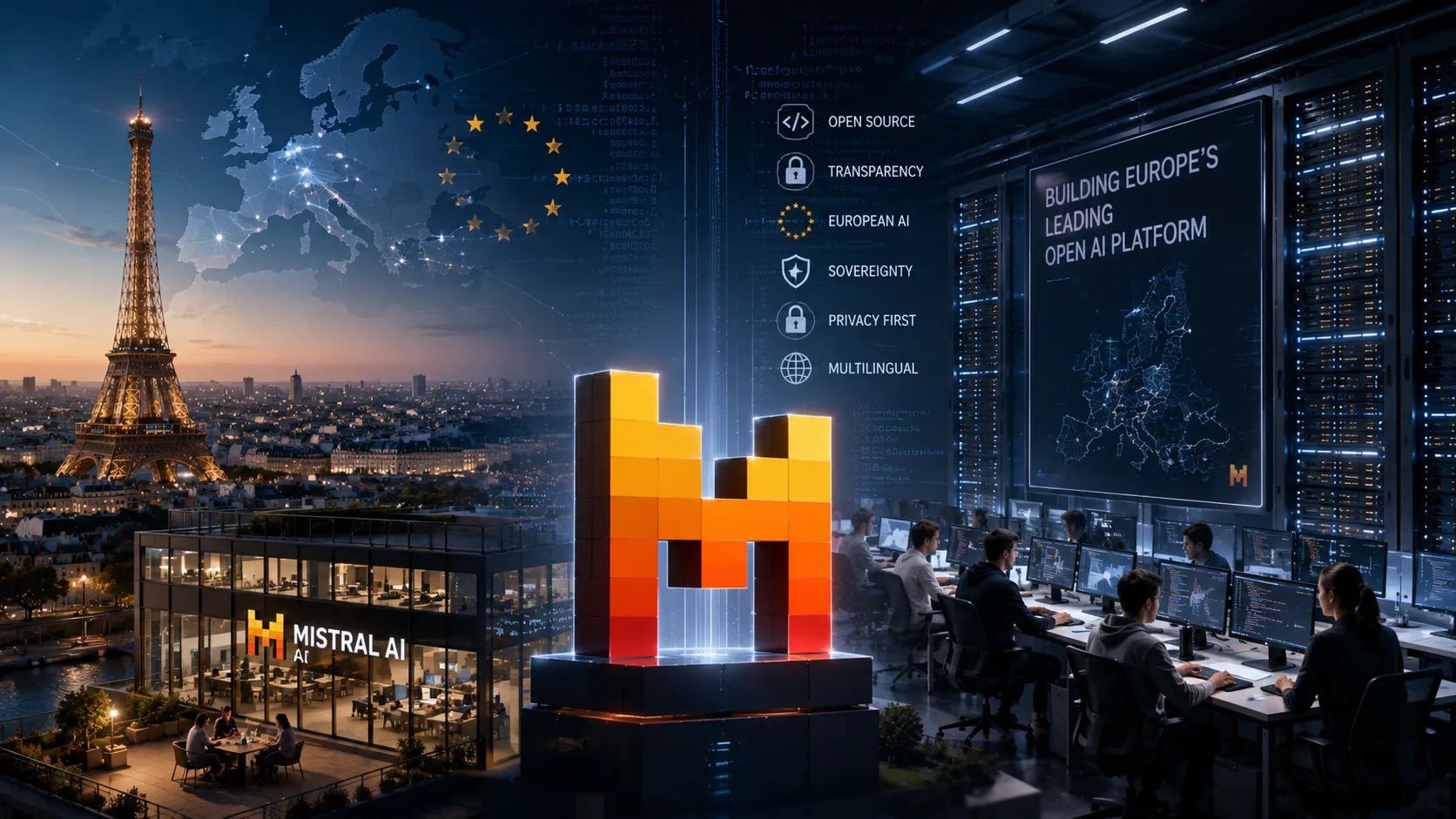
The Global AI Race Is Being Dominated By American And Chinese Giants. Mistral Is Attempting Something Far More Ambitious Than Building Another Startup: It Wants To Prove Europe Can Still Produce A Technology Champion Capable Of Shaping The Future.
Artificial intelligence has become far more than a technology trend. It is increasingly viewed as a strategic asset capable of influencing economic growth, industrial competitiveness and geopolitical power. Governments are investing billions into AI research, companies are reorganizing entire business models around machine intelligence and investors are pouring unprecedented amounts of capital into the sector. What began as a race to build better software has evolved into a contest over who will control the infrastructure of the next digital era. In this environment, the companies developing advanced AI models are no longer viewed simply as startups. They are becoming national assets, strategic platforms and potential gatekeepers of future innovation.
For Europe, this transformation presents a challenge that extends well beyond technology. The continent has long been home to some of the world's most respected universities, research institutions and engineering talent. European scientists have contributed significantly to breakthroughs in mathematics, computer science and artificial intelligence. Yet when it comes to creating globally dominant technology companies, Europe has often struggled to translate scientific excellence into commercial leadership. While Silicon Valley produced companies such as Google, OpenAI, Microsoft and Meta, Europe frequently found itself consuming technologies developed elsewhere rather than defining the industry itself.
That reality has become increasingly uncomfortable as artificial intelligence moves toward the center of the global economy. European policymakers worry about becoming dependent on foreign AI systems for critical infrastructure, enterprise software and public services. Business leaders fear that the continent could lose competitiveness if the most powerful AI tools remain concentrated outside Europe. Investors recognize that allowing the next technological revolution to be dominated entirely by foreign companies could weaken Europe's influence in one of the most important industries of the century. The question facing the continent is therefore larger than who builds the best chatbot. It is whether Europe can remain a creator of transformative technologies rather than merely a customer.
This is the environment that helped propel Mistral from an obscure startup into one of the most closely watched companies in artificial intelligence. Founded in Paris in 2023 by former researchers from Google DeepMind and Meta, the company entered the market with an unusually ambitious mission. Rather than focusing on niche applications or specialized enterprise tools, Mistral set out to compete directly in foundation models, the category currently dominated by some of the largest technology organizations in the world. It was a bold decision, particularly given the enormous resources required to build advanced AI systems.
Investors responded with extraordinary enthusiasm. Within months of launching, Mistral secured hundreds of millions of euros in funding and rapidly achieved a multibillion-euro valuation. The company became one of Europe's fastest-growing technology startups and quickly established itself as the continent's most credible challenger in the AI race. What attracted investors was not only the technical expertise of the founding team but also the broader significance of the mission. Mistral represented the possibility that Europe could still create a company capable of competing at the highest level of artificial intelligence.
Europe Wants An AI Champion Of Its Own
The excitement surrounding Mistral reflects a growing shift in how Europe views technological leadership. For years, the continent's technology strategy often emphasized regulation, privacy and consumer protections. Those priorities remain important, but artificial intelligence has highlighted a different requirement. If Europe wants influence over the technologies shaping the future, it also needs companies capable of building them. Regulation alone cannot create innovation. The continent increasingly recognizes that it must support both technological governance and technological creation.
This realization has become particularly urgent because AI is evolving into foundational infrastructure. Businesses increasingly depend on AI systems for productivity, customer service, software development and decision-making. Governments are exploring AI applications in healthcare, education and public administration. The organizations controlling these systems will inevitably shape how future economies operate. European leaders therefore view companies like Mistral not merely as startups but as strategic assets capable of strengthening the region's technological independence.
Mistral's success also challenges a long-standing narrative about European entrepreneurship. Critics have often argued that Europe produces excellent researchers but struggles to build companies capable of achieving global scale. Mistral's rapid growth suggests that this assumption may be outdated. The company has demonstrated that world-class AI talent exists throughout Europe and that investors are willing to support ambitious projects originating outside Silicon Valley. Whether Mistral ultimately succeeds or fails, its emergence has already changed perceptions about what European technology companies can achieve.
The startup's rise has also encouraged broader discussions about sovereignty in the digital age. Dependence on foreign cloud providers, software platforms and AI models creates vulnerabilities that extend beyond economics. Governments increasingly view technological capabilities as essential components of national competitiveness. Mistral therefore occupies a unique position where commercial success intersects with broader strategic objectives. Few startups carry such symbolic importance for an entire region.
The Open-Source Strategy Is Its Biggest Differentiator
One of the most distinctive aspects of Mistral's approach is its commitment to openness. While many leading AI companies have adopted highly proprietary strategies, Mistral has repeatedly released open-weight models that allow developers and businesses greater visibility into how the technology operates. This decision has helped the company establish a unique identity within an industry increasingly dominated by closed ecosystems and tightly controlled platforms.
The strategy serves both ideological and commercial purposes. Open models encourage experimentation, customization and innovation by allowing developers to adapt technology to specific needs. This approach aligns closely with Europe's historical support for open standards and technological interoperability. It also enables Mistral to build relationships with developers who might otherwise gravitate toward larger American competitors. By emphasizing openness, the company has created a competitive advantage that extends beyond pure technical performance.
At the same time, the strategy reflects practical realities. Competing directly with technology giants on infrastructure spending alone would be extraordinarily difficult. Companies such as OpenAI, Google and Anthropic benefit from vast financial resources and access to enormous computing capacity. Mistral needs alternative methods of differentiation. Open-source development provides one such path, allowing the company to cultivate a broader ecosystem while establishing goodwill among researchers and enterprise customers.
This approach has helped Mistral position itself as more than another AI startup. It has become a symbol of a different vision for artificial intelligence—one that emphasizes accessibility, transparency and collaboration rather than complete centralization. Whether that vision ultimately proves commercially superior remains uncertain, but it has undoubtedly contributed to the company's rapid rise.
The Real Challenge Is Still Ahead
Despite the excitement surrounding Mistral, the company's most difficult challenges remain in the future. Building advanced AI models is one thing. Maintaining competitiveness against some of the richest organizations in history is another. The AI industry requires extraordinary levels of investment in talent, infrastructure and computing resources. Every new generation of models becomes more expensive to develop, creating enormous pressure on companies attempting to remain at the technological frontier.
Competition is also intensifying rapidly. OpenAI, Google, Anthropic, Meta and numerous Chinese firms continue investing aggressively in research and product development. These organizations possess advantages in scale, distribution and infrastructure that are difficult to match. Mistral must therefore execute with exceptional discipline while continuing to innovate quickly enough to remain relevant in a rapidly changing industry.
The company also faces the challenge of converting technical achievements into sustainable business models. Building powerful AI systems attracts attention, but long-term success ultimately depends on revenue, adoption and customer value. Mistral must demonstrate that it can compete commercially as well as technologically. Investors may be enthusiastic today, but expectations will continue rising alongside the company's valuation.
Yet these challenges are precisely why the company has become so important. If Mistral succeeds, it will demonstrate that global AI leadership is not limited to Silicon Valley and China. It will prove that Europe can produce companies capable of shaping the future rather than simply adapting to it. That possibility explains why investors continue writing larger checks and why policymakers continue watching the company so closely.
The Bigger Story
Viewed narrowly, Mistral is an artificial-intelligence startup competing in a crowded market. Viewed more broadly, it represents Europe's attempt to secure a meaningful role in one of the most consequential technological transformations of the modern era. Artificial intelligence is rapidly becoming infrastructure for economies, businesses and governments. The organizations controlling that infrastructure will wield enormous influence over how future societies function.
That is why Mistral matters far beyond its valuation or funding rounds. The company has become a symbol of a larger ambition: the belief that Europe can remain a builder of transformative technologies rather than merely a consumer of them. Investors are not simply backing an AI company. They are backing the possibility that technological leadership can emerge from places beyond the traditional centers of power.
Because the battle for artificial intelligence is no longer just about creating smarter models.
It is about deciding who gets to shape the future those models create.