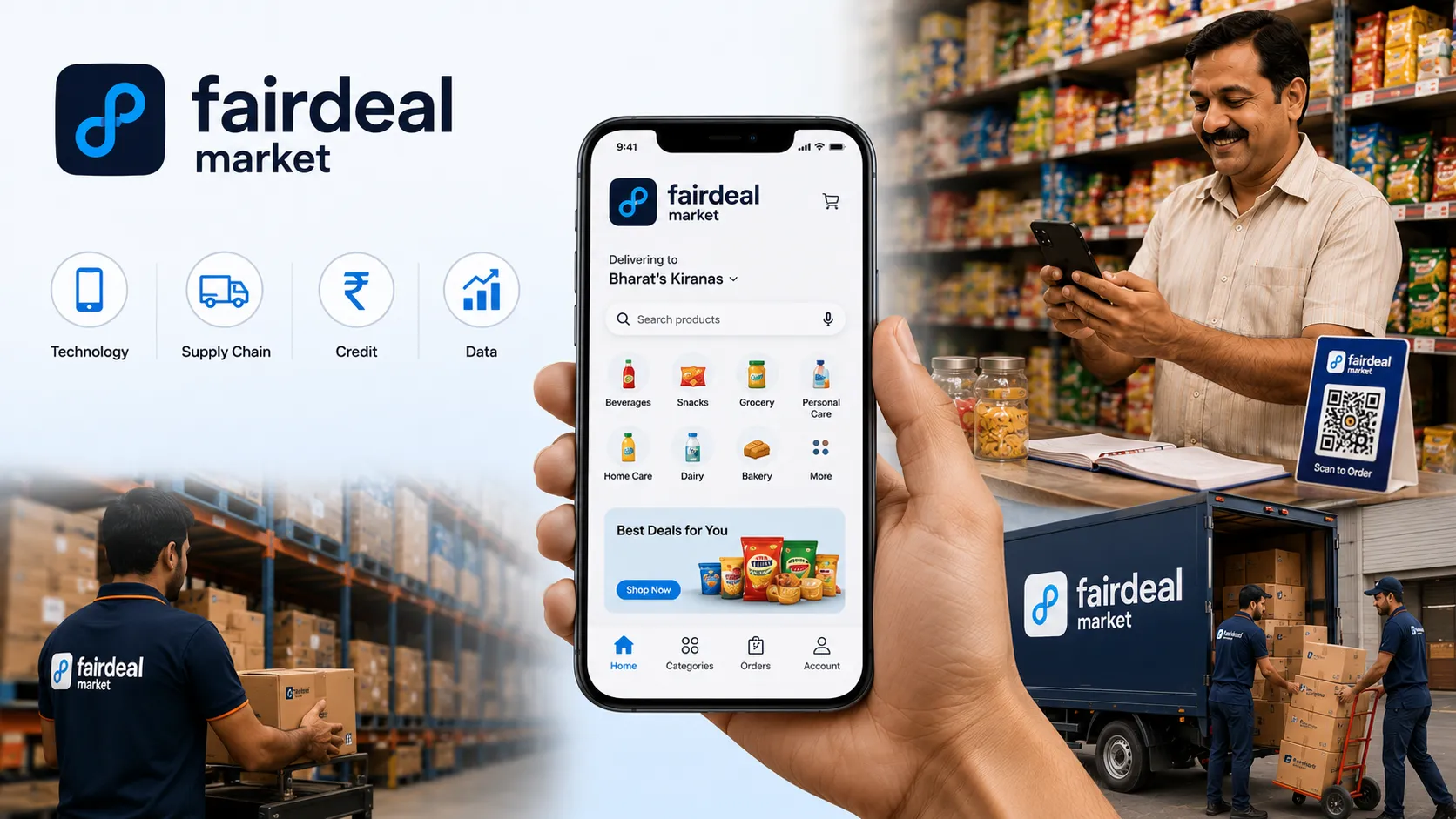
While Consumer Brands Fight For Attention, Fairdeal Is Focused On Something Less Visible But Equally Important: Helping Products Reach Millions Of Small Retail Stores Across India
Much of India's startup conversation revolves around consumer-facing businesses. E-commerce platforms, quick-commerce companies, digital payment applications and consumer brands often dominate headlines because they interact directly with customers and generate visible growth metrics. Investors and media outlets naturally gravitate toward businesses that consumers recognize immediately because their impact is easy to understand. Yet behind every successful consumer brand lies an extensive distribution ecosystem responsible for ensuring products actually reach store shelves. Without that infrastructure, even the most successful consumer products struggle to scale.
This reality is particularly important in India because the country's retail economy remains heavily dependent on kirana stores. Despite the rapid growth of e-commerce and organized retail, millions of neighborhood shops continue to serve as the primary point of purchase for a large portion of the population. These stores form one of the largest retail networks in the world, but reaching them efficiently remains a significant challenge. Distribution often involves multiple intermediaries, fragmented supply chains and operational inefficiencies that increase costs for manufacturers while reducing profitability for retailers.
Companies like Fairdeal are positioning themselves within this opportunity. Rather than competing for consumer attention directly, the business focuses on strengthening the infrastructure that connects manufacturers, distributors and kirana stores because efficient distribution remains one of the most important yet overlooked components of India's commerce ecosystem. While consumers typically notice the products on shelves, investors increasingly recognize that the systems moving those products may represent an equally valuable business opportunity.
The significance of this approach becomes clearer when examining how commerce functions across India. Large metropolitan markets often receive the majority of attention because they offer dense populations and higher spending power. However, a substantial portion of India's economic activity takes place across smaller cities, towns and regional markets where traditional retail networks continue to dominate. Reaching these markets requires more than marketing budgets or digital platforms. It requires logistics, relationships, inventory management and distribution capabilities capable of operating across highly fragmented geographies.
This is why infrastructure businesses are attracting renewed investor interest. For years, venture capital focused heavily on consumer applications because software-based platforms could scale rapidly with relatively limited physical assets. Increasingly, however, investors are recognizing that some of the strongest long-term opportunities exist within the systems supporting economic activity itself. Distribution networks, supply-chain platforms and commerce infrastructure businesses often create deeper competitive advantages because they become embedded within daily operations rather than competing solely for consumer attention.
Fairdeal benefits from this shift in thinking because distribution remains a critical challenge across multiple industries. Consumer goods companies want broader market access. Retailers want reliable inventory availability. Suppliers want efficient routes to market. Solving these problems creates value across the entire ecosystem because improvements in distribution efficiency can influence sales, profitability and market expansion simultaneously. Businesses capable of streamlining these relationships therefore occupy strategically important positions within commerce networks.
Technology is also changing what distribution businesses can achieve. Traditional supply chains often relied on manual processes, limited visibility and fragmented communication because real-time data was difficult to access. Modern platforms increasingly use digital tools to improve inventory tracking, forecasting and operational coordination. As a result, infrastructure businesses can operate with greater efficiency while providing better insights to partners throughout the value chain. This combination of physical distribution and digital intelligence is becoming a powerful competitive advantage.
The opportunity becomes even larger when viewed through the lens of Bharat-focused growth. Investor discussions increasingly emphasize businesses serving regional markets because future economic expansion is expected to come not only from major cities but also from smaller urban centers and emerging consumer markets. Kirana stores remain deeply embedded within these communities, making them important gateways to broader commercial activity. Companies helping strengthen those networks therefore gain exposure to one of India's most significant long-term growth themes.
What makes Fairdeal particularly interesting is that it operates within a category that consumers rarely think about directly. Unlike consumer brands, distribution businesses often remain invisible despite playing a critical role in enabling commerce. Yet history shows that infrastructure companies frequently become some of the most valuable businesses in any economic ecosystem because they support the activities of thousands of other enterprises. Their growth becomes tied not to a single product category but to the broader expansion of economic activity itself.
This is one reason investors increasingly pay attention to businesses operating behind the scenes. The next phase of India's commerce evolution may depend as much on infrastructure as on consumer innovation. Distribution networks, supply-chain platforms and retail-enablement businesses provide the foundation upon which consumer growth occurs. Without them, expanding into new markets becomes significantly more difficult.
Fairdeal's story therefore reflects a larger shift taking place within India's startup ecosystem. Investors are looking beyond visible consumer brands and exploring the systems that make commerce possible. As competition intensifies across traditional startup categories, infrastructure-focused businesses are gaining recognition for solving problems that affect entire industries rather than individual customers.
And in a country where millions of kirana stores continue to drive everyday commerce, the companies building the networks behind those stores may ultimately become some of the most important businesses of all.