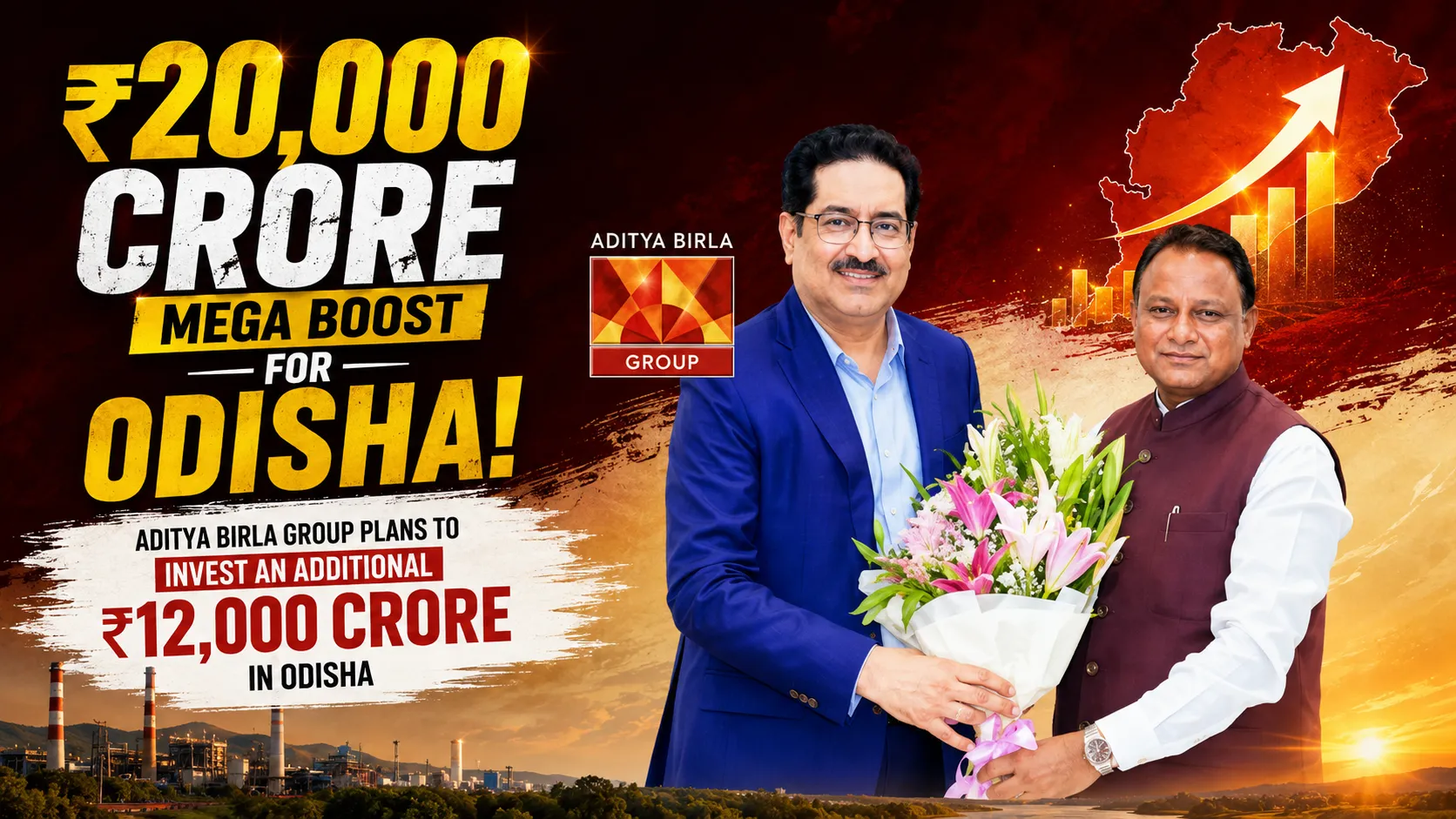
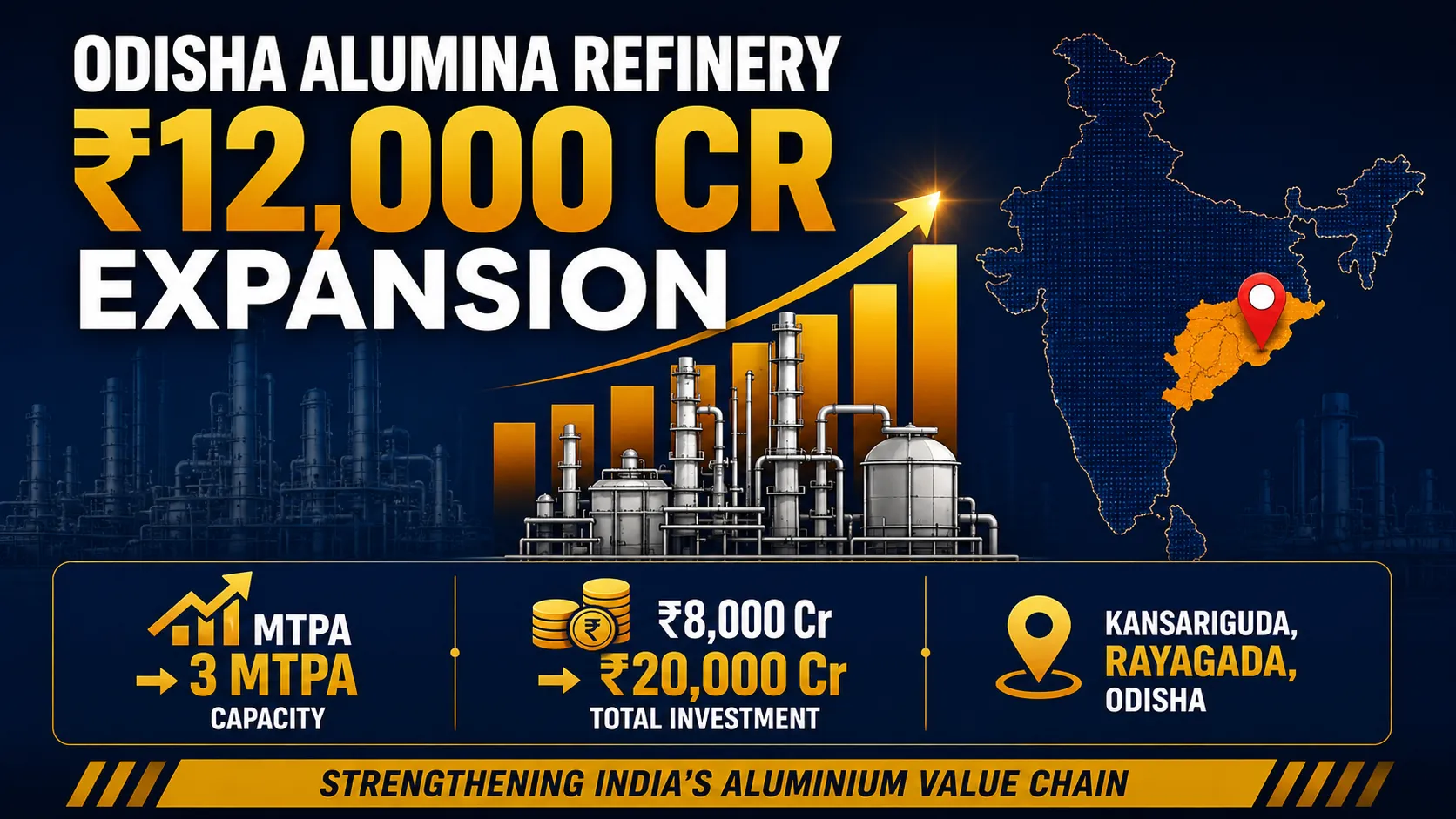
In the mineral-rich terrain of Odisha's Rayagada district, a greenfield project that began life as a relatively modest 1-million-tonne-per-annum alumina refinery is about to become something considerably more ambitious. Hindalco Industries, the metals flagship of the Aditya Birla Group, has proposed an additional investment of roughly ₹12,000 crore — approximately $1.25 to $1.26 billion — to triple the capacity of its Kansariguda alumina refinery from 1 million tonnes per annum to 3 MTPA, a move that, once combined with the ₹8,000 crore already committed to the project's original design, brings the total investment in the single facility to approximately ₹20,000 crore, or roughly $2.1 billion.
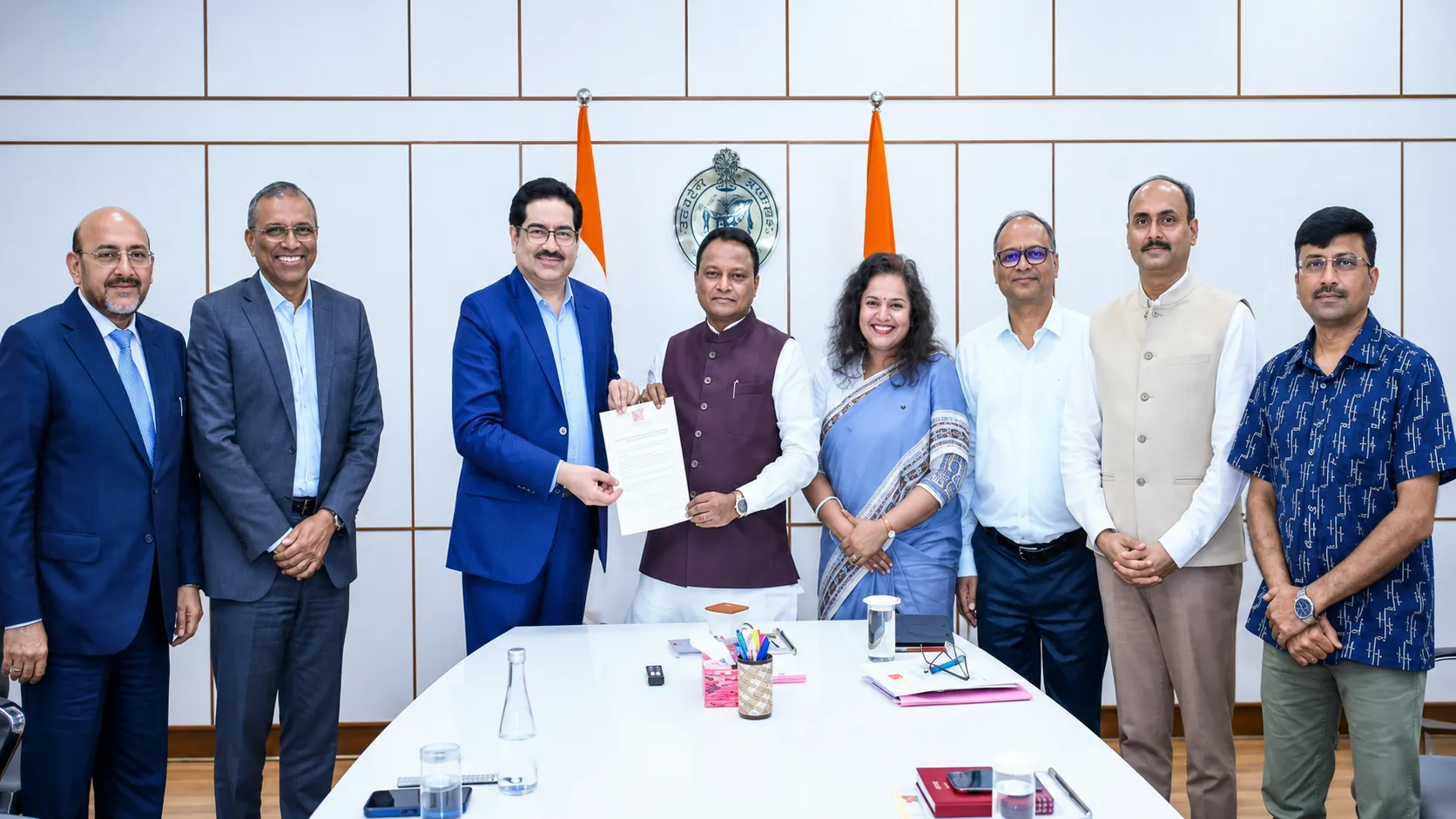
The proposal was formally discussed during a meeting between Odisha Chief Minister Mohan Charan Majhi and Aditya Birla Group Chairman Kumar Mangalam Birla, part of a broader review of the conglomerate's ongoing and planned investments across the state. The Chief Minister's Office, in a statement following the meeting, confirmed that the expansion would lift the refinery's production capacity to 3 MTPA and is expected to generate substantial direct and indirect employment, while opening up meaningful opportunities for local enterprises, service providers, and downstream industries connected to the broader aluminium value chain.
WHY ALUMINA, AND WHY NOW
To understand the strategic logic behind this expansion, it helps to understand exactly where alumina sits in the aluminium production process. Alumina — aluminium oxide — is the intermediate material extracted from bauxite ore that gets processed into pure aluminium metal at smelting facilities. For any integrated metals company, controlling a large, reliable, domestic supply of alumina is close to existential: alumina prices on international spot markets can be notoriously volatile, subject to swings driven by everything from Chinese production quotas to bauxite supply disruptions in major producing countries like Guinea and Australia. A company that has to buy alumina on the open market to feed its smelters is, in effect, exposed to a cost input it cannot control. A company that produces its own alumina domestically, by contrast, insulates its aluminium production margins from exactly that kind of external volatility.
This is precisely the strategic rationale driving Hindalco's Odisha buildout, and it explains why the Kansariguda expansion is not happening in isolation. Alongside the refinery capacity increase, Hindalco's subsidiary Aditya Aluminium is separately pursuing a brownfield expansion of its aluminium smelter at Lapanga in Sambalpur district, lifting smelting capacity from 6.8 lakh tonnes per annum to 9.0 lakh tonnes per annum — an addition of roughly 2.2 lakh tonnes. That expansion recently cleared what industry observers describe as a critical procedural milestone: it received unanimous community support during the public hearing mandated under India's Environmental Impact Assessment framework, a notably smooth outcome given how contentious public hearings for large industrial projects can become in mineral-rich states where land displacement and environmental concerns frequently intersect with local livelihood interests.
The pairing of expanded alumina refining capacity with expanded smelting capacity is, in the words of industry analysts tracking the sector, strategically coherent in a way that goes beyond simple scale-chasing. By securing a large, captive, domestically produced source of alumina and routing a meaningful share of it directly to a co-located or nearby smelting operation, Hindalco is building the kind of vertically integrated production chain that global aluminium majors have long recognised as a defining competitive advantage — one that reduces exposure to international alumina price swings and strengthens the company's overall cost position relative to smelters that remain dependent on third-party alumina purchases.
THE SCALE OF HINDALCO'S ODISHA FOOTPRINT
Once both Kansariguda and Hindalco's existing Utkal Alumina International refinery — a separate, already-operational facility in Rayagada with a capacity of approximately 2.12 MTPA, fed by bauxite from the Baphlimali mines via an 18-kilometre conveyor system — are running at their targeted capacities, Hindalco's combined alumina refining output in Odisha alone would approach 5 MTPA. That figure would place the state among the largest single-location concentrations of alumina production capacity anywhere in Asia outside of China, a striking statement about how central Odisha has become to Hindalco's, and by extension the Aditya Birla Group's, long-term metals strategy.
The Kansariguda and Lapanga projects are, in fact, only part of a considerably larger investment commitment the Aditya Birla Group has made to the state. Beyond the ₹12,000 crore Kansariguda expansion, the group's metals flagship has separately outlined plans for an additional ₹38,000 crore of investment across Odisha, encompassing everything from the ongoing ₹21,000 crore expansion of the Lapanga smelting complex to continued development of the state's oldest operating aluminium facility, the Hirakud smelter. Odisha has also become a testing ground for Hindalco's low-carbon production ambitions, with the company implementing what it describes as an integrated, round-the-clock renewable energy solution designed to reduce the carbon intensity of its aluminium output — an increasingly important differentiator as global buyers, particularly in Europe, begin factoring embedded carbon emissions into procurement decisions for industrial metals.
THE FINANCIAL BACKDROP
The expansion announcement lands at a moment when Hindalco's underlying financial performance offers a mixed but broadly encouraging picture. The company reported record consolidated quarterly revenue of ₹78,133 crore for the fourth quarter of FY26, a 20 percent year-on-year increase from ₹64,890 crore in the corresponding quarter of the previous fiscal year. Quarterly EBITDA also hit a record high of ₹11,197 crore, up 9 percent year-on-year, reflecting strong operational performance across the company's metals businesses. Profit after tax, however, told a more complicated story, declining nearly 51 percent year-on-year to ₹2,597 crore from ₹5,284 crore in the same quarter last fiscal, with basic earnings per share falling correspondingly to ₹11.69 from ₹23.80 — a decline that analysts have generally attributed to one-off and non-operational factors rather than a deterioration in the company's core operating performance, given the simultaneous records set in both revenue and EBITDA.
That combination — record top-line and operating profitability alongside a sharp bottom-line decline — appears to have done little to dampen the group's appetite for further capital investment in its core metals business, a signal in itself about how management views the underlying demand trajectory for aluminium and alumina over the coming decade.
THE DEMAND STORY UNDERPINNING THE BET
Hindalco's aggressive capacity expansion reflects a broader conviction, widely shared across the global metals industry, that demand for aluminium is entering a structurally higher growth phase, driven by sectors that barely factored into aluminium demand forecasts a generation ago. Infrastructure spending across India's ongoing highway, rail and urban development programmes continues to consume enormous quantities of aluminium and aluminium-based products. The renewable energy transition — solar panel frames, wind turbine components, and the broader electrical grid infrastructure needed to support renewable capacity additions — has emerged as a genuinely new and fast-growing source of aluminium demand. Electric mobility, too, is reshaping demand patterns, given that electric vehicles typically use significantly more aluminium than traditional internal combustion vehicles, both to offset the weight of battery packs and to meet efficiency targets.
Chief Minister Majhi, welcoming the Kansariguda proposal, framed the expansion in terms that go beyond the immediate industrial investment, emphasising that the state's mineral wealth must translate into greater value addition, advanced manufacturing capability, and quality employment for Odisha's residents, rather than simply serving as a source of raw material extraction for processing elsewhere. That framing reflects a broader policy shift that has gained momentum across India's major mineral-producing states in recent years — a push to capture more of the value chain domestically, rather than exporting raw or semi-processed materials for finishing elsewhere.
WHAT COMES NEXT
For a project of this scale, the path from proposal to full operational capacity typically spans several years, encompassing environmental clearances, detailed engineering, construction, and phased commissioning. The original 1 MTPA Kansariguda project itself was conceived as a greenfield development, meaning the expanded 3 MTPA facility will require substantial additional construction rather than simply retrofitting existing infrastructure — digestion and calcination circuits capable of handling significantly higher bauxite throughput, expanded material handling and logistics infrastructure, and the associated utilities and power infrastructure needed to support a threefold increase in output.
Odisha's state government has publicly committed to providing what it describes as comprehensive support for the project's timely execution, including assistance with land acquisition, infrastructure development, utility provisioning and statutory approvals, delivered through what officials describe as a coordinated, single-window approach. Given the scale of capital involved and the strategic importance the Aditya Birla Group has placed on Odisha within its broader metals strategy, the Kansariguda expansion is likely to be closely watched not just as a single industrial project, but as a bellwether for how effectively India's mineral-rich states can convert natural resource endowments into the kind of large-scale, value-added manufacturing capacity the government's broader industrial policy has long sought to encourage.
ODISHA'S TRANSFORMATION INTO A METALS POWERHOUSE
The Kansariguda expansion cannot be understood in isolation from the broader industrial transformation Odisha has undergone over the past two decades. Once viewed primarily as a source of raw bauxite and iron ore extraction for processing elsewhere in the country, Odisha has steadily repositioned itself as a destination for the full value chain of metals processing — from mining through refining, smelting and, increasingly, downstream fabrication. Global and domestic metals majors including Vedanta, NALCO and now an expanding Hindalco footprint have collectively poured tens of thousands of crores into the state over the past several years, drawn by a combination of abundant bauxite reserves, coastal access for both raw material imports and finished product exports, and a state government that has actively courted large industrial investment as a centrepiece of its economic development strategy.
For local communities in Rayagada and neighbouring districts, projects of this scale carry a complicated but generally positive economic calculus. Large greenfield industrial projects bring substantial direct employment during both the construction and operational phases, alongside a considerably larger multiplier effect through indirect employment in logistics, ancillary manufacturing, and service industries that spring up around major industrial hubs. At the same time, projects of this scale inevitably require careful navigation of land acquisition, environmental clearance and community consultation processes — precisely the kind of process that the associated Lapanga smelter expansion recently navigated successfully, securing unanimous community support at its mandatory public hearing, a result that industry watchers view as a positive signal for how the broader Kansariguda expansion's own approval process might unfold.
GLOBAL ALUMINIUM MARKET CONTEXT
Hindalco's expansion decision also needs to be read against the backdrop of where global aluminium markets currently stand. Aluminium demand globally has been on a broadly upward trajectory, driven by the same structural forces reshaping demand within India — renewable energy infrastructure, electric vehicle production and continued urbanisation-linked construction activity — even as global supply has faced its own constraints, from energy-cost-driven smelter curtailments in parts of Europe to production discipline in China aimed at managing environmental compliance costs. In that context, a large, low-cost, vertically integrated Indian producer expanding capacity at scale is well positioned to capture a growing share of both domestic and export demand, particularly as global buyers increasingly weigh considerations like embedded carbon intensity and supply chain reliability alongside price when selecting aluminium suppliers — an area where Hindalco's parallel investment in renewable-powered production processes in Odisha could prove to be a meaningful competitive differentiator over the coming decade.
THE BOTTOM LINE FOR INVESTORS AND STAKEHOLDERS
For shareholders in Hindalco and the broader Aditya Birla Group ecosystem, the Kansariguda expansion represents a classic long-cycle capital allocation decision: a multi-year, multi-billion-dollar commitment made on the basis of a multi-decade demand thesis, rather than a bet on near-term commodity price movements. Such decisions inherently carry execution risk — large greenfield industrial projects in India have, in the past, faced delays tied to regulatory approvals, land acquisition disputes, or financing bottlenecks — but they also offer the kind of durable competitive moat that is difficult for competitors to replicate quickly, given the years-long lead time required to bring comparable refining capacity online. As the project moves from proposal to formal approval and eventually to construction, the coming quarters will offer clearer visibility into the execution timeline, and by extension, into when the Aditya Birla Group's substantial bet on Odisha's aluminium future will begin translating into tangible production output.
---