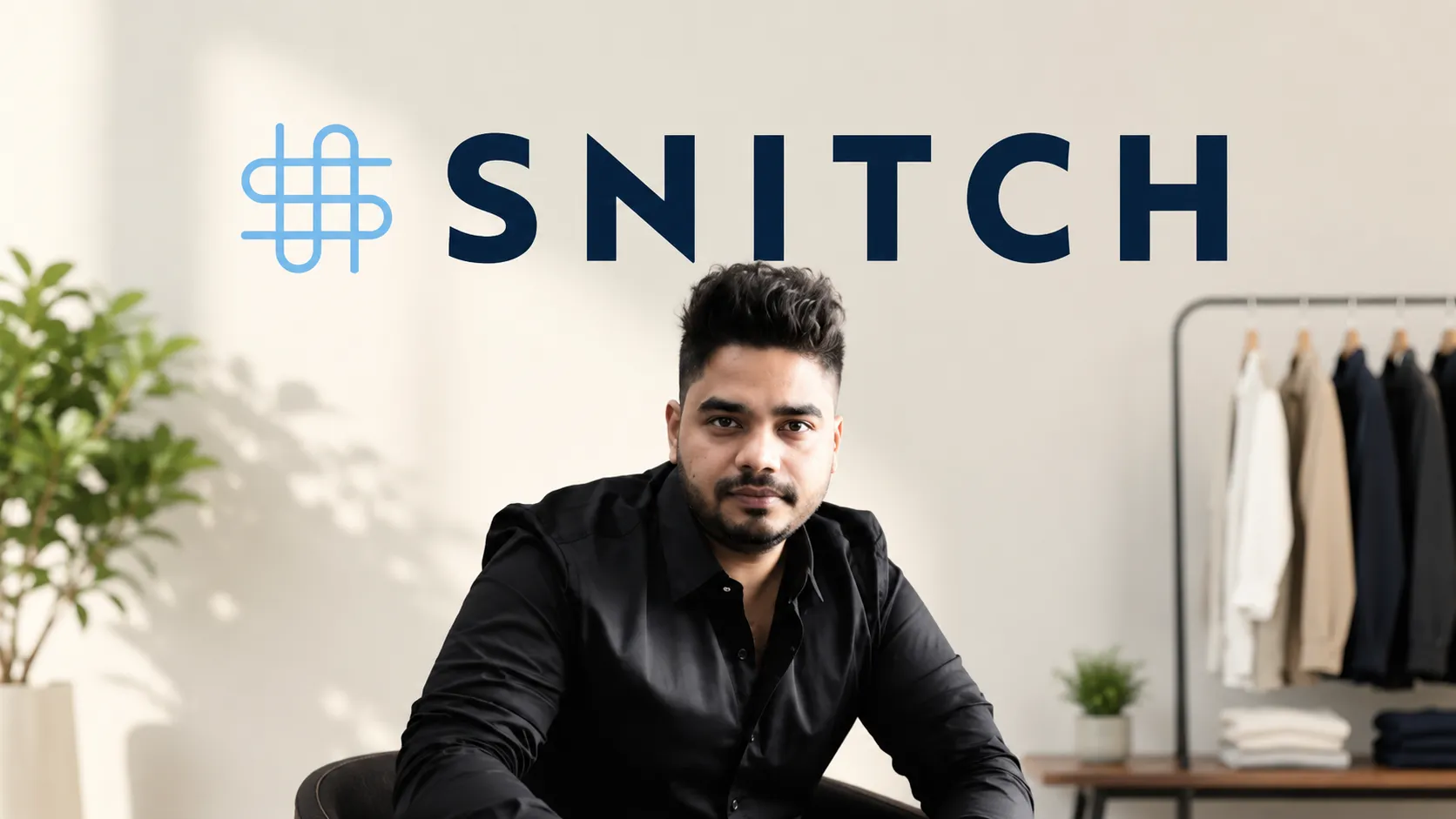
He Made His First Sale in One Hour. Now He Just Raised $40 Million.
On July 4, 2020, in the middle of a pandemic that had shut down physical retail across India, Siddharth Dungarwal launched snitch.co.in with 39 products, a team of four people, and what he has described as a prayer and a plan. The website went live. Within one hour, Snitch made its first sale.
He could not have known, in that hour, that he was launching one of India's fastest-growing menswear brands. He was a man from Kolar Gold Fields, a small town 100 kilometres from Bengaluru, who had been working in textile manufacturing and B2B supply since he was 18. His father ran Mr & Mr, a B2B men's shirt manufacturing business. The pandemic had shut the retail doors and left him staring at inventory that had nowhere to go. So instead of liquidating stock on marketplaces and absorbing the loss, he pivoted. He built a website. He learned digital marketing from YouTube during lockdown. He delivered an order himself on his bicycle once, because the product was a gift and he wanted it to arrive on time.
That particular quality — the willingness to do the thing that needs to be done, regardless of whether it is on a founder's job description — runs through everything Snitch has built since.
On June 2, 2025, Snitch announced the closure of a $40 million Series B funding round, led by Mumbai-based 360 ONE Asset Management, with continued participation from existing investors IvyCap Ventures and SWC Global, and new backing from the Ravi Modi Family Office — the family behind Manyavar, India's dominant ethnic wear brand — alongside other angel investors. The round included both primary and secondary components, with ₹280 crore in primary capital and the remainder through secondary transactions that allowed early investors to partially exit.
Five years. 39 products to 55-plus stores. One sale in one hour to ₹241 crore in annual revenue. The story of how Snitch got here is the story of what India's D2C fashion market can become when someone builds it with the right obsessions.

What Snitch Actually Built — and Why It Is Different
The Indian menswear market has historically been underserved in a specific way. Women's fashion had dozens of brands competing aggressively on trend, price, and digital-first distribution. Men's fashion had the legacy brands — Raymond, Peter England, Louis Philippe — built for a formal retail experience, and a handful of D2C players competing on basics and essentials. The fast-fashion, trend-driven, affordable-and-aspirational segment that had been captured in women's apparel by brands like Myntra, Nykaa Fashion, and Ajio largely did not exist in a dedicated way for men.
Dungarwal saw this gap not as a niche but as a category waiting to be defined. His manufacturing background meant he understood the full stack — fabric sourcing, production timelines, cost structures, quality control — in a way that most D2C founders who come from marketing or tech backgrounds do not. The insight he built Snitch around was speed: if he could compress the design-to-delivery cycle to weekly launches rather than seasonal drops, he could give Indian men the same experience of perpetual newness that fast-fashion brands gave women, at price points the market would actually pay.
The weekly drop model became Snitch's signature. New styles every week, trend-driven rather than wardrobe-staple-driven, priced for a 25 to 35-year-old professional who wants to look relevant without spending designer money. The brand gained national recognition on Shark Tank India Season 2 — where all five sharks reportedly wanted to invest, a validation signal that the brand's consumer resonance translated into investor conviction. While Dungarwal ultimately did not close a deal on the show, the visibility it generated drove a spike in sales that confirmed what the weekly numbers were already suggesting: there was a large, underserved market of Indian men who wanted this product and were waiting for someone to build it properly.
The numbers since then are consistent. FY24 revenue: ₹241 crore, a 128 per cent year-on-year increase. Profit after tax: ₹4.39 crore — rare among D2C brands at this stage of growth, and significant because it signals unit economics that are not dependent on continuous promotional burn to sustain. The company's gross margins and store-level profitability have been cited by investors as what distinguishes Snitch from the cohort of D2C brands that grew fast but burned faster.
Chetan Naik, Senior Fund Manager and Strategy Head at 360 ONE Asset, was specific about what made the investment case:
"Profitable" and "high growth" in the same sentence, about the same company, is not something that appears often in Indian D2C. That combination is what the $40 million is backing.
What the Money Is For
The $40 million Series B is not a survival round. It is an acceleration round for a company that has already demonstrated the model works and is now asking how fast it can scale it.
The capital allocation is specific. Snitch plans to grow its offline retail presence from 55-plus stores to over 100 stores by end of 2025, building a strong presence across India's 20 largest cities. This is not a pivot from D2C to offline — it is an omnichannel expansion that Dungarwal has described as the natural next phase of reaching customers who want to touch and try the product before they buy it, particularly in the Tier 2 and Tier 3 cities where online fashion D2C has historically struggled with returns and fit uncertainty.
The brand is also entering quick commerce — a distribution channel that has transformed food and grocery delivery in India and is increasingly being applied to fashion for impulse and urgency-driven purchases. For a brand that has built its identity around weekly drops and trend responsiveness, quick commerce is a logical extension: if your selling proposition is that you have the newest thing available now, the ability to deliver it in under an hour closes the loop.
International expansion is also explicitly on the agenda. South Asia and the Middle East are the first targets — markets with large Indian diaspora communities and established demand for Indian menswear aesthetics, where Snitch's price-to-quality positioning travels well. The brand is also expanding its product categories into plus-size clothing, eyewear, footwear, and bags — building from menswear into a full lifestyle offering for the same customer base.
Vikram Gupta, Founder and Managing Partner of IvyCap Ventures, who reinvested in the round, was direct about the conviction:
Reinvestment is the clearest signal an early-stage investor can send. It is the difference between saying you believe in a company and putting more money in when you could instead take your returns.
The Ravi Modi Family Office's participation is a different kind of signal. Manyavar built India's dominant position in ethnic occasion wear through a combination of aggressive franchise expansion, aspirational positioning, and a brand identity tied to cultural moments — weddings, festivals, celebrations. The family office backing Snitch is a bet that the same playbook — building a category-defining brand in Indian menswear, expanding through franchise and offline retail, becoming the default choice rather than one choice among many — can work in the fast-fashion everyday wear segment.
The IPO Ambition — and Whether the Numbers Support It
Siddharth Dungarwal has been explicit about the destination. Snitch is targeting ₹1,000 crore in revenue by FY26 and an IPO within three years of the Series B close. Both ambitions are demanding. Both are grounded in a growth trajectory that, if maintained, makes them plausible.
The revenue target requires roughly 4x growth from the FY24 base of ₹241 crore. With 128 per cent year-on-year growth in FY24, and a fresh ₹280 crore in primary capital to fund both online and offline expansion, the arithmetic is not impossible. It requires execution — the 100-store target, the quick commerce entry, the international pilots, the category expansion — to all deliver simultaneously. That is a lot of things to do at once, which is why the management team, the supply chain infrastructure, and the unit economics foundation matter as much as the funding.
The IPO ambition is consistent with the broader trajectory of India's D2C market, where companies like Nykaa and Mamaearth have established that D2C brands can command public market listings and sustain them if the fundamentals are real. Snitch's FY24 profitability, however modest, is the kind of number that matters for a public market story: it proves the model is not dependent on indefinite subsidy to survive.
Dungarwal has been consistent in how he frames the journey:
What Snitch's Story Means for Indian D2C
The Snitch Series B is a data point in a larger argument about what India's D2C market can produce when a founder builds from manufacturing knowledge rather than marketing knowledge alone.
Most of India's most celebrated consumer brands — Nykaa, Mamaearth, SUGAR Cosmetics — were built by founders who understood the customer and built the product to serve them. What Dungarwal added to that formula is supply-chain intimacy: the ability to design, manufacture, and deliver a new style in a compressed timeline because he grew up understanding every step of the textile production process. That is the operational moat that makes the weekly drop model possible, and it is the part of the Snitch story that is hardest to replicate.
The investors backing this round are not betting on fast fashion as a category. They are betting on a specific operating model — lean manufacturing, trend agility, omnichannel distribution, and a customer relationship built on the expectation of perpetual newness — in the one segment of Indian apparel that had not yet been captured by a brand built around those specific capabilities.
39 products. One hour. One sale. Five years later: $40 million, 55 stores, and a public market ambition that the numbers say is within reach if the execution continues at the pace it has set.
The category is being defined. The question is how fast Snitch can run before someone else figures out the playbook.