HDFC Bank, India's largest private sector lender by both assets and market capitalisation, on July 18, 2026, reported a steady set of numbers for the first quarter of financial year 2027, with net profit climbing 5 per cent year-on-year to ₹19,059.72 crore. Total income for the April-to-June quarter came in at ₹92,184.38 crore, while net interest income — the core measure of a bank's lending profitability — rose 6.7 per cent, a print broadly in line with what analysts had pencilled in ahead of the results.
The board meeting at which the results were cleared ran for roughly three hours, from 11 a.m. to 2 p.m., before continuing with other items on the agenda, a length that underscored the scale and complexity of reviewing India's largest private banking franchise. In line with insider-trading regulations and its own share-dealing code, the bank confirmed that its trading window for designated persons — employees and insiders restricted from trading around results — would reopen on July 21, 2026, formally marking the end of the blackout period around this quarter's earnings.
The results were released into a market environment that has grown considerably more discerning about bank earnings quality over the past year, with investors and analysts alike scrutinising not just headline profit growth but the underlying composition of that growth — how much is coming from core lending operations versus treasury gains or one-off items, how provisioning trends are evolving, and whether margin trajectories suggest sustainable, repeatable earnings power rather than one-quarter anomalies. Against that more demanding backdrop, HDFC Bank's June-quarter performance was read by most sell-side desks as a solid, if unspectacular, continuation of the steady post-merger integration story the bank has been telling investors for the past several years.
Deposits Do The Heavy Lifting
The most striking theme in this quarter's numbers was deposit growth, an area HDFC Bank has been prioritising since its 2023 merger with parent HDFC Ltd left it with a loan-to-deposit ratio that regulators and analysts alike flagged as stretched. Average deposits grew 13.3 per cent year-on-year and 5.6 per cent sequentially to reach ₹30.12 lakh crore for the quarter — a pace of growth that comfortably outstripped the bank's loan growth, allowing management to continue the multi-quarter project of bringing its loan-to-deposit ratio down toward more comfortable, sustainable levels.
Within that deposit base, the quality mix also improved. Average current account and savings account, or CASA, deposits — the cheapest and most profitable form of funding for any bank — rose 11.2 per cent year-on-year and 4.2 per cent sequentially to ₹9.57 lakh crore. A rising CASA ratio typically signals improving customer stickiness and branch productivity, both metrics that have been under close watch since the merger dramatically expanded HDFC Bank's balance sheet and customer base almost overnight.
A Balance Sheet Approaching ₹44 Lakh Crore
HDFC Bank's total balance sheet size expanded to ₹43.98 lakh crore as of June 30, 2026, up from ₹39.54 lakh crore a year earlier — an increase of more than ₹4.4 lakh crore in twelve months, a figure larger than the entire balance sheet of many mid-sized global banks. That scale places HDFC Bank firmly among the largest banking institutions in Asia by assets, a position it has consolidated steadily since the merger that combined India's largest housing finance company with its largest private bank.
The bank's physical distribution network also continued its steady expansion, if unevenly. As of June 30, 2026, HDFC Bank operated 9,694 branches, up from 9,499 a year earlier, spread across 4,175 cities compared with 4,153 the previous year — evidence of continued, if measured, geographic expansion. Roughly half of these branches are located in semi-urban and rural India, a deliberate strategic tilt the bank has pursued in recent years as it looks to tap credit demand and deposit mobilisation opportunities beyond India's largest metro markets, where competition for both loans and deposits is most intense.
Somewhat more counterintuitively, the bank's ATM count actually declined slightly, from 21,251 a year ago to 20,958 as of June 2026 — a trend consistent with an industry-wide shift toward digital and UPI-based transactions that has reduced the marginal need for physical cash machines even as branch banking, particularly for lending, advisory and relationship banking, continues to expand. To support its rural and semi-urban push, the bank also leaned further into its network of 14,392 business correspondents, staffed primarily through Common Service Centres, extending its reach into geographies where a full-service branch may not yet be commercially viable.
A Leaner Workforce
In a detail that may draw as much attention as the headline profit number, HDFC Bank's employee count actually fell over the past year, from 2,18,822 as of June 2025 to 2,12,958 as of June 2026 — a reduction of nearly 6,000 employees even as the balance sheet grew by more than 11 per cent. The decline suggests the bank is leaning increasingly on automation, digital self-service channels and productivity gains per employee rather than headcount expansion to drive growth, a strategic shift that mirrors trends seen across large private banks globally as they digitise both customer-facing and back-office operations.
For a bank of HDFC Bank's scale, even modest improvements in per-employee productivity translate into meaningful operating leverage over time, and analysts tracking the stock have flagged efficiency metrics — cost-to-income ratio in particular — as a key area to watch in coming quarters as the full benefits of this leaner operating model potentially flow through to margins.
Reading The Numbers Against Analyst Expectations
Ahead of the results, brokerages had broadly pencilled in a mid-to-high single-digit rise in both net interest income and net profit for HDFC Bank's June quarter, with several houses specifically flagging net interest margin trajectory and loan growth as the two swing factors most likely to determine whether the bank beat, met, or missed the median estimate. The actual print — 6.7 per cent NII growth and 5 per cent profit growth — landed toward the more conservative end of that expected range, suggesting the quarter was one of steady, unspectacular execution rather than a dramatic upside surprise.
That said, several analysts flagged the underlying deposit and CASA growth figures as the more encouraging story buried within the headline numbers, arguing that a bank successfully growing its cheapest, most valuable source of funding at double-digit rates, while simultaneously bringing down its loan-to-deposit ratio, is laying more durable groundwork for margin expansion in future quarters than a bank that grows profit faster in the near term but does so by drawing down on more expensive wholesale funding sources. This nuance, analysts note, is often lost on investors who focus purely on the single-line profit growth number without examining the underlying balance sheet composition driving it.
Context: A Sector Under The Microscope
HDFC Bank's results landed in the middle of a packed and closely watched Q1 FY27 earnings season for Indian banks, with ICICI Bank, Axis Bank, Kotak Mahindra Bank, Yes Bank and a string of public-sector lenders including Punjab National Bank and Indian Overseas Bank all reporting results within the same window. Broadly, the sector delivered a mixed but resilient quarter: net interest margins across most large banks stayed largely flat as the cost of deposits caught up with earlier repo rate moves, while asset quality broadly held stable and loan growth in the low double digits continued to support the bottom line for most large lenders.
That said, the sector has not been immune to the broader market stress described elsewhere in this issue. Banking stocks, including HDFC Bank itself, came under renewed selling pressure in the days immediately following results, as rising credit costs, capital outflows tied to global risk aversion, and the broader rupee-and-oil narrative weighed on sentiment even as fundamental results came in largely as expected. This disconnect between steady fundamentals and weak stock performance has become something of a recurring theme this earnings season, with analysts noting that macro headline risk is, for now, overpowering company-specific good news in determining near-term stock price direction.
The Rural And Semi-Urban Bet, Explained
HDFC Bank's decision to house roughly half its branch network in semi-urban and rural India is worth unpacking in more detail, because it represents one of the more deliberate long-term strategic bets embedded within this quarter's results. Historically, India's largest private banks concentrated their branch networks disproportionately in metro and urban centres, where higher average account balances and greater cross-sell opportunities for products like credit cards, mutual funds and insurance made for more immediately profitable branch economics. Rural and semi-urban expansion, by contrast, typically involves a longer payback period, as branches in these geographies often start with lower average balances and take longer to build the kind of dense, multi-product customer relationships that drive branch-level profitability.
The rationale for pursuing this strategy regardless lies in the scale of the opportunity: India's rural and semi-urban markets remain meaningfully under-penetrated in terms of formal banking relationships relative to urban India, and a bank that can establish an early, trusted presence in these markets stands to capture a disproportionate share of future credit and deposit growth as incomes rise and formal financial inclusion deepens over the coming decade. HDFC Bank's post-merger scale — inherited in part from HDFC Ltd's decades-long history of housing finance penetration into smaller towns — gives it a structural head start in executing this strategy relative to several private-sector peers with a more urban-concentrated legacy footprint.
How The Stock Reacted
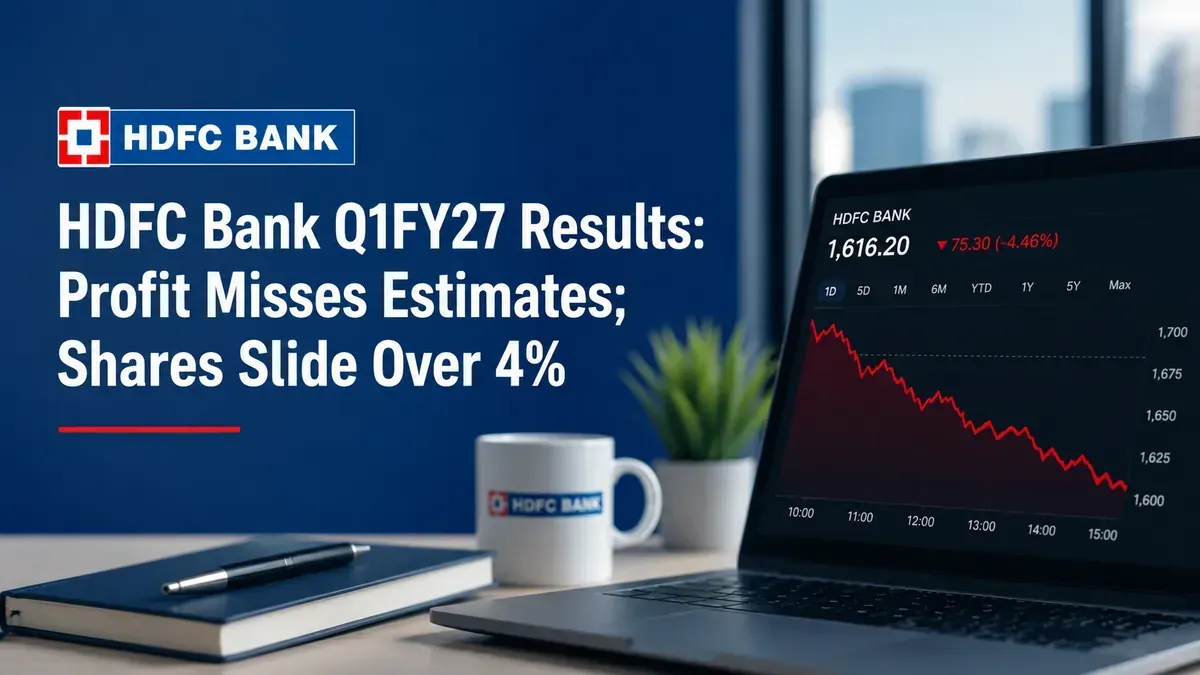
Despite delivering results broadly in line with, and on several metrics modestly ahead of, analyst expectations, HDFC Bank's stock did not see a significant post-results rally, instead drifting lower by roughly 1 per cent in trading sessions immediately following the announcement. This muted-to-negative stock reaction to a fundamentally solid quarter has puzzled some retail investors, but sell-side analysts point to the broader macro backdrop — rising crude prices, a softening rupee, and renewed global risk aversion — as the dominant force overriding company-specific good news in the immediate aftermath of results.
This disconnect is not unique to HDFC Bank this earnings season; it has been a recurring pattern across several large-cap results this July, where solid, in-line or even better-than-expected numbers have failed to translate into sustained stock outperformance because macro headline risk has been dominating investor positioning decisions. Analysts caution against reading too much into short-term stock price reactions in this kind of environment, instead pointing to the underlying operating metrics — deposit growth, asset quality, and margin trajectory — as the more reliable long-term indicators of the bank's health.
What Analysts Are Watching Next
Heading into the second quarter of FY27, the key metrics analysts say they will be tracking most closely for HDFC Bank include the trajectory of the loan-to-deposit ratio, which remains elevated relative to the bank's pre-merger history even after several quarters of improvement; the pace of unsecured retail lending growth, an area regulators have kept a close eye on across the sector; and whether the bank's aggressive deposit mobilisation strategy in semi-urban and rural markets begins to show up more visibly in net interest margin expansion.
The bank's insurance and asset management subsidiaries — HDFC Life and HDFC Asset Management Company — also reported their own quarterly numbers within the same results window, and analysts tracking the broader HDFC group ecosystem noted that cross-selling synergies across banking, insurance and asset management continue to be a structural, if slow-building, growth lever for the group as a whole. As the group's various listed entities increasingly report results within the same tight window each quarter, analysts have also begun paying closer attention to consolidated, group-wide metrics as a more complete picture of the HDFC ecosystem's overall financial health, rather than evaluating each listed entity in isolation.
With India's private banking sector continuing to consolidate market share from public-sector peers even amid a challenging macro backdrop, HDFC Bank's ability to convert its unmatched scale into steady, predictable earnings growth remains, in the view of most sell-side analysts, the single most important story to watch in Indian banking through the remainder of financial year 2027. Whether the bank's efficiency gains, deposit-led balance sheet growth and rural expansion strategy combine to deliver visible margin expansion over the coming quarters will likely determine whether the stock can decouple from the broader macro-driven weakness currently weighing on the sector.