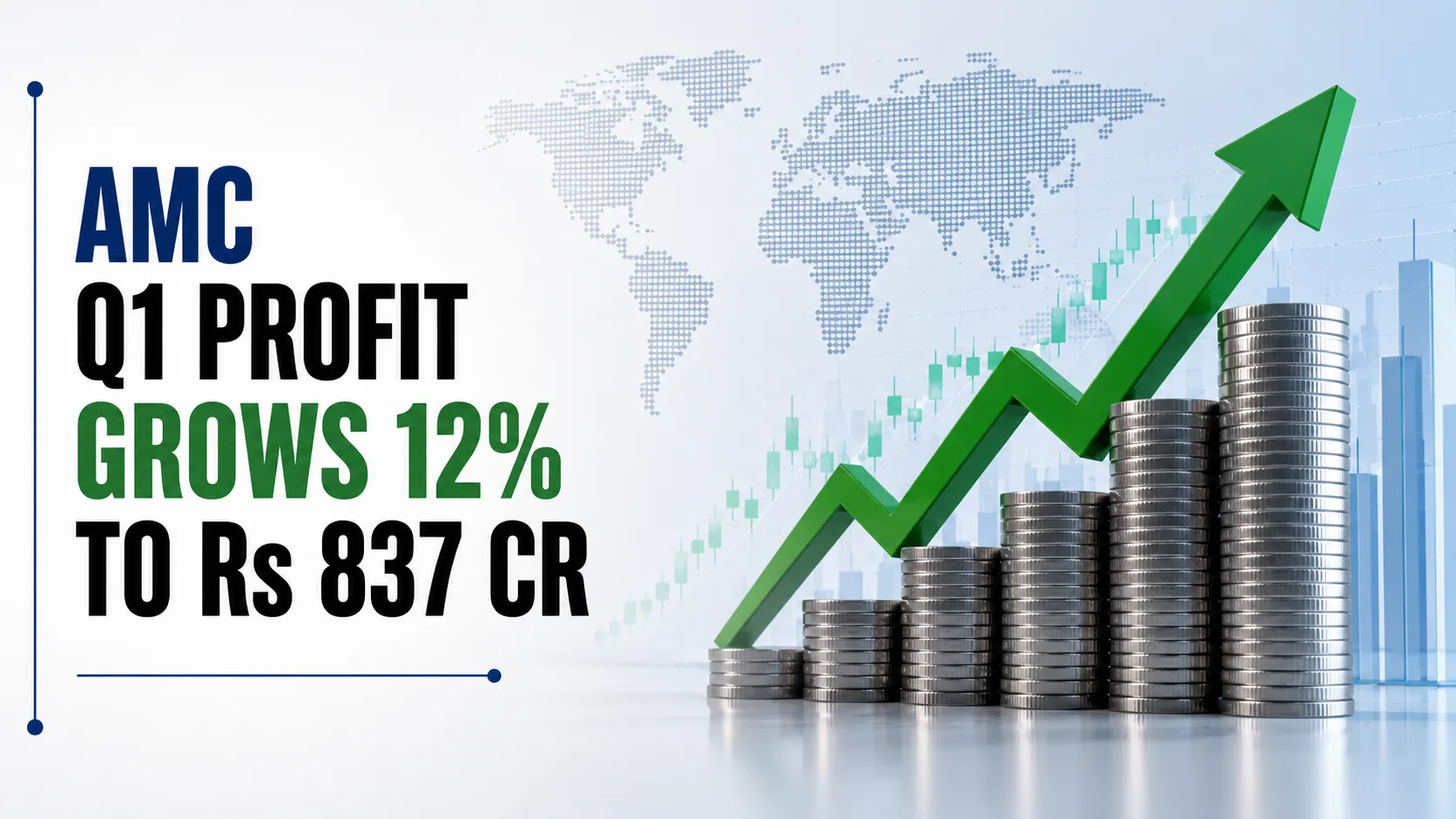
HDFC Asset Management Company, one of India's largest and most closely watched mutual fund houses, opened financial year 2027 with a set of results that reinforced its position at the leading edge of India's structural shift toward financialised household savings, reporting consolidated net profit of ₹837 crore for the quarter ended June 30, 2026 — a 12 percent increase year-on-year from ₹748 crore in the same period last year — even as the stock itself saw a volatile trading reaction across the days surrounding the announcement.
**The headline financial numbers**
Revenue from operations for the quarter climbed 13.6 percent year-on-year to ₹1,100 crore, up from ₹968 crore in Q1FY26, reflecting continued expansion in HDFC AMC's core asset management business alongside a growing overall asset base. Operating EBITDA reached ₹851 crore, a 10 percent year-on-year increase from ₹773 crore, though the operating EBITDA margin moderated slightly to 77.4 percent from 79.9 percent in the year-ago quarter — a modest compression that reflects rising operating costs even as the underlying business continued to scale. Total income, inclusive of other income, rose to ₹1,362.56 crore, up 13.44 percent year-on-year and a notably larger 28.18 percent higher than the preceding March 2026 quarter — a sequential jump driven substantially by other income of ₹262.84 crore, up sharply from just ₹11.55 crore in the unusually low base recorded in the March quarter. Diluted earnings per share came in at ₹19.46, compared with ₹17.41 in the same quarter last year and ₹14.48 in the preceding quarter.
**Assets under management: crossing a significant milestone**
Perhaps the most closely watched metric within HDFC AMC's results was the continued expansion of its assets under management, which reached ₹9,319 billion — approximately ₹9.32 lakh crore — as of the close of the June 2026 quarter, according to the company's disclosures. Quarterly average assets under management, a metric that smooths out single-day fluctuations to provide a more representative picture of the asset base generating fee revenue across the quarter, stood at ₹9,351 billion, giving HDFC AMC an 11.2 percent market share of India's overall mutual fund industry — a commanding position that reflects the company's status as one of the two or three largest asset managers in the country by assets under management.
**The retail investor advantage**
Among the more striking data points disclosed alongside HDFC AMC's headline financial results was the composition of its investor base, which skews notably more retail-heavy than the broader mutual fund industry average. Individual investors accounted for 69 percent of HDFC AMC's total monthly average AUM in June 2026, significantly higher than the mutual fund industry's overall average of 61 percent for the comparable metric. This higher retail concentration carries meaningful strategic significance: individual retail investors, particularly those investing through systematic investment plans, have historically demonstrated considerably greater behavioural stickiness through periods of market volatility compared to institutional or high-net-worth investors, who tend to exhibit more tactical, sentiment-driven allocation behaviour. A retail-heavy AUM base of this kind provides HDFC AMC with a structurally more stable and predictable revenue foundation, an advantage the company's own commentary implicitly credits to strong brand trust, wide distribution reach, and growing adoption of mutual funds among individual Indian investors navigating an increasingly financialised savings landscape.
**The equity fund engine**
HDFC AMC's actively managed equity-oriented quarterly average AUM, specifically excluding index and passive fund products, stood at ₹57.40 lakh crore during the quarter, reflecting the company's overall scale within the broader active equity fund category specifically, where HDFC AMC commands a 12.8 percent market share, reinforcing its position among the very largest active equity mutual fund managers operating in India today. The company's equity-to-non-equity quarterly average AUM mix stood at 66:34 for the quarter, a composition that compares favourably against the broader mutual fund industry average, reflecting HDFC AMC's particular strength in higher-fee-generating equity products relative to lower-yield debt and liquid fund categories — a mix advantage that directly supports the company's superior revenue-per-rupee-of-AUM economics relative to asset managers with a more debt-heavy overall product composition.
**Market reaction: a study in mixed signals**
The market's reaction to HDFC AMC's results proved notably volatile across the days surrounding the announcement, offering an interesting case study in how investors can interpret the same set of results quite differently depending on which specific metrics they weight most heavily. On the day of the results announcement itself, July 15, 2026, HDFC AMC shares initially surged as much as 4 percent intraday to touch ₹2,767.30, before closing 2.6 percent higher at ₹2,729.20 — a positive initial reaction reflecting the headline profit and revenue growth beating some market estimates, which had reportedly pegged profit closer to ₹760 crore against the ₹837 crore actually delivered. However, in trading the following day, July 16, HDFC AMC shares reversed sharply, falling as much as 4.58 percent to ₹2,604.30 by mid-afternoon trade — a pullback that market commentary attributed to closer scrutiny of the underlying quality of earnings, particularly the extent to which the strong sequential profit jump had been driven by the unusually large other income contribution during the quarter, rather than purely organic growth in the company's core asset management fee revenue.
**Corporate developments alongside the results**
HDFC AMC's Q1 FY27 disclosure also came bundled with several notable corporate developments that added further context to the quarter. The company recently received an ESG rating of 72 from Crisil ESG Ratings & Analytics, assigned independently based on publicly available data as of July 13, 2026, reflecting continued institutional attention to environmental, social, and governance considerations within India's asset management industry. Separately, on June 4, 2026, the company launched a new sustainability-oriented portfolio management strategy branded the HDFC Growth for GOOD Portfolio, extending its product suite into the growing category of ESG and sustainability-themed investment offerings increasingly in demand among a subset of India's sophisticated investor base. In a less conventional corporate disclosure, the company also flagged that it had secured a temporary injunction from the Bombay High Court on June 1, 2026, against a ransomware group identifying itself as "Morpheus," specifically aimed at preventing the further distribution of data the group had reportedly exfiltrated in connection with a cybersecurity incident dated May 16, 2026 — a disclosure that underscores the growing cybersecurity risks facing large Indian financial institutions holding vast troves of sensitive customer data, even as it reflects a proactive legal response aimed at limiting the potential damage from the breach.