A State Long Associated With Industrial Growth Is Beginning To Enter A Different Investment Phase
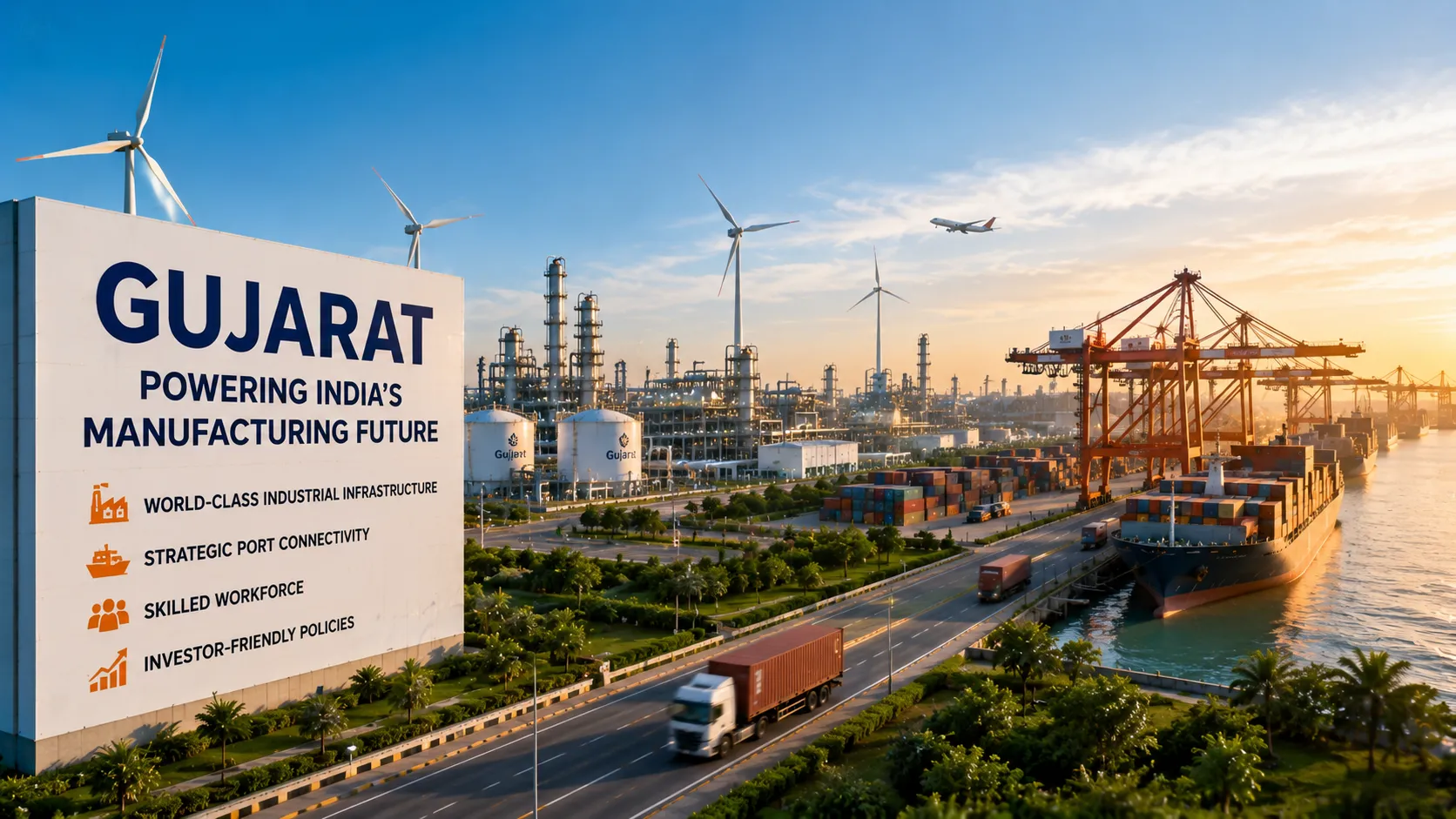
For decades, Gujarat occupied a distinctive position within India’s industrial landscape. The state frequently appeared at the center of conversations involving ports, petrochemicals, heavy industry and large-scale manufacturing infrastructure. Its economic identity evolved through a combination of industrial policy, logistics connectivity and business ecosystems that gradually positioned Gujarat among India’s most significant manufacturing regions. Large industrial corridors, export-oriented infrastructure and strong private-sector participation increasingly transformed the state into one of the country’s major economic engines.
Over recent years, however, another shift appears to be unfolding beneath that long-standing industrial story. Gujarat increasingly seems to be entering a phase where investment activity is no longer driven solely by domestic industrial expansion. Instead, larger global developments involving supply-chain diversification, manufacturing relocation and changing geopolitical trade dynamics increasingly appear influencing how international capital views the state. Across multiple sectors, global companies and institutional investors increasingly seem to be evaluating Gujarat not simply as a manufacturing destination within India but as part of broader efforts to redesign global production networks.
Recent investment announcements and policy discussions increasingly reflect the scale of this transition. Gujarat attracted substantial commitments through large investment summits and industrial agreements involving sectors such as semiconductors, renewable energy, chemicals, electronics and advanced manufacturing. The Vibrant Gujarat Global Summit 2024 alone saw investment proposals worth trillions of rupees across multiple sectors, highlighting the extent to which the state increasingly occupies attention within broader industrial conversations. While not all investment commitments ultimately translate into completed projects, the broader direction increasingly suggests strong investor confidence surrounding Gujarat’s long-term positioning.
Viewed independently, these developments may initially appear like ordinary industrial announcements. Viewed through a broader funding and market lens, however, they increasingly suggest a larger story involving how global manufacturing systems themselves may be changing.
Global Supply Chains Increasingly Appear To Be Entering A Reconfiguration Phase
Part of the significance surrounding Gujarat’s recent momentum involves developments taking place well beyond India itself. Over the last several years, businesses globally increasingly reassessed supply-chain structures that previously depended heavily on concentrated manufacturing ecosystems. Pandemic disruptions, geopolitical uncertainty and broader logistical challenges frequently exposed vulnerabilities surrounding highly centralized production systems.
As a result, global companies increasingly began exploring diversification strategies designed around creating more resilient and geographically distributed supply environments. Terms such as “China Plus One” gradually entered broader business discussions as companies explored opportunities extending beyond traditional manufacturing locations.
India increasingly appears to have emerged as one of the major beneficiaries of these shifts.
Within India, Gujarat frequently occupies an advantageous position because manufacturing ecosystems increasingly depend on more than labor costs or industrial incentives alone. Port connectivity, transportation systems, land availability and existing industrial networks frequently influence long-term investment decisions.
The state’s extensive coastline, major ports and established industrial infrastructure increasingly appear aligned with broader requirements involving export-oriented manufacturing ecosystems. Investors increasingly seem interested not simply in isolated facilities but in environments capable of supporting larger industrial systems over extended periods.
Funding Activity Increasingly Suggests Confidence Around Long-Term Manufacturing Growth
Another important dimension surrounding Gujarat’s expansion story increasingly involves capital flows themselves.
Recent years witnessed substantial investment activity across sectors involving semiconductors, electronics, renewable energy systems and broader manufacturing infrastructure. Large domestic conglomerates, multinational companies and institutional investors increasingly continued announcing commitments involving industrial projects across the state.

Importantly, the scale surrounding several announcements increasingly extends beyond conventional manufacturing environments. Semiconductor initiatives, green-energy ecosystems and advanced industrial facilities frequently involve billions of dollars in long-term capital commitments. These projects often require extensive infrastructure support and operate through timelines extending across many years.
This increasingly matters because long-term capital frequently reflects long-term assumptions.
Large industrial investments rarely emerge solely around short-term opportunities. Investors frequently commit substantial resources only when broader ecosystems appear capable of supporting future growth.
Recent developments increasingly suggest that investors appear viewing Gujarat not simply through current demand patterns but also through assumptions surrounding future manufacturing environments and long-term industrial competitiveness.
Manufacturing Increasingly Appears Connected To Ecosystems Rather Than Individual Facilities
Historically, manufacturing expansion frequently centered around factories themselves. Discussions often focused on plant announcements, production capacity and infrastructure additions. Increasingly, however, broader investment thinking appears evolving toward ecosystem development.
Large manufacturing projects today frequently depend on interconnected environments involving suppliers, logistics networks, workforce ecosystems and supporting infrastructure operating simultaneously. Companies increasingly appear evaluating whether regions can support entire value chains rather than isolated industrial activity.
Gujarat increasingly seems positioned around this broader framework.
Industrial corridors, transportation networks and sector-specific ecosystems increasingly create environments where related industries operate in close proximity. Semiconductor projects require supply environments. Renewable-energy systems frequently depend on manufacturing ecosystems. Logistics infrastructure influences broader competitiveness.
The broader movement increasingly suggests manufacturing growth itself increasingly depends on networks rather than standalone investments.
The Larger Story Increasingly Extends Beyond One State Alone
The broader significance surrounding Gujarat’s recent investment momentum may ultimately involve what it reveals regarding India’s larger economic transition itself.
Historically, manufacturing conversations frequently focused heavily on production capability and industrial expansion. Increasingly, however, future manufacturing ecosystems appear influenced by broader global developments involving resilience, supply-chain diversification and long-term strategic positioning.
Viewed through that broader lens, Gujarat’s investment story increasingly resembles more than regional industrial growth. It increasingly appears connected to changing assumptions surrounding where future production ecosystems may emerge and how countries increasingly compete for long-term manufacturing capital.
The larger funding story therefore may not simply involve factories, industrial corridors or investment announcements. Increasingly, it may involve understanding how global supply-chain restructuring itself is beginning to redirect capital toward regions capable of supporting future manufacturing ecosystems at scale.