GIFT Nifty futures, the most closely watched overnight barometer for how India's benchmark Nifty 50 index is likely to open, were trading meaningfully lower ahead of the July 22, 2026 session, down over 1 per cent from the previous Nifty 50 close at last check. The weak signal points to another cautious, and potentially outright negative, start for Indian equity markets, extending a run of volatile sessions that has characterised Dalal Street through much of the past two weeks as investors grapple with a rapidly evolving mix of global and domestic risk factors.
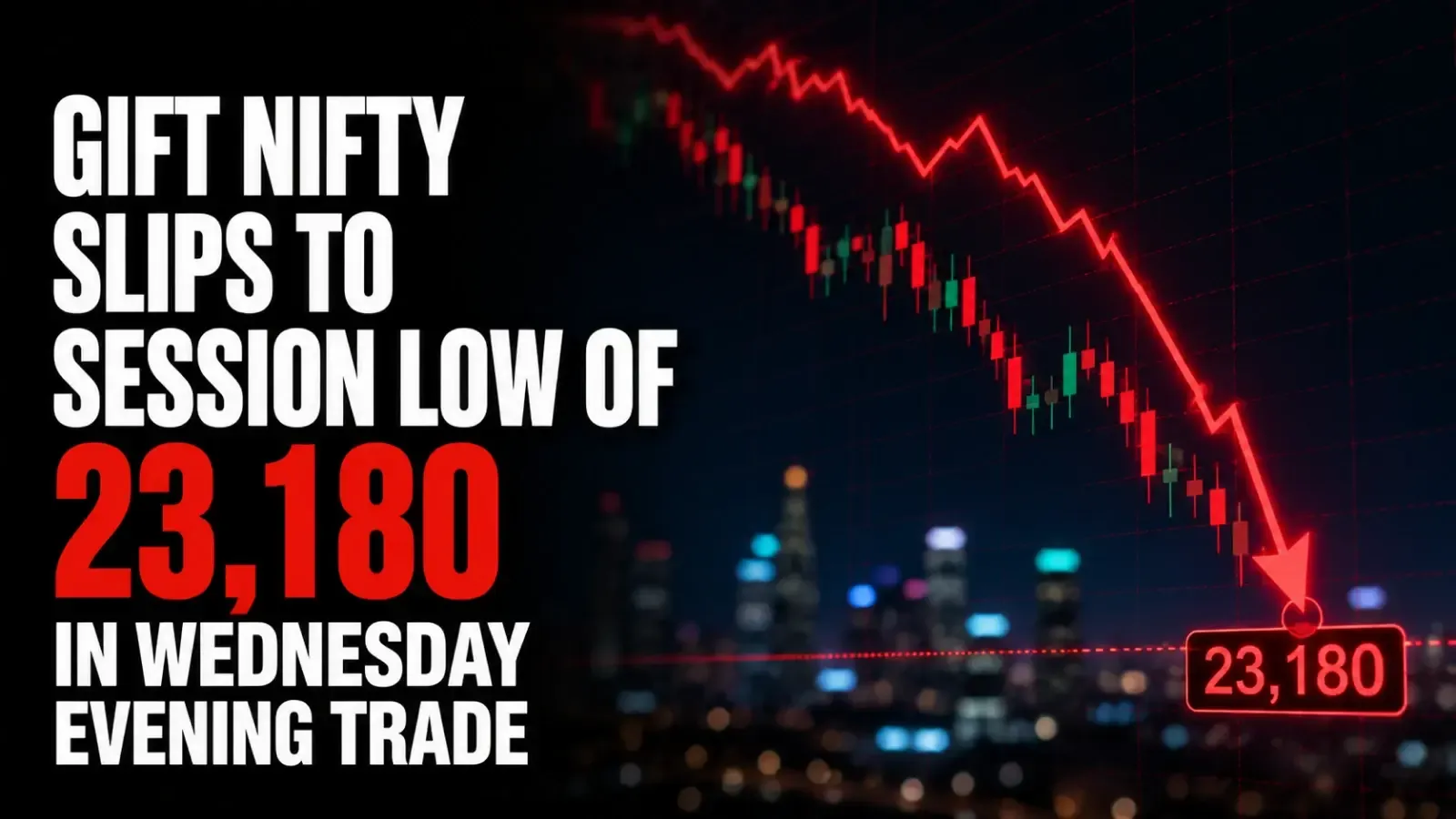
At last available reading, GIFT Nifty was quoted around the 24,125 level, down roughly 270 points, or 1.11 per cent, reflecting the broader wave of risk-off sentiment that has gripped global markets following fresh escalation in the US-Iran conflict and a sharp accompanying rise in crude oil prices. For traders and portfolio managers alike, the GIFT Nifty print has, in recent years, become an indispensable early read on market direction, often shaping trading strategy well before the Indian cash market itself opens for the day.
The scale of the overnight move — well over a full percentage point — places it among the more significant single-session GIFT Nifty declines recorded so far this year, according to traders who track the contract's day-to-day movements closely, underscoring just how sharply global sentiment shifted in the hours following the latest round of US strikes on Iranian targets.
What Exactly Is GIFT Nifty, And Why Does It Matter
GIFT Nifty, traded on the NSE International Exchange located in Gujarat's GIFT City, is a derivative contract that tracks the Nifty 50 index and trades across an extended window that includes hours when India's primary cash equity markets, the NSE and BSE, remain closed. This extended trading window allows GIFT Nifty to absorb and reflect overnight developments in global markets — moves in US equity indices, shifts in crude oil prices, and breaking geopolitical news — well before Indian domestic markets open each trading day.
Because of this structural advantage, GIFT Nifty has, since its consolidation from the earlier SGX Nifty contract, become the single most widely referenced pre-market indicator for Indian equities, closely tracked by both institutional trading desks and increasingly sophisticated retail investors seeking an early read on how the day's trading session is likely to unfold. A GIFT Nifty print showing a gap of the magnitude seen ahead of the July 22 session — over 1 per cent below the previous Nifty close — is generally regarded by traders as a strong, though not infallible, signal of a genuinely weak opening for the domestic market.
Trading volumes on GIFT Nifty have grown substantially since the contract's consolidation onto Indian soil, reflecting both the broader internationalisation of India's derivatives market infrastructure and the contract's increasingly central role in how global participants, including foreign institutional investors managing India exposure from outside the country, position themselves ahead of the domestic market open.
The Overnight Drivers Behind The Weakness
The primary driver behind the weak GIFT Nifty signal is, unsurprisingly, the same set of global factors that have dominated market attention over the past several sessions: a fresh escalation in the US-Iran conflict, marked by additional US airstrikes on Iranian targets, and the accompanying surge in global crude oil benchmarks, with Brent crude trading above $90 a barrel for the first time in weeks. This combination has driven a broad-based risk-off shift across global markets, with Asian equity indices broadly following US and European markets lower in overnight and early trading, and currency markets showing renewed strength in the US dollar as capital rotates toward traditional safe-haven assets.
For India specifically, the combination of higher crude prices and a stronger dollar represents a particularly unwelcome one-two punch, given the country's heavy reliance on imported oil and the direct pressure higher oil prices place on both the rupee and the broader inflation outlook. Traders tracking the overnight session noted that the GIFT Nifty weakness was broadly consistent with, rather than an outlier relative to, the wider Asia-Pacific market reaction to the latest round of Gulf-related headlines.
Overnight US market action has also fed directly into the GIFT Nifty signal, with several major US indices having posted mixed to negative sessions amid the fresh conflict headlines, even as pockets of resilience emerged in specific sectors such as technology and energy. This transmission mechanism — overnight US market moves feeding through GIFT Nifty into the Indian opening — has, over recent years, become an increasingly well-understood and closely monitored feature of how global market sentiment propagates into Indian trading each day, particularly during periods of elevated cross-border correlation of the kind currently being driven by the shared oil-and-geopolitics narrative affecting markets worldwide.
The History Of GIFT Nifty As A Predictive Tool
GIFT Nifty's predecessor contract, SGX Nifty, traded out of Singapore for many years before Indian regulators and exchanges worked to consolidate this offshore trading activity onto Indian soil through the GIFT City International Financial Services Centre, a transition completed in 2023. Since that consolidation, GIFT Nifty has developed a robust track record as a predictive indicator, with historical analysis suggesting that the direction, if not always the precise magnitude, of GIFT Nifty's overnight move correctly anticipates the direction of the Nifty 50's opening move in the substantial majority of trading sessions.
That said, market technicians caution against treating GIFT Nifty as a perfectly reliable predictor, noting that the relationship between the overnight futures signal and the actual cash market opening can be influenced by domestic-specific factors that emerge only after Indian markets open — corporate news flow, block deals, or domestic institutional flows — that are simply not reflected in the overnight GIFT Nifty pricing. This nuance is particularly relevant during periods of active, fast-moving news flow, such as the current stretch dominated by the evolving US-Iran conflict, when the gap between the overnight GIFT Nifty print and the actual cash market open can occasionally widen or narrow meaningfully based on developments that unfold in the hours between the two.
What Traders Are Watching At The Open
With the domestic cash market bracing for a weak start, traders and analysts have identified several specific factors likely to shape the actual course of trading once the session gets under way. Foremost among these is whether the initial gap-down open triggers a further wave of selling as stop-losses are hit, or whether it instead presents a buying opportunity that value-oriented investors and domestic institutions move to capitalise on, a pattern that has played out on several occasions during this month's volatile trading.
Sector-specific positioning will also be closely watched, with banking stocks — already under pressure through much of the past week on a combination of rising credit costs and broader risk aversion — likely to remain in sharp focus, alongside crude-sensitive sectors such as aviation, paints and tyres that stand to see the most direct negative impact from sustained elevated oil prices. Conversely, upstream energy producers and select defence-adjacent names may continue to see relative outperformance even within an otherwise weak broader market, continuing a pattern that has been visible through much of the recent bout of volatility.
How This Fits Into The Broader Technical Picture
Market technicians tracking the Nifty and Sensex have, over recent sessions, identified a relatively well-defined sideways trading range for both indices, with the Sensex seen holding between roughly 77,100 and 77,900, and the Nifty exhibiting a broadly similar consolidative pattern. A weak GIFT Nifty-signalled open of the magnitude seen ahead of July 22 raises the immediate question of whether the session will see the Nifty test or break below the lower end of this recent range, a development that chartists say would open the door to a deeper near-term correction, or whether buying interest at lower levels — a pattern seen repeatedly through this volatile stretch — will once again emerge to cushion the decline.
Options market positioning, closely tracked by derivatives traders as a gauge of broader market sentiment, has also shown signs of increased hedging activity in recent sessions, with elevated volumes in downside put options suggesting that a meaningful segment of the market has been actively preparing for further near-term weakness even before the latest GIFT Nifty signal emerged.
Volatility indices tracking the Nifty's expected near-term price swings have also climbed meaningfully over the past several sessions, a pattern consistent with the broader increase in hedging activity and one that traders typically interpret as a signal of elevated near-term uncertainty rather than a directional forecast in itself. Elevated volatility of this kind tends to widen the range of plausible outcomes for any given trading session, making the kind of sharp, whipsaw price action seen on several days this month more likely to recur until the underlying sources of uncertainty — chiefly the Gulf conflict and shifting global rate expectations — show clearer signs of resolution.
How Institutional Desks Position Ahead Of A Weak Open
Institutional trading desks, which typically begin positioning well before the Indian cash market formally opens, have reportedly used the overnight GIFT Nifty signal to calibrate their opening order flow, with several desks said to be favouring a cautious, wait-and-watch approach in the first thirty minutes of trading rather than committing to large directional positions immediately at the open — a common risk-management response to pre-market signals of this magnitude, particularly when the underlying drivers are themselves still actively evolving, as is the case with the ongoing US-Iran conflict.
Domestic mutual funds and insurance companies, which collectively command substantial daily trading volumes on the NSE and BSE, are also understood to be watching the opening minutes closely for signs of whether retail and foreign institutional selling intensifies or moderates, information that will likely shape the scale and timing of any counter-cyclical buying these domestic institutions choose to deploy over the course of the session.
The Global Context Behind The Signal
India's market weakness at the open is unfolding against a broader backdrop of genuinely elevated global uncertainty, extending well beyond the specific US-Iran conflict driving the immediate crude price spike. Expectations around US Federal Reserve policy have also shifted in a way that adds to the cautious mood, with the probability of a September rate hike climbing meaningfully in recent days on the back of hawkish commentary from Fed officials concerned about oil-driven inflation risk — a dynamic that tends to strengthen the dollar globally and pressure emerging-market currencies and equities alike.
Taken together, this combination of an active regional military conflict, a sharp commodity price shock, and shifting global monetary policy expectations represents an unusually dense cluster of simultaneous risk factors, which analysts say helps explain why GIFT Nifty's signal ahead of the July 22 session has been so decisively negative relative to the comparatively more modest daily moves seen through earlier, calmer stretches of this month's trading.
Cross-asset correlations have also tightened noticeably through this period, with moves in crude oil, the dollar index, global equity benchmarks and GIFT Nifty all showing an unusually high degree of day-to-day co-movement — a pattern that quantitative strategists say typically emerges during periods when a single dominant macro narrative, in this case the Gulf conflict, comes to overshadow the more idiosyncratic, company- and country-specific factors that usually drive a greater share of daily market variation.

What Investors Should Watch For
For retail investors monitoring the situation, market veterans generally advise treating a single pre-market signal, however sharp, as a starting point for the trading session rather than a definitive predictor of how the full day will ultimately unfold — GIFT Nifty indications have, on numerous occasions historically, been partially or fully reversed by the time the Indian cash market closes, particularly when domestic institutional buying emerges to counter an initial bout of opening weakness.
Even so, with the underlying drivers behind the current weak signal — an active and escalating geopolitical conflict, a sharp crude oil price spike, and shifting global rate expectations — all likely to remain relevant well beyond a single trading session, market participants broadly expect continued volatility in the sessions ahead, with GIFT Nifty likely to remain an unusually closely watched indicator for Indian traders navigating this stretch of heightened global uncertainty.
Financial advisors have, through this period of elevated volatility, generally counselled retail investors against making significant portfolio decisions based purely on a single day's pre-market signal, instead encouraging a focus on longer-term asset allocation strategy and company-specific fundamentals — advice that market history suggests has, more often than not, served long-term Indian equity investors well through past periods of geopolitically driven short-term volatility.