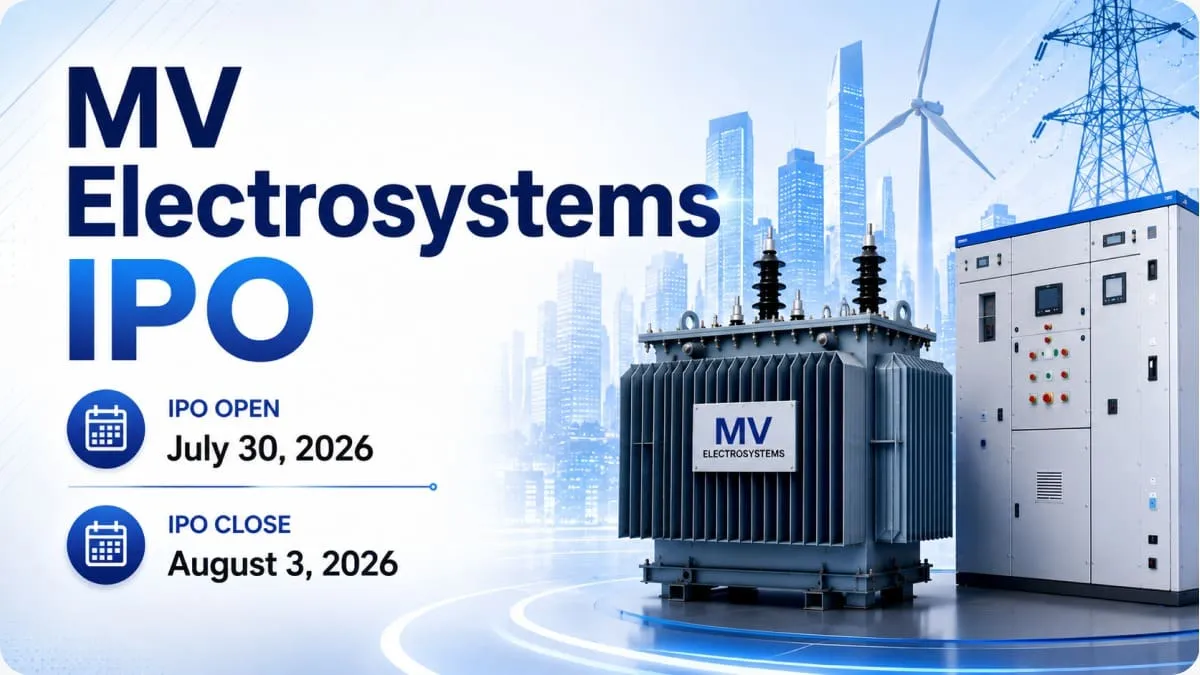
In a nondescript industrial cluster in Faridabad, Haryana, a company most retail investors had never heard of a fortnight ago has just pulled off one of the more dramatically oversubscribed IPOs of India's 2026 primary market season. MV Electrosystems Limited, a specialist manufacturer of railway propulsion electronics and switchgear equipment, closed its ₹290 crore initial public offering on August 3, 2026, with subscription levels that, by the final day of bidding, had crossed the 100-times mark — a level of demand that places it firmly among the standout listings of the year.
The numbers behind that demand are worth sitting with for a moment. According to Business Standard's tracking of the issue in its final hours, the offer was booked more than 101 times overall, with the retail investor category alone oversubscribed by close to 37 times its designated quota — a scale of retail enthusiasm that is relatively unusual for a company operating in a specialised, business-to-business industrial niche rather than a consumer-facing sector more typically associated with viral retail investor interest.
The mechanics of the offer itself were relatively modest in scale even as demand for it proved anything but. The IPO comprised a total issue size of 68,23,529 shares, structured entirely as a fresh issue rather than an offer for sale by existing shareholders — meaning the entirety of the proceeds will flow directly into the company's own balance sheet rather than to selling shareholders cashing out. Of that total allocation, 75%, or 51,17,647 shares, was reserved for Qualified Institutional Buyers, 15%, or 10,23,529 shares, for Non-Institutional Investors, and the remaining 10%, or 6,82,353 shares, for Retail Individual Investors — a fairly standard mainboard allocation structure, but one that nonetheless generated outsized interest across every single category.
The price band for the offer was fixed at ₹400 to ₹425 per share, with a lot size of 34 shares per application, translating into a minimum retail investment of approximately ₹14,450 at the upper end of the band. Ahead of the public offer opening, MV Electrosystems raised ₹130.50 crore from anchor investors, with the anchor bidding process concluding on July 29, 2026 — a strong early signal of institutional appetite that likely helped set the tone for the frenzied retail and non-institutional demand that followed once the issue opened for public subscription on July 30.
Grey market activity around the issue told its own story of steadily building — if somewhat volatile — investor conviction in the weeks leading up to listing. According to tracking by InvestorGain, the stock's grey market premium started the subscription window at relatively modest levels before climbing to as high as ₹135 by July 31, 2026, representing an unofficial premium of roughly 31.76% over the upper price band at that point — the highest level recorded during the entire pre-listing period. The lowest GMP recorded during the tracked period was just ₹60, back on July 25, 2026, illustrating just how much the premium fluctuated as bidding progressed and as broader market sentiment around new listings shifted day to day.
By the time the issue closed on August 3, GMP had settled into a somewhat lower but still healthy range. Multiple trackers reported figures clustering around the ₹90 to ₹115 mark on the final trading day before allotment, implying an expected listing premium in the range of 21% to 27% over the ₹425 upper price band. Business Standard's own tracking on the final day pegged the GMP at ₹112, implying shares trading around ₹537 in the grey market — a 26% premium over the offer price — while data platform IPOGyani recorded a GMP of ₹115 with the issue subscribed 76.11 times as of its own final snapshot, alongside an AI-driven model prediction of a 26.8% listing gain. It's worth stressing, as every one of these platforms is careful to note, that grey market premium figures are informal, unofficial and not published or endorsed by any stock exchange — useful as a barometer of sentiment, but not a guarantee of actual listing-day performance.
What, precisely, does MV Electrosystems make — and why has it captured this degree of investor imagination? Incorporated in 2009, the company is engaged in the design, development, assembly and manufacturing of electrical and power electronics equipment specifically used in railway rolling stock. Its core product portfolio includes IGBT-based 3-Phase Drive Propulsion equipment for electric locomotives — the sophisticated power electronics that convert and control electrical energy to drive a locomotive's traction motors — alongside switchgear panels for railway coaches and electric multiple units (EMUs), cable protection and management products, and a broader range of electrical components, systems and sub-systems used across India's rail network.
That product focus places MV Electrosystems squarely at the intersection of two powerful, long-running policy tailwinds that have reshaped India's railway sector over the past decade. The first is the government's sustained push toward mandated broad-gauge electrification across the Indian Railways network, a multi-year infrastructure programme that has steadily converted diesel-hauled routes to electric traction and, in doing so, created sustained structural demand for precisely the kind of propulsion electronics and switchgear equipment that MV Electrosystems specialises in manufacturing. The second is the broader Make-in-India procurement push within the railway sector specifically, which has increasingly favoured domestic manufacturers of rolling stock components over imported alternatives — a policy tailwind that companies with established domestic manufacturing capability, like MV Electrosystems, are particularly well positioned to capture.
Beyond electrification and localisation, the company's prospectus also points to the expansion of India's rail network more broadly, including the country's emerging portfolio of high-speed rail corridors, as a further source of medium-term demand growth — a signal that MV Electrosystems' addressable market is not simply a function of maintaining or upgrading the existing network, but of an actively expanding one, with new high-speed lines requiring their own dedicated propulsion, switchgear and cable-protection infrastructure built to more demanding specifications than legacy routes.
The company's financial profile ahead of listing, however, tells a more complicated story than the blockbuster subscription numbers alone might suggest. According to valuation data compiled by IPO tracking platform IPOJi, the company's return on net worth stood at a negative 20.29%, and its price-to-book ratio at listing valuation works out to a relatively rich 13.90 times — metrics that, taken together, suggest a company whose recent financial performance has been under some pressure even as investors bet heavily on its forward growth trajectory tied to the broader rail electrification theme. IPOJi's own coverage separately noted that the company's financial performance has remained largely flat in the periods leading up to the offer, a caveat worth weighing against the sheer scale of subscription enthusiasm the issue has generated.
That tension — between a structurally compelling sector narrative and a financial profile that has not, at least recently, shown the kind of explosive growth the subscription numbers might imply — is a familiar pattern in India's current IPO cycle, where sector themes tied to defence, railways, renewable energy and domestic manufacturing have repeatedly attracted outsized retail and institutional demand almost independent of the specific financial metrics of any individual issuer. Whether MV Electrosystems' listing-day performance validates that enthusiasm, or whether the gap between grey market pricing and underlying fundamentals proves to be a source of post-listing volatility, will become clearer once trading actually begins.
The formal mechanics of the listing are now well underway. With the subscription window having closed on August 3, share allotment is expected to be finalised on August 4, 2026 — the same day investors and market-watchers across India are also tracking a busy Q1 FY27 corporate earnings calendar and the ongoing RBI Monetary Policy Committee deliberations, making it a particularly information-dense Tuesday for anyone tracking Indian capital markets closely. Shares are tentatively scheduled to debut on both the BSE and NSE on August 6, 2026, giving anchor investors, QIB allottees and the retail investors who chased this issue nearly 40 times over their allocated quota a first opportunity to see whether the grey market's roughly 26% premium translates into a genuine listing-day pop.
Sundae Capital Advisors served as the book-running lead manager for the offer, with KFin Technologies acting as registrar — both relatively established names in India's mid-market IPO ecosystem, which has seen a steady stream of smaller, sector-specific manufacturing and infrastructure-linked issues come to market over the past year as investor appetite for India's broader industrial and infrastructure buildout has remained robust even amid periodic volatility in the broader secondary market.
For a company that, as recently as a month ago, was largely unknown outside specialist railway supply-chain circles, MV Electrosystems' IPO now stands as a useful data point in a much larger story: the extent to which India's public markets have become an increasingly willing funding source for the unglamorous, highly technical manufacturing businesses that sit quietly behind the country's much more visible infrastructure headlines — the electrified tracks, the new high-speed corridors, and the steadily expanding footprint of trains that, thanks in small part to companies like this one, increasingly run on power generated and controlled by equipment engineered and assembled inside India.
MV Electrosystems' listing also arrives amid a broader wave of railway and defence-adjacent manufacturing IPOs that have tested Indian capital markets over the past eighteen months, several of which have similarly generated outsized retail subscription relative to their issue size, reflecting a durable investor thesis around India's multi-year capital expenditure cycle in rail, defence and broader infrastructure. That thesis has been reinforced by successive government budgets that have continued to prioritise capital spending on railway modernisation, alongside explicit local-content and domestic-manufacturing requirements embedded in railway procurement contracts — policy commitments that give companies like MV Electrosystems a degree of revenue visibility that pure-play consumer or technology companies, more exposed to discretionary spending cycles, typically cannot offer.
That said, seasoned IPO market participants routinely caution against conflating grey market enthusiasm with long-term investment merit, particularly for smaller-capitalisation manufacturing businesses whose order books and margins can be considerably more volatile quarter to quarter than their larger, more diversified peers in the railway supply chain. The negative return on net worth figure disclosed ahead of listing is a reminder that MV Electrosystems, whatever its sector positioning, will need to demonstrate a credible path to sustained profitability once it becomes a publicly listed and considerably more closely scrutinised company, with quarterly disclosure obligations that will expose its financial performance to a level of ongoing public analysis it has not previously faced as a privately held manufacturer.
For retail investors who chased this issue to nearly 37 times their allocated quota, the coming days will offer the first real test of whether that enthusiasm was well-placed. A strong listing-day debut, in line with or exceeding the grey market's implied 26% premium, would likely be read as validation of the broader rail-electrification investment thesis and could pave the way for further IPOs from similarly specialised component manufacturers looking to tap public markets. A weaker debut, on the other hand, would serve as a reminder that even the most compelling sectoral narrative cannot indefinitely outrun a company's own underlying financial fundamentals — a lesson India's IPO market has relearned, in one form or another, with almost every new listing cycle.
Sundae Capital Advisors served as the book-running lead manager for the offer, with KFin Technologies acting as registrar — both relatively established names in India's mid-market IPO ecosystem, which has seen a steady stream of smaller, sector-specific manufacturing and infrastructure-linked issues come to market over the past year as investor appetite for India's broader industrial and infrastructure buildout has remained robust even amid periodic volatility in the broader secondary market.
Investors who missed the subscription window will now be watching allotment outcomes closely, given how heavily oversubscribed the retail category was; with demand running at nearly 37 times the allocated quota, the vast majority of retail applicants are likely to receive no allotment at all, or at best a single lot through the proportionate allotment process mandated for oversubscribed mainboard issues — a reminder that grey market enthusiasm, however strong, does not translate into guaranteed access to shares for every investor who applies.
This report is based on MV Electrosystems' IPO prospectus and subscription data, and coverage from Business Standard, Chittorgarh.com, IPOJi, IPOGyani and India TV News.