The $28.5 Million Bet on Indian Precision
On June 11, 2026, Bengaluru-based deep-tech startup Ethereal Machines announced that it had raised $28.5 million in a Series B funding round led by Avataar Ventures, with participation from existing investor Peak XV Partners and others . The round brings the company's total funding to nearly $50 million, following a $13 million Series A in June 2024 and $7.3 million in seed funding from Peak XV's Surge programme .
But the numbers tell only part of the story. Beneath the headline lies a more interesting narrative: a company that spent five years building world-class precision machinery, couldn't sell it because no one trusted Indian manufacturing, pivoted to a service model, and is now on the verge of cracking one of the most difficult technologies in industrial manufacturing—the CNC controller.
The fresh capital will be deployed across five strategic priorities: constructing a 300,000-square-foot mega-factory near Bengaluru, developing India's first proprietary multi-axis CNC controller, expanding its AI-powered factory software platform Vesper, strengthening its presence in semiconductor manufacturing, and establishing dedicated teams in the United States and Europe .
The Indigenous CNC Controller: Cracking the Brain of the Machine
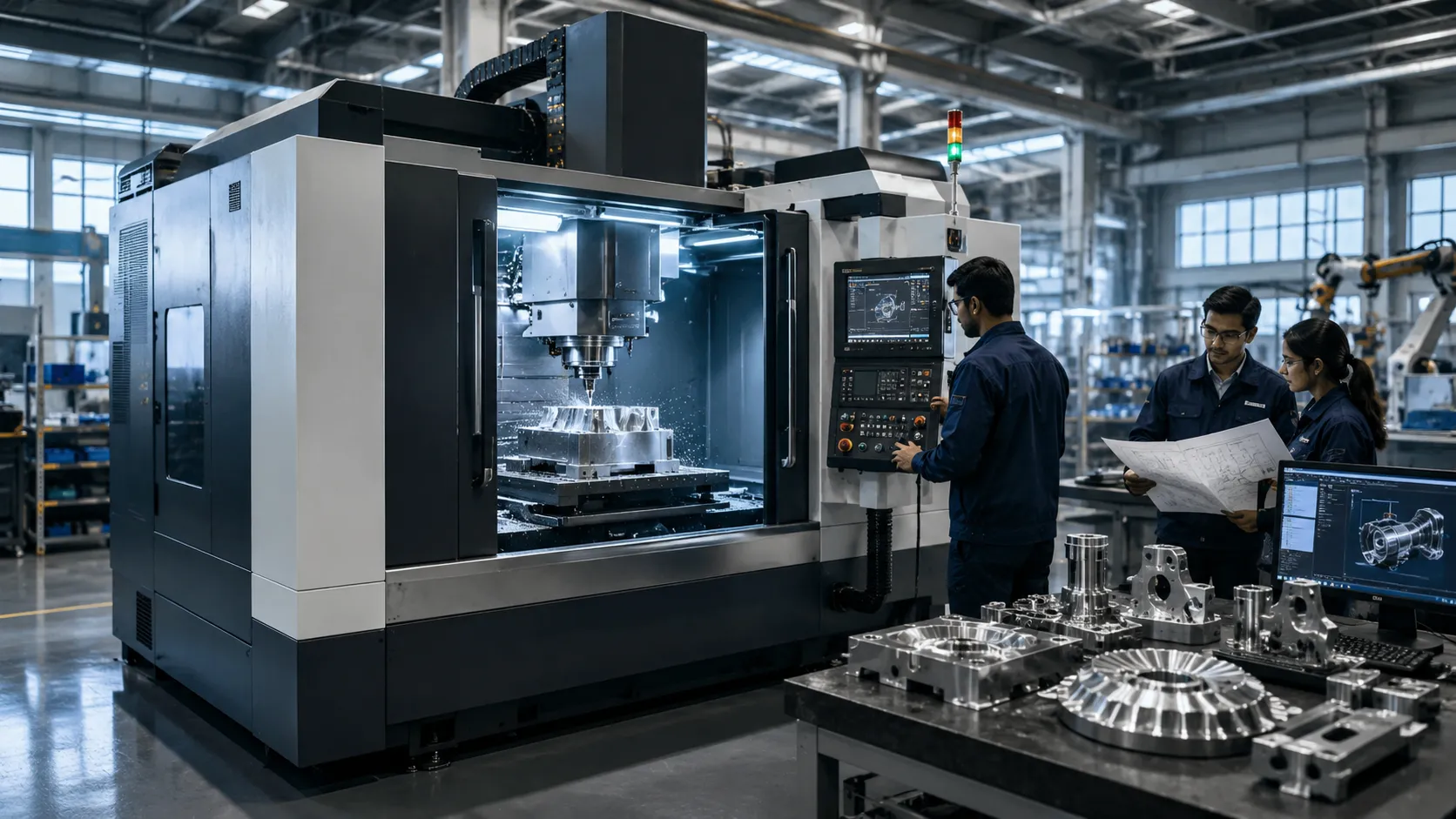
At the heart of Ethereal's ambition lies a piece of technology that very few companies in the world have mastered: the multi-axis CNC controller. The controller acts as the "brain and nervous system" of a computer numerical control machine, governing every movement, every cut, every micron of precision . Globally, the controller market is concentrated among a handful of suppliers—Fanuc from Japan, Siemens from Germany, and Heidenhain from Germany—companies that have spent decades building and protecting their intellectual property .
Ethereal has been working on its proprietary controller for more than five years. According to co-founder and CEO Kaushik Mudda, the company is now in the final stretch, with cutting trials already underway and two machines already running on its proprietary controller . If successful, Ethereal will become the first Indian company to have cracked multi-axis CNC control—a capability that has significant implications for national security, defence manufacturing, and semiconductor production.
Why does this matter? CNC controllers are not just technical components. They are sovereign technologies. A country that cannot control the brains of its own precision manufacturing equipment remains dependent on foreign suppliers for everything from fighter jet components to medical implants to chip-making infrastructure. In an era of supply chain fragmentation and geopolitical tension, that dependence becomes a strategic vulnerability. Ethereal is attempting to eliminate it.
The Pivot: Why No One Would Buy Their Machines
Ethereal's path to this moment was anything but linear. The company was founded in 2014 by Kaushik Mudda and Navin Jain, two engineers who believed that India could build world-class precision manufacturing equipment . After five years of development, they had a sophisticated five-axis machine ready—the Nimbus, capable of sub-10-micron accuracy at production scale, matching the precision of elite German and Japanese competitors at roughly half the price .
But when they tried to sell it, they hit an unexpected wall: a profound lack of faith in Indian manufacturing prowess. As Mudda recounted, potential customers would see the machine working perfectly and still refuse to believe that an Indian company had built it. "They'd see the machine working perfectly and still say, 'I don't know, it wouldn't work,'" Mudda said .
The skepticism was not limited to customers. After Blume Ventures wrote its first cheque in 2019, Ethereal did not land any other institutional funding until 2023 . The venture capital community, like the manufacturing community, struggled to believe that a deep-tech hardware company from India could compete with German and Japanese incumbents.
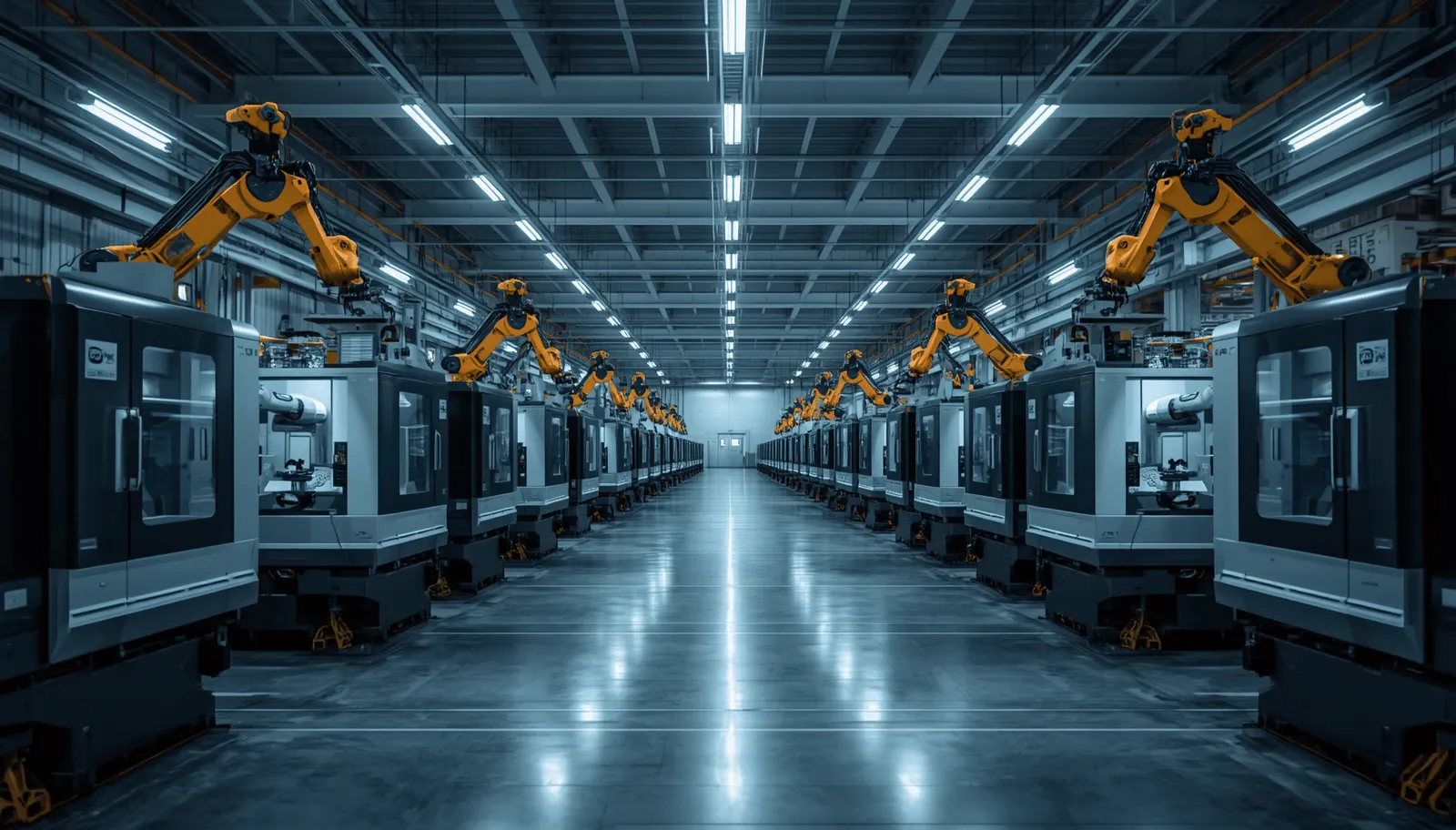
The solution was a radical pivot. In mid-2022, Ethereal stopped trying to sell its machines. Instead, it would use its own machines to manufacture precision components for customers—a model the company calls Machining-as-a-Service or MaaS . The approach allowed customers to start with smaller orders, testing quality and delivery without making a large upfront investment. It transformed an abstract claim about precision into an objective, verifiable outcome.
The pivot worked. Since its Series A round in June 2024, Ethereal has tripled its MaaS revenue year-over-year and scaled production capacity tenfold . The company now operates what it describes as India's first fully automated smart manufacturing facility in Bengaluru's Peenya industrial area, running 24x7 across three shifts .
The Mega-Factory: Six Times Larger, 2,000 Jobs
The next phase of Ethereal's growth will be physical. The company has signed a memorandum of understanding with the Government of Karnataka to establish a 300,000-square-foot mega-factory on the outskirts of Bengaluru—six times larger than its current facility . The land has already been procured, and construction is set to begin by the end of 2026 .
The location is strategic. The new facility will be situated in Doddaballapur, near Foxconn's emerging industrial belt . This proximity is not accidental. Ethereal is positioning itself as a key supplier to India's growing electronics and semiconductor manufacturing ecosystem, providing the high-precision components that chip-making infrastructure requires.
The company currently operates more than 60 machines. The longer-term target is to scale to 250-300 units over the next 18-24 months, with the mega-factory built in three phases . The facility is expected to create more than 2,000 jobs and become one of the largest advanced manufacturing facilities outside China, according to the company .
The Market Opportunity: Capturing the China+1 Moment
Ethereal's ambition is not merely to build a successful company. It is to capture a share of a much larger market. India currently consumes roughly $2.2 billion worth of CNC machines annually, of which about $1.2 billion is imported, predominantly the higher-end four-axis and five-axis machines . Domestic manufacturers have largely stuck to two-axis and three-axis machines, ceding the more sophisticated end of the market to foreign suppliers.
The global precision manufacturing market is currently estimated at $220 billion and is projected to reach $400 billion by 2030 . The "China+1" supply chain diversification trend—accelerated by geopolitical tensions and the pandemic—has created a once-in-a-generation opportunity for countries like India to capture manufacturing capacity that would otherwise have remained in China.
Mudda articulated this opportunity directly: "The world is actively looking for resilient alternatives in global manufacturing, and India has a once-in-a-generation opportunity to emerge as a serious deep-tech manufacturing powerhouse" . Ethereal's bet is that Indian precision manufacturing can compete not just on cost but on quality, reliability, and technological sophistication.
The early evidence is encouraging. Nearly 70 per cent of Ethereal's revenue now comes from exports, with clients across the United States, the United Kingdom, Europe, and early inroads into Southeast Asia and Japan . The company counts Collins Aerospace, Hindustan Aeronautics Limited, and Bharat Electronics Limited among its key clients .
The Semiconductor Connection
One of the most significant aspects of Ethereal's expansion is its focus on semiconductor manufacturing. The company has identified chip-making infrastructure as a major growth area, alongside aerospace, defence, healthcare, and consumer electronics .
This is not a niche play. Semiconductor manufacturing requires the highest levels of precision in industrial production. A single chip fab contains thousands of components that must be machined to tolerances measured in microns. Historically, this supply chain has been concentrated in Taiwan, South Korea, Japan, and the United States. India has been almost entirely absent.
Ethereal's entry into this space is part of a broader national effort to build domestic semiconductor capabilities. The Indian government has committed billions of dollars in incentives for chip manufacturing through its Semiconductor Mission, but a fab is only as good as its supply chain. Companies like Ethereal are building the precision manufacturing infrastructure that the semiconductor ecosystem requires.
The Technology Stack: Nimbus, Aura, and Vesper
Ethereal's product portfolio reflects its dual focus on hardware and software. The company's flagship Nimbus is a five-axis CNC machine capable of sub-10-micron accuracy at production scale—approximately one-tenth the width of a human hair . The company also manufactures Aura, a three-axis CNC machine for less complex applications .
But hardware alone is not enough. Ethereal has also developed Vesper, its proprietary AI-powered factory operating software that predicts manufacturing lead times, monitors factory performance, and optimises production workflows . The software layer allows Ethereal to run its smart factory with minimal human intervention, reducing costs and improving consistency.
The combination of proprietary hardware, indigenous software, and service-based delivery creates a moat that pure-play contract manufacturers cannot easily cross. As Mudda noted, "extraordinary technical barriers protect this value proposition" .
The Investor Backing
The quality of Ethereal's investor base reflects growing confidence in Indian deep-tech. The Series B round was led by Avataar Ventures, a venture capital firm focused on enterprise and deep-tech investments. Peak XV Partners, formerly Sequoia India, participated as an existing investor. The company's backers also include Blume Ventures and Intel CEO Lip-Bu Tan .
The presence of Lip-Bu Tan—a semiconductor industry veteran who led Cadence Design Systems and serves on Intel's board—is particularly significant. His investment suggests that Ethereal's technology has been vetted by someone who understands precision manufacturing at the highest level.
Peak XV's continued participation is also noteworthy. The firm backed Ethereal through its Surge programme, participated in the Series A, and has now followed on in the Series B. This is not a passive investment. It is a conviction that Indian deep-tech manufacturing can scale to global relevance.
Ethereal Machines is not trying to build the next e-commerce unicorn. It is trying to do something harder, slower, and potentially more valuable: build a precision manufacturing capability that can compete with Germany and Japan. The $28.5 million Series B is not just capital. It is validation that the pivot worked, that the technology is real, and that the market is ready.
The company still faces significant challenges. The indigenous CNC controller is not yet proven at scale. The mega-factory will take years to build and optimize. Global competitors will not cede market share without a fight. And the "China+1" opportunity, while real, is being pursued by multiple countries simultaneously.
But Ethereal has already accomplished something remarkable. It has proven that an Indian company can build world-class precision machinery, operate it at scale, and win customers in the most demanding industries on earth. That was not obvious five years ago. It is becoming obvious now.


