Global professional services firm Deloitte has released a fresh growth forecast for the Indian economy that broadly aligns with the Reserve Bank of India's own revised projection of 6.6 per cent GDP growth for financial year 2026-27, offering independent corroboration of the central bank's economic outlook at a moment when investors and policymakers alike have been closely scrutinising India's growth trajectory against a backdrop of an ongoing corporate earnings season, an unresolved trade negotiation with the United States, and a widening merchandise trade deficit that has raised fresh questions about the sustainability of the country's current growth-driven import intensity.
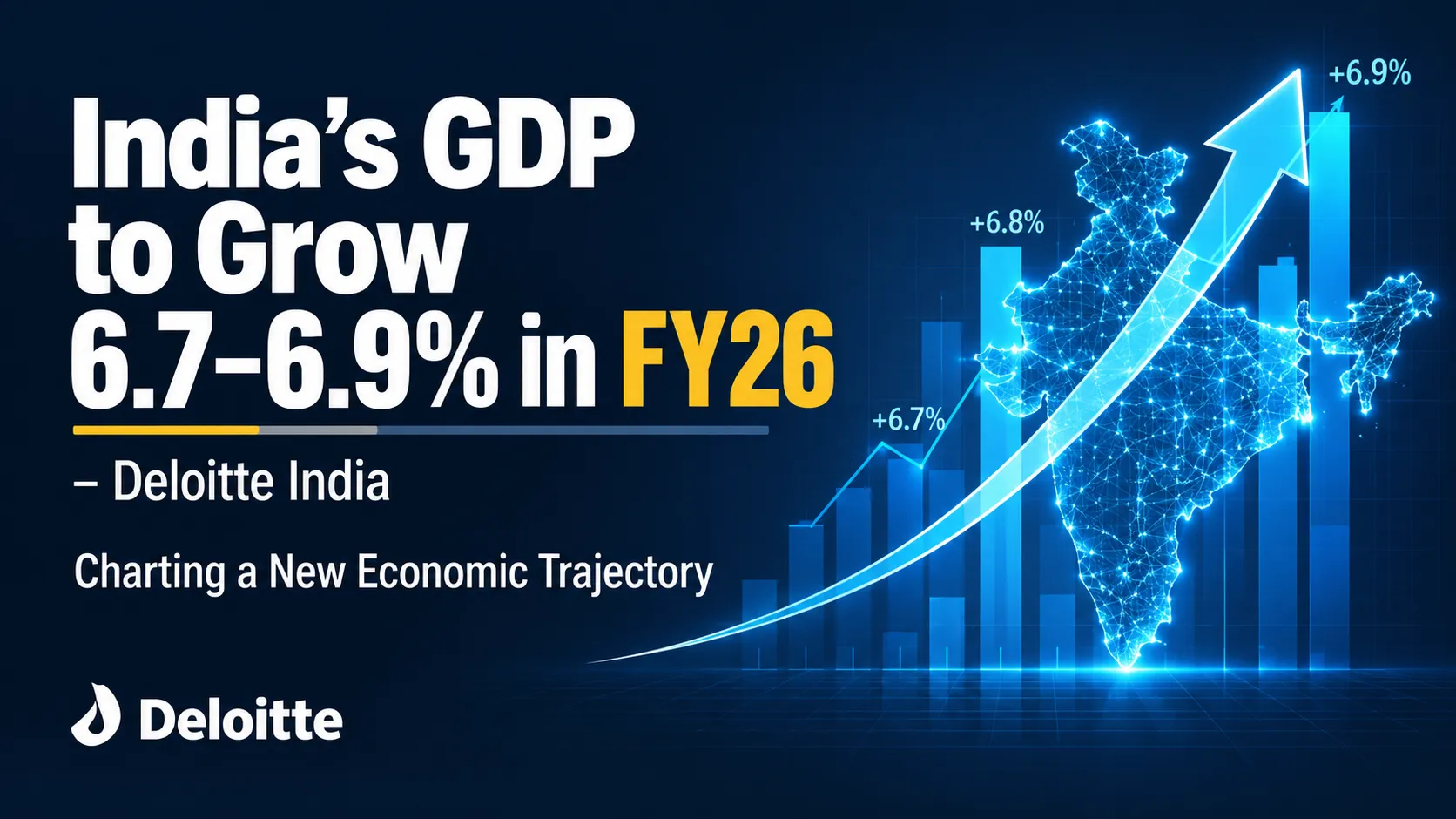
The significance of Deloitte's forecast lies substantially in its independence from India's own domestic policy and central banking apparatus. While the RBI's own growth projections carry considerable weight given the central bank's direct visibility into monetary and financial conditions across the economy, external validation from a major global advisory firm — one that similarly counsels a wide range of multinational corporations and institutional investors on their own India-related investment and operational decisions — provides an additional, differently sourced data point that market participants can weigh alongside domestic policy projections when forming their own views on India's near-term economic trajectory.
Deloitte's forecast arrives at a moment when several other indicators have painted a broadly consistent, encouraging picture of India's underlying economic momentum. The country's automobile industry has just posted its best-ever first-quarter performance for financial year 2026-27, with passenger vehicles up 25.9 per cent year-on-year, commercial vehicles up 18.3 per cent, two-wheelers up 20.3 per cent, and three-wheelers up 29.7 per cent — a genuinely broad-based consumption and business investment signal that aligns well with a GDP growth trajectory in the mid-six per cent range. Electric vehicle adoption has simultaneously reached a record 12 per cent share of total vehicle sales in June, adding a further dimension of underlying economic dynamism beyond simple volume growth. Corporate earnings for the ongoing Q1 FY27 season have likewise opened on a broadly constructive note, with early IT sector reporters posting encouraging profit growth figures that have helped drive the Sensex and Nifty to some of their strongest gains in recent weeks.
Not every recent data point has painted an unambiguously positive picture, however, and Deloitte's forecast necessarily incorporates these more mixed signals into its overall growth assessment. India's merchandise trade deficit widened to a five-month high of approximately $30.43 billion in June, as imports surged 31 per cent year-on-year even as exports grew a comparatively slower 16 per cent — a widening gap that, while partly a natural consequence of an economy growing briskly enough to pull in more imports to fuel that very growth, nonetheless represents a variable that growth forecasters must weigh carefully against India's overall external account sustainability. Wholesale price inflation running at 9.68 per cent in May has similarly featured as a recurring theme in corporate earnings commentary through the current results season, with companies across sectors addressing how they are managing input cost pressures within their own margin structures.
The methodology underpinning growth forecasts of this nature typically draws on a combination of high-frequency economic indicators, sector-specific demand signals, fiscal and monetary policy trajectory assumptions, and an assessment of external factors including global trade conditions and commodity price trends. For India specifically, forecasters must additionally weigh the still-unresolved outcome of the country's trade negotiations with the United States, given that the temporary 10 per cent tariff arrangement between the two nations is set to expire on July 24, 2026, with the ultimate resolution of those talks carrying meaningful implications for India's export-oriented manufacturing sectors and, by extension, for the broader growth trajectory that forecasts such as Deloitte's are attempting to project.
For corporate India and the investment community more broadly, having multiple independent forecasters converge around a similar growth range — in this case, the mid-to-high six per cent territory — provides a meaningfully more confident anchor for the various downstream assumptions that flow from GDP growth projections, from corporate earnings growth expectations and capital expenditure planning to government revenue projections and fiscal deficit targeting. When domestic and international forecasters diverge significantly in their growth assessments, it typically signals genuine uncertainty about the underlying economic trajectory that makes forward planning considerably more difficult for both businesses and policymakers; convergence, by contrast, offers a degree of confidence that allows for more decisive forward planning across both the public and private sectors.
Sector-specific implications of this growth outlook are already visible in how various parts of corporate India are approaching their own investment and expansion plans. Anil Agarwal's Vedanta Group, for instance, is preparing to invest approximately $20 billion over the next three to five years across its various demerged entities, a commitment predicated substantially on continued robust Indian demand growth for the natural resources and industrial inputs at the core of the group's business portfolio. Similarly, the government's recent ₹1.9 trillion commitment to semiconductor and mobile phone manufacturing reflects a policy bet that India's domestic electronics consumption and broader industrial growth trajectory will justify the scale of that investment over the coming years — bets that become considerably more credible when reinforced by independent growth forecasts converging around the same broadly optimistic range that domestic policymakers have themselves been projecting.
Looking ahead, the durability of this convergence between Deloitte's independent assessment and the RBI's own projection will face its next meaningful test as the remainder of the Q1 FY27 earnings season concludes, as the outcome of the India-US trade negotiations becomes clear around the July 24 deadline, and as subsequent monthly economic data — including trade figures, inflation readings, and industrial production numbers — either reinforces or complicates the currently broadly positive growth narrative. For now, though, the alignment between one of the world's largest professional services firms and India's own central bank on a 6.6 per cent growth trajectory for FY27 offers a meaningful vote of confidence in the country's economic momentum, even as several individual data points continue to warrant careful, ongoing monitoring.
Sector-level growth contributions embedded within forecasts of this nature typically reveal a considerably more nuanced picture than the single headline GDP figure suggests. Services sector growth, which continues to represent the largest single contributor to India's overall economic output, has benefited from resilient domestic consumption alongside a still-growing IT and business process outsourcing export sector, even as that latter segment continues navigating the disruptive pressures of generative AI on traditional service delivery models. Manufacturing sector growth, meanwhile, has increasingly been shaped by the government's expanding portfolio of production-linked incentive schemes, most recently including the ₹1.9 trillion semiconductor and mobile phone manufacturing push, which forecasters expect to contribute meaningfully to industrial output growth over the coming several years as newly incentivised manufacturing capacity gradually comes online.
Consumer demand indicators feeding into growth forecasts have painted a broadly encouraging picture through the first quarter of financial year 2026-27, reinforcing the confidence reflected in Deloitte's aligned projection. Beyond the record automobile sales figures already reported for the quarter, other consumption-linked indicators including credit card spending growth, e-commerce transaction volumes, and organised retail sales have similarly pointed toward resilient household consumption, even as economists continue to monitor whether this consumption strength is being driven by genuine income growth or by an expansion of consumer credit that could eventually require more careful management if it were to accelerate beyond sustainable levels.
Fiscal policy considerations also factor meaningfully into how forecasters like Deloitte arrive at their growth projections, with the government's own capital expenditure trajectory, tax collection trends, and fiscal deficit targets all feeding into assumptions about how much of India's growth is likely to be driven by public investment relative to private consumption and corporate capital expenditure. The government's continued emphasis on infrastructure spending, alongside its recent large-scale commitments to semiconductor and electronics manufacturing incentives, suggests that public capital expenditure is likely to remain a meaningful growth driver through the remainder of the fiscal year, complementing rather than crowding out the private sector investment that companies like Vedanta have separately committed to pursuing.
International comparisons offer further useful context for assessing the significance of a 6.6 per cent growth projection. Among the world's major economies, India's projected growth rate for FY27 continues to substantially outpace that of advanced economies including the United States, the European Union and Japan, while also comparing favourably against most other large emerging markets. This relative growth outperformance has been a consistent feature of India's economic trajectory for several years now, underpinning the country's growing weight within global equity benchmarks and its increasingly prominent role in multinational corporations' emerging market investment and expansion strategies. Deloitte's own global economic outlook publications have repeatedly cited India as among the more attractive large-economy growth stories currently available to international investors, a characterisation that this latest India-specific forecast reinforces.
Employment and labour market implications flow directly from any GDP growth projection of this magnitude, with economists generally expecting growth in the mid-six per cent range to support continued formal sector job creation, particularly within the manufacturing and services sectors that have been the primary beneficiaries of recent government policy initiatives. The scale of India's youth population entering the workforce each year means that sustained growth at or above this rate is generally viewed by labour economists as a necessary, though not on its own sufficient, condition for the country to make meaningful progress on formal employment generation and the broader demographic dividend that policymakers, including Finance Minister Nirmala Sitharaman in her own recent public remarks, have repeatedly identified as central to India's long-term economic ambitions.

For portfolio managers and institutional allocators assessing India as an investment destination, this alignment between independent forecasters offers a useful risk-management input alongside the more bottom-up, company-specific analysis that ultimately drives individual investment decisions. Macro growth forecasts of this nature rarely determine investment outcomes on their own, but they do help establish the broader economic backdrop against which individual company earnings trajectories, sector rotation decisions, and overall portfolio risk exposure to India can be more confidently assessed, particularly for international investors weighing India against other emerging market destinations competing for the same pool of globally mobile investment capital.
As the remainder of financial year 2026-27 unfolds, the durability of this converged growth narrative will be tested repeatedly against incoming economic data, from monthly trade and inflation figures to the conclusion of the current corporate earnings season and the eventual outcome of India's trade negotiations with the United States — each a variable capable of either reinforcing or complicating the broadly optimistic 6.6 per cent growth trajectory that both Deloitte and the Reserve Bank of India currently project for the year ahead.
Historical accuracy of prior-year forecasts offers a further useful lens for assessing how much weight markets should place on this latest projection. Both Deloitte and the RBI have, over recent years, generally tracked reasonably close to India's eventual realised growth outcomes, even as both institutions have periodically revised their in-year projections up or down in response to evolving data — a pattern of disciplined, iterative forecasting rather than fixed, unchanging annual predictions. This track record of reasonable forecasting accuracy lends further credibility to the current 6.6 per cent alignment, even as both institutions would likely acknowledge that any single-point growth forecast carries inherent uncertainty given the number of moving variables, from global trade policy to domestic monsoon outcomes, capable of shifting India's actual growth trajectory over a full fiscal year.
For India's state governments, many of which rely on central government revenue transfers calculated partly against projected national growth and tax collection figures, a stable, broadly agreed-upon growth outlook of this nature also offers a more predictable planning environment for their own budgetary and capital expenditure decisions, reducing at least one source of fiscal planning uncertainty even as states continue navigating their own individual economic circumstances and revenue collection challenges.
For now, the convergence between Deloitte's independent assessment and the RBI's own central projection offers India's policymakers, investors and businesses alike a reasonably confident, well-corroborated foundation on which to plan the remainder of financial year 2026-27 — even as every party involved continues to watch, closely and in real time, for the incoming data that will ultimately determine whether this 6.6 per cent growth trajectory proves to be the year's defining number.