In 2017, Nobody Would Fund Defense. In 2026, Nobody Can Fund It Fast Enough.
When Palmer Luckey and a group of Silicon Valley veterans founded Anduril Industries in 2017, the defense sector was, in venture capital terms, radioactive. Most VC firms had explicit policies against funding weapons companies. The best engineers in the country wanted nothing to do with the Pentagon. The conventional wisdom held that defense was for old-money contractors — Lockheed Martin, Northrop Grumman, Raytheon — not for scrappy startups funded by Founders Fund and a16z.
Nine years later, the conventional wisdom has been completely reversed.
In May 2026, Anduril raised $5 billion in a round led by Thrive Capital and Andreessen Horowitz, doubling its valuation to $61 billion. The U.S. Army, in March 2026, awarded the company a 10-year enterprise contract with a ceiling of up to $20 billion — consolidating over 120 separate procurement actions into a single framework. Sacra estimates Anduril hit $2.2 billion in revenue in 2025, up 110 per cent from $1 billion the year prior, with projections pointing toward $4.3 billion in 2026. Founders Fund wrote a $1 billion cheque into the Series G round in 2025 — the largest single cheque the firm had ever written.
"When we founded Anduril in 2017, defense was not a category that attracted significant venture investment. That has changed meaningfully over the last several years," CEO Brian Schimpf said at the time of the latest raise.
That may be the understatement of the decade.
What Changed — and Why It Changed Now
The shift in VC sentiment toward defense did not happen in a single moment. It built across a sequence of geopolitical, technological, and financial signals that, taken together, made a category that once felt off-limits suddenly feel like the obvious place to be.
The first signal was Ukraine. The 2022 Russian invasion demonstrated, in real time and in public, that the future of warfare was autonomous, software-defined, and dependent on the kind of AI and sensor systems that Silicon Valley was building anyway. Cheap drones outperformed expensive armoured vehicles. Software coordination beat legacy command structures. The companies best positioned to supply those capabilities were not the incumbents — they were the startups.
The second signal was the Pentagon's own frustration with its traditional suppliers. The Department of Defense had spent decades paying prime contractors enormous sums for systems that were over-budget, years late, and increasingly behind the capability curve of geopolitical rivals. The 2024 IVAS contract — a $22 billion augmented reality headset programme originally awarded to Microsoft — being taken over by Anduril was perhaps the clearest signal yet that the Pentagon was actively looking for alternatives to the old guard.
The third signal was financial. Defense contracts, unlike consumer software, come with real margins, real revenue, and real government backing. At a time when investors had grown deeply skeptical of growth-at-all-costs software companies burning cash to acquire users, defense startups offered something that most VC portfolios were short on: proof of payment. "Defense contracts come with actual margins," as one analyst noted. "That's catnip for late-stage investors who've watched too many unicorns flame out on the path to IPO."
All three signals converged around the same window, and the capital responded accordingly.
Anduril: Reinventing the Defense Contractor from Scratch
Anduril's founding vision was not to become a defence company in the traditional sense. It was to industrialise defense technology the way software companies had industrialised software — by privately funding R&D, building products first, and selling to the government rather than waiting for government contracts to fund the development.
That model, which the company's founders called the "Silicon Valley approach to defense," was initially treated with skepticism by the establishment on both sides. Pentagon officials questioned whether a startup could navigate the procurement process. VC investors questioned whether defense could generate the kind of returns they expected from their portfolios.
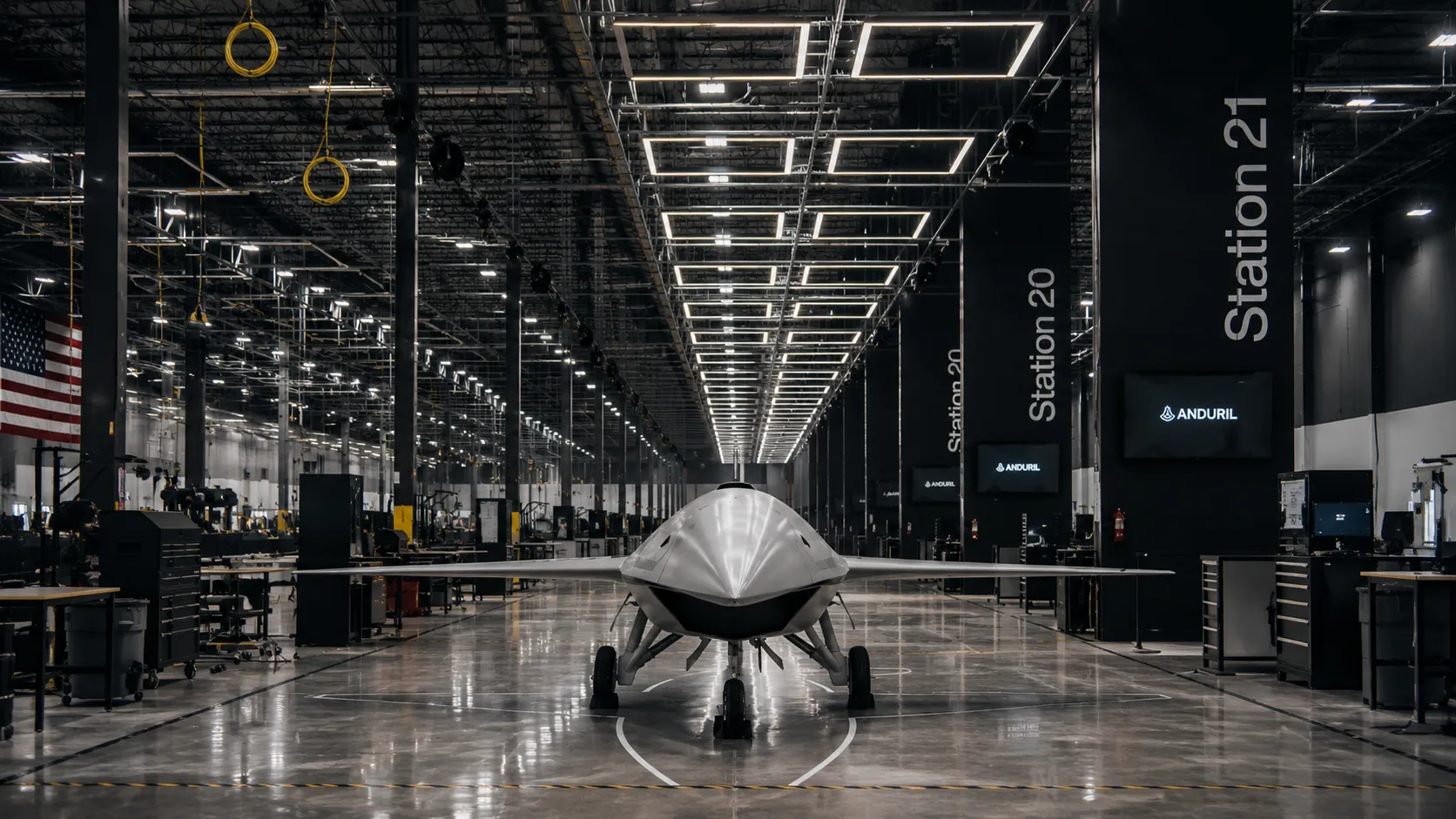
What resolved both questions was traction. Anduril began with autonomous surveillance towers deployed at the U.S.-Mexico border and in contested zones overseas. It built Lattice, an AI-enabled software platform designed to coordinate teams of autonomous systems during military operations. It competed for — and won — contracts against legacy prime contractors. It doubled revenue from $1 billion in 2024 to $2.2 billion in 2025. It broke ground on Arsenal-1, a 5-million-square-foot weapons manufacturing facility in Ohio. It opened a Mississippi solid rocket motor factory targeting production of 6,000 tactical motors per year by end-2026 — making Anduril the United States' third supplier of solid rocket motors alongside Northrop Grumman and Aerojet Rocketdyne.
This is not a software startup that happens to sell to the government. It is a vertically integrated defense manufacturer that happens to be run by people who grew up in Silicon Valley. The distinction matters enormously — and it is why the $5 billion raise, at a $61 billion valuation, is being backed by the same investors who funded the first wave of enterprise software and consumer internet.
Luckey, who founded Oculus VR before selling it to Facebook for $2.3 billion in 2014, has said he would "definitely" take Anduril public. An IPO would make it one of the most significant public offerings in American defense history.
Gecko Robotics: The Unicorn That Climbs Warships
If Anduril represents the high end of the defense tech boom — hypersonic missiles, autonomous aircraft, AI-coordinated battlefield systems — Gecko Robotics represents a quieter but equally important part of the same shift: the infrastructure layer.
Founded in Pittsburgh in 2013 by Jake Loosararian, Gecko builds robots that crawl, climb, swim, and fly across critical industrial infrastructure — Navy warships, oil refineries, power plants, pipelines, and factories — collecting high-fidelity data on the physical health of assets that are expensive to maintain and catastrophic to lose. That data feeds into Cantilever, the company's AI software platform, which currently manages over 500,000 critical assets and predicts exactly when and where things are likely to fail.
In June 2025, Gecko raised a $125 million Series D led by Cox Enterprises, with participation from Founders Fund and Y Combinator, doubling its valuation from its previous round to $1.25 billion and formally entering unicorn status. The company has now raised $354 million in total.
The investment thesis is specific and compelling: unplanned downtime costs industrial companies an estimated $50 billion per year. Gecko's robots inspect infrastructure 10 times faster than conventional methods, collecting 100 times the data. Every customer that deploys Gecko's robots builds a digital twin of their physical assets — a data moat that compounds over time and makes switching away from the platform increasingly painful.
The customer list tells its own story: L3Harris Technologies and the U.S. Navy for military aircraft and ships, NAES — the United States' largest independent power operator — for power plant modernisation, and ADNOC, the Abu Dhabi National Oil Company, for gas facilities and tanks internationally. In March 2026, the company was awarded the largest Navy robotics contract in its history, accessible by any federal agency without a new procurement cycle.
"Gecko reached unicorn status with a $1.25 billion valuation in 2025, was awarded the largest Navy robotics contract in its history in March 2026, and has begun expanding internationally," TSG Invest noted in an analysis of the company's trajectory.
The Cantilever platform, the robots, and the multi-year service contracts combine into a model that is structurally very difficult to displace — and structurally very easy to expand, because every new customer relationship generates more data, which makes the AI models better, which makes the inspections more valuable.
The Broader Ecosystem: It Is Not Just Anduril and Gecko
The Anduril and Gecko stories are the most visible, but they are not isolated. The defense tech category has been generating significant rounds across multiple sub-sectors simultaneously.
Shield AI, which builds autonomous flying systems for military use, raised $1.5 billion in a Series G in March 2026 at a $12.7 billion valuation, and is projecting over $540 million in revenue for 2026. Hermeus, which is building hypersonic unmanned fighter jets, raised $350 million at a $1 billion-plus valuation led by Khosla Ventures. Saronic, an autonomous shipmaker, has been attracting attention as the naval autonomy category gains momentum. European defense tech company Helsing was reportedly approaching a $1.2 billion raise at approximately an $18 billion valuation.
Andreessen Horowitz has committed $1.176 billion through its American Dynamism fund to companies working at the intersection of national security, manufacturing, and advanced technology. Founders Fund has made defense one of its most prominent thesis areas, with investments spanning Anduril, Gecko, and adjacent companies.
"Defense tech startups have seen a bonanza in funding," CNBC noted in its coverage of Anduril's May 2026 raise — citing recent rounds from Shield AI, Saronic, and several space companies as evidence that the trend is broad-based, not company-specific.
What Traditional Contractors Are Now Up Against
The incumbents — Lockheed Martin, Northrop Grumman, RTX — are not standing still. But they face a structural disadvantage that is difficult to close. Their business model was built around cost-plus government contracting, where revenue is tied to how much you spend developing a system rather than how well the system performs. The incentive to innovate is structurally weaker. The incentive to extend procurement timelines is structurally stronger.
The new generation of defense startups — Anduril chief among them — has inverted that model. By privately funding R&D and selling finished products to the government, they capture the upside of both commercial software margins and government contract stability. They can iterate faster, deliver sooner, and price more competitively, because they are not waiting for the government to fund each step of development.
The Pentagon has signalled, through its contracting decisions, that it understands this dynamic. The $20 billion Army contract framework awarded to Anduril is not just a validation of the company — it is a statement about how the DoD wants to buy technology going forward.
What This Means for Founders Outside the Defense Sector
The defense tech boom contains a lesson that applies well beyond national security, and it is this: the categories that institutional capital avoids longest are often the ones where the eventual returns are largest — precisely because the avoidance keeps competition low and valuation multiples compressed during the formative years.
Anduril operated for years as a company that top-tier investors would not touch on principle. That same period was when the company built the technology, won the first contracts, and established the proof of concept that made the $5 billion raise inevitable. By the time the sector became "acceptable," Anduril had already built a moat wide enough to define the category.
The founders who will define the next version of this story are building in sectors that today's VC conventional wisdom still considers uninvestable — energy infrastructure, physical security, advanced manufacturing, biomanufacturing — and building the proof long before the consensus catches up to the opportunity.
Defense was not the outsider sector because it lacked potential. It was the outsider sector because the people allocating capital had decided, for cultural and reputational reasons, not to look at it. When that decision changed — when geopolitics forced the question and traction made the case — the capital did not trickle in. It flooded.
That pattern has repeated itself throughout the history of venture capital. The lesson Anduril and Gecko have written into the record of 2026 is simple and durable: the sectors the market overlooks longest are not the ones without value. They are the ones where the patient founder who did the work early, quietly, and without permission is waiting — fully built, fully proven, and entirely ready for the flood when it finally arrives.