For generations, the narrative of grassroots business in India has faced a quiet, systemic roadblock. Across bustling urban centers and tight-knit local communities, countless women possess the technical skills, creative ideas, and entrepreneurial drive to build sustainable businesses. However, when these dreams hit the cold reality of formal banking institutions, they almost always encounter an unyielding barrier: the requirement of collateral.
Because land titles, family homes, and heavy financial assets are historically and culturally held primarily in the names of male family members, a vast majority of aspiring female founders are locked out of substantial institutional credit. This dynamic effectively restricts brilliant micro-enterprises, traditional handloom collectives, and forward-thinking tech startups to survival-level operations. They are left relying on high-interest informal loans or small, insufficient savings pools.
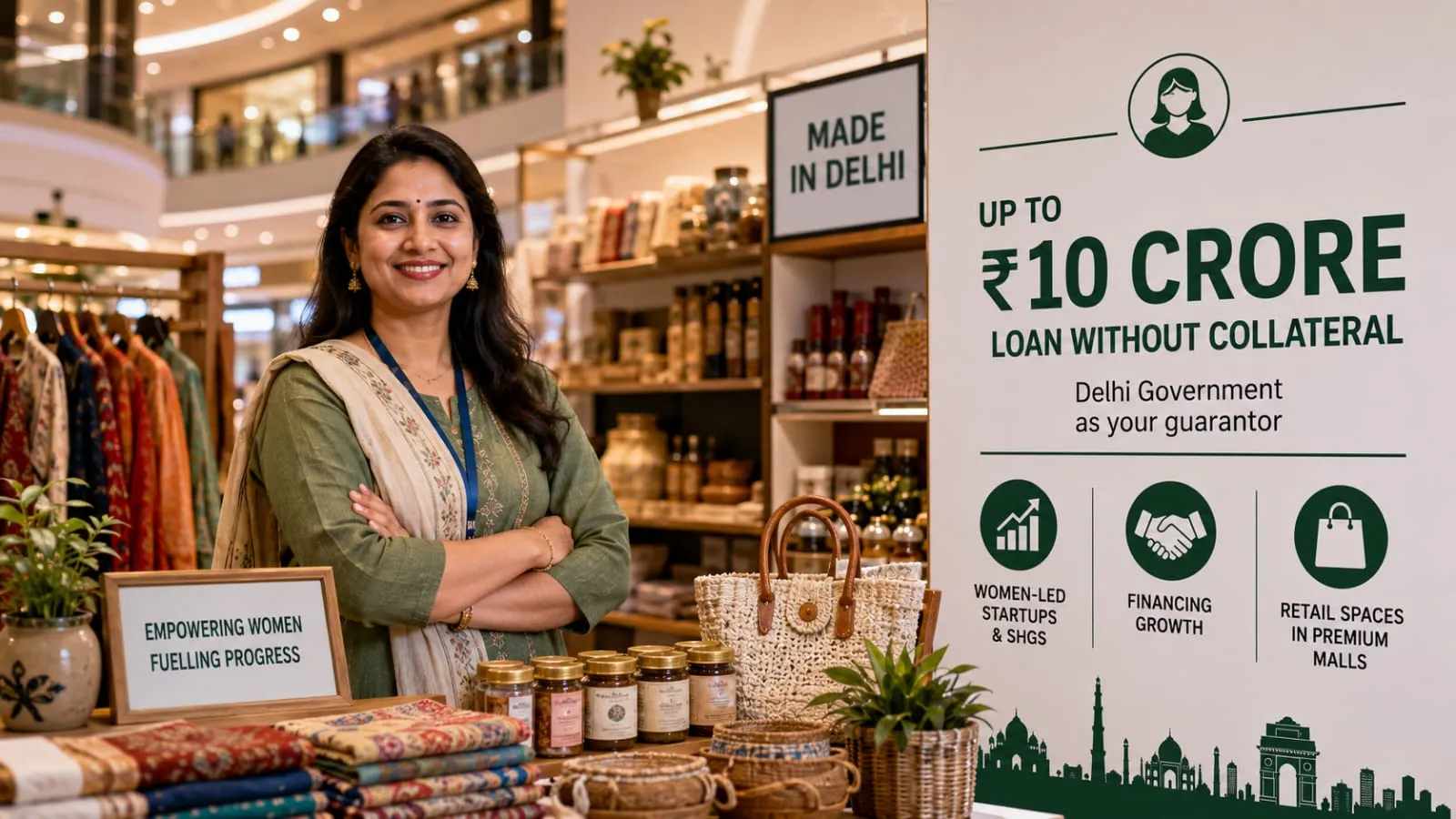
In an unprecedented economic intervention designed to flip this script, Delhi Chief Minister Rekha Gupta announced a radical legislative policy. The Delhi Government will facilitate collateral-free business loans up to a massive ceiling of ₹10 crore for women-led startups and Self-Help Groups (SHGs), with the administration itself stepping in to serve as the legal guarantor for these institutional credit lines.
Unveiled at the bustling two-day Mega Self Help Group Mela 2026 in Rohini, this announcement marks a structural shift in state economics. By absorbing the lending risk, the government is transforming banks from rigid gatekeepers into enthusiastic capital partners. This levels the playing field for women who want to scale their operations into organized, high-growth entities.
Dismantling the Collateral Trap
The true value of this credit program lies in its ambitious scale. While microfinance and small-tier loans have existed for years, they generally cap out at a few lakhs—enough to keep a home kitchen or a local boutique afloat, but entirely inadequate for taking a company to the regional or national stage.
When a women-led collective or an early-stage startup needs to invest in industrial machinery, set up an automated food packaging unit, secure proprietary software licenses, or build an aggressive distribution supply chain, their capital requirements immediately climb into crores.
By eliminating asset pledges for amounts up to ₹10 crore, Delhi's scheme actively detaches a woman’s borrowing power from her personal property ownership. The credit lines are extended based on the viability of the business model, the operational history of the collective, and the commercial promise of the product. The government backs these bank loans via a specialized risk-sharing architecture developed alongside the Credit Guarantee Fund Trust for Micro and Small Enterprises (CGTMSE). Under this model, the state protects banks from default risks, reducing their credit exposure to a mere fraction and giving them the confidence to lend freely.
From Street Corners to Luxury Malls: The Spatial Strategy
Injecting capital into an enterprise is only half the battle won. A well-funded factory still fails if its products are confined to temporary local street stalls or irregular seasonal markets. To address this commercial bottleneck, the Delhi Government is marrying financial backing with an aggressive retail integration plan.
The administration has pledged to establish dedicated, permanent marketing platforms and retail booths for these women-led SHGs and startups inside elite shopping malls and prominent commercial complexes across the capital. This clever geographic placement aims to reshape consumer behavior.
Local Indian crafts, organic hand-ground spices, custom crochet apparel, and artisanal household items often equal or exceed foreign brands in quality, but they suffer from a lack of corporate distribution and sophisticated shelf visibility. Moving these items out of standard exhibition grounds and positioning them directly within high-income consumer hubs connects grassroots creators to consistent, profitable demand.
This spatial strategy seamlessly accelerates major national development initiatives, including the Prime Minister's Vocal for Local, Atmanirbhar Bharat (Self-Reliant India), and the One District, One Product (ODOP) visions. It provides home-grown luxury the professional presentation it deserves.
The Compounding Power of Self-Help Groups
From a sociological perspective, investing directly in women’s collectives triggers a powerful economic multiplier. Statistical evidence consistently shows that when a male entrepreneur accesses capital, the economic return benefits the individual; conversely, when a woman gains financial agency, she reinvests up to 90% of her earnings back into her family's health, local nutrition, and children's education.

By linking formal banking structures to decentralized networks of neighborhood SHGs, the state is formalizing a massive, previously invisible segment of the workforce. At the Rohini exhibition, over 24 distinct collectives showcased premium khadi textiles, intricate handicrafts, and compliant food products, proving that these groups are fully prepared for market expansion.
As these community collectives secure multi-crore capital, they shift away from small-scale crafting and step into organized manufacturing hubs. A single successful SHG in a semi-urban pocket of Delhi can provide stable, fair-wage livelihoods to dozens of local families, elevating vulnerable neighborhoods out of poverty through dignified, sustainable labor.
Civic Synergy and Sustainable Lifestyles
Interestingly, this micro-economic blueprint is intimately tied to the Delhi Government’s wider ecological and urban health campaigns. By urging citizens to deliberately swap imported corporate goods for locally produced, indigenous consumer alternatives, the policy actively reduces the vast carbon footprints and fuel costs embedded in global logistics chains.
Furthermore, this neighborhood-focused business model fits perfectly with community initiatives designed to ease urban traffic gridlock. Whether through supporting local production networks or promoting resource-saving civic habits like "Monday Metro" and "No Vehicle Days," the underlying strategy is uniform: grand environmental changes are built on the back of resilient, highly localized economies.
The ₹10 crore collateral-free credit guarantee scheme serves as a historic statement of trust in the capabilities of Delhi's female workforce. By clearing away the administrative red tape and asset vulnerabilities that have long constrained female innovation, the capital is modeling a progressive blueprint for governance. It ensures that the upcoming wave of commercial expansion will not just be faster and more technologically advanced, but thoroughly equitable, inclusive, and powered by its women.