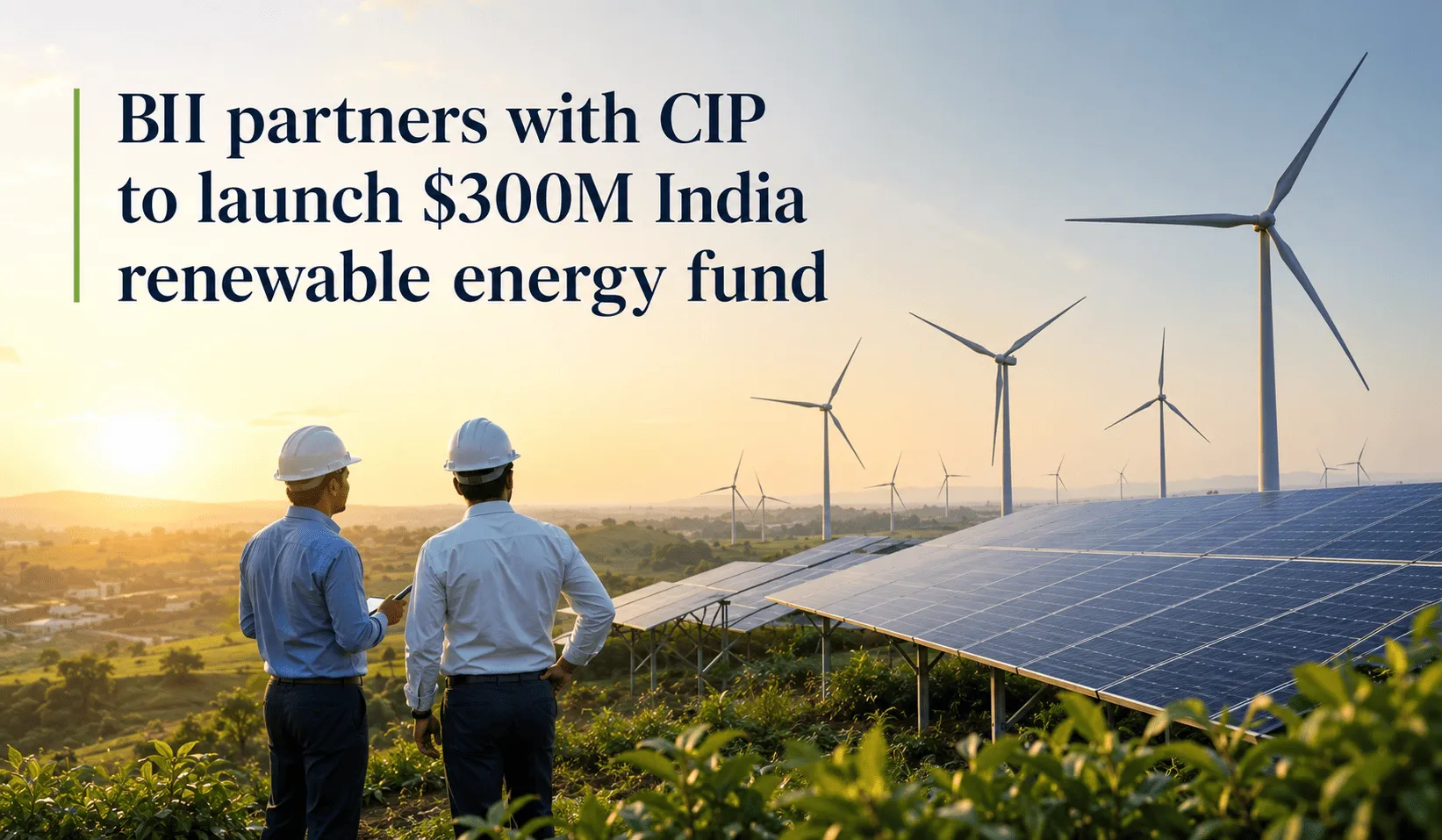
On May 19, 2026, British International Investment (BII), the UK's development finance institution and impact investor, alongside Danish global fund manager Copenhagen Infrastructure Partners (CIP), announced the launch of North Star, a $300 million renewable energy platform dedicated to accelerating clean power generation in India .
The two partners are each committing up to $150 million to the platform. BII's contribution comes from its own balance sheet, while CIP's investment flows through its Growth Markets Fund II (GMF II), a fund focused on clean energy project development in high-growth middle-income markets across Asia, Latin America, and EMEA .
North Star is not just another investment vehicle. It is structured specifically to address a persistent bottleneck in India's renewable energy sector: the lack of development-stage capital and execution capabilities among project developers. While renewable energy tenders have expanded rapidly across the country, many developers struggle to move projects from early-stage development through construction and into operations. North Star is designed to bridge that gap, supporting projects across their entire lifecycle while attracting additional institutional capital over time .
The First Investment Under British Climate Partners
North Star carries strategic significance beyond its $300 million price tag. It is the first investment made through British Climate Partners (BCP), a £1.1 billion climate finance initiative that BII launched in April 2026 as part of its new five-year strategy .
BCP is designed to mobilise large-scale institutional capital into climate solutions across fast-growing and coal-dependent economies in Asia. Along with India, the initiative will target markets including the Philippines, Indonesia, Vietnam, and other Southeast Asian countries . BII has stated that BCP is expected to mobilise approximately £3.5 billion of private capital over the lifetime of its investments, taking total expected commitments to £4.6 billion .
India was selected as the first investment market under BCP for a specific set of reasons. The country has set a target of achieving 500 gigawatts of installed renewable energy capacity by 2030 and net-zero emissions by 2070. But meeting that ambition requires closing an estimated climate financing gap of at least $160 billion annually through the end of the decade. The combination of scale, ambition, and unmet financing needs made India the natural starting point for the initiative .
The Investment Thesis: Why Solar, Wind, Hybrid, and Storage
North Star will invest across four technology verticals: solar, wind, hybrid renewable energy systems, and energy storage projects . Once fully operational, the platform's portfolio is expected to generate more than 4 million megawatt-hours of clean energy annually while helping avoid approximately 4 million tonnes of carbon emissions each year .
The inclusion of energy storage and hybrid systems is particularly significant. Industry experts believe these segments will become central to India's next phase of clean energy expansion. As renewable penetration increases, grid stability becomes a growing challenge. The sun does not always shine, and the wind does not always blow. Storage capacity and hybrid technologies are increasingly viewed as critical for ensuring round-the-clock power availability and managing intermittency .
Rohit Anand, Managing Director and Head of Asia Infrastructure at BII, told CNBC TV18 that while gaps exist across all renewable domains, solar remains the most immediately attractive. But he added that significant investment is now required in storage capacity, as hybrid technologies become vital to maintaining grid reliability .
The $160 Billion Annual Problem
The launch of North Star highlights the scale of capital required for India's energy transition. According to BII, India faces a climate financing gap of at least $160 billion annually until 2030, despite aggressive policy support and a sharp rise in renewable energy tenders .
India currently has the third-largest installed renewable capacity in the world, after China and the United States. The rate of growth, the sheer scale, and the speed of implementation are at a different level. As Rohit Anand noted, India is the fastest-growing emerging market globally, and no country matches it in scale . That combination of rapid growth and massive financing requirements makes the country uniquely attractive to development finance institutions like BII.
Anand explained the logic further. He said the reason India is so attractive to development finance institutions is that the country has set a very clear ambition: 500 gigawatts by 2030. That provides a clear policy direction and momentum around investments. What BII hopes to do is create the kind of conditions that will attract other development finance institutions to do the same .
Building on a Proven Track Record

North Star is not BII's first foray into India's renewable energy market. The institution has a proven track record of seeding platforms that later attract significant private capital and scale successfully .
In 2018, BII invested $100 million to launch Ayana Renewable Power, a renewable generation platform based in India. Ayana subsequently attracted hundreds of millions of dollars in private capital from investors including the National Investment and Infrastructure Fund of India (NIIF). The platform developed over 4 gigawatts of solar, wind, and round-the-clock projects before being sold in early 2025 to ONGC NTPC Green for an enterprise value of $2.3 billion . BII described the exit as successful catalytic capital at work.
Beyond Ayana, BII has backed Fourth Partner Energy, a leading commercial and industrial renewable provider, with roughly $80 million in mezzanine debt facilities to support over 500 megawatts of capacity across India and parts of Southeast Asia. Other investments include stakes supporting ReNew Energy Global's solar manufacturing ambitions with $100 million in 2025, as well as various transmission, distribution, and smart metering plays .
In the grid modernization space, BII has financed smart meter deployments through Apraava Energy as part of a $92 million package with Standard Chartered for around 2 million meters, and Polaris Smart Metering with ₹710 crore for over 2.2 million meters in West Bengal. These investments address aggregate technical and commercial losses and aid renewable integration .
CIP, for its part, has partnered in India previously with Ampin Energy Transition. Earlier commitments through its New Markets Fund supported an approximately 1.7 gigawatt Unicus solar and hybrid portfolio. More recent extensions target another around 2 gigawatts, bringing combined exposure toward $1.5 billion in asset value across solar, wind, hybrid, and storage .
The Broader Context: Why India, Why Now
The launch of North Star comes at a moment when global investors are sharpening their focus on India's rapidly expanding clean energy market. Rising electricity demand, supportive policy frameworks, and declining clean energy costs have made India one of the world's most attractive renewable energy destinations .
But challenges remain. BII and CIP have both acknowledged that while renewable energy tenders have expanded significantly, many developers continue to face constraints related to capital availability and project development capabilities. North Star has been specifically structured to address these constraints by supporting projects through development, construction, and operational stages while also attracting additional private investment into the sector .
The platform enters a competitive landscape. Domestic players, international funds, and other development finance institutions continue to deploy capital into Indian renewables, while sovereign-backed entities have also been eyeing scaled platforms . BII, with total net assets around £9.87 billion and a mandate focused on poverty reduction and climate, plans for at least 40 percent of new commitments through 2031 to qualify as climate finance. CIP manages tens of billions across funds focused on greenfield renewables globally.
Leslie Maasdorp, the Chief Executive of British International Investment, framed the launch as the first embodiment of BII's new strategy. He stated that at the launch of the new strategy last month, BII said it would focus on mobilising private capital to address acute development needs and combat the climate emergency. North Star is the first embodiment of that commitment. By partnering with CIP, BII is crowding in private capital from day one of this new platform, and Maasdorp said he expects further private investment in North Star over the following years .
The Bottom Line
North Star is not just a $300 million fund. It is a test of whether catalytic capital from development finance institutions can unlock the much larger pools of private investment that India needs to meet its 2030 renewable energy targets. BII's track record with Ayana—seeding a platform that grew to a $2.3 billion enterprise value before exiting—provides a template for what success could look like.
The platform's focus on development-stage capital addresses a genuine market gap. Many renewable energy developers in India have the technical expertise to bid on tenders but lack the balance sheet strength to fund projects through the long, capital-intensive period between winning a bid and reaching commercial operation. North Star is designed to bridge that gap, providing not just funding but the development capacity and execution expertise that smaller developers cannot easily access on their own.
Whether the model can be replicated across other Asian markets remains an open question. But BII has signalled that it believes it can. As Rohit Anand told CNBC TV18, BII remains convinced that not only is this a solid investment platform for India, but it is also a replicable platform that could be deployed in other parts of Asia . For now, North Star is focused on India. But the ambition, like the country's renewable targets, is scaled for the long term.