FundingMarket Data Women6 MIN READ

Beyond India VIX: NSE Quietly Builds a New Volatility Gauge of Its Own — and This Time, It Wants Derivatives That Actually Trade

The National Stock Exchange is quietly laying the groundwork for what could become a meaningful shift in how Indian markets measure and trade volatility, exploring the development of an entirely new...

28 July 2026
Beyond India VIX: NSE Quietly Builds a New Volatility Gauge of Its Own — and This Time, It Wants Derivatives That Actually Trade

The National Stock Exchange is quietly laying the groundwork for what could become a meaningful shift in how Indian markets measure and trade volatility, exploring the development of an entirely new volatility index built on a methodology distinct from India VIX, the benchmark gauge of near-term market risk that traders and institutional investors have relied upon as India's primary "fear gauge" since its introduction in 2008. According to people familiar with the matter, NSE has initiated preliminary discussions around a pilot programme, with multiple candidate methodologies currently under consideration, and testing expected to begin shortly.

To understand why NSE might want to build a volatility index of its own, it helps to understand the somewhat unusual licensing arrangement underpinning India VIX's current existence. India VIX uses the computation methodology of the Chicago Board Options Exchange, adapted with suitable amendments to fit the specific characteristics of the Nifty options order book, including techniques such as cubic splines to smooth out gaps in available strike price data. Crucially, "VIX" itself is a trademark held jointly by the Chicago Board Options Exchange, commonly known as CBOE, and Standard & Poor's — meaning NSE operates India VIX under a license granted by these two US-based entities, rather than owning the underlying methodology or brand outright. As one industry expert succinctly put it when commenting on NSE's exploration of an alternative, "All the data and research for India VIX is provided by NSE. So, it may make sense to explore a volatility index of its own" — a logic that essentially asks why NSE should continue operating under a foreign licensing arrangement for a product built almost entirely on data and research the exchange itself already generates and controls.
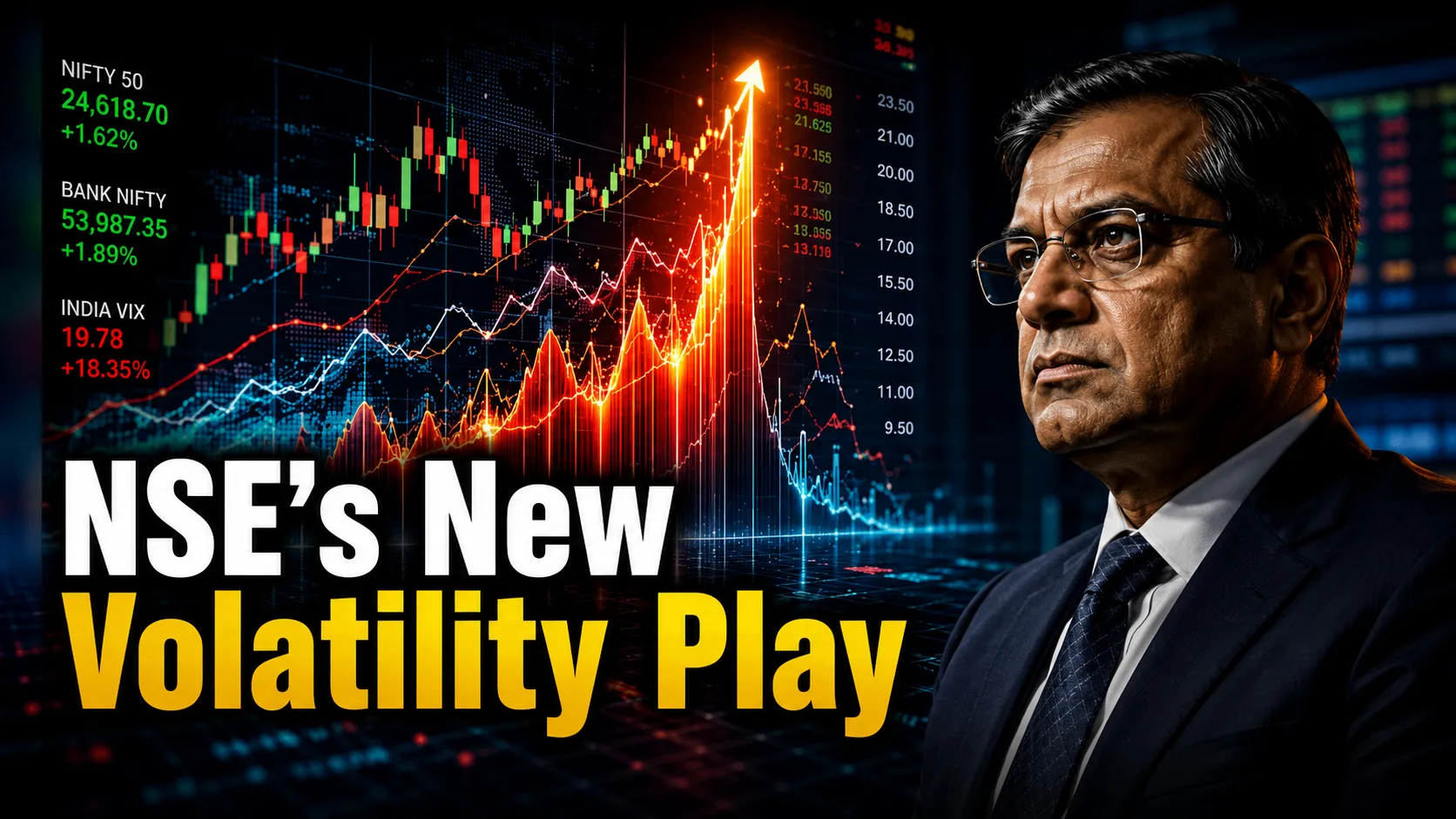
image.png

Beyond the licensing dynamics, a second and arguably more commercially significant motivation appears to be driving NSE's interest in a new index: the ambition to succeed, where India VIX has historically struggled, in building genuinely liquid, tradable derivatives contracts linked to volatility. NSE first launched futures contracts on India VIX, branded NVIX, back in 2014, with the debut session clocking approximately ₹325 crore in trading volume across 227 participating members — a promising start for what was, at the time, described as the first product in India allowing investors to directly hedge volatility risk through an exchange-traded instrument. However, that early promise did not translate into sustained trading activity: NSE was ultimately forced to discontinue India VIX futures in 2017, citing persistently low liquidity and weak trader participation that had developed over the intervening three years.

According to people familiar with the current initiative, one of the primary objectives behind developing this new, distinct volatility index is precisely to enable a fresh attempt at launching derivative contracts that might succeed where the earlier NVIX futures ultimately did not. Any such move, however, would require NSE to seek entirely fresh regulatory approval from the Securities and Exchange Board of India, separate and distinct from the existing regulatory approvals currently tied to India VIX itself — reflecting the reality that a genuinely new index, built on different underlying methodology, would represent a distinct financial product requiring its own dedicated regulatory review process rather than simply extending or modifying the existing India VIX framework.

The proposed testing process, as described by people familiar with the discussions, is intended to be methodical rather than rushed. "The pilot may involve testing how the index behaves on different volatile days and whether it correctly reflects market movements. The testing could take several months, followed by discussions," one person familiar with the developments explained, indicating that NSE intends to rigorously validate any new methodology's accuracy and reliability across a range of genuinely volatile trading conditions before moving toward the broader stakeholder consultation phase that would typically precede any formal public launch. That subsequent consultation process is expected to draw in market participants, academics, and other industry stakeholders — a fairly standard approach for major new index methodologies, given how central accurate, trusted volatility measurement is to a wide range of institutional risk management, options pricing, and portfolio hedging activities across the broader financial ecosystem.

All the data and research for India VIX is provided by NSE. So, it may make sense to explore a volatility index of its own," an industry expert observed — capturing the essential logic behind the exchange's move to build a proprietary alternative.

It is worth emphasising just how central India VIX has become to how professional and institutional market participants navigate Indian equity markets, underscoring why any potential successor or complement to it carries genuine significance for the broader market ecosystem. India VIX measures the market's expectation of Nifty 50 price volatility over the coming 30 calendar days, derived from the implied volatility embedded in Nifty 50 options prices across both near-month and mid-month contracts, spanning both weekly and monthly option series. The index is updated every 15 seconds during NSE trading hours, providing a genuinely real-time gauge of shifting options market sentiment throughout each trading session. As a general rule, India VIX and the Nifty 50 index tend to move in opposite directions — when Nifty falls sharply, India VIX typically spikes higher, reflecting increased demand for options-based hedging and rising uncertainty among market participants, while calmer, more range-bound market conditions are typically associated with lower India VIX readings.

NSE's exploration of a new volatility index also arrives at a notable moment in the exchange's own corporate trajectory. The exchange has itself filed a Draft Red Herring Prospectus with SEBI as part of its own long-anticipated path toward a public listing — a process that has been the subject of extensive market speculation for several years, given NSE's position as India's dominant stock exchange by trading volume. When asked about the new volatility index initiative in the context of this broader corporate development, NSE has stated only that it has filed the DRHP with SEBI and cannot provide further information on other matters at this time — a fairly standard, cautious public communications posture for any company navigating the sensitive pre-IPO period, during which additional public disclosures beyond the formal DRHP filing itself are typically kept to a minimum to avoid running afoul of securities regulations governing pre-IPO publicity.

image.png

For traders and market participants, the practical implications of a successfully launched new volatility index, and any associated tradable derivatives, could be meaningful. A more robust, exchange-owned volatility benchmark could offer a clearer, more directly replicable reference point for hedging both equity portfolios and options positions, potentially simplifying short-term risk management for a broad range of market participants. Were the associated derivatives contracts to achieve the liquidity that eluded the earlier NVIX futures, traders would gain a genuinely new instrument category through which to express either directional views on expected market volatility, or more sophisticated volatility-based hedging strategies that are currently more difficult to execute efficiently given the absence of a genuinely liquid, exchange-traded volatility product in the Indian market.

That said, market observers examining NSE's current derivatives franchise note that success is far from guaranteed, pointing to the exchange's broader pattern of index derivatives activity as a useful cautionary data point. Currently, NSE offers derivative contracts across several benchmark indices including Nifty 50, Nifty Bank, Nifty Financial Services, Nifty Next 50, and Nifty Midcap Select — yet of these, only Nifty 50 currently benefits from weekly expiry contracts, the specific product structure that has historically driven the overwhelming majority of trading volume and liquidity within India's derivatives markets. Whether any new volatility index and its associated derivatives can replicate anything close to that kind of liquidity concentration — rather than suffering the same fate that ultimately doomed the original NVIX futures contract back in 2017 — will likely depend heavily on the specific contract design, market-making arrangements, and broader liquidity-building strategy NSE ultimately adopts once its extended testing and stakeholder consultation phases eventually give way to a formal product launch.

TagsNSE IndiaIndia VIXVolatility IndexDerivatives TradingStock Market IndiaNSE IPOOptions TradingRisk ManagementFinancial Markets IndiaBusiness News India

Reader reviews

Sign in to rate and review this article.
Loading reviews…