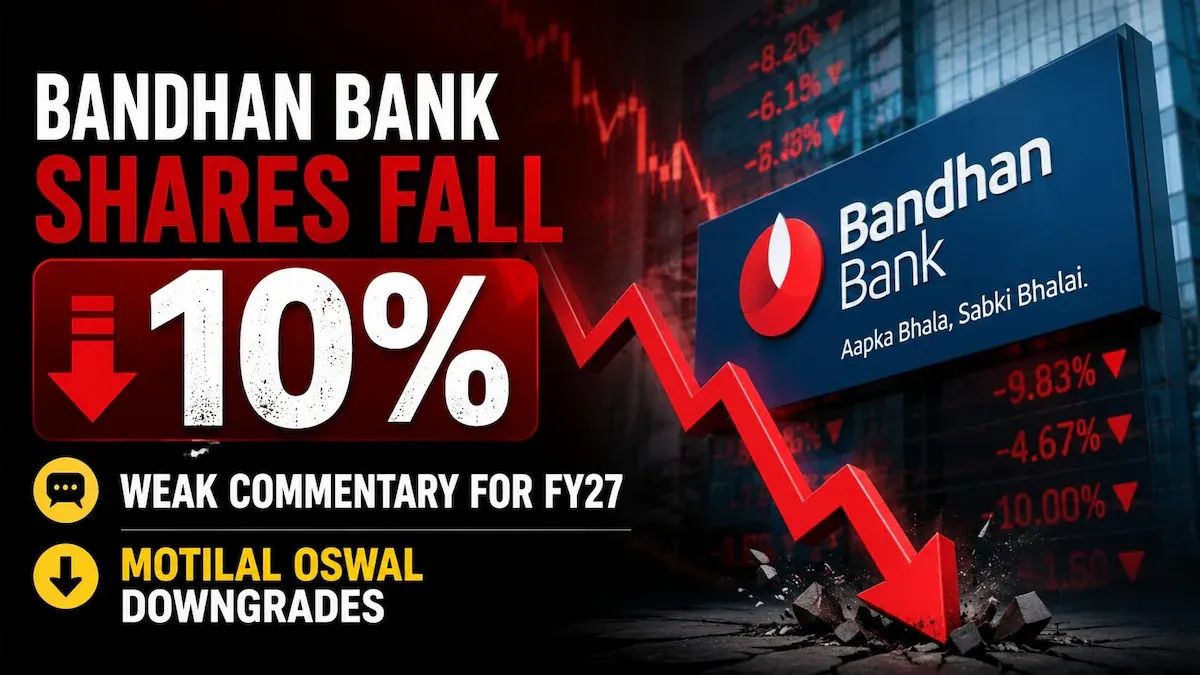
Kolkata-headquartered Bandhan Bank delivered one of the sharpest single-day stock collapses seen on Dalal Street this earnings season, with its shares plunging nearly 19 per cent in early trade on Wednesday, July 22, 2026, even as the lender reported what most textbooks would call a "healthy" quarter. The stock tumbled to an intraday low of Rs 169.56 on the National Stock Exchange, compared with the previous close of Rs 208.83, before the counter was pulled into a mandatory cooling-off period after breaching the exchange's 10 per cent circuit trigger. By the time the dust settled, the bank's market capitalisation had been shaved down to roughly Rs 28,596 crore — a brutal reminder that in Indian banking stocks, the market rewards not the quarter that was, but the quarter that management promises is coming. The trigger was not a miss on revenue or a spike in bad loans in the immediate print. Instead, it was guidance. Bandhan Bank's management, in its post-market commentary released after hours on Tuesday, July 21, chose to meaningfully lower its full-year return-on-assets target for FY27, cutting the exit RoA guidance to a range of 1.2 to 1.4 per cent from an earlier, more optimistic band of 1.6 to 1.8 per cent. For a bank whose entire investment case over the past few years has rested on a turnaround story — diversifying away from its microfinance roots into secured, retail and commercial banking — a guidance cut of that magnitude functions less like a footnote and more like a red flag. Institutional investors, who had been willing to look past near-term asset-quality bumps on the promise of margin recovery, reacted first and asked questions later. To understand why the market reacted with such ferocity, it helps to understand what Bandhan Bank actually is. Founded by banker Chandra Shekhar Ghosh, the institution began life as a microfinance company focused on extending small, collateral-free loans to women borrowers in some of India's most underserved rural pockets, primarily across West Bengal, Assam, and the wider East and Northeast. It received a universal banking licence from the Reserve Bank of India in 2015, becoming one of only a handful of specialised lenders to make that leap, and it listed on the exchanges soon after to considerable investor enthusiasm. Its microfinance heritage was, for years, the source of both its highest margins and its highest volatility — a business model that thrives when rural cash flows are strong and collections discipline holds, and one that comes under visible strain the moment either wobbles. That tension is precisely what appears to be resurfacing now. The Indian microfinance sector as a whole has been navigating a stress cycle that began building through 2024 and has continued to work its way through loan books over the following two years. Overleveraging among borrowers who took multiple loans from multiple lenders simultaneously, tighter regulatory guardrails from the Reserve Bank of India around lending caps and household indebtedness, and patchy rural income growth in several states have combined to push up delinquencies across the microfinance-lending universe. Bandhan Bank, despite years of effort to rebalance its book toward housing loans, commercial banking, and retail secured lending, still carries a meaningfully higher exposure to unsecured, small-ticket rural lending than most of its universal-bank peers. When the sector sneezes, Bandhan tends to catch a cold faster and more visibly than institutions like HDFC Bank or ICICI Bank, whose retail books are far more diversified.
Wednesday's Q1 FY27 numbers, taken purely at face value, were not disastrous. The bank posted healthy year-on-year growth in its loan book and continued to expand its balance sheet, according to details shared in its results commentary — the kind of top-line growth that, in an ordinary quarter, would have been cheered rather than punished. What changed the narrative was the tone of the management guidance that accompanied those numbers. Lowering RoA guidance is, in banking-analyst shorthand, an admission that margins are going to stay compressed for longer than previously projected — a combination of elevated credit costs from provisioning against stressed rural loans, a higher cost of funds as the bank competes for deposits, and continued caution on growing the higher-yielding microfinance book at the pace it once did. Put simply: management effectively told the Street that profitability recovery, the entire thesis several investors were holding the stock for, has been pushed further down the road. The market's response was swift and largely mechanical. As soon as the stock breached its lower circuit limit of 10 per cent, National Stock Exchange systems triggered a cooling-off period — a regulatory safety valve designed to let panic-selling pause and allow price discovery to happen in a more orderly fashion. But when trading resumed, sellers were still firmly in control, and the stock continued its slide, eventually landing close to the 19 per cent mark for the session — one of the steepest single-day falls for a large-cap-adjacent private bank stock in recent memory. Trading volumes spiked well above recent averages as both retail and institutional investors rushed for the exits, a pattern typically associated with capitulation-style selling rather than measured profit-booking. For context, Wednesday's move did not happen in isolation. It came on a day when the broader Indian market was already under pressure, with the BSE Sensex falling over 700 points and the Nifty50 slipping below the psychologically important 24,000 mark, dragged down by a mix of rising crude oil prices linked to tensions in West Asia, persistent foreign institutional investor selling, and a weakening rupee. Banking and financial stocks broadly underperformed that session, but Bandhan Bank's decline stood out even against that weak backdrop — a company-specific event layered on top of an already risk-averse macro mood. What does this mean for investors who are either holding the stock or eyeing it after the fall? Market watchers tracking the banking space have been quick to caution that a sharp single-day correction, however dramatic, is not by itself a verdict on the underlying franchise. Bandhan Bank retains a large distribution network across East and Northeast India, a deposit franchise that has been steadily improving in quality, and a management team that has been explicit — arguably to a fault, given Wednesday's reaction — about being conservative in its outlook rather than sandbagging investors with rosy promises it cannot keep. Some analysts view the guidance cut as prudent housekeeping: better to reset expectations early in the fiscal year than to disappoint repeatedly through subsequent quarters. Others see it as confirmation that the bank's microfinance-linked stress has further to run before it troughs out.
There is also a longer arc worth noting. Bandhan Bank's stock has, for much of the past two to three years, traded at a discount to its private-sector banking peers, precisely because of this recurring pattern: promising diversification, delivering partial progress, and then being tripped up by a fresh wave of asset-quality or margin concerns tied to its legacy microfinance book. Wednesday's crash, uncomfortable as it was for shareholders, fits that pattern rather than breaking new ground. What will matter over the coming quarters is whether the bank's continued push into secured retail lending, home loans, and commercial banking can dilute the volatility of its microfinance exposure fast enough to change that narrative — or whether every earnings season will continue to bring some version of Wednesday's shock. For the broader banking sector, the episode is also being read as a cautionary tale during an earnings season that has, so far, been a mixed bag. With dozens of banks and non-banking financial companies reporting Q1 FY27 results through this week — including IndusInd Bank, HDFC Bank peers, and a wide swath of public and private lenders — investors are being reminded that in the current environment of elevated global uncertainty, geopolitical risk in West Asia pushing up energy costs, and a still-cautious Reserve Bank of India on the rate front, guidance matters as much as, if not more than, the reported number. Banks that under-promise and over-deliver are being rewarded; banks whose forward commentary disappoints, even against a backdrop of decent current-quarter growth, are being punished hard and fast, exactly as Bandhan Bank discovered on Wednesday. Retail shareholders, many of whom entered the stock at much higher levels during its post-listing enthusiasm years, are once again facing the familiar question of whether to average down, hold, or exit. Financial advisors typically counsel against knee-jerk decisions in either direction immediately after a circuit-breaking move, suggesting instead that investors wait for at least one or two subsequent quarters of execution against the newly reset guidance before drawing firm conclusions. For now, though, Wednesday's session will be remembered as one of the more dramatic single-stock stories of the July 2026 earnings season — a reminder that in banking, the market prices tomorrow's promise far more aggressively than today's performance. As trading resumes through the rest of this week, all eyes will remain on how the stock stabilises, whether bargain-hunters step in at the lower price band, and whether management follows up with any additional clarifying commentary to steady investor nerves. Until then, Bandhan Bank's near-19-per-cent rout stands as the single sharpest reminder yet this earnings season that in Indian markets, a healthy quarter is worth very little if the guidance attached to it isn't healthy too.
It is also worth situating Wednesday's move within the wider story of East and Northeast India's banking landscape, a region where Bandhan Bank remains one of the most systemically important private lenders by sheer branch density and customer count. Unlike banks headquartered in Mumbai or Delhi with pan-India retail footprints, Bandhan's fortunes are unusually tied to the economic health of West Bengal, Assam, Bihar, and the smaller northeastern states — geographies where agricultural cycles, state-level welfare disbursements, and informal-economy cash flows play an outsized role in loan repayment behaviour. A guidance cut rooted in margin compression is, in this sense, also an indirect signal about how borrower cash flows in these states are trending through the current fiscal year, something regional economists and rural-credit analysts will likely parse closely in the weeks ahead. There is a structural angle here too. Over the past two fiscal years, the Reserve Bank of India has progressively tightened the regulatory framework around microfinance lending, introducing caps on the number of lenders a single borrower can access simultaneously and pushing for more standardised, income-linked lending limits across the sector. While these measures are widely viewed as necessary correctives to a period of aggressive, sometimes reckless, MFI expansion in the years prior, they also mean that lenders like Bandhan Bank cannot simply grow their way out of margin pressure by expanding the microfinance book at the pace they once did. Growth has to come increasingly from secured retail products — home loans, loans against property, gold loans, and commercial banking relationships — categories where Bandhan is still a relative newcomer compared to established private banks that have spent decades building those franchises. That transition takes time, capital, and — as Wednesday demonstrated — patience from a market that isn't always inclined to extend it. Retail investors scrolling through their portfolios on Wednesday evening were left grappling with a familiar dilemma that recurs almost every reporting season for mid-sized private banks: is a sharp, guidance-driven sell-off a buying opportunity created by short-term panic, or is it the market correctly repricing a business that is structurally more fragile than its share price previously implied? Historical precedent within Bandhan Bank's own trading history offers mixed lessons — the stock has seen similarly sharp corrections in the past tied to asset-quality scares, some of which proved to be excellent entry points in hindsight, and others which preceded prolonged periods of underperformance as the underlying stress took multiple quarters to fully play out. Wealth managers approached by financial dailies through the day were largely unanimous on one point: investors should resist the urge to average down purely because the stock "looks cheap" after a 19 per cent fall, and should instead wait to see at least one further quarter of data before drawing conclusions about whether the reset guidance marks a floor or merely a waystation to further downgrades. Looking ahead, the next major checkpoint for Bandhan Bank watchers will be the September-quarter results, due later this fiscal year, where the market will be looking for early signs of whether the lower guidance band is being met, exceeded, or already at risk of another downward revision. Until that data arrives, Wednesday's crash leaves the stock — and the broader story of India's microfinance-linked banking segment — firmly in "prove it" territory, with sentiment likely to remain fragile and headline-sensitive in the sessions ahead.