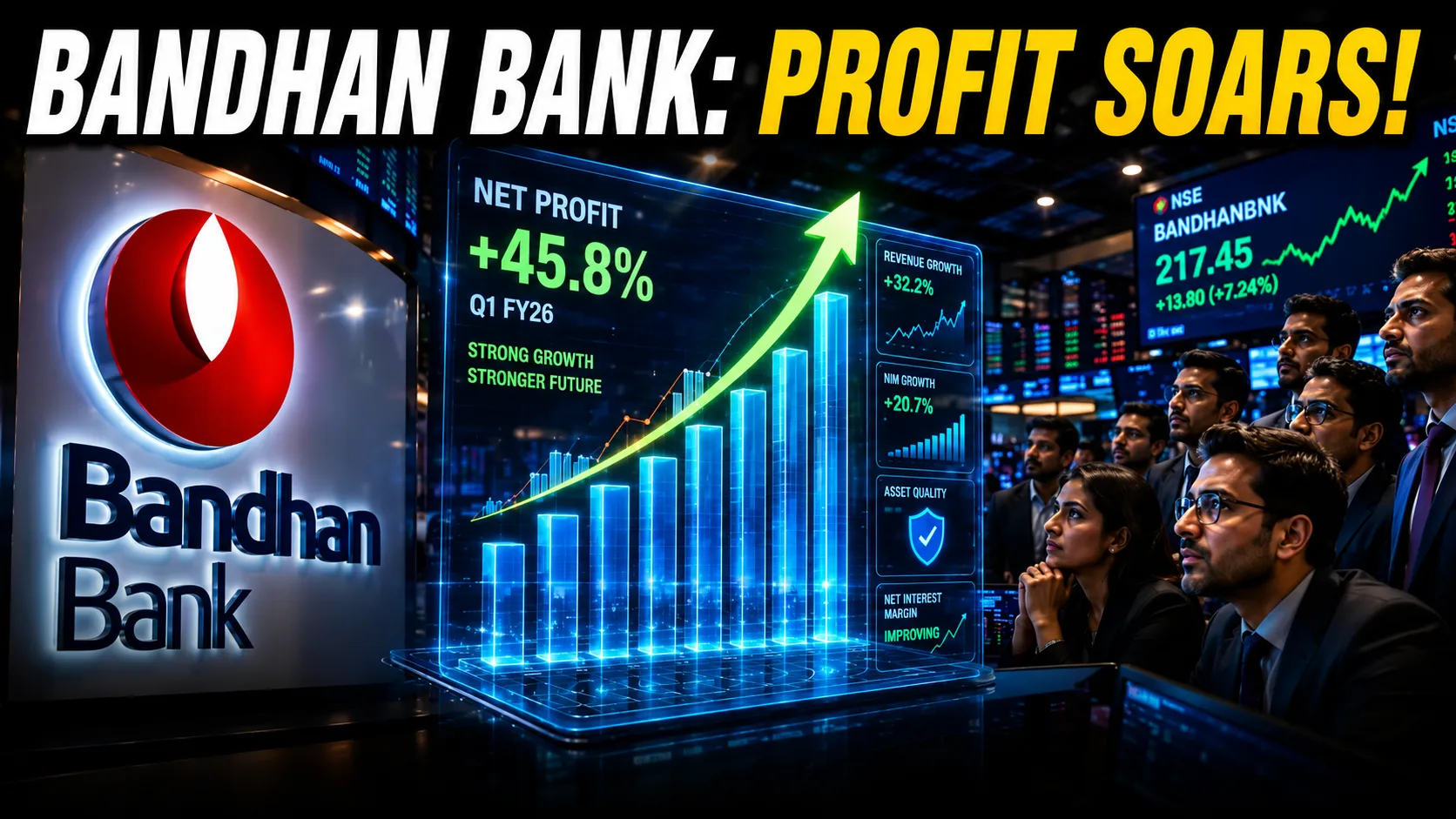
Bandhan Bank has delivered a strong set of first-quarter numbers for FY27, reporting a roughly 35 per cent year-on-year jump in net profit alongside a meaningful improvement in asset quality — a combination that market watchers are reading as the clearest confirmation yet that the Kolkata-headquartered lender's years-long turnaround effort is beginning to bear sustained fruit. The bank's April-June quarter results, announced as part of a broader wave of Q1 FY27 earnings that has kept Dalal Street busy through much of July, showed profit after tax rising to a level significantly ahead of the bank's own year-ago base, with return on assets improving to around 1.0 per cent, a metric closely tracked by bank analysts as a measure of how efficiently a lender is converting its balance sheet into bottom-line profitability.
The results follow through on what had been a fairly optimistic set of pre-earnings expectations. Ahead of the announcement, brokerage research had pencilled in a double-digit percentage rise in net profit for the quarter, with one widely cited estimate projecting net profit of around ₹460 crore, marking roughly a 23 per cent year-on-year increase, alongside expectations of a moderate improvement in net interest income and a continued decline in both gross and net non-performing asset ratios. The actual reported profit growth of roughly 35 per cent came in comfortably ahead of even those relatively upbeat pre-results projections, reinforcing the sense among analysts that the bank's operational trajectory has been improving at a pace faster than the market had been giving it credit for.
Asset quality — long the central pain point in the Bandhan Bank investment case — showed continued healing during the quarter. Gross non-performing assets, which stood at around 3.3 per cent of total loans three months earlier, were estimated ahead of results to improve to roughly 3.1 per cent, with net non-performing assets projected to ease from around 1 per cent to closer to 0.9 per cent of total loans. Provisions for the quarter were also expected to decline meaningfully, from around ₹1,146 crore in the year-ago period to an estimated ₹730 crore, reflecting the benefit of recoveries achieved through the preceding quarters and a generally more benign credit environment within the bank's loan book compared to the stress seen in prior years.
To understand why this quarter's numbers carry the significance they do, it helps to revisit Bandhan Bank's recent history. The bank, which built its early reputation and loan book almost entirely around microfinance lending — small, typically collateral-free loans extended to low-income borrowers, largely women in rural and semi-urban India — went through a genuinely difficult multi-year stretch as microfinance as an asset class across the Indian banking and NBFC sector came under significant stress, driven by a combination of over-leveraging among borrowers, localised loan-waiver-related disruptions in certain states, and broader post-pandemic income pressures on the bank's core customer base. That stress showed up starkly in Bandhan Bank's own numbers in past years, including a period in which the bank reported a sharp decline in net profit driven specifically by rising bad loans tied to its microfinance exposure.
In response, Bandhan Bank's management has spent recent years executing a deliberate, multi-pronged diversification strategy, aimed at reducing the bank's historical over-reliance on microfinance and building out a more balanced loan book spanning housing finance, retail and commercial banking, and other secured lending categories. That strategic pivot — away from a book once described as being close to entirely microfinance-dominated toward a more conventional, diversified commercial banking model — has been a slow, deliberate process, but this quarter's results, alongside the broader trend of improving asset quality over recent quarters, suggest the strategy is now translating into tangible financial outcomes rather than remaining merely an aspiration in investor presentations.
The market's reaction to the improving fundamentals has been notable. Bandhan Bank shares have risen roughly 47 per cent on a year-to-date basis through the run-up to this quarter's results, a dramatic outperformance relative to the broader benchmark indices, which have been under pressure for much of 2026 amid crude-oil-driven volatility and persistent foreign investor selling. That kind of stock performance reflects a market that has been progressively re-rating the bank upward as each successive quarter has delivered incremental evidence of the turnaround thesis playing out — a pattern common to bank stocks emerging from a credit-cost cycle, where re-rating tends to accelerate once asset-quality metrics cross certain psychological thresholds that give investors confidence the worst of the stress cycle is genuinely behind the institution.
It is worth situating Bandhan Bank's results within the wider context of this earnings season for Indian private banks, which has been notably uneven. Larger private lenders such as HDFC Bank reported results broadly in line with market expectations but saw their shares come under pressure regardless, reflecting valuation concerns and broader risk-off sentiment across the banking sector. Against that backdrop, Bandhan Bank's ability to deliver a genuine, clean earnings beat — rather than simply an in-line print — stands out, and several market commentators tracking the bank and gas sector broadly this week have specifically flagged Bandhan Bank as one of the more constructive stories within an otherwise volatile banking and energy-stock landscape shaped by F&O expiry dynamics and geopolitical tension in energy markets.
Looking at the bank's broader operating metrics, the improvement in net interest income and the moderation in provisioning costs together point to a lender that is not just growing its loan book but doing so with materially better underwriting discipline and risk management than in the stress-laden years that preceded this recovery. For a bank whose investment case has, for several years, essentially been a binary bet on whether management could successfully steer the institution away from its historical concentration risk, this quarter offers some of the clearest quantitative validation yet that the diversification strategy is delivering results across multiple financial metrics simultaneously, rather than showing improvement on just one or two isolated line items.
That said, analysts covering the stock are likely to caution against reading a single strong quarter as definitive proof that the turnaround is fully complete. Microfinance as an asset class across the Indian banking system remains one that requires continued vigilance, given its inherent sensitivity to localised economic shocks, weather-related disruptions affecting rural incomes, and periodic political interventions around loan waivers that have historically had outsized effects on repayment behaviour in this specific lending segment. Bandhan Bank's own commentary alongside the results is likely to focus on guidance for the remainder of FY27, with investors keen to understand whether the pace of asset-quality improvement seen this quarter can be sustained through the rest of the financial year, particularly as the bank continues to grow its non-microfinance loan book as a proportion of the overall balance sheet.
For now, though, Bandhan Bank has delivered exactly the kind of quarter its shareholders have been waiting years for — one where profit growth, improving asset quality, and strategic diversification are all pointing in the same encouraging direction simultaneously. In a results season otherwise marked by disappointments across sectors from pharmaceuticals to select private banks, Bandhan Bank's Q1 FY27 performance stands out as one of the more genuinely constructive stories to emerge from Dalal Street this July — and one that, if sustained, could mark a genuine inflection point in the bank's multi-year recovery narrative.
Zooming out further, Bandhan Bank's trajectory also offers a useful case study in how India's broader microfinance and small-ticket lending ecosystem has evolved following its most recent stress cycle. Regulators, including the Reserve Bank of India, have over recent years introduced tighter guardrails around microfinance lending practices — including limits on the number of lenders a single borrower can access simultaneously and stricter guidelines around loan-to-income ratios — specifically aimed at preventing the kind of over-leveraging among borrowers that contributed to the sector-wide stress seen in prior years. Bandhan Bank's improving asset-quality trajectory this quarter can, in part, be read as an early beneficiary of that tightened regulatory environment working in tandem with the bank's own internal risk-management improvements, a combination that bodes reasonably well for the durability of the recovery rather than it being a purely cyclical, one-off improvement.
The bank's diversification push beyond microfinance also deserves a closer look in terms of where exactly that growth has been directed. Housing finance has emerged as a particularly important pillar of Bandhan Bank's non-microfinance strategy, following its earlier absorption of a dedicated affordable-housing finance business into its broader lending operations — a segment that tends to carry meaningfully lower credit risk than unsecured microfinance lending, given that housing loans are collateralised against the underlying property. Building out a larger, more mature secured-lending book alongside its traditional microfinance franchise gives Bandhan Bank a more balanced risk profile overall, reducing the degree to which the bank's aggregate financial performance remains hostage to the specific credit cycle dynamics of the microfinance segment alone.
Investor and analyst commentary following results of this nature typically also turns quickly to valuation considerations — specifically, whether the market's roughly 47 per cent year-to-date rally in the stock ahead of these results has already priced in much of the good news now being confirmed, or whether there remains meaningful further re-rating potential should the bank continue to deliver similarly strong quarters through the rest of FY27. That valuation debate is likely to feature prominently in brokerage notes published in the days following this result, with price-target revisions expected from several covering analysts as they update their models to reflect both the stronger-than-expected profit growth and the improving asset-quality trajectory confirmed this quarter.
Management commentary accompanying the results, including guidance on loan growth targets, cost-of-credit expectations, and the pace of further diversification into secured lending categories for the remainder of the financial year, will be closely scrutinised by the analyst community over the coming days as they finalise their post-results notes and updated recommendations on the stock.
It is also worth noting that Bandhan Bank's results this quarter arrive within a wider banking-sector narrative in which mid-sized and specialised lenders across India have shown considerably more divergence in performance than the large, universal private banks. While institutions like HDFC Bank and ICICI Bank tend to move within a relatively narrow band of outcomes each quarter given their scale and diversified loan books, banks with more concentrated historical exposure to specific segments — whether microfinance, small business lending, or particular geographic clusters — have shown much wider swings in reported performance from one quarter to the next, reflecting the more idiosyncratic risk factors embedded in their loan books. Bandhan Bank's ability to deliver a clean, broad-based beat this quarter, rather than a narrower improvement concentrated in just one metric, therefore carries somewhat greater signalling value for investors trying to distinguish genuine structural improvement from short-term, potentially reversible fluctuations in reported numbers.

With the earnings season still in full swing and several more banks yet to report, Bandhan Bank's numbers will likely serve as an early, encouraging reference point for how the broader mid-tier private banking space is navigating the current credit cycle, and for how far a determined, multi-year diversification strategy can ultimately shift a lender's fortunes when it is executed with discipline. For long-suffering shareholders who stayed invested through the bank's toughest years, this quarter offers tangible, numbers-backed vindication that patience with a genuine turnaround story can, eventually, be rewarded. As the bank heads into the traditionally busier second half of the financial year, the market will be watching closely to see whether this quarter marks the start of a sustained new chapter, or simply one strong data point in what remains, by the bank's own admission, an ongoing multi-year rebuilding process. Either way, Bandhan Bank has, for now, earned itself a place among the more talked-about turnaround stories of this earnings season, and one that rival lenders navigating their own legacy stress cycles will likely study closely for lessons on execution, discipline, and the patience required to see a genuine multi-year turnaround through to completion. It is, in short, a quarter that gives long-term investors real reason for optimism heading into the rest of FY27.