Mumbai, July 31, 2026 — While India's benchmark indices posted a modest, broad-based gain on Thursday, July 30, one sector delivered a performance that stood out clearly from the pack: automobiles. Mahindra & Mahindra led the charge with a 2.2% jump in its share price, propelled by a strong set of June-quarter results that beat expectations on both revenue and profit growth. The rally didn't stop there — Maruti Suzuki and Tata Motors both followed with gains of 1.6% apiece, as the entire auto sector rode a wave of positive earnings-driven sentiment that stood in sharp contrast to the more muted, mixed performance seen elsewhere in the market that day, particularly in banking and realty stocks.
For a sector that has spent much of the past two years navigating a complex mix of tailwinds and headwinds — from robust rural demand recovery and a normalising monsoon cycle, to concerns over input cost inflation and the enormous capital requirements of the ongoing shift toward electric vehicles — Thursday's rally offered a reassuring signal that India's domestic auto demand story remains fundamentally intact, even as the broader economy continues to navigate genuine uncertainty tied to the unresolved India-US trade negotiation and elevated global crude oil prices.
Mahindra & Mahindra: the standout performer
Mahindra & Mahindra's stock price surge came on the back of a set of June-quarter results that comfortably exceeded market expectations across the board. The company, one of India's largest manufacturers of utility vehicles, tractors and commercial vehicles, has increasingly positioned itself at the intersection of two of the Indian auto sector's most resilient demand pools: urban SUV buyers drawn to the company's increasingly premium-positioned utility vehicle lineup, and rural and semi-urban customers whose tractor and farm equipment purchasing decisions remain closely tied to agricultural income and monsoon performance.
This dual exposure has served Mahindra & Mahindra particularly well through the current fiscal year, as India's monsoon has, by most agricultural sector accounts, tracked close to normal levels, supporting rural income and, by extension, both tractor sales and the broader rural consumption basket that indirectly supports demand for the company's entry-level and mid-range utility vehicles. Company management has, in recent investor commentary, repeatedly emphasised this dual urban-rural exposure as a structural differentiator relative to auto manufacturers more heavily concentrated in either purely urban passenger vehicle segments or purely rural farm equipment categories, arguing that it provides a natural hedge against demand volatility in any single segment.
Maruti Suzuki and Tata Motors: broad-based sector strength
Maruti Suzuki's 1.6% gain reflected continued investor confidence in India's largest passenger vehicle manufacturer by volume, a company whose fortunes are closely watched as a bellwether for overall domestic passenger vehicle demand given its commanding market share across entry-level and mid-segment car categories. Maruti's performance has, over recent quarters, benefited from a gradual recovery in entry-level car demand — a segment that had lagged the broader passenger vehicle market's growth for an extended period as cost-conscious first-time car buyers faced pressure from rising vehicle prices driven by stricter safety and emissions regulations, even as the SUV segment more broadly continued to expand at a faster pace.
Tata Motors, meanwhile, has continued to attract investor attention across multiple fronts simultaneously: its domestic passenger vehicle business, where it has built a genuinely credible position in the electric vehicle segment; its commercial vehicle business, which serves as a direct barometer of broader industrial and logistics activity within the Indian economy; and its international operations through Jaguar Land Rover, whose performance has, at various points over the past several years, swung between being a significant earnings drag and a meaningful profit contributor depending on the specific product cycle and demand conditions in key international markets including the United Kingdom, Europe, China and the United States.
What's driving India's auto demand resilience
Beyond the specific company-level drivers behind Thursday's rally, sector analysts point to several broader structural factors underpinning India's auto demand resilience through the current fiscal year. Household income growth, while uneven across income segments, has continued to support discretionary spending on vehicle purchases among India's expanding middle class, while financing conditions for auto loans have remained broadly accommodative even as the Reserve Bank of India has maintained a measured, data-dependent approach to overall monetary policy.
Government policy support has also played a meaningful role, with continued infrastructure spending supporting commercial vehicle demand tied to logistics and construction activity, alongside various state and central government incentive schemes aimed at accelerating electric vehicle adoption that, while still representing a relatively small share of overall vehicle sales, have begun contributing meaningfully to sales volumes for manufacturers with credible EV product lineups, Tata Motors chief among them within the domestic passenger vehicle space.
The electric vehicle transition: opportunity and capital intensity
Even as India's auto sector delivers strong near-term earnings performance, the industry as a whole continues to navigate the considerable capital demands of the ongoing global shift toward electric vehicles. Industry estimates suggest automobile and auto-component projects worth roughly ₹70,300 crore are expected to be commissioned between FY27 and FY29 alone, a substantial portion of which is directed toward building domestic capacity in batteries, electric drivetrains and other EV-specific components — investment that, while essential for long-term competitiveness, represents a meaningful near-term capital allocation challenge for manufacturers simultaneously required to maintain and upgrade their existing internal combustion engine vehicle production capacity to meet continued strong demand in that segment.
This dual imperative — continuing to invest in and profit from the still-dominant internal combustion engine vehicle business, while simultaneously building out competitive electric vehicle capabilities for what most industry participants view as an inevitable, if gradually unfolding, long-term shift in overall vehicle demand composition — represents one of the defining strategic challenges facing India's major auto manufacturers over the remainder of this decade. Thursday's strong quarterly results from Mahindra & Mahindra, Maruti Suzuki and Tata Motors suggest that, for now at least, all three companies are managing this balancing act effectively enough to deliver robust near-term financial performance even while continuing to invest for the longer-term transition.
How the auto rally fits into the broader market picture
Thursday's auto sector strength arrived within a broader market session characterised by notably uneven sector performance. While the Sensex and Nifty both closed higher, supported significantly by a continuing rally in IT stocks, banking and realty names lagged behind, with several large banking stocks seeing profit-booking even as the overall index advanced. Against this backdrop, the auto sector's strong showing provided a second genuine pillar of strength for the broader market rally, alongside IT, offering reassurance to market participants that Thursday's gains reflected genuinely broad-based improvement in risk appetite across distinct parts of the Indian economy, rather than a narrow, single-theme rally vulnerable to reversal should sentiment in any one sector shift.
Auto ancillary and component makers also in focus
The strength in vehicle manufacturer stocks has, as is typically the case during periods of strong original equipment manufacturer (OEM) performance, extended into related auto component and ancillary manufacturer stocks, with several listed auto parts suppliers also posting gains on the back of the positive sector sentiment generated by the strong OEM results. This broader auto ecosystem strength reflects the interconnected nature of India's automotive manufacturing supply chain, in which component makers' own financial performance is closely tied to production volumes and demand trends at the large vehicle manufacturers they supply.
What analysts are watching next
Looking ahead, sector analysts point to several specific factors likely to shape auto sector performance through the remainder of FY27. The trajectory of India's festive season demand, which typically begins ramping up from late in the third calendar quarter and represents a historically significant driver of annual passenger vehicle and two-wheeler sales volumes, will be closely watched as an early indicator of whether the current demand resilience can be sustained through the historically important autumn and early-winter selling season. Continued monsoon performance, given its direct relevance to rural income and tractor demand specifically, will similarly remain a key variable, alongside the broader trajectory of input costs, particularly for key raw materials including steel and specialised electronic components used across modern vehicle production, both of which have periodically introduced margin pressure for manufacturers over recent fiscal years.
A closer look at the M&M results that sparked the rally
Digging deeper into Mahindra & Mahindra's June-quarter performance, the company's utility vehicle segment posted strong volume growth, continuing a multi-quarter trend of gaining market share within India's fast-growing SUV category, where the company's product portfolio spanning compact, mid-size and larger SUV formats has increasingly resonated with a broad cross-section of Indian buyers. The farm equipment segment, encompassing the company's tractor business, similarly posted healthy growth, benefiting from what agricultural sector observers have characterised as a broadly favourable monsoon and rural income environment through the current fiscal year to date.
Management commentary accompanying the results struck a notably confident tone regarding the company's outlook for the remainder of FY27, with specific references to continued strong order books across key SUV models and sustained momentum in the farm equipment business heading into the traditionally important festive and post-monsoon selling season. This forward-looking confidence, combined with the strong reported numbers themselves, appears to have driven much of the specific investor enthusiasm reflected in Thursday's 2.2% share price gain.
Two-wheeler makers watch from the sidelines
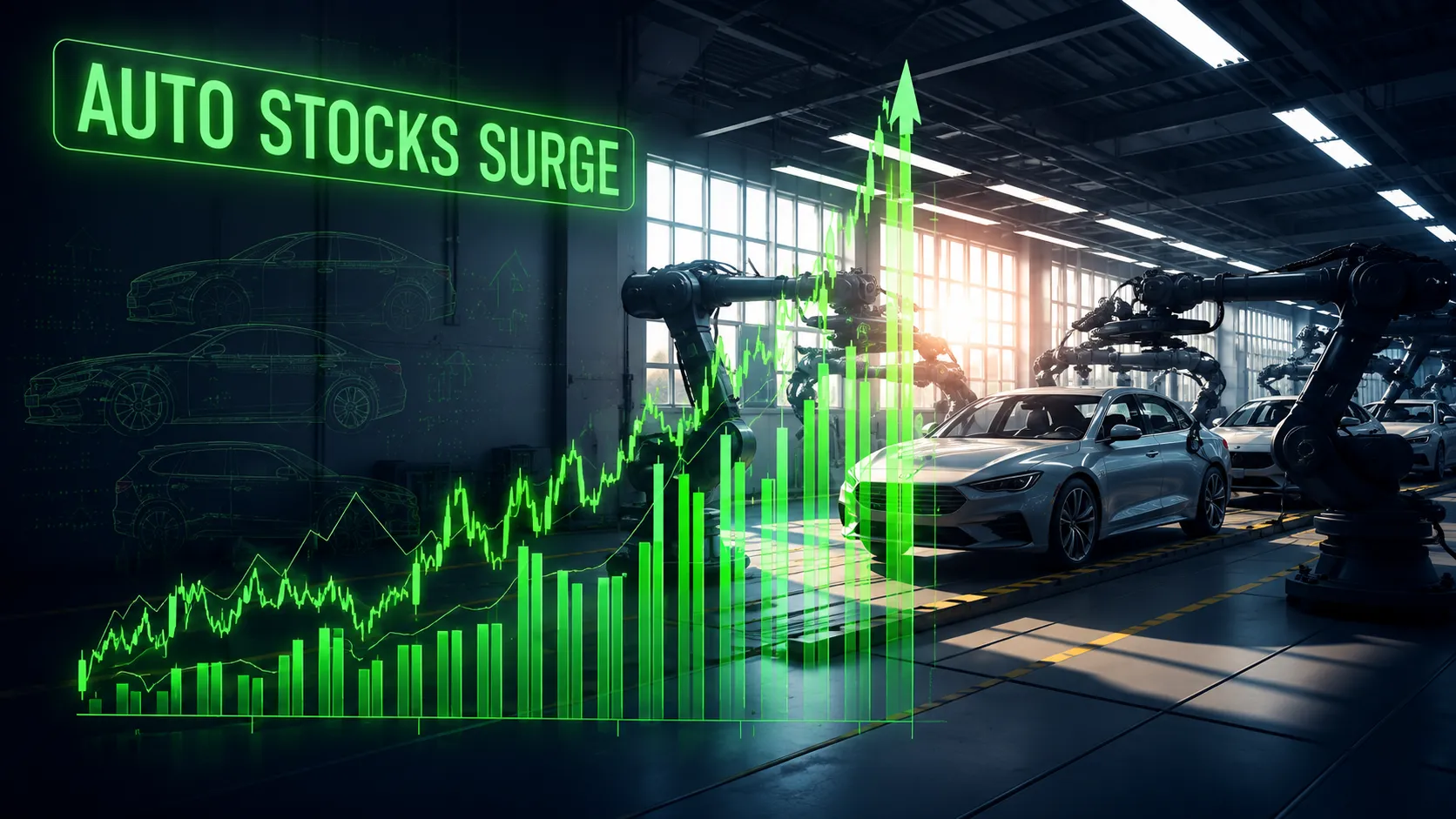
While the rally on Thursday was concentrated primarily among passenger vehicle, utility vehicle and commercial vehicle manufacturers, India's substantial two-wheeler segment — encompassing motorcycle and scooter manufacturers serving what remains the single largest vehicle category by unit volume in the Indian market — did not feature as prominently among the day's gainers, even as the segment continues to represent a critical barometer of entry-level and rural consumer purchasing power more broadly. Sector analysts note that two-wheeler demand trends have, over recent quarters, shown a somewhat more mixed picture compared to the stronger momentum visible in utility vehicles and tractors specifically, reflecting differences in the underlying consumer segments each category primarily serves.
The broader capital markets read-through
Beyond the immediate stock price movements, Thursday's auto sector rally carries broader read-through implications for how investors are currently calibrating their views on Indian consumer demand more generally. Automobile purchases, particularly at the higher end of the passenger vehicle spectrum, represent a meaningfully discretionary spending category sensitive to broader consumer confidence and income growth trends. A sector-wide rally driven by genuinely strong operational results, rather than mere speculative positioning, offers a data point supporting the broader thesis that India's domestic consumption engine remains fundamentally healthy, even amid the various external uncertainties — trade policy, currency volatility, elevated crude prices — that have periodically weighed on overall market sentiment through 2026.
Institutional versus retail positioning in auto stocks
Data on trading patterns around Thursday's rally suggests both institutional and retail investors participated meaningfully in the buying activity across auto sector names, a pattern that market observers note tends to produce more durable price gains than rallies driven predominantly by any single investor category alone. Domestic mutual funds, which have historically maintained substantial overweight positions in auto sector stocks relative to broader index weights, appear to have added further to those positions following the strong earnings prints, while foreign institutional investors, who had shown renewed buying interest across Indian equities more broadly this week, similarly directed a portion of that capital toward the auto sector specifically, drawn by the combination of strong reported earnings and continued constructive commentary on demand trends from company management teams. This broad-based participation across investor categories reinforces the view that Thursday's auto rally reflected genuine, fundamentals-driven conviction rather than narrow, speculative positioning by any single class of market participant.