Ather Energy Just Made Its Boldest Move Since Going Public — And the Numbers Back It Up
There's a difference between a company raising money because it has to and a company raising money because it sees an opportunity too big to miss. Ather Energy's latest capital raise announcement lands firmly in the second category — and the financial results sitting behind it make that very clear.
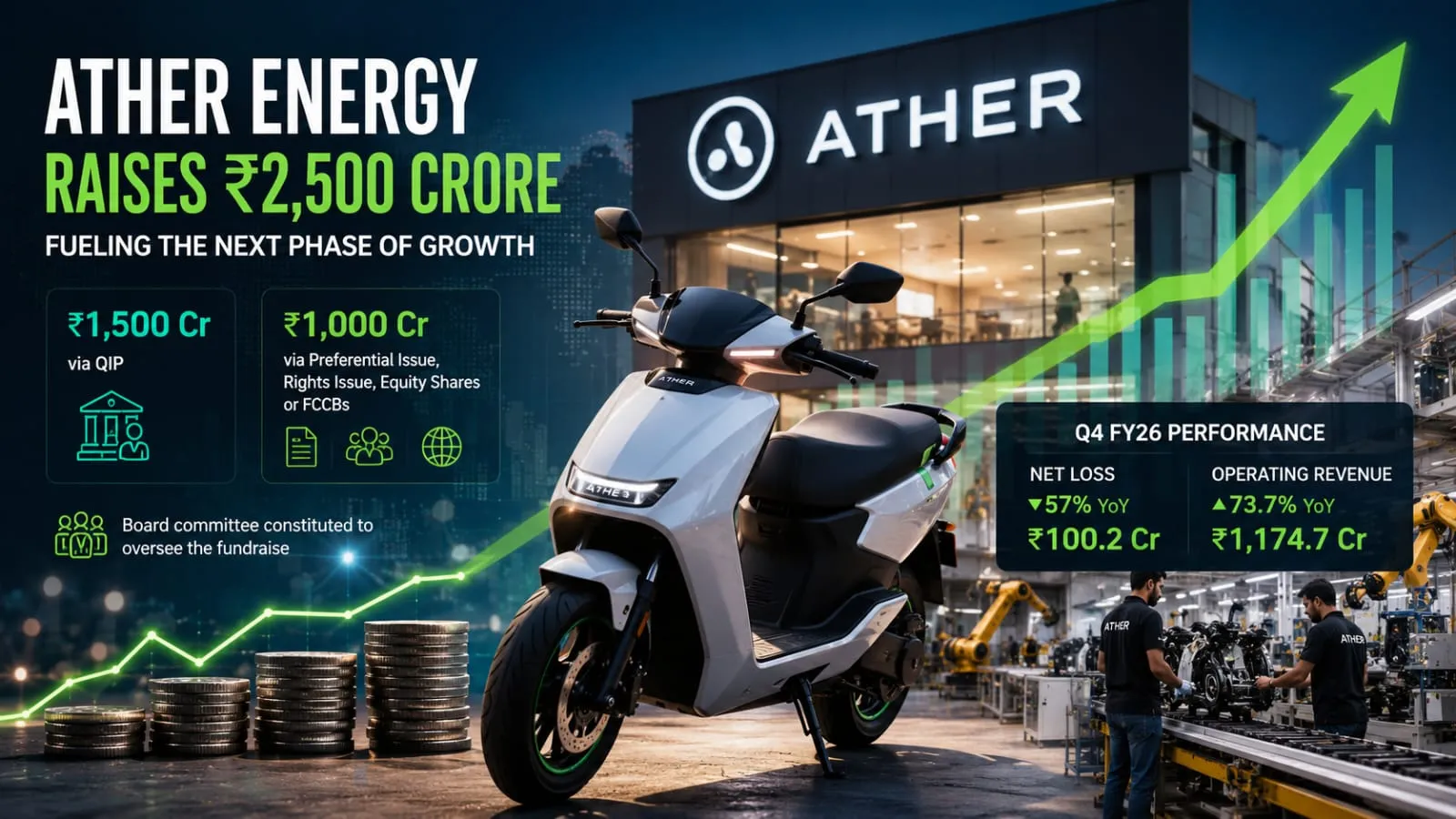
Ather Energy's board has approved a plan to raise up to ₹2,500 crore in fresh capital. The structure is split across two channels: ₹1,500 crore through a Qualified Institutional Placement — known as a QIP — which allows the company to issue shares directly to institutional investors at speed. The remaining ₹1,000 crore will be raised through a mix of routes including a preferential issue, rights issue, equity shares, or foreign currency convertible bonds. The board has already constituted a dedicated committee to manage every aspect of this fundraise — signalling this isn't exploratory thinking. This is execution mode.
A Year After the IPO — And the Story Has Changed
When Ather Energy listed on Indian stock exchanges in May 2025 through a ₹2,981 crore IPO, the reception was cautious. The issue scraped through with just 1.4x subscription. Institutional investors carried the weight. The market was watching — not convinced.
Fast forward fourteen months, and everything has changed. Ather's market capitalisation now sits at approximately ₹38,400 crore — more than three times its IPO valuation. Shares trade near ₹1,011, a dramatic re-rating that reflects something more than market sentiment. It reflects real, measurable operational progress.
The Q4 Numbers That Tell the Real Story
The most powerful argument for this fundraise isn't the strategy deck — it's the quarterly results. In Q4 FY26, Ather delivered numbers that would make any investor sit up straight.
Net loss trimmed by 57% year-on-year to just ₹100.2 crore. A year ago, that number was significantly higher. Operating revenue surged 73.7% year-on-year to ₹1,174.7 crore in the same quarter. That's not a company bleeding capital in a desperate race for market share. That's a company that has found its footing, tightened its operations, and is now accelerating from a position of genuine strength.
The improvement came from a deliberate shift toward premium products, favourable battery cell costs, and years of investment in R&D-driven value engineering finally paying dividends. Ather didn't cut corners to improve its margins — it built better products and sold more of them.
Why ₹2,500 Crore? Why Now?
India's electric two-wheeler market is at an inflection point. The transition from petrol to electric isn't a future prediction anymore — it's happening right now, on Indian roads, every single day. But capturing that transition requires something every EV company needs in enormous quantities: capital.
Capital for manufacturing capacity. Capital for charging infrastructure. Capital for R&D on the next generation of products. Capital for the retail network expansion that brings Ather to every corner of the country, not just its current strongholds in Bengaluru and the south.
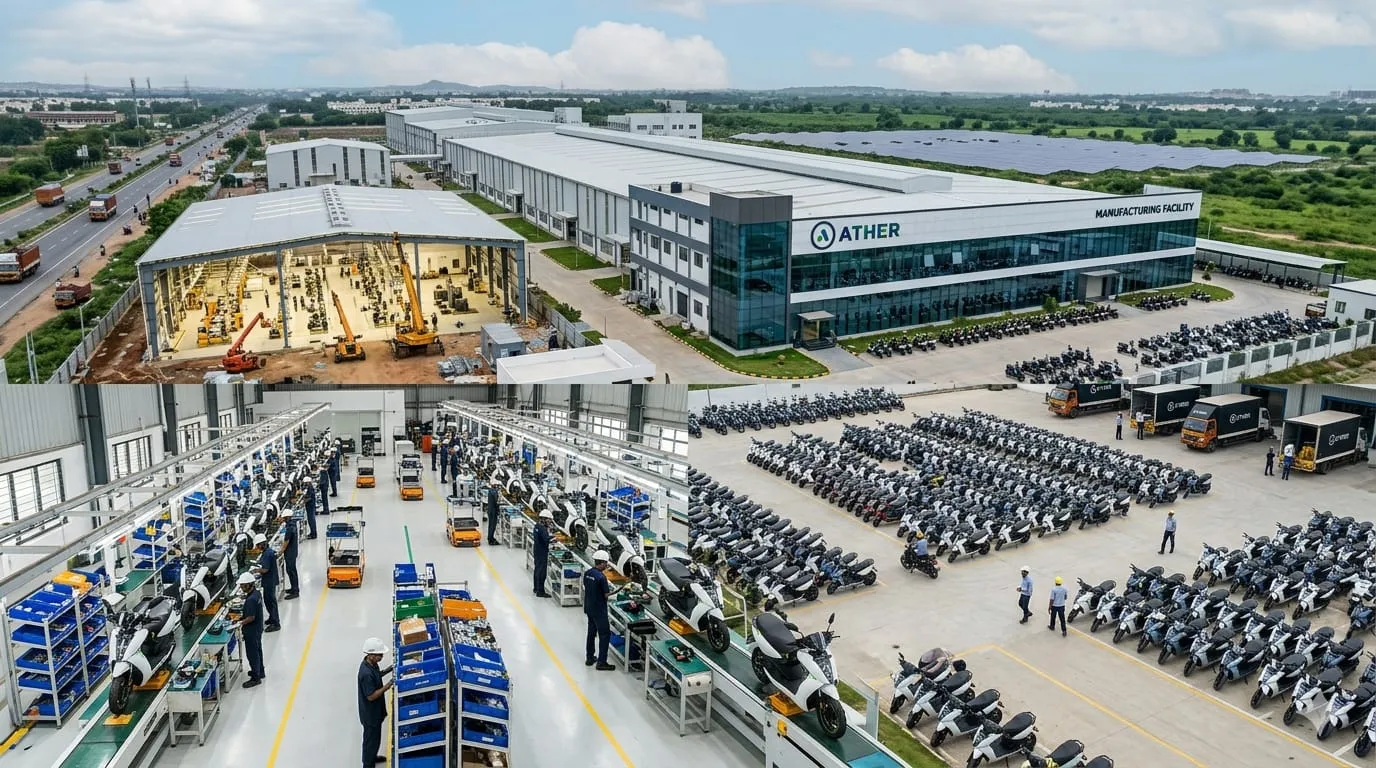
Ather has ambitious plans to expand its production capacity by up to 300% — and that kind of scale-up cannot be funded from quarterly cash flows alone. The ₹2,500 crore raise is the fuel that powers that expansion.
Unlike rival Ola Electric, which recently raised ₹780 crore through a QIP amid concerns over market share and profitability, Ather is approaching investors from a fundamentally different position — with improving financials, growing market share, and a clear product roadmap. That distinction matters enormously when institutional investors are deciding how to allocate capital.
The Bigger Picture
India's EV transition is one of the most significant economic stories of this decade. The government's push through PLI schemes, the FAME subsidies framework, and the broader infrastructure buildout is creating conditions for explosive growth in electric mobility. The question was never whether India would go electric — it was always which companies would be standing when the dust settled.
Ather Energy has been answering that question, quarter by quarter, with better products and better numbers. Its founders Tarun Mehta and Swapnil Jain built the company from an IIT Madras lab project into a listed EV giant — and the ₹2,500 crore fundraise is their signal that the second chapter of that story is going to be even bigger than the first.
The EV wars in India are intensifying. Ather just showed up with fresh ammunition.