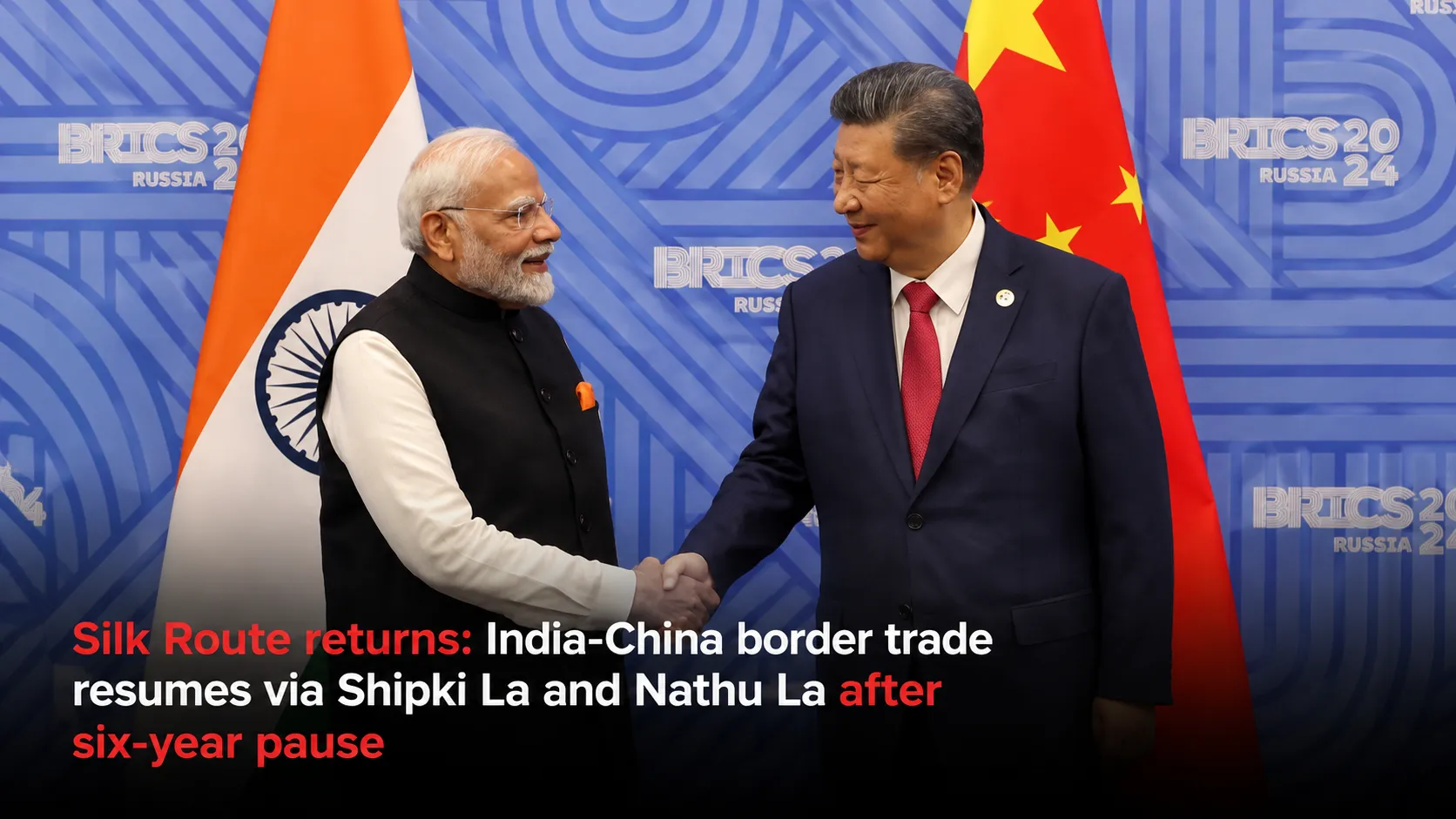
SHIMLA / GANGTOK — In a significant marker of gradually thawing India-China relations, cross-border trade through two of the Himalayas' most historic trading corridors — the Shipki La pass in Himachal Pradesh and the Nathu La pass in Sikkim — resumed over the weekend of August 1-2, ending a six-year suspension that had cut off centuries-old barter commerce between local traders and their counterparts across the Tibetan border, with the economic ripple effects and broader diplomatic significance continuing to be assessed as the new trading week began on Monday.
At Shipki La, in the high-altitude tribal district of Kinnaur, Himachal Pradesh's Revenue and Horticulture Minister Jagat Singh Negi flagged off 16 local traders on Saturday, presenting them with traditional Khataks — ceremonial scarves — before they departed with their horses laden with goods toward Shipki village on the Tibetan side of the border. Under the barter-based trading arrangement that governs commerce through this route, the exchange of goods takes place without conventional currency transactions, with traders required to return to Indian territory after conducting trade in the Tibetan region for a fixed window of 72 hours.
The Nathu La reopening in Sikkim followed a parallel path, with an inaugural ceremony held at the designated “No Man's Land” between the border gates of India and China, attended by officials from the Government of Sikkim and Chinese counterparts. Sikkim's Commerce and Industries Minister TT Bhutia described the resumption as a “historic milestone” that would strengthen the state's economy, generate employment and create fresh livelihood opportunities for communities in the border region — explicitly linking the trade revival to the Centre's broader Act East Policy, the PM Gati Shakti infrastructure initiative, and the government's overarching Viksit Bharat (developed India) development vision.
Both trade routes carry genuine historical weight. Nathu La's trading history stretches back generations, having first resumed in its modern form in July 2006 after remaining closed for 44 years following the 1962 India-China war — only to be suspended once again in 2020, initially attributed to the Covid-19 pandemic but subsequently prolonged by the broader deterioration in bilateral relations following the military standoff between Indian and Chinese forces in eastern Ladakh that same year. Shipki La's border trade, similarly suspended since 2020 in the aftermath of that Ladakh standoff, represents part of the same broader freeze in cross-border economic engagement that has only now begun to thaw.
The resumption of both trading routes follows directly from an understanding reached during Chinese Foreign Minister Wang Yi's visit to New Delhi the previous year, when both governments agreed in principle to reopen border trade through three designated trading points: Nathu La in Sikkim, Lipulekh Pass in Uttarakhand, and Shipki La in Himachal Pradesh — part of a broader, carefully calibrated roadmap aimed at gradually restoring diplomatic and economic engagement between the two Asian giants after years of strained relations following the 2020 border clashes.
Notably, the reopening of these historic trade corridors arrives just weeks after the resumption of the Kailash Mansarovar Yatra — the sacred Hindu and Buddhist pilgrimage route through Tibet — via both Lipulekh Pass and Nathu La, with Shipki La now also being added as an additional pilgrimage route according to communications from India's External Affairs Ministry to state governments. Taken together, officials characterize this sequence of developments — pilgrimage route restoration followed closely by border trade resumption — as evidence of a deliberate, phased normalization of people-to-people and economic exchanges between India and China, even as more substantive strategic and territorial disputes between the two countries remain unresolved and continue to be addressed through separate diplomatic channels.
For the local communities directly served by these trade routes, the economic stakes are considerable, if modest in absolute national economic terms. Negi, addressing the significance of the Shipki La reopening, noted that many trading families on the Indian side maintain deep cultural affinities with their counterparts across the border, relationships built up across three to four generations of ancestral trading ties that were abruptly severed by the six-year suspension. The minister emphasized that the resumed trade would provide renewed strength to the border-area economy and expand employment and self-employment opportunities for local youth, alongside boosting broader commercial activity, tourism and hospitality sectors in these remote Himalayan regions.
Beyond the immediate economic benefits to traders, transport operators, porters, warehouse owners and small hospitality businesses in Kinnaur and East Sikkim, officials in both border states have signaled ambitions to expand the scope of the resumed trade considerably beyond its initial reopening scale. Sikkim's state government, in particular, has formally urged India's Directorate General of Foreign Trade to expand the current list of tradable items permitted under the border trade arrangement and to increase overall trade volumes — changes that, if implemented, could meaningfully expand the economic opportunity available to local entrepreneurs beyond the relatively narrow scope of goods currently authorized for cross-border barter trade.
Infrastructure investment has accompanied the diplomatic and trade normalization process, with officials noting that road connectivity, communication networks and other basic amenities serving these remote border areas have seen accelerated development work in the lead-up to Saturday's reopening, undertaken as part of both states' broader efforts toward holistic development of border regions. Security arrangements for the resumed trade have also been a significant focus, with the Indo-Tibetan Border Police (ITBP) credited with ensuring what officials described as foolproof security and seamless coordination for the successful flagging-off of the first trade convoys through both passes.
As border trade activity through Shipki La and Nathu La settles into its resumed rhythm over the coming weeks and months, the broader trajectory of India-China economic and diplomatic engagement will continue to be closely watched — both by the border communities whose livelihoods are most immediately and tangibly affected, and by a wider set of policymakers and analysts assessing whether this carefully calibrated trade normalization represents a durable thaw in one of Asia's most consequential and complex bilateral relationships, or a more limited, symbolically significant but economically modest gesture within a broader relationship that continues to be shaped by unresolved strategic tensions along other stretches of the shared Himalayan frontier.