When Blackstone-backed AirTrunk CEO Robin Khuda sat across from Prime Minister Narendra Modi in New Delhi on June 5, 2026, the conversation that unfolded produced a number that startled even the most experienced infrastructure investors in the room: thirty billion dollars, to be deployed across India by 2030 in the form of hyperscale AI-ready data-centre capacity. That single announcement makes AirTrunk’s commitment the largest proposed investment in India’s digital infrastructure from a single private operator — by a margin that invites no close comparison. It is, in every meaningful sense, a bet-the-decade commitment to the country’s technological future.
To understand why a figure of this magnitude arrived in 2026 and not earlier, it is necessary to understand what has changed in India’s data-centre landscape over the past three years. When AirTrunk first began studying the Indian market, the country’s total live data-centre capacity stood at approximately 1.5 gigawatts — the combined output of every server farm in Mumbai, Bengaluru, Chennai, Hyderabad, and Delhi combined. The projected demand by 2030, driven by AI workloads, cloud computing adoption, and the digital economy’s expansion into Tier 2 and Tier 3 cities, stands at 8 gigawatts. The gap between supply and demand represents one of the most compelling infrastructure investment opportunities anywhere in the world — and AirTrunk, backed by Blackstone’s capital and its own decade of Asian data-centre expertise, has moved to capture it.
AirTrunk entered India only two months before this announcement, acquiring Lumina CloudInfra in April 2026 — a transaction that gave the company an immediate development pipeline of 600 megawatts across Mumbai, Chennai, and Hyderabad. That acquisition was itself significant: it demonstrated AirTrunk’s intent to build on existing Indian infrastructure relationships rather than starting from scratch, and it gave the company the regulatory registrations, power purchase agreements, and customer relationships that a foreign operator would otherwise spend years assembling. On June 1, 2026, Maharashtra Chief Minister Devendra Fadnavis confirmed that the state had exchanged a letter of intent with AirTrunk for land allotment at the Raigad Pen Growth Centre — a single hyperscale campus project involving an investment of ₹2 trillion, or approximately $21 billion. That project alone accounts for the majority of the planned 5GW.
The competitive implications of AirTrunk’s commitment reverberate across the entire Indian data-centre industry. Existing domestic operators — AdaniConneX, Reliance’s JioDC, STT GDC India, CtrlS, and NTT India — now face a well-capitalised international competitor operating with the backing of one of the world’s most sophisticated infrastructure investors, a proven Asia-Pacific operational platform, and the explicit endorsement of both the Indian Prime Minister and the Maharashtra Chief Minister. For these domestic operators, the arrival of AirTrunk is simultaneously a validation of the market thesis they have been building toward, and a competitive pressure that will accelerate the efficiency improvements their own operations require.

For India’s AI startup ecosystem, the implications are unambiguously positive. One of the most persistent constraints on Indian AI development has been the dependence on foreign cloud infrastructure for the compute-intensive work of model training and large-scale inference. Training a competitive large language model, fine-tuning a domain-specific AI system, or running the inference pipelines that serve millions of users simultaneously requires GPU clusters of a scale that, until recently, existed almost exclusively in American and European data centres. AirTrunk’s 5GW commitment changes this equation at scale. By 2030, India will have access to data-centre capacity comparable to the largest regional AI compute clusters in the world — built in India, governed by Indian law, accessible to Indian companies at costs that reflect Indian power tariffs and India’s improving renewable energy infrastructure.
The global context of AirTrunk’s India bet is equally instructive. CBRE’s 2026 Asia Pacific Data Centre Trends report identifies India and Malaysia as the leading hyperscale hotspots in the region, with Mumbai recording live capacity growth of 15 to 25 percent year-on-year in 2025. Google broke ground in April 2026 on a $15 billion AI hub in Visakhapatnam — its largest India investment ever. Microsoft’s Hyderabad data centre is on track to go live by mid-2026 as part of a $17.5 billion India commitment. The convergence of these commitments from Blackstone, Google, and Microsoft in the same six-month period is not coincidental. It reflects a coordinated recognition by the world’s most analytically sophisticated infrastructure investors that India’s AI decade is not a projection — it is underway, and the infrastructure buildout that serves it represents one of the most significant capital deployment opportunities of the 2020s.
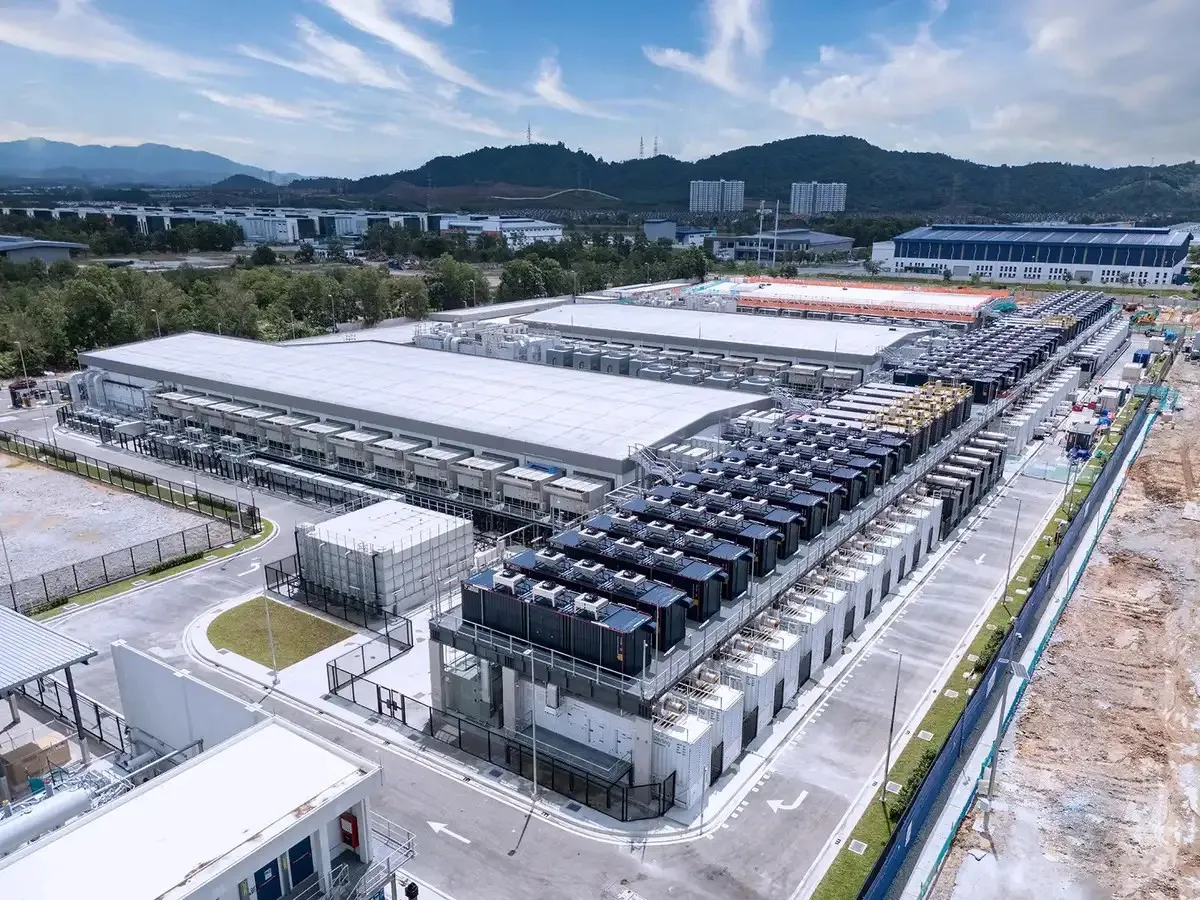
Prime Minister Modi’s endorsement of the commitment — posted on X with the characterisation that the proposal was “among the largest in the country’s digital infrastructure ecosystem” — signals the level of government facilitation that AirTrunk can expect as it navigates the land acquisition, environmental clearance, power grid access, and regulatory approvals that hyperscale data-centre construction in India requires. This is not ceremonial language. When the Prime Minister publicly backs a specific infrastructure project, it activates a cascade of state-level cooperation, central ministry facilitation, and regulatory priority that significantly compresses the timeline from announcement to operational capacity. The 2030 deadline, which would otherwise be ambitious, becomes credible.
For The Impactful Global Indian — the global community of Indian-origin professionals, entrepreneurs, and investors who watch India’s technological ascent with both pride and analytical interest — AirTrunk’s $30 billion commitment carries a significance that transcends its financial scale. It is confirmation, from the most commercially rigorous source imaginable, that the country’s digital infrastructure ambitions are credible, fundable, and urgent. It is proof that India’s AI story is not contingent on government spending alone, but is attracting the private capital that creates sustainable, scalable, and world-class infrastructure. And it is a signal to every Indian AI founder training a model, every Indian enterprise evaluating AI adoption, and every Indian student choosing a technology career: the foundation is being built. The decade ahead belongs to those who build on it.