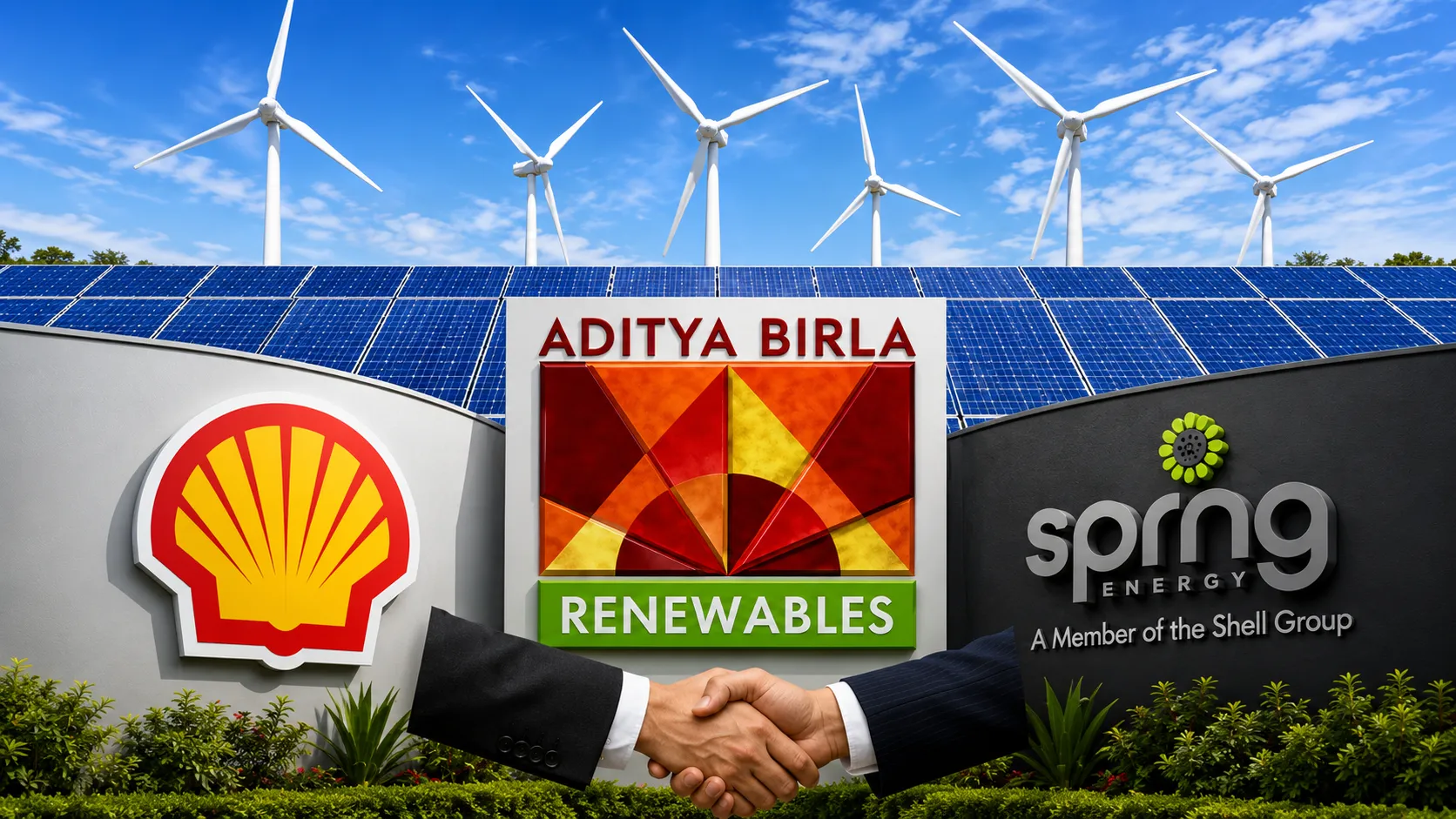
In one of the most significant clean-energy transactions to hit Indian headlines in recent months, the Aditya Birla Group has announced a deal to acquire Shell's Indian renewable energy platform, Sprng Energy, in a transaction reportedly valued at around Rs 17,200 crore. The acquisition represents a decisive and large-scale entry by one of India's most storied industrial conglomerates into the renewable energy sector, a space that has, until now, been dominated by a handful of specialised green-energy players and a small number of other large diversified conglomerates that moved early and aggressively into solar, wind, and battery storage capacity over the past several years. For the Aditya Birla Group — a sprawling business empire with interests spanning cement, metals, textiles, financial services, telecommunications, and chemicals, among others, under the leadership of chairman Kumar Mangalam Birla — the Sprng Energy acquisition represents both a strategic diversification move and an implicit acknowledgment that renewable energy has moved from being a peripheral, ESG-driven consideration for large Indian industrial houses to a core, must-have piece of any credible long-term growth strategy. India's largest conglomerates have increasingly been racing to build out clean-energy capacity, both to hedge against the rising cost and regulatory uncertainty associated with fossil-fuel-dependent operations across their existing industrial businesses, and to capture what is widely viewed as one of the most significant capital-deployment opportunities of the coming decade as India works toward its ambitious renewable energy capacity targets. Sprng Energy itself brings a substantial, already-operational renewable energy portfolio to the table, having been built up by Shell over recent years as part of the global energy major's broader strategy of expanding into renewable power generation in high-growth emerging markets, even as it has simultaneously continued to manage its legacy fossil-fuel business globally. The platform's asset base reportedly spans a mix of solar and wind generation capacity across multiple Indian states, positioning it as one of the more mature, revenue-generating renewable energy platforms available for acquisition in the Indian market, as opposed to a purely greenfield development opportunity that would require years of project execution risk before generating meaningful returns. For Aditya Birla Group, acquiring an already-operational platform of this scale allows the conglomerate to establish an immediate, sizeable foothold in the renewable energy generation business, rather than having to build that capacity organically from scratch over a multi-year timeline. The transaction also fits into a broader pattern that has been reshaping India's renewable energy ownership landscape over the past two to three years: global energy majors, several of which made early bets on Indian renewable assets during the sector's initial growth phase, have increasingly been looking to monetise those investments as valuations have risen and as domestic Indian conglomerates, flush with capital and eager to build scale in the sector, have emerged as willing and well-capitalised buyers. Shell's decision to divest Sprng Energy to Aditya Birla Group can be read, in that light, as part of a broader global energy major playbook of recycling capital out of mature renewable assets in specific geographies to redeploy toward other strategic priorities, while allowing well-capitalised local players to take on the next phase of scaling and operating those assets within India's evolving regulatory and grid-integration environment.
For India's broader renewable energy sector, the deal carries significance well beyond the specific transaction value. India has set itself ambitious national targets for renewable energy capacity addition as part of its broader climate commitments and energy security strategy, aiming to substantially reduce its dependence on imported fossil fuels while building out a domestic clean-energy generation base large enough to support the country's rapidly growing electricity demand, driven by industrialisation, data-centre expansion linked to the broader technology and artificial intelligence boom, and rising household electricity consumption as living standards improve. Achieving those targets requires not just policy support and grid infrastructure investment from the government, but sustained, large-scale capital deployment from private industry — precisely the kind of commitment that a transaction of this size from a conglomerate as prominent as Aditya Birla Group signals to the broader market and to potential co-investors and lenders considering their own renewable energy commitments in India. The timing of the deal is also notable given the broader energy market backdrop currently dominating headlines. Even as global crude oil prices have been pushed higher by escalating tensions in West Asia, exposing the vulnerability of countries heavily dependent on imported fossil fuels to geopolitical shocks thousands of miles from their own borders, transactions like the Aditya Birla-Sprng Energy deal serve as a reminder of the parallel, longer-term structural shift underway in India's energy mix — one where domestic renewable generation capacity is increasingly viewed not merely as an environmental imperative, but as a genuine energy security hedge against exactly the kind of imported-fuel price volatility that has been rattling Indian markets and consumers in recent weeks. Solar and wind assets, once operational, carry minimal ongoing fuel-cost exposure compared to conventional thermal power generation, insulating their economics from the kind of crude-oil-driven cost shocks currently working their way through India's refining, transportation, and consumer fuel markets. From a corporate strategy perspective, the acquisition also reflects Aditya Birla Group's broader pattern of pursuing large, transformative acquisitions to establish rapid scale in strategically important sectors, rather than relying solely on slower organic growth. The group has, across its various business verticals over the years, demonstrated a willingness to deploy significant capital toward acquisitions that immediately establish it as a top-tier player in a given sector, and the Sprng Energy deal appears to follow that same playbook within the renewable energy space. Industry analysts tracking the deal have noted that successful integration and scaling of the acquired platform will be the key determinant of whether the transaction ultimately proves to be a value-accretive strategic move or simply an expensive entry ticket into an increasingly crowded and competitive Indian renewable energy sector, where established players including several other large conglomerates and specialised green-energy companies have already built substantial scale and operational track records. Financing structure and balance-sheet implications for Aditya Birla Group will also be closely watched by credit rating agencies and institutional investors in the group's various listed entities, given the scale of the transaction relative to the group's existing capital allocation priorities across its other core businesses. Large acquisitions of this nature typically require a mix of debt financing, internal accruals, and potentially fresh equity or strategic partnership capital, and how the group structures the financing for the Sprng Energy deal will offer useful signals about its broader capital allocation philosophy and risk appetite as it continues to build out its presence in the renewable energy sector alongside its more traditional industrial businesses.

For the Indian renewable energy sector's competitive landscape more broadly, the entry of a conglomerate with Aditya Birla Group's scale, balance-sheet strength, and cross-sector relationships — spanning everything from cement manufacturing, which is itself a significant energy consumer and a sector under increasing pressure to decarbonise, to financial services, which could potentially support future renewable energy project financing within the group's own ecosystem — adds a formidable new competitor to a field that had, until recently, been led primarily by a smaller set of dedicated renewable energy specialists and a handful of other diversified conglomerates. Whether this deal marks the beginning of a broader wave of similar large-scale acquisitions by other Indian industrial houses looking to build renewable energy capacity through M&A rather than organic development remains to be seen, but the scale and prominence of the Aditya Birla-Sprng Energy transaction ensures that it will be closely studied as a template — and a competitive benchmark — by rival conglomerates weighing their own renewable energy strategies in the months ahead. As India's energy transition continues to accelerate against a backdrop of rising domestic power demand and persistent global fossil-fuel price volatility, deals of this scale and ambition are likely to become an increasingly regular feature of the country's corporate landscape, and the Aditya Birla Group's decisive move into the sector via the Sprng Energy acquisition stands as one of the clearest signals yet that India's renewable energy story has firmly entered its next, conglomerate-driven phase of growth. The deal also arrives at a moment when India's electricity demand growth trajectory has been drawing increasing attention from both domestic and international energy analysts. The rapid build-out of data centre capacity linked to the broader artificial intelligence and cloud computing boom, alongside continued industrial expansion and rising household consumption as more Indian families gain access to air conditioning and other energy-intensive appliances, has pushed India's electricity demand growth rate to levels that are increasingly straining existing generation and grid infrastructure during peak demand periods. Meeting that incremental demand purely through conventional thermal generation would not only run counter to India's climate commitments but would also deepen the country's exposure to exactly the kind of imported fuel price volatility currently being felt through the West Asia-driven crude oil price spike. Large-scale renewable capacity additions, of the kind the Sprng Energy platform represents, are increasingly being viewed by energy planners as essential to meeting this demand growth in a way that does not simply substitute one form of energy insecurity for another. Global capital markets have also been watching how Indian conglomerates finance and structure these kinds of large renewable acquisitions, given the broader international investor appetite for climate-aligned investment opportunities in high-growth emerging markets. Aditya Birla Group's ability to successfully integrate and potentially scale the Sprng Energy platform further, whether through organic capacity additions, follow-on acquisitions of smaller renewable developers, or partnerships with global infrastructure and pension funds seeking exposure to Indian renewable assets, could position the group to attract exactly this kind of international climate-focused capital over the coming years, potentially creating a virtuous cycle where the initial acquisition becomes a platform for substantially larger future capital deployment rather than a one-off diversification move. Whether that broader ambition materialises will likely become clearer as the group outlines its integration plans and longer-term capacity growth targets for the newly acquired platform in the coming months, but the scale of Thursday's announcement leaves little doubt that the Aditya Birla Group intends the Sprng Energy acquisition to be a foundational move rather than a token gesture toward India's clean energy future.
For Shell, the divestment reflects a continuation of its own global portfolio rationalisation strategy, one in which the energy major has periodically exited operational assets in specific markets once they reach a stage of maturity that makes them more attractively valued by local strategic buyers than by Shell's own global capital allocation framework, freeing up proceeds for redeployment toward the company's other strategic priorities across its global renewable and traditional energy portfolio. That pattern of global majors building, maturing, and then selling down renewable assets to well-capitalised local conglomerates is likely to recur across other emerging energy markets in the years ahead, making the Aditya Birla-Sprng Energy transaction a useful case study not just for India's own energy sector, but for how the broader global energy transition's capital cycle is beginning to mature. Analysts covering both companies will be watching subsequent regulatory filings and closing conditions closely over the coming weeks for further clarity on deal timelines, financing structure, and any conditions attached to the transfer of operational assets and long-term power purchase agreements tied to the Sprng Energy portfolio. Competition Commission of India clearance and standard regulatory approvals will also need to be secured before the transaction can formally close, a process that typically takes several weeks to a few months for deals of this scale and sector sensitivity. Market observers expect the coming quarters to bring greater clarity on how Aditya Birla Group intends to brand, operate, and potentially expand the acquired platform within its existing corporate structure, including whether Sprng Energy will be folded into an existing group entity or retained as a distinct operating unit.