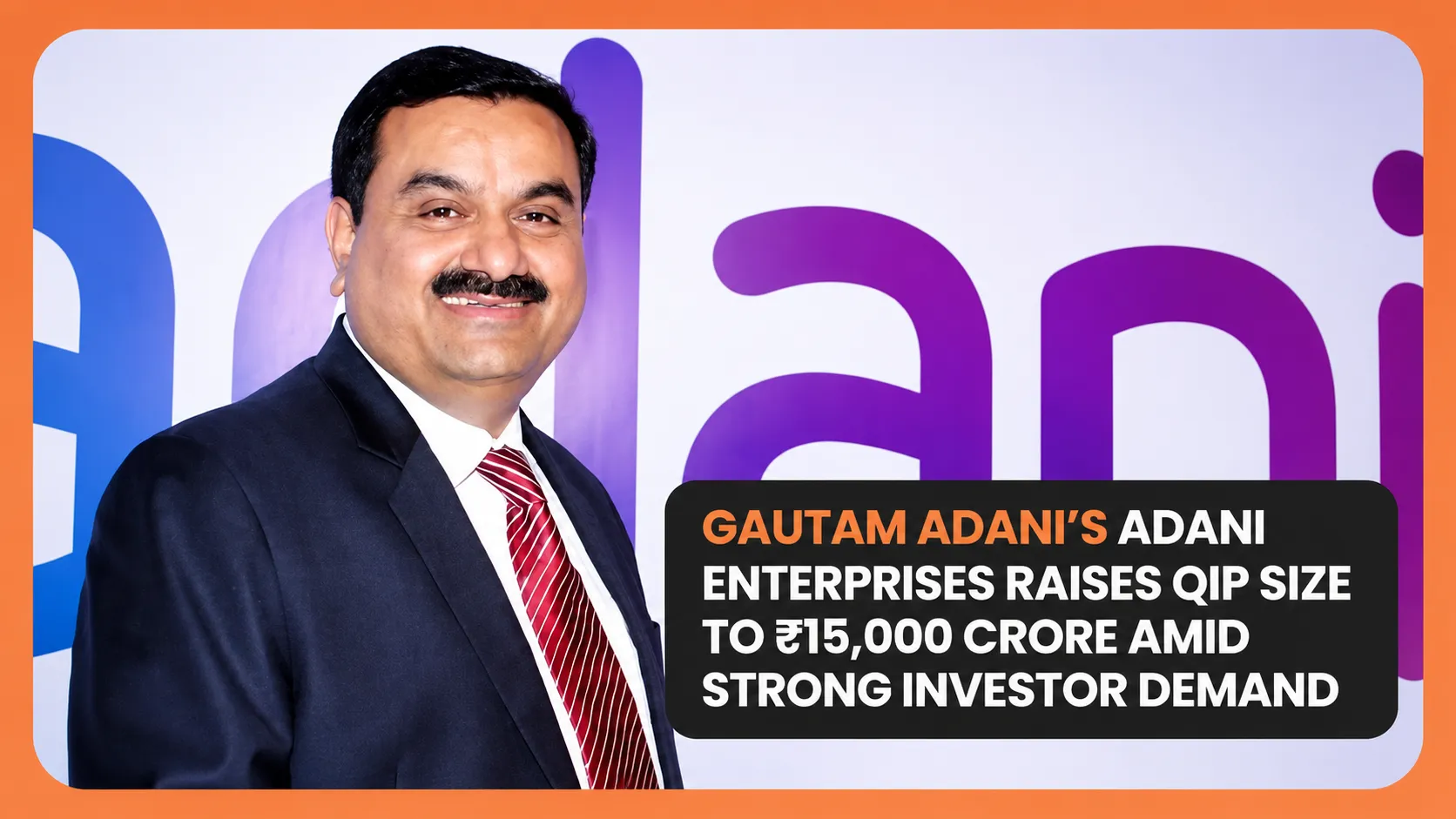
India's qualified institutional placement market opened the second half of 2026 with a striking surge in activity, with companies collectively raising approximately ₹15,000 crore through QIPs in early July, led decisively by Adani Enterprises, the flagship listed entity of the Adani Group. The scale and pace of this fundraising activity has been read by market participants as a clear signal of improving institutional sentiment toward Indian equities more broadly, and toward Adani Group entities specifically, at a moment when the conglomerate has been working actively to close out lingering legal uncertainty tied to a years-long US legal case that had, at its peak, wiped out billions of dollars in market capitalisation across the group's listed companies.
Qualified institutional placements represent one of the more efficient mechanisms available to Indian listed companies for raising fresh equity capital, allowing eligible companies to sell shares directly to institutional investors — including mutual funds, insurance companies, foreign portfolio investors and other qualified buyers — without the more extensive regulatory and procedural requirements that accompany a full public offering open to retail investors. The mechanism has become an increasingly popular fundraising route for well-established, already-listed Indian companies looking to strengthen their balance sheets, fund expansion capital expenditure, or reduce leverage without the time and cost overhead associated with either a rights issue or a follow-on public offering.
Data on institutional buying activity through June and into early July paints a striking picture of renewed confidence in Adani Group securities specifically. Mutual funds deployed substantial capital through both block deals and QIPs during this period, with Adani Enterprises alone attracting approximately ₹4,660 crore in mutual fund purchases, while JSW Infrastructure separately drew roughly ₹4,607 crore in similar institutional buying activity. This pattern of concentrated mutual fund buying in specific large-capitalisation infrastructure and conglomerate names reflects a broader institutional rotation toward companies perceived to offer strong exposure to India's ongoing infrastructure and industrial capital expenditure cycle, even as fund managers continue to differentiate carefully between individual companies based on their specific balance sheet strength, growth visibility, and any residual company-specific risk factors.
For Adani Enterprises specifically, this institutional buying surge arrives at a particularly significant juncture in the group's ongoing effort to rebuild investor confidence following the initial market shock triggered by US legal allegations first raised against the conglomerate and its chairman, Gautam Adani, several years ago. The group has pursued a sustained, multi-pronged strategy to address the aftermath of that episode, combining an active capital markets fundraising programme designed to demonstrate continued institutional appetite for Adani securities with a parallel legal strategy aimed at formally closing out the underlying US case — most recently including a sworn affidavit filed by Gautam Adani himself, explicitly denying any improper arrangement behind the US Department of Justice's eventual dismissal of the criminal charges that had originally been brought against him.
The scale of mutual fund participation in this QIP surge carries particular significance given how closely institutional asset managers typically scrutinise the companies they invest client capital into, particularly for a group that has faced sustained public scrutiny over its corporate governance practices and disclosure standards. Continued, and indeed growing, mutual fund participation in Adani Group securities through this period suggests that at least a meaningful segment of India's professional institutional investor community has concluded that the group's underlying operational cash flows, asset quality, and growth prospects across its core infrastructure businesses — spanning ports, power generation and transmission, renewable energy, and airports — justify continued and even expanding investment exposure, notwithstanding the legal and governance scrutiny the group has faced.
JSW Infrastructure's strong showing alongside Adani Enterprises in this fundraising wave reflects a broader institutional enthusiasm for India's infrastructure sector more generally, rather than an isolated vote of confidence in Adani specifically. India's ports, logistics and broader infrastructure sector has benefited from sustained government capital expenditure, growing trade volumes, and the steady formalisation of India's logistics ecosystem away from fragmented, informal operators toward larger, professionally managed infrastructure companies capable of handling the country's growing volumes of both domestic and international trade. Institutional investors have increasingly viewed exposure to well-capitalised infrastructure operators as an attractive way to gain exposure to this broader structural growth theme within the Indian economy.
The broader capital markets backdrop against which this QIP surge unfolded has been notably supportive, with the Sensex and Nifty posting healthy gains through much of the period on the back of an encouraging Q1 FY27 corporate earnings season, creating favourable conditions for companies to price and complete institutional placements at attractive valuations. This supportive secondary market environment, combined with continued strong domestic mutual fund inflows driven by India's deepening systematic investment plan culture, has together created conditions in which large-scale QIP fundraising of the kind seen in early July has become increasingly achievable for well-positioned Indian companies across sectors.
Looking ahead, the sustained pace of institutional fundraising activity through QIPs, alongside the parallel wave of large IPOs moving through India's primary market pipeline, suggests that India's broader capital markets remain firmly in an expansionary phase as the country moves through the second half of calendar year 2026. For Adani Enterprises and the broader Adani Group specifically, continued strong institutional participation in its capital raising activities will likely remain one of the clearest, most closely watched real-time indicators of whether the group has successfully navigated past the legal and reputational challenges of recent years, even as the conglomerate continues to pursue an ambitious, capital-intensive expansion agenda across its core infrastructure businesses.
The mechanics of how a QIP is priced and allocated also offer useful insight into what this fundraising surge reveals about institutional conviction. Under SEBI's QIP regulations, pricing is typically benchmarked against a formula tied to the stock's recent trading average, with limited scope for companies to offer steep discounts to attract institutional participation. A successful, well-subscribed QIP completed at or close to prevailing market prices — as appears to have been the case with Adani Enterprises' recent placement — therefore signals genuine institutional conviction in the company's valuation, rather than participation driven primarily by an attractively discounted entry price, a distinction that market analysts consider meaningful when assessing the underlying quality of demand behind any given fundraising round.