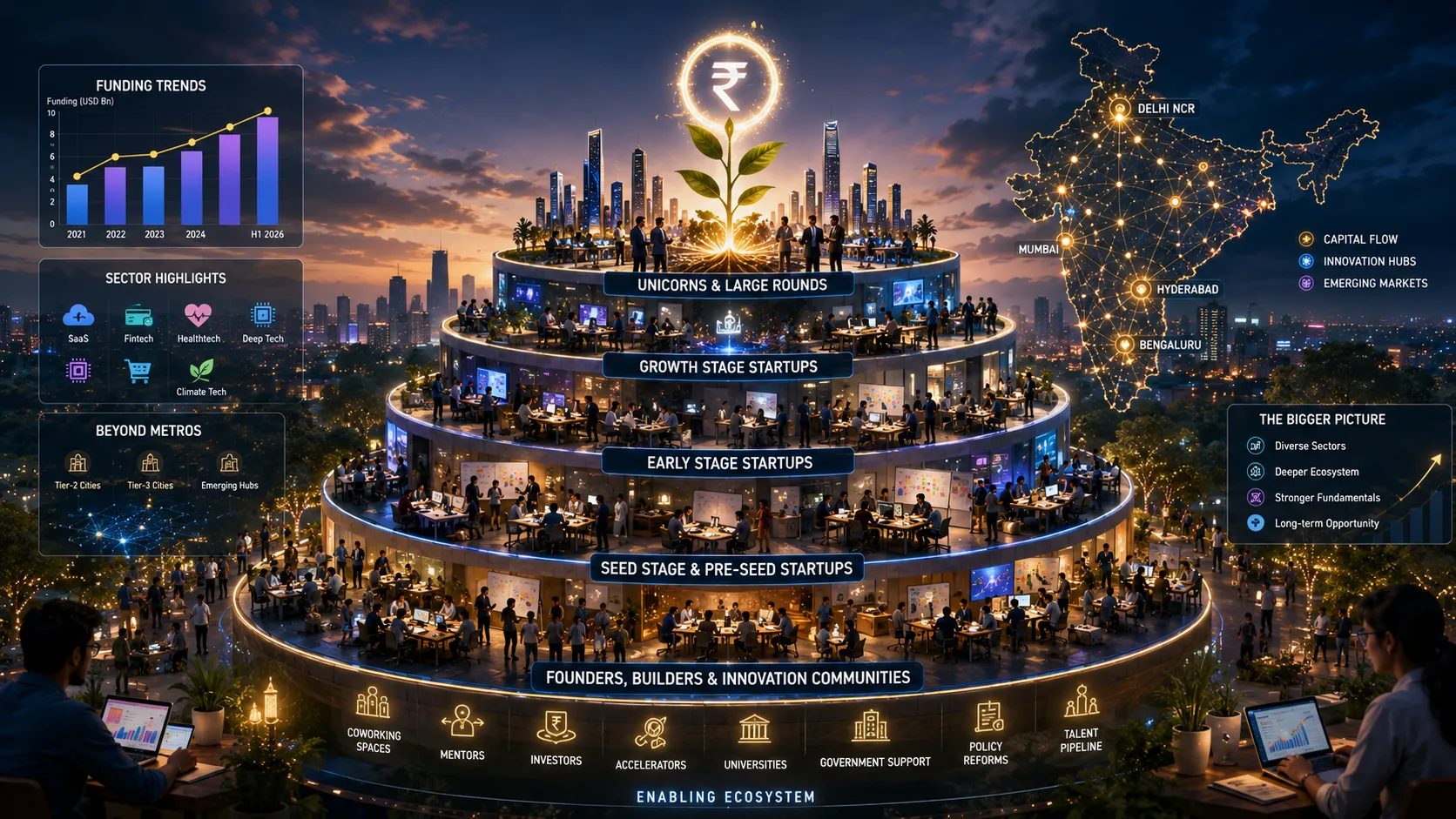
The latest data cut from Tracxn is, on first reading, mildly discouraging: $8.09 billion raised across 806 equity funding rounds in India through the first half of 2026, down 17.88% from the $9.85 billion raised across 1,473 rounds in the same period of 2025. But experienced India watchers know that reading this number at face value is like judging a marathon runner's performance by their pace in the first mile. The real story of India's H1 2026 funding landscape is structural quality improvement — and it is a story that should excite every Global Indian building or investing in the ecosystem.

The most important data point is not the aggregate decline but the concentration pattern. India's funding activity peaked at $2.114 billion in March 2026 before moderating. That peak was driven by large-ticket deals in AI infrastructure, fintech, and logistics. The fact that India can generate $2 billion in a single month of startup funding tells you more about the ecosystem's ceiling than the year-on-year comparison tells you about its floor. Deep tech — AI, robotics, biotech, quantum computing — accounts for about 12% of India's startup base with more than 3,600 companies, per KPMG's 2026 report. Deep tech funding held up better than expected, validating years of patient ecosystem building.
The Business Connect India analysis of June 2026 offers the most astute framing: 'Capital is crowding into companies that appear capable of owning strategic infrastructure: foundational AI platforms, compute-heavy businesses, semiconductor-adjacent ventures, data systems, cybersecurity layers, and automation tools with immediate enterprise demand.' This is crucial insight for founders. The investors writing cheques in H1 2026 are not betting on product categories — they are betting on companies with procurement relationships, demonstrated enterprise demand, and defensible positions in non-discretionary budget lines.