
What happens when a government looks at its startup ecosystem—now home to over 2 lakh recognised startups—and decides that the first ₹10,000 crore fund wasn't enough? It doubles down. It goes deeper. It targets the hardest problems: quantum computing, AI chips, advanced materials, and space tech. It backs founders who are building technologies that take a decade to mature, not a year. And it signals to the world that India isn't just a services economy anymore—it's a nation that builds, designs, and scales the technologies of tomorrow. The era of patient, domestic, deep-tech capital has arrived. And it's backed by ₹10,000 crore of government conviction.
On February 14, 2026, the Union Cabinet, chaired by Prime Minister Narendra Modi, approved the establishment of the Startup India Fund of Funds 2.0 (Startup India FoF 2.0) with a total corpus of ₹10,000 crore. The scheme, unveiled in the budget for 2025-26, represents the government's most ambitious bet yet on India's innovation economy.
But to understand the magnitude of this moment, you have to look back at where it all began.
The Legacy of FFS 1.0
In 2016, when the original Fund of Funds for Startups (FFS 1.0) was launched under the Startup India Action Plan, India had fewer than 500 recognised startups. The venture capital ecosystem was nascent. Foreign capital was scarce. And Indian founders struggling to build deep-tech products had nowhere to turn.
FFS 1.0 changed that. With its own ₹10,000 crore corpus, the fund committed capital to 145 Alternative Investment Funds (AIFs). These AIFs, in turn, invested over ₹25,500 crore in more than 1,370 startups across a breathtaking range of sectors—agriculture, artificial intelligence, robotics, automotive, clean tech, e-commerce, fintech, healthcare, manufacturing, space tech, and biotechnology. It nurtured first-time founders, crowded in private capital, and built the foundation for India's modern venture capital ecosystem.
But the ecosystem has evolved. And so must the policy.
Why FoF 2.0? The Deep-Tech Imperative
Today, India has over 2 lakh DPIIT-recognised startups, with 2025 marking the highest-ever annual registrations. But as the ecosystem grows, so do the funding gaps—especially in areas where returns take longer and risks are higher.
Deep tech, advanced manufacturing, and early-growth stage ventures face what economists call the "patient capital" gap. These are sectors where technologies take years—sometimes a decade—to mature. Commercialisation is uncertain. Private investors, who operate on shorter time horizons, often hesitate to deploy capital.
This is precisely the gap FoF 2.0 is designed to fill.
The new fund is built on a simple but powerful premise: India cannot become a global innovation leader without building its own deep-tech capabilities. And building deep-tech requires domestic, long-term, patient capital that isn't beholden to foreign investors' quarterly return expectations.
The Four Segme
nts: A Targeted Approach
Unlike its predecessor, FoF 2.0 adopts a structured, segmented approach to capital deployment. The operational guidelines, issued by DPIIT on April 25, 2026, divide AIFs into four distinct segments:
1. Deep-Tech Focused Funds
No corpus cap
Fund life may extend up to 18 years
FoF contribution capped at 40% of corpus (maximum ₹500 crore)
1.5X investment multiplier applies
Must reference the deep-tech definition under Gazette Notification
2. Micro-Venture Capital Funds (Early-Growth Stage)
Corpus up to ₹400 crore
Tenure up to 10 years
FoF contribution up to 30% (maximum ₹100 crore)
2X investment multiplier
Must commit 50% of corpus to seed/early-stage funding with per-startup limits of ₹10 crore
3. Innovative and Technology-Led Manufacturing Funds
No corpus cap
Tenure extends up to 18 years
FoF contribution limited to 30% (maximum ₹200 crore)
1.75X multiplier
Must support government-defined champion sectors
4. Sector- and Stage-Agnostic Funds
No corpus cap
Tenure up to 12 years
FoF contribution up to 25% (maximum ₹180 crore)
2.5X multiplier—the highest among all segments
How It Works: The Investment Mechanism
FoF 2.0 is designed as a catalyst, not a direct investor. The government will not invest directly in startups. Instead, the ₹10,000 crore corpus will flow into SEBI-registered Category I and II Alternative Investment Funds (AIFs) , which will then invest in DPIIT-recognised startups.
The selection of AIFs follows a two-stage process:
Initial screening and due diligence by the Implementation Agency (initially SIDBI)
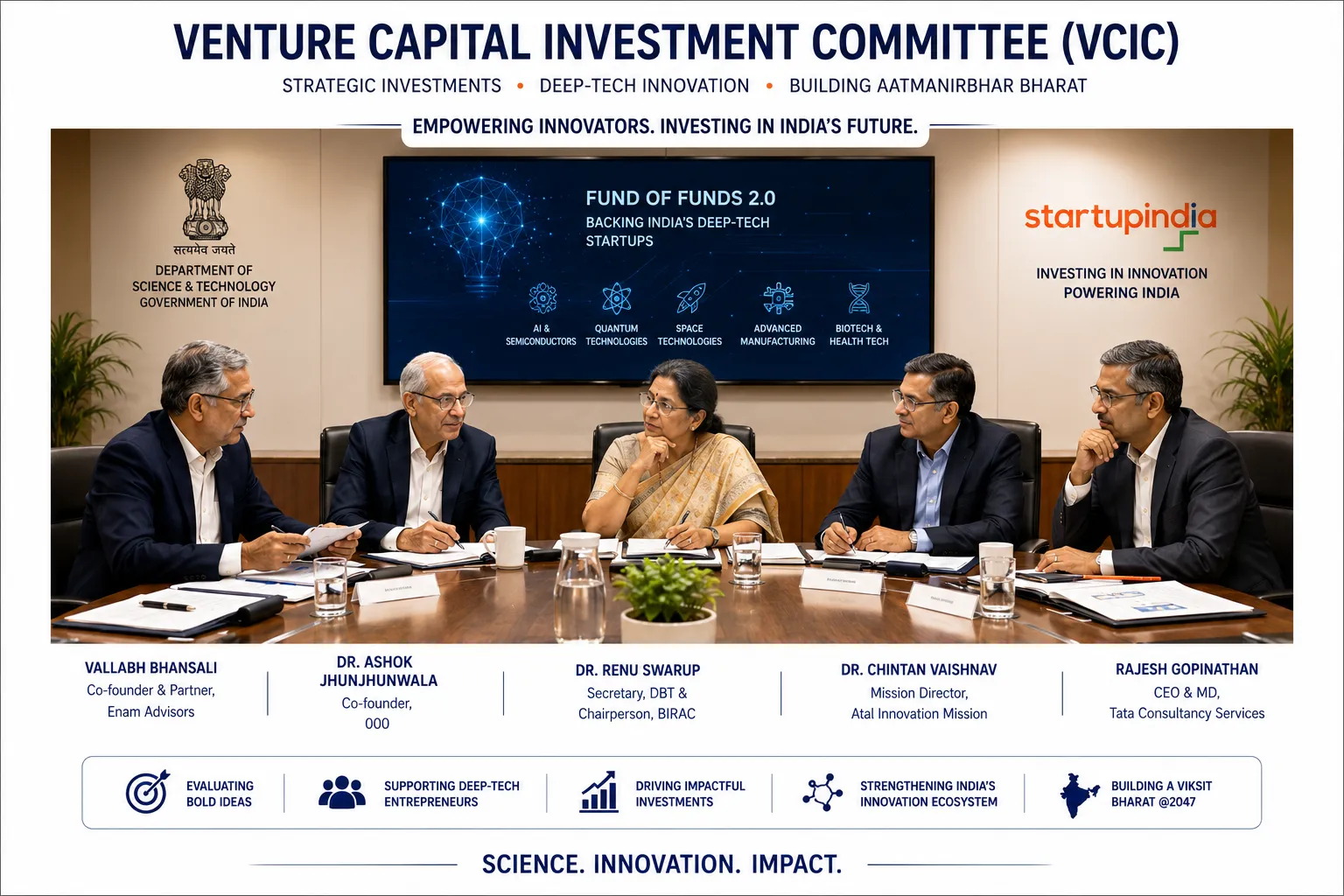
Evaluation by a Venture Capital Investment Committee (VCIC) comprising distinguished leaders from industry, academia, and the innovation ecosystem, including Vallabh Bhansali, Dr. Ashok Jhunjhunwala, Dr. Renu Swarup, Dr. Chintan Vaishnav, and Rajesh Gopinathan
An Empowered Committee, chaired by the DPIIT Secretary, will monitor implementation and performance.
Beyond Bengaluru: The National Reach Mandate
One of FoF 2.0's most ambitious goals is to expand access to capital beyond established metro hubs. For too long, India's startup story has been a Bengaluru-Gurugram-Mumbai narrative. Founders in Tier-2 and Tier-3 cities—who often struggle to access venture networks—have been left out of the funding boom.
FoF 2.0 is designed to change that. Officials have made it clear that the funding pipeline should reach every corner of the country. The larger idea is simple: innovation should not stay limited to a few big cities. It should grow across India.
The Multiplier Effect: Crowding in Private Capital
The mathematics of FoF 2.0 is built around multiplier effects. With multipliers ranging from 1.5X to 2.5X across segments, the government's ₹10,000 crore is expected to crowd in significant private capital.
The guidelines mandate minimum private capital mobilisation, reinforcing market-led investment discipline. This isn't government charity; it's government leverage. Every rupee of public money is designed to attract multiple rupees of private investment.
Beyond Funding: Ecosystem Capacity Building
FoF 2.0 isn't just about writing cheques. The scheme includes provisions to allocate a portion of returns towards ecosystem capacity-building initiatives—mentorship, shared infrastructure, and ecosystem development interventions.
The fund also serves as an umbrella framework for co-investments by Ministries, Departments, and institutional investors in priority sectors. This creates a coordinated, whole-of-government approach to supporting India's innovation economy.
The Viksit Bharat @ 2047 Vision
Perhaps the most significant framing of FoF 2.0 is its alignment with the national vision of Viksit Bharat @ 2047. By supporting startups that build globally competitive technologies, products, and solutions, the Fund will contribute to strengthening India's economic resilience, boosting manufacturing capabilities, generating high-quality jobs, and positioning India as a global innovation hub.
This isn't just about startup funding. It's about building a nation that doesn't just consume technology but creates it. It's about moving India from a services-led economy to an innovation-led one. It's about making Indian companies stronger, more competitive, and better able to compete with the rest of the world.

The Road Ahead
As SIDBI commences operationalisation of the scheme, the startup ecosystem watches with anticipation. The ₹10,000 crore corpus will be spread across the 16th and 17th Finance Commission cycles, ensuring a steady, long-term pipeline of capital.
For founders building deep-tech products, FoF 2.0 is a lifeline. For investors managing smaller funds, it's a validation. For Tier-2 and Tier-3 city entrepreneurs, it's a promise that geography won't determine destiny. And for India, it's a statement: the country is ready to compete with the world's most advanced innovation economies.
The first Fund of Funds built the ecosystem. Fund of Funds 2.0 is designed to take Indian innovation to the next level. And with ₹10,000 crore of conviction behind it, the next level might just be the stratosphere.