"You Want Ryan Reynolds Money?": The Star vs. Studio War That Will Define Bollywood's Next Decade
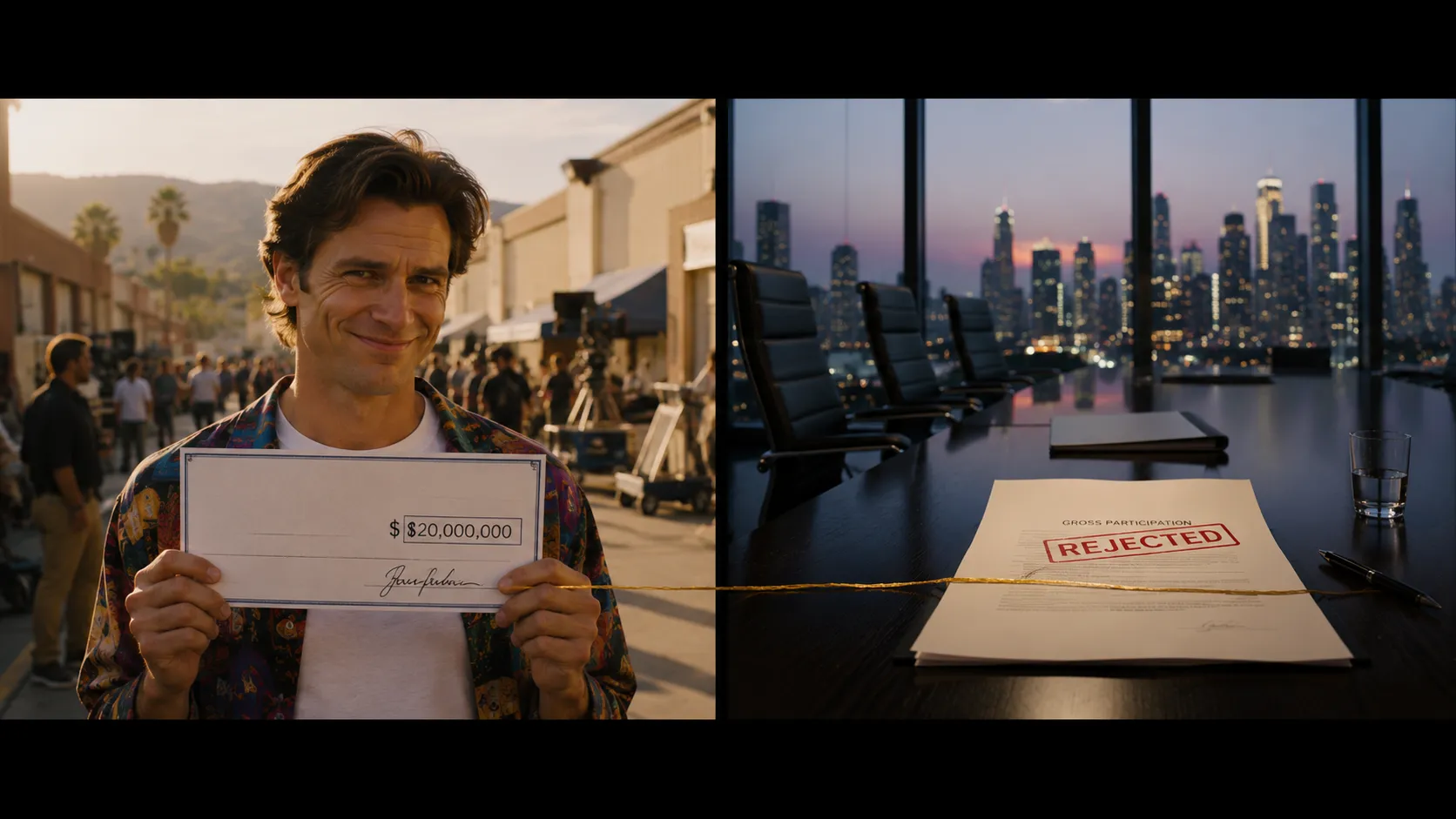
MUMBAI — May 29, 2026 — Sometime in the spring of 2026, in a conference room at a Bandra‑Kurla Complex high‑rise, a negotiation took place that, in retrospect, will be remembered as the moment the old Bollywood died. The details remain private—the parties involved have signed NDAs that will outlast the film they were discussing—but the broad strokes are known because they have been repeated, with variations, in every studio and talent agency in the city. A star, whose last two films had together grossed over ₹1,700 crore, asked for a back‑end deal. Not a signing fee. Not a profit share disguised as a producer credit on a shell company that existed only on paper. A real, Hollywood‑style, gross‑participation contract: a percentage of the film's revenue, paid from the first rupee, regardless of whether the studio turned a profit.
The studio refused. The star walked. The film—a ₹300 crore project that had been scheduled to begin shooting within weeks—is now in limbo, its sets half‑built, its crew released, its producers scrambling to find a replacement who can deliver the same opening‑weekend guarantees. The standoff was not about money, or at least not only about money. It was about control. The star believed that his name on the poster was the single most important determinant of the film's commercial fate, and that he should be compensated accordingly—not as a hired hand, but as a partner. The studio believed that the star's fee was already the largest line item in the budget, that the risk of the film failing should be borne by the studio alone, and that the precedent of granting a back‑end deal to one star would trigger a cascade of demands from every other star in the industry. Both sides were right. Both sides were wrong. And the question that the standoff raised—who actually creates the value in a ₹300 crore film?—is the question that will define the economics of Indian cinema for the next decade.

The Anatomy of a Back‑End Deal
To understand why the Bandra standoff matters, one must first understand what a back‑end deal actually is—and why it has been the defining feature of Hollywood star compensation for three decades, while remaining almost entirely absent from Bollywood.
In Hollywood, a star of sufficient stature does not simply receive a fixed fee for their services. They negotiate a "gross participation" contract: a percentage of the film's revenue—typically 10 to 20 percent of the box‑office gross or the distributor's gross—that is paid from the first dollar the film earns, before the studio recovers its production costs. The model was pioneered by Jim Carrey, who demanded and received 20 percent of the gross for The Cable Guy in 1996—a deal that earned him approximately $20 million even though the film underperformed. It was refined by Tom Cruise, whose back‑end on the Mission: Impossible franchise has reportedly earned him over $1 billion across his career. It was weaponised by Robert Downey Jr., whose Avengers back‑end deals made him the highest‑paid actor in Hollywood for three consecutive years. The logic of the model is straightforward: the star is the brand, the brand is the primary driver of the film's commercial performance, and the brand should share in the upside it creates.
In Bollywood, the logic has been inverted. The star is paid upfront—often a substantial portion of the film's total budget—and bears no financial risk if the film underperforms. The studio, or the producer, absorbs the loss. The star's incentive, under this model, is to maximise their upfront fee, because they will not participate in the film's success if it exceeds expectations. The studio's incentive is to minimise the star's fee, because every rupee paid to the star is a rupee that cannot be spent on production, visual effects, or marketing. The result is an adversarial negotiation in which both parties are trying to extract value from each other, rather than aligning their interests around the film's performance. The system has persisted for decades because the balance of power favoured the studios—there were only a handful of bankable stars, and the studios controlled the distribution infrastructure that gave those stars access to audiences. But that balance has shifted. The bankable stars are now more powerful than the studios that hire them, and they are beginning to demand the compensation structure that their Hollywood counterparts have enjoyed for a generation.
The Dhurandhar franchise is the most visible catalyst for this shift. Ranveer Singh's two‑film spy saga has together grossed over ₹1,700 crore worldwide, making it the highest‑grossing Hindi‑language franchise in history. The actor's commercial value, which was uncertain as recently as 2024, has been fundamentally recalibrated by those numbers. The star who was once considered a risk—whose filmography included underperformers like 83, Jayeshbhai Jordaar, and Cirkus—is now the safest bet in the business. And the leverage that those numbers confer is being exercised not just in the size of the upfront fee, but in the structure of the deal. The Don 3 exit, the FWICE dispute, and the Pralay standoff are all expressions of the same structural tension: a star who believes his name on the poster is worth more than the studio is willing to pay, and a studio that believes the star's demands are a threat to the economic model that has sustained the industry for half a century.
The SRK Precedent and the Jawan Model
The most instructive example of back‑end‑style compensation in Bollywood is not a formal gross‑participation contract, but a de‑facto arrangement that Shah Rukh Khan pioneered with Jawan (2023) and has refined with every film since. SRK, who understood earlier than most that the post‑pandemic box office would reward spectacle over sentiment, structured his compensation for Jawan as a combination of a reduced upfront fee and a substantial share of the film's profits. When the film grossed over ₹1,148 crore worldwide, SRK's total compensation reportedly exceeded ₹200 crore—roughly double what he would have earned under a conventional upfront‑fee model. The arrangement was not a formal gross‑participation contract—SRK's production company, Red Chillies Entertainment, was a co‑producer on the film, which gave him a legitimate claim to a share of the profits—but it achieved the same economic outcome: the star shared in the upside he had helped create.
The SRK model has been adopted, in modified form, by a small number of stars who have the leverage to demand it. Aamir Khan has structured his compensation for years around profit‑sharing rather than upfront fees—a model that served him well with Dangal and less well with Laal Singh Chaddha. Akshay Kumar, whose post‑pandemic box‑office volatility made him a less reliable bet for upfront fees, has increasingly moved toward a hybrid model that combines a reduced signing amount with a share of the film's profits. The logic is spreading, but it is spreading unevenly, and the studios that have resisted it most fiercely are the ones that control the largest distribution networks—the very networks that the stars need to reach the audiences that justify their compensation.
The Ramayana music deal provides a parallel illustration from a different corner of the industry. A.R. Rahman's reported ₹30 crore fee—plus profit‑sharing—for scoring the film represents the first time a composer has secured a back‑end arrangement on a project of this scale. The deal is a direct challenge to the industry's historical treatment of composers as work‑for‑hire, and it was made possible by the same structural forces that are empowering the stars: the recognition that a specific individual's contribution—in this case, Rahman's name and Hans Zimmer's name on the poster—can be the difference between a film that earns ₹2,000 crore and a film that earns ₹2,500 crore. The ₹30 crore upfront fee is a record. The profit‑sharing component is a revolution.
The Studio Counter‑Argument
The studios' resistance to back‑end deals is not purely a matter of greed. It is a matter of arithmetic. The Indian film industry's profit margins are thinner than Hollywood's, and the revenue streams that sustain Hollywood's back‑end culture—sophisticated box‑office tracking, transparent accounting, and the institutional infrastructure of talent agencies, lawyers, and guilds that enforce contractual compliance—are less developed in India. A studio that grants a gross‑participation contract to a star is making a legally enforceable promise to share revenue that it may not be able to accurately track, let alone collect, in an exhibition ecosystem that is still dominated by single‑screen theatres that report their box‑office collections in handwritten ledgers.
The studio argument, articulated in private by executives who would never make it in public, is that the Indian star is already overcompensated relative to the value they create. The average star fee as a percentage of the film's budget is substantially higher in Bollywood than it is in Hollywood—a reflection of the fact that the Indian film industry is more star‑dependent, less franchise‑driven, and less capable of generating returns from intellectual property than its American counterpart. The star who demands a back‑end deal on top of an already inflated upfront fee is, in the studio's view, asking to be compensated twice for the same contribution. The Pralay dispute—in which Ranveer Singh's walkout from Don 3 triggered a ₹45 crore compensation demand from Excel Entertainment—is a cautionary tale of what happens when the balance of power shifts too far toward the star. The studio that invested in pre‑production, scouted locations, and scheduled a shoot is left holding sunk costs while the star moves on to a better offer. The FWICE non‑cooperation directive against Ranveer is, in this reading, less a labour dispute than a proxy war between the studios and the stars over who controls the terms of engagement.
The Hollywood parallel is instructive. When Jim Carrey demanded 20 percent of the gross for The Cable Guy, the studio—Columbia Pictures—agreed because the alternative was losing the star to a competitor. The deal was widely criticised at the time as a capitulation to star power that would destroy the economics of the industry. Instead, it became the template for a generation of star compensation that aligned the interests of the talent and the studio, and that helped fuel the most profitable period in Hollywood history. The Bollywood studios that are resisting back‑end deals today are making the same argument that Columbia's rivals made in 1996: that the precedent will be ruinous. The argument was wrong then. It may be wrong now. But the evidence one way or the other will not be available until a star of sufficient stature signs a formal gross‑participation contract—and until the film that results from that contract either validates the model or destroys it.
The Ranveer‑Excel standoff, the Rahman‑Ramayana deal, and the SRK‑Jawan precedent are all pointing in the same direction. The Indian film industry is moving, slowly and unevenly, toward a compensation model that more closely resembles Hollywood's—a model in which the star is not merely the highest‑paid employee on the set, but a genuine partner in the financial outcome of the film. The transition will be messy. It will produce disputes, walkouts, and the occasional film that is held hostage while the lawyers negotiate. But it is also, in the long run, inevitable. The star who can deliver ₹1,700 crore across two films is not going to accept a fixed fee forever, any more than Robert Downey Jr. did. The question is not whether the model will change. It is which studio will be the first to embrace the change—and which star will be the first to sign the contract that makes it real.
The Ryan Reynolds Benchmark
The figure that has come to haunt every Bollywood studio negotiation in 2026 is not an Indian star. It is Ryan Reynolds. The Canadian actor, who leveraged his Deadpool franchise and his personal brand into a series of celebrity‑founded ventures—Mint Mobile (sold to T‑Mobile for $1.35 billion), Aviation Gin (sold to Diageo for $610 million), Maximum Effort (a marketing agency acquired by MNTN)—has become the benchmark for what a star can achieve when they stop thinking of themselves as talent and start thinking of themselves as a brand. Reynolds did not simply demand a back‑end deal on his films. He demanded, and received, equity stakes in the companies he endorsed, creative control over the campaigns he fronted, and a share of the enterprise value he helped create. His career is the most visible demonstration of a principle that Bollywood stars are only now beginning to articulate: that the value of a celebrity is not measured in their fee, but in the revenue they can generate.
The Reynolds model is not directly transferable to Bollywood—the Indian market lacks the venture‑capital infrastructure, the exit opportunities, and the consumer‑brand ecosystem that made his ventures possible—but it has become a reference point in every star‑studio negotiation. "You want Ryan Reynolds money?" is the studio executive's rhetorical question, deployed to dismiss a star's demand as unrealistic. "Ryan Reynolds built his own brands," is the star's response. "I am the brand." The exchange captures the central tension of the moment: the studios believe that Bollywood stars are not yet ready for Hollywood‑style deals, and the stars believe that the studios are not yet willing to acknowledge the value they create. The truth, as usual, lies somewhere in between—but it is moving closer to the stars with every ₹500 crore opening weekend.
The Rahman‑Ramayana deal, the SRK‑Jawan precedent, and the Ranveer‑Excel standoff are not isolated incidents. They are the first skirmishes in a war that will determine who captures the value of Indian cinema's global expansion—the studios that finance the films, or the stars whose names sell the tickets. The Hollywood precedent suggests that the stars will eventually win. The Bollywood resistance suggests that the victory will take longer than anyone expects. The ₹4,000 crore Ramayana wager, which depends for its success on both the star power of Ranbir Kapoor and the distribution muscle of Warner Bros., is the most visible test case for the new model. If the film succeeds, the stars will have the leverage to demand back‑end deals on every major production. If it fails, the studios will have the evidence they need to resist them. The battle is just beginning. The outcome will determine the shape of Indian cinema for a generation.


