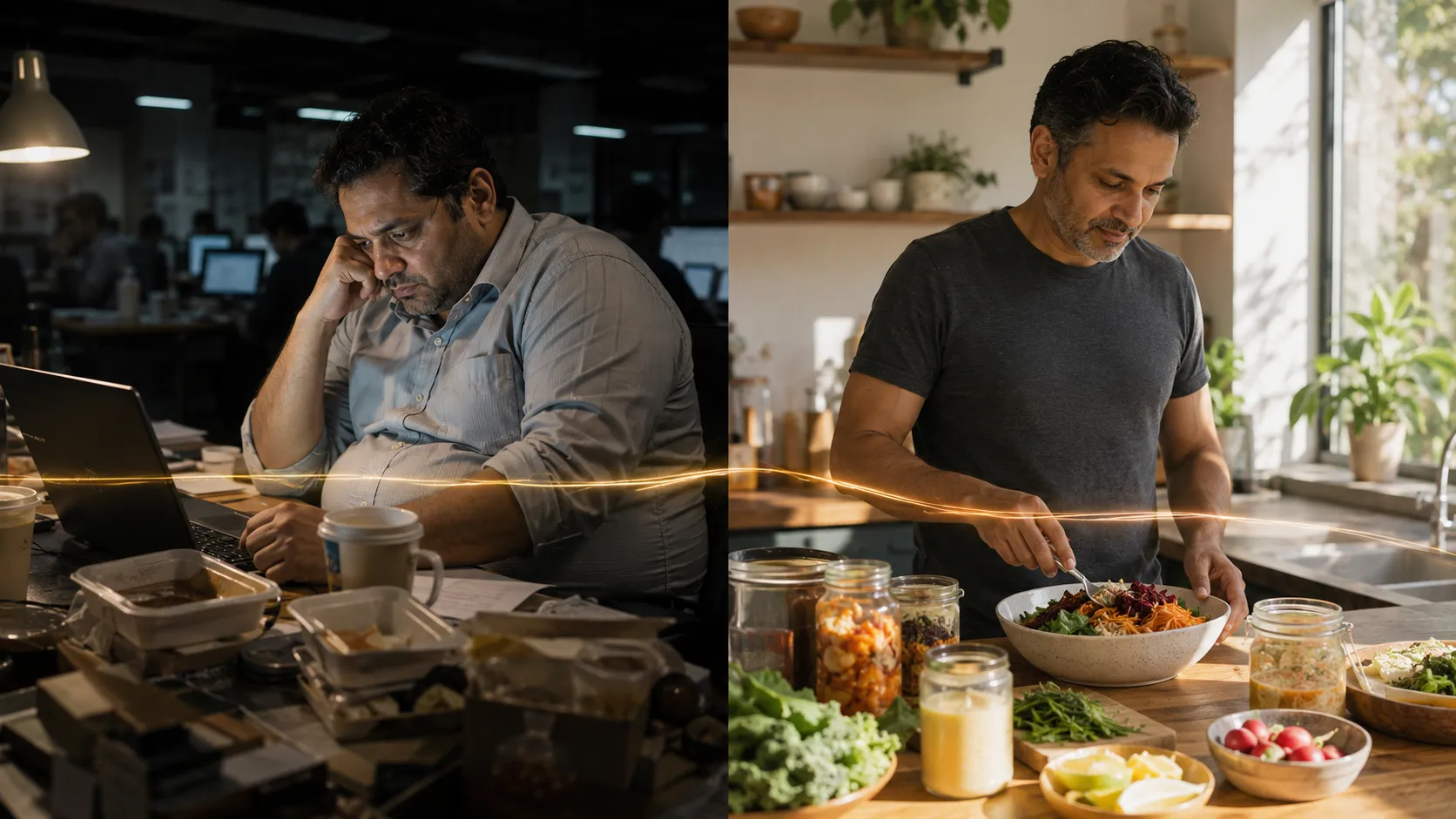
"You Are Going to Die": The Professor's Warning That Changed Everything—How Ritesh Bawri Lost 28 Kg in 4 Months, Reversed Diabetes, and Built a Health Empire With the Wife Who Made Nutrition Delicious
MUMBAI — May 26, 2026 —
Then came the dinner in Palo Alto. A professor looked at him across the table and said four words that would alter the trajectory of his life. "You are going to die." The remark felt abrupt, even offensive. But medical tests soon confirmed what the professor had seen with a single glance: Ritesh's health was declining fast. Years of neglect had taken their toll. He was diagnosed with Type 2 diabetes. His blood pressure was dangerously high. He had asthma. His VO₂ Max—a measure of how well the body uses oxygen during exercise—was a dangerously low 27. He was breathless after climbing a single flight of stairs. Evenings brought crushing fatigue and what he later learned was reactive hypoglycaemia—a sharp crash in blood sugar that he had been misinterpreting as "emotional eating." He could not tie his shoelaces without struggling. He avoided photographs because he did not like how he looked. At 40, he was overweight, sick, and terrified.
Today, at 51, Ritesh Bawri is the founder and Chief Science Officer of nirā balance, a science-backed wellness platform that has guided over 10,000 clients, achieved a 95 percent success rate in improving health outcomes, and partnered with Garmin to integrate wearable data into its personalised health protocols. He has reversed his Type 2 diabetes without relying on a single pill. He has been asthma-free for over 11 years. His blood pressure sits at a healthy 110/70. He lost 28 kilograms—in just four months—and has kept it off for more than a decade. But the most remarkable dimension of his transformation is not the numbers. It is the partnership that made it possible: his wife, Dimple Bawri, an artist who refused to let nutrition become boring, and who built the food philosophy that turned his personal recovery into a platform that is now transforming thousands of other lives.
The Warning That Changed Everything
The turning point was not the diagnosis. It was the moment Ritesh realised that the diagnosis was not being treated—at least, not in any way that addressed the root cause. His doctors prescribed medication. He took it. Nothing dramatic changed. "I realised I was treating it like a short-term problem," he told Mint, "and health doesn't work that way."
The frustration of being on medication without seeing meaningful improvement triggered something deeper: a decision to become his own expert. Over the following years, he read more than 700 books and analysed nearly 6,000 research papers to understand how sleep, stress, food, movement, and recovery work together at the cellular level. He pursued certifications in physiology from Harvard Medical School and nutrition from Tufts University School of Medicine. He became, in effect, his own doctor, nutritionist, and coach—not because he wanted to, but because no one else had as much at stake in his recovery as he did. "I was reading more than 700 books and 6,000 research papers," he said. "I became my own doctor, nutritionist and coach in many ways. Because no one had a bigger stake in my health than myself."
The transformation that followed was not the result of an extreme diet or a punishing exercise regimen. It was the result of what Ritesh calls a "systems approach"—rebuilding the entire operating system of his body, from sleep to nutrition to movement to stress management, rather than attacking a single symptom. He cut out processed carbohydrates and seed oils. He replaced them with whole foods: vegetables, fruits, lentils, healthy fats like ghee, and fermented foods like yoghurt, kefir, and kimchi. His fibre consumption soared from 15 grams to 40 grams a day. As a vegetarian, he made sure to get nearly 100 grams of protein every day. "Breakfast turned from many cups of coffee to protein-heavy meals," he said. "I even swapped my morning coffee for a turmeric wellness shot consisting of turmeric, ginger, black pepper and lemon."
Movement evolved gradually. He started with simple walks. Then progressed to 20-to-25-kilometre cycling rides. Then strength training became the focus: squats, deadlifts, presses, rows, and pull-ups that built muscle, corrected posture, and fortified his cardiovascular system. The results were palpable—and measurable. Energy levels soared. Breathlessness reduced. Body composition shifted. In the subsequent four months, he shed 28 kilograms. More significantly, his metabolic markers changed radically. His diabetes went into remission. He has been free of asthma for 11 years. His blood pressure stays at a healthy 110/70. He now wakes up at 4 AM to meditate and exercise, prepares his own meals, carries home-cooked food when he travels, regularly fasts, and goes to bed by 8 PM. "Your health is not something you can delegate," he said. "It must be lived."
One of the biggest myths he had to unlearn was the idea that health improves simply by "trying harder." The body responds to inputs, not intentions. "What you eat, how well you sleep, and how consistently you move matter more than bursts of motivation," he said. "I stopped chasing quick outcomes and focused on systems I could sustain. Once sleep, nutrition, and movement aligned, the results followed naturally."
The Artist Who Made Health Delicious
The most strategically significant dimension of Ritesh's recovery was not his own discipline. It was his wife's kitchen. Dimple Bawri, an artist by training and instinct, understood something that the global wellness industry has spent decades forgetting: that nutrition only works if people actually want to eat the food.
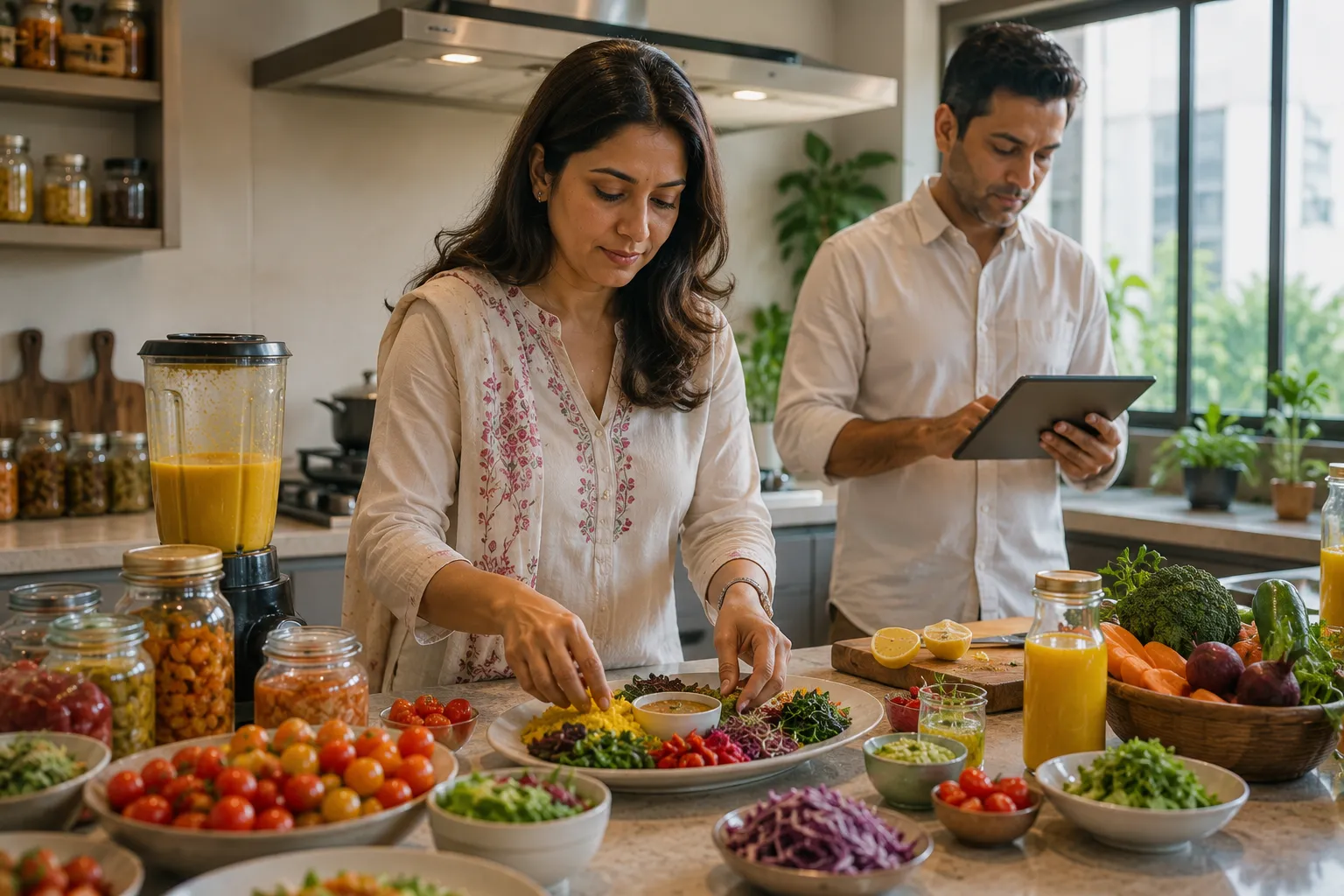
"Nutrition is often viewed as all about strict diets and boring foods," she explained. "I wanted to completely change that notion by showing how healthy eating can be fun and flavorful. I started experimenting at the ingredient level and curating recipes you look forward to eating, keeping nutrition, culture, and preferences in mind, making it effortless to follow. So simple that all you got to do is eat." The philosophy is deceptively simple, but it contains the seed of everything that would follow. Ritesh had the science. He understood the metabolic pathways, the cellular mechanisms, the biochemical basis of health. But knowledge alone does not change behaviour. Behaviour changes when the alternative is not just healthier, but more enjoyable—when the turmeric shot tastes better than the morning coffee, when the fermented foods satisfy more than the processed snacks, when the meal you are supposed to eat is also the meal you want to eat.
Dimple made that possible. She took Ritesh's research—the 700 books, the 6,000 papers, the Harvard and Tufts certifications—and translated it into food that was not just nutritious, but genuinely delicious. She experimented at the ingredient level, testing combinations until she found recipes that met Ritesh's strict nutritional requirements without sacrificing flavour, texture, or the cultural familiarity that makes food feel like home. The meals she created were not "diet food." They were real food—Indian food, cooked with whole ingredients, designed to satisfy the palate while rebuilding the metabolism. The partnership worked because each of them occupied a distinct and essential lane. Ritesh brought the science. Dimple brought the art. Together, they built a nutrition philosophy that was both evidence-based and sustainable—and that would eventually become the foundation of nirā balance.
The couple launched their first venture, BreatheAgain, more than a decade ago—a structured health-coaching programme that provided personalised guidance and close follow-ups to clients struggling with the same metabolic dysfunction that had nearly killed Ritesh. The programme was successful, but it was limited by the constraints of one-on-one coaching. The couple wanted to reach more people. They wanted to build a platform that could deliver the same personalised, science-backed, behaviourally sophisticated health guidance at scale—not just to a handful of wealthy clients, but to anyone who needed it. BreatheAgain became nirā balance, a digital wellness platform that integrates diagnostic precision with personalised nutrition, biomarker tracking, and AI-powered coaching. The name—derived from the Pali word for "without" or "free from"—reflects the philosophy at the core of the platform: freedom from metabolic dysfunction, freedom from chronic disease, freedom from the fear that the body is failing.
The Platform That Science and Partnership Built
The most strategically significant dimension of nirā balance is not the founding story. It is the platform that the Bawris have built—and the metrics that validate it.
The platform has achieved a 95 percent success rate in improving health outcomes over the past decade. It has earned 99 percent client referrals—a metric that is virtually unheard of in the wellness industry, where customer churn is high and satisfaction is often fleeting. It has guided over 10,000 clients across India and the world, each one receiving a personalised protocol that integrates nutrition, movement, sleep, and stress management. The platform is not a one-size-fits-all programme. It is a tailored intervention, designed around the specific metabolic profile, lifestyle constraints, and health goals of each individual client.
In September 2025, nirā balance announced a groundbreaking partnership with Garmin, the global wearable-technology company. The collaboration integrates Garmin's wearable health-tracking data directly into the nirā balance app, allowing the platform to move from passive suggestions to dynamic biofeedback. A client who wears a Garmin device can now see their sleep quality, heart-rate variability, activity levels, and stress metrics flow directly into their nirā balance dashboard, where the platform's algorithms translate the data into personalised, actionable recommendations. "This collaboration, I truly believe, will redefine wellness in an unprecedented way," Ritesh said at the announcement. "It shifts the nirā balance experience from passive suggestions to dynamic biofeedback."
The Garmin partnership is significant because it signals a structural shift in how the wellness industry is evolving. For decades, wellness was something you did in a spa, or a gym, or a doctor's office—separate from your daily life, disconnected from the data that your own body was generating every second. The integration of wearable technology with personalised health coaching collapses that separation. The same device that tracks your steps and your sleep is now feeding data into a platform that knows your metabolic history, your nutritional preferences, and your health goals, and that can tell you—specifically, in real time—what you need to do today to move closer to those goals. The platform is not a gadget. It is a coach, and the coach gets smarter with every data point.
The couple's division of labour within the platform mirrors the division of labour that saved Ritesh's life. He leads science and systems with empathy, overseeing the research, the algorithms, and the clinical protocols that underpin the platform's recommendations. She shapes the experience and daily rituals—the food, the habits, the small, consistent actions that make change sustainable and effortless. "Ritesh leads science and systems with empathy, while Dimple shapes the experience and daily rituals that make change sustainable and effortless," the company's profile notes. The partnership is not a marketing narrative. It is the operating model of the business, and it reflects a truth that the wellness industry has spent decades learning: that knowledge changes nothing without behaviour, and that behaviour changes only when the alternative is not just healthier, but more enjoyable.
The platform also integrates a philosophy that Ritesh calls "reducing inconsistency." Most people who try to improve their health fail not because they lack knowledge, but because they lack consistency. They start a diet, then stop. They join a gym, then quit. They buy a fitness tracker, then abandon it in a drawer. The cycle is familiar, and it is driven by a fundamental misunderstanding of how behaviour works. "People think they need motivation to begin, but motivation fluctuates," Ritesh said. "Consistency in small actions is what changes health." The nirā balance platform is engineered around that insight. It does not demand perfection. It reduces inconsistency—by making the healthy choice the easy choice, by providing accountability without judgment, and by designing interventions that fit into the user's life rather than demanding that the user's life fit into the intervention.
What This Signals
The nirā balance story is not primarily about a wellness platform. It is about the collision of two structural crises that are reshaping the Indian health landscape—and about the couple who are building a business at the intersection of both.
The first crisis is metabolic. India is in the grip of a diabetes epidemic that is among the worst in the world. An estimated 101 million Indians are living with diabetes—the highest number of any country—and millions more are in the pre-diabetic range, their blood sugar creeping upward, their bodies accumulating the damage that will eventually manifest as heart disease, kidney failure, blindness, and amputation. The crisis is not primarily genetic. It is behavioural—driven by a food environment that is saturated with processed carbohydrates, seed oils, and sugar, and by lifestyles that are increasingly sedentary, stressful, and sleep-deprived. The healthcare system that is supposed to address this crisis is designed to treat illness, not to prevent it. The doctor who prescribes metformin for a diabetic patient is treating a symptom. The platform that helps that patient rebuild their metabolism—through nutrition, movement, sleep, and stress management—is treating the root cause.
The second crisis is the failure of the wellness industry to deliver on its promises. The global wellness market is valued at over $6 trillion, and much of it is noise. Fad diets that produce short-term results and long-term failure. Supplements that promise miracles and deliver placebos. Fitness programmes that are designed for the already-fit and that intimidate the people who need them most. The consumer who wants to improve her health is drowning in information and starving for guidance. She knows she should eat better, sleep more, and exercise regularly. She does not know how to do any of those things in a way that is sustainable, enjoyable, and compatible with the demands of her actual life. The platform that can solve that problem—that can translate the science of metabolic health into daily behaviours that actually stick—will capture a market that is measured in the tens of billions of dollars.
Ritesh and Dimple Bawri are not the founders they were supposed to be. He was supposed to be another statistic—a successful businessman who died young of a preventable disease, his family left to wonder why he had not taken better care of himself. She was supposed to be the wife who mourned him. Instead, they built nirā balance—a platform that has guided over 10,000 clients, achieved a 95 percent success rate, and partnered with one of the world's largest wearable-technology companies to bring personalised health coaching to anyone with a smartphone and a commitment to change. The 28 kilograms that Ritesh lost are still gone. The diabetes that was supposed to define the rest of his life is in remission. The asthma that he had accepted as permanent has not troubled him for over a decade. The professor's warning—"You are going to die"—was accurate, in its way. The man who was going to die chose to live instead, and the couple who built a platform to help others make the same choice have only just begun.


