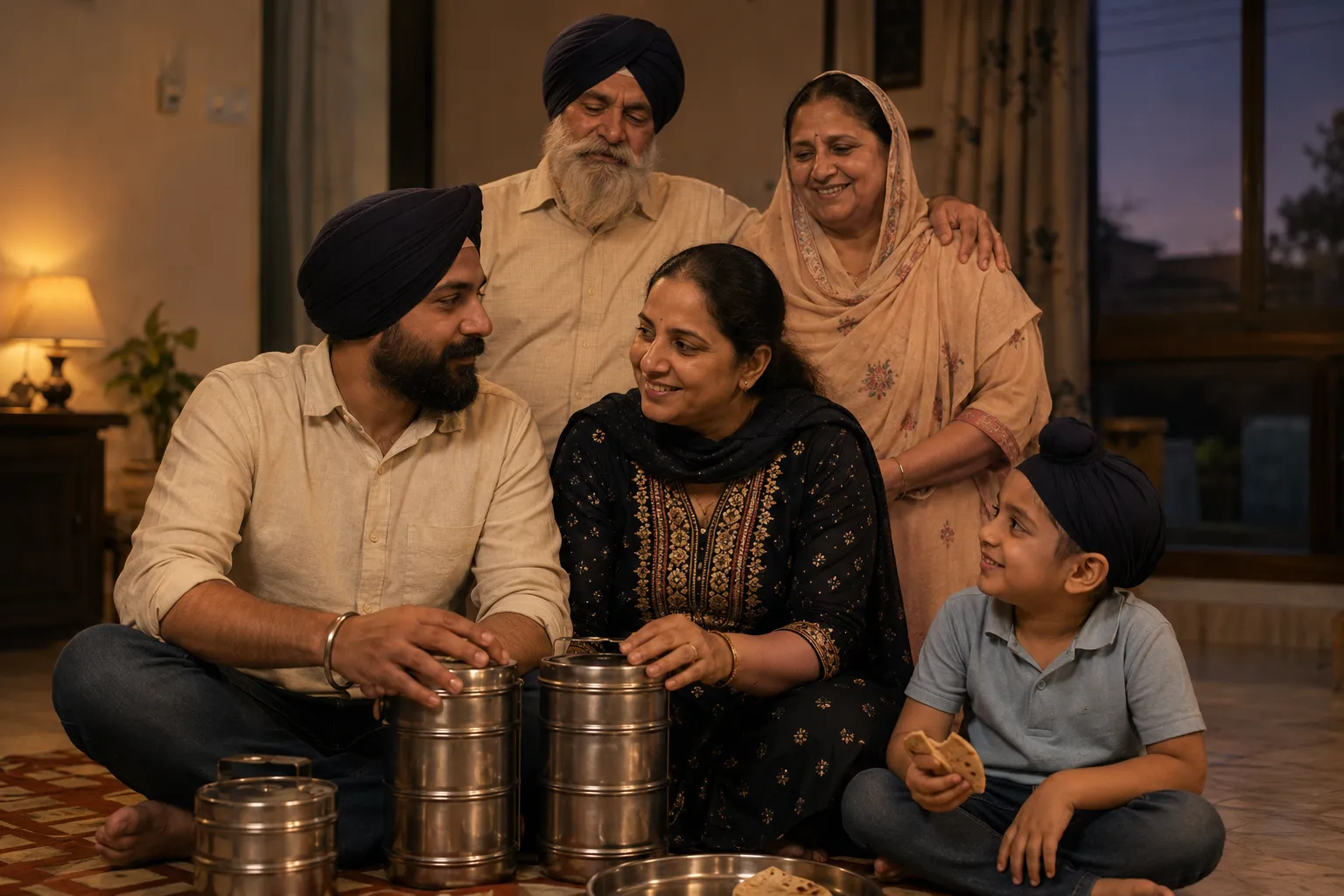
"Yeh Toh Roti Hai": The 5-Year-Old Boy Who Became His Deaf-Mute Parents' Voice—and Built Mohali's Most Beloved Tiffin Service
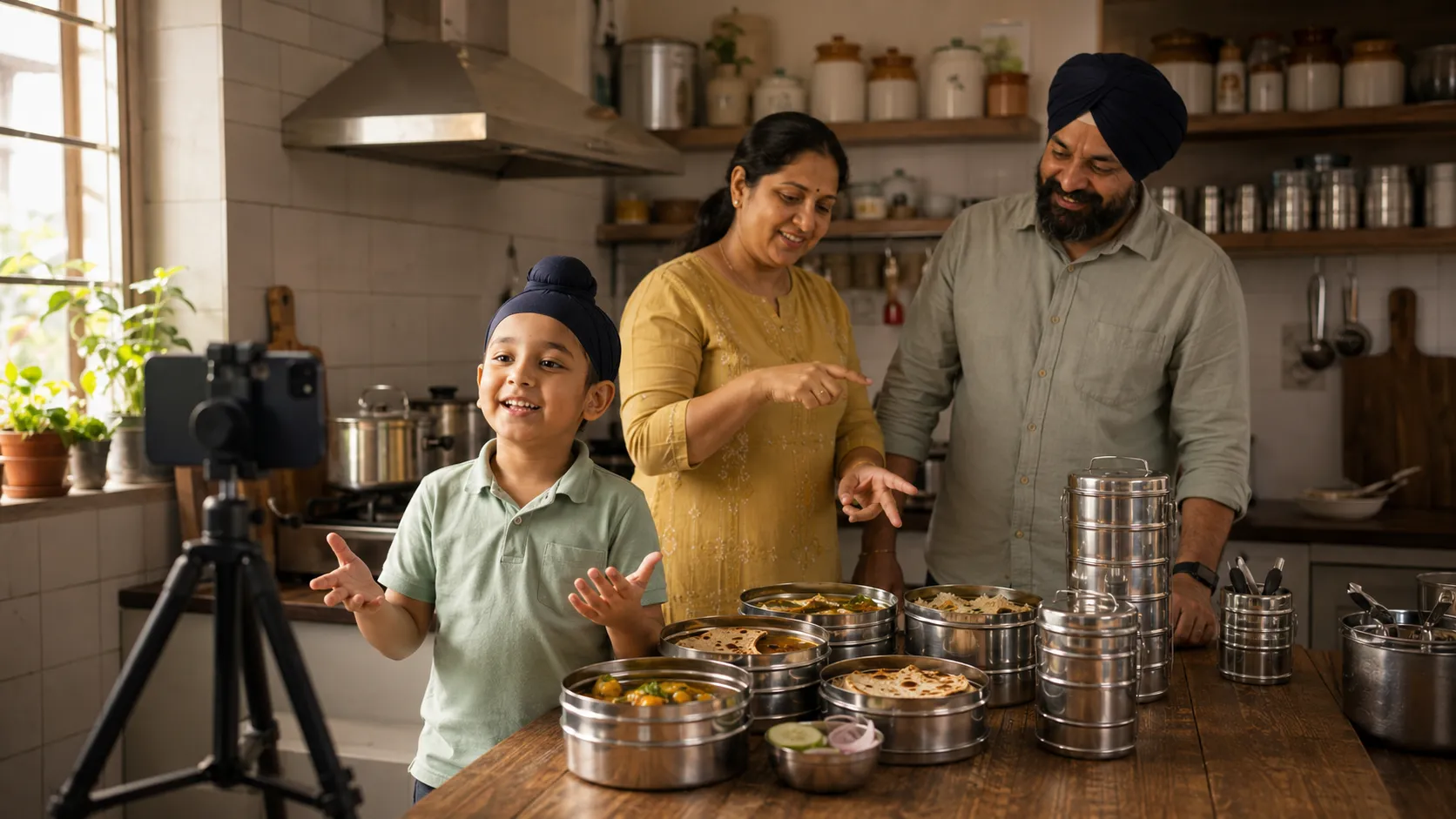
MOHALI, PUNJAB — May 26, 2026 — The video begins the same way every day. A small boy, barely five years old, stands before a phone camera in a modest kitchen in Sector 66A. Behind him, his mother gestures silently toward a pan of vegetables. The boy watches her hands, then turns to the camera with the steady confidence of a child who has been doing this his entire life. "Yeh toh roti hai," he says, pointing. "Ye toh aloo-gobhi hai." His father stands beside him, smiling, as the boy continues through the day's menu: dal, chole, rice, sometimes poori, sometimes a sweet. The video is simple. The boy is Sukhmehar Singh. And he is the voice of his parents, Vanshpreet Singh and Anmol Kaur, both deaf and mute since birth, who run a vegetarian tiffin service called Quietly Delicious that has captured the hearts of thousands.
The name is not a brand strategy. It is a description. In this kitchen, there are no shouted orders, no clattering urgency, none of the background noise of a typical food business. Vanshpreet and Anmol communicate through hand gestures, through glances, through the quiet synchronisation of two people who have built a life together in the absence of sound. "Some people inspire without words," reads the caption of one viral video. The internet agreed. Within weeks of their first post, Quietly Delicious had amassed more than 21,600 followers on Instagram, been featured by nearly every major Indian news outlet, and registered on Swiggy to manage the surge in demand. The family that had recently relocated to a rented home in Mohali after their transport business failed in Sitapur, Uttar Pradesh, had stumbled into something they never expected: a community of strangers who wanted not just their food, but their story.
The Family That Lost Everything and Found a Kitchen
The story of Quietly Delicious begins not with a business plan, but with a collapse. Gurmeet Singh and Inderjeet Kaur, Vanshpreet's parents, had run a transport business in Sitapur, Uttar Pradesh, for years. It was not glamorous, but it sustained the family. When the business failed—a casualty of circumstances that the family has not detailed publicly—they were left with few options and fewer resources. They moved to Mohali, to a rented home, to start again. The idea of a cloud kitchen emerged not from ambition but from arithmetic: they had a kitchen, Vanshpreet could cook, and the city around them was full of people who wanted home-cooked meals they did not have time to prepare themselves.
Vanshpreet had learned to cook the way generations of Indians have learned—by watching his mother. For years, he had assisted Inderjeet Kaur in the kitchen, absorbing the techniques and the instincts that produce the kind of food that tastes like home. Dal, chole, seasonal vegetables, rotis, the occasional poori, and sweets made for special occasions. The food was simple, vegetarian, and unpretentious—exactly the kind of food that millions of Indian households produce every day, and that the tiffin economy was built to deliver.
What set Quietly Delicious apart was not the menu. It was the messenger. Sukhmehar Singh, the couple's school-going son, had grown up translating his parents' sign language for the world. It was a skill he had acquired as naturally as other children learn to speak—by necessity, by immersion, by the quiet daily practice of being the bridge between two people who could not hear and a world that could not sign. When the family decided to promote their tiffin service on Instagram, there was never any question about who would be the voice of the brand. Sukhmehar was already the voice of the family. He simply became the voice of the business.
The first videos were unpolished: a child standing before a camera, describing what his mother had cooked, while behind him his parents gestured and smiled. There was no marketing strategy, no production budget, no influencer collaboration. There was only a family working together—Vanshpreet and Anmol cooking, Sukhmehar speaking, and the food speaking for itself. The internet, saturated with polished content and professional influencers, responded to the authenticity with an intensity that surprised everyone. "What a cute and lovely family. May God bless them with good health," wrote one Instagram user. "Food is looking awesome. God bless you guys," wrote another. "Next time I visit Tricity, I will make sure to order from them at least one meal of the day," promised a third. The comments were not charity. They were admiration—for the food, for the resilience, and for the quiet dignity of a family that had refused to let their challenges define them.
The numbers tell the story of how fast the word spread. Quietly Delicious launched its Instagram page and began posting videos in late 2025. Within weeks, the page had crossed 10,000 followers. By January 2026, it had surpassed 21,600—a following larger than many established restaurant brands. The viral videos were shared across X (formerly Twitter), where one post received thousands of retweets and comments. News outlets—Hindustan Times, The Times of India, The Indian Express, India Today, NDTV, The Print—covered the story within days of each other, each one struck by the same image: a small boy, translating his mother's hand gestures into Hindi, explaining each dish with a confidence that belied his age. The family's tiffin service was suddenly not just a local business. It was a national story.
The Kitchen That Runs on Teamwork
The most remarkable dimension of Quietly Delicious is not the viral fame. It is the family infrastructure that makes the business possible—a distributed network of relatives, each contributing a specific skill, each essential to the whole.
Vanshpreet and Anmol are the kitchen. They plan the menu, prepare the food, pack the tiffins, and manage the daily operations of the cloud kitchen. They are the heart of the business, and everything else depends on them. But they cannot answer phone calls from customers. They cannot negotiate with suppliers who do not understand sign language. They cannot manage the social media presence that has become the primary engine of their growth. Those tasks are handled by others.
Himanshi, Vanshpreet's sister-in-law, is a data engineer living abroad. She manages the Quietly Delicious Instagram page, uploading the videos that Sukhmehar and the family record, responding to messages, and maintaining the digital storefront that connects the kitchen to its customers. She does this remotely, from another country, in a different time zone, as a volunteer—a daughter-in-law of the family who contributes her professional skills to a business she cannot physically touch. Charanmeet Singh, Vanshpreet's younger brother, is also a data engineer abroad and provides support whenever needed. The family's reach, like its resilience, is distributed.
Gurmeet Singh and Inderjeet Kaur, the patriarch and matriarch, live with Vanshpreet and Anmol in the rented Mohali home. Gurmeet serves as the family's spokesperson to the outside world—translating Vanshpreet's sign language for journalists who come to interview them, explaining the business to customers who call, and managing the relationships that his son and daughter-in-law cannot. Inderjeet, the woman who taught Vanshpreet to cook, continues to contribute to the kitchen that her son now runs. The family that lost their transport business in Sitapur has built something new in Mohali, and every member of the family has a role.
Sukhmehar, the five-year-old, is the public face of the brand. He is, as one news report described him, a "full-time mischief maker" and the "primary ambassador" for the tiffin service. He packs tiffin boxes alongside his parents. He appears in the videos, explaining the day's menu in a voice that is shy and confident at the same time. He has become, in a few short months, the most visible symbol of a business that might have remained invisible without him. His younger sibling, still too small to help, watches and learns. The family that runs Quietly Delicious is not a nuclear unit. It is a collective, and the collective is what makes the business work.
The food itself is simple, vegetarian, and prepared the way Indian home cooking has always been prepared: dal, chole, seasonal vegetables, rotis, rice, and occasional sweets. The thalis are packed fresh each day and delivered to customers in the housing societies near the family's Sector 66A home. Bulk orders come from people making religious offerings or serving food to the poor. The quality is consistent—"just like we prepare in our homes," Gurmeet told the Press Trust of India—and that consistency, rather than any culinary innovation, is what keeps customers coming back. The poori and chole, he added, are in particularly high demand.
The Sewa Kitchen
The most powerful dimension of the Quietly Delicious story is not the viral fame or the growing customer base. It is what the family does when the cameras are off.
In multiple videos shared on their Instagram page, Vanshpreet and Anmol are seen distributing food to the poor on freezing winter nights in Mohali. They do not announce it. They do not use it as marketing. They serve meals with folded hands and gentle smiles, treating the recipients with the same dignity they bring to their paying customers. The family describes this not as charity, but as sewa—voluntary service, a concept rooted in Sikh tradition that carries no expectation of recognition or reward. "They often prepare and distribute food to those in need, seeing it as sewa rather than charity," NDTV Food reported. "In one video shared on their Instagram handle, the family can be seen serving meals to the poor with the same calm and sincerity they bring into their kitchen."
The sewa dimension of Quietly Delicious is not a marketing strategy. It predates the viral fame. The family that lost everything in Sitapur and rebuilt their lives in a rented Mohali home understands, at a visceral level, what it means to have nothing. The food they distribute to the poor is the same food they sell to their customers—dal, chole, roti, vegetables—prepared in the same kitchen, with the same ingredients, and with the same care. The people who receive it are not customers. They are fellow human beings, and the family serves them as such. The videos of these distributions have become among the most shared content on the Quietly Delicious Instagram page—not because they are polished or professional, but because they are genuine. In a digital economy saturated with performative charity, the Singh family's quiet, consistent commitment to sewa stands out precisely because it does not try to stand out.
The business has also begun attracting bulk orders from people who want to make religious offerings or serve food to the underprivileged—a model that allows the family to sustain their sewa practice through the same kitchen that supports their livelihood. The line between commerce and service, in this kitchen, is deliberately blurred. The tiffin boxes that go to paying customers and the meal packets that go to the homeless are prepared by the same hands, with the same ingredients, and with the same philosophy: food is not a commodity. It is a form of care. The family that built a business from nothing has not forgotten what nothing feels like, and the food they give away is the evidence.
What This Signals
The Quietly Delicious story is not primarily about a tiffin service. It is about the structural biases that define the Indian economy—and about what happens when a family refuses to be defined by them.
For decades, disability in India has been treated as a personal tragedy rather than a social challenge. The deaf and mute have been among the most marginalised communities in the country—excluded from formal education, shut out of formal employment, and dependent on family networks that are themselves stretched and fragile. The assumption, rarely stated but universally present, is that a deaf-mute person cannot run a business, cannot manage customers, and cannot participate in the economy on equal terms. The Singh family's tiffin service is a rebuttal to that assumption. It demonstrates that the barriers to economic participation are not intrinsic to disability. They are extrinsic—built into a society that has never designed its institutions, its communication systems, or its labour markets to accommodate people who cannot hear or speak. The family did not wait for the society to become more inclusive. They built a business that worked around the society's limitations—using Instagram as their voice, using their son as their translator, using the distributed network of relatives as their infrastructure. The business is not a charity case. It is a proof of concept.
The viral fame that has accompanied Quietly Delicious is a double-edged phenomenon. The attention has brought customers, validation, and the kind of word-of-mouth marketing that no advertising budget can buy. But it has also risked reducing the family to a feel-good story—a heartwarming video to be shared and forgotten, rather than a business to be supported. The Singhs have navigated this tension with the same quiet dignity they bring to everything else. They have not refused the attention. They have simply continued doing what they were doing before the cameras arrived: cooking food, packing tiffins, serving customers, and feeding the poor. The internet's attention span is short. The Singh family's commitment is not.
The five-year-old boy who stands before the camera every day, translating his mother's hand gestures into Hindi, is not just the voice of his parents' business. He is the embodiment of a principle that the Indian economy has spent decades ignoring: that ability comes in many forms, that communication does not require sound, and that the families who have been excluded from the formal economy are not lacking in talent, work ethic, or entrepreneurial instinct. They have been lacking in platforms. Quietly Delicious is a platform—built not by a venture capitalist or a government programme, but by a family that refused to accept that their challenges were insurmountable.
Vanshpreet Singh and Anmol Kaur are no longer just the deaf-mute couple who moved to Mohali after their family's transport business failed. They are the founders of a tiffin service that has captured the imagination of a nation, the parents of a boy who has become the most unlikely brand ambassador in Indian food, and the quiet, persistent embodiment of a truth that the economy has spent decades learning: that the people who have been written off as incapable are often the most capable of all. The tiffin boxes are packed. The Instagram page is updated. The sewa continues. The boy is still speaking. The kitchen is still quiet. And the food, as thousands of customers have now discovered, is delicious


