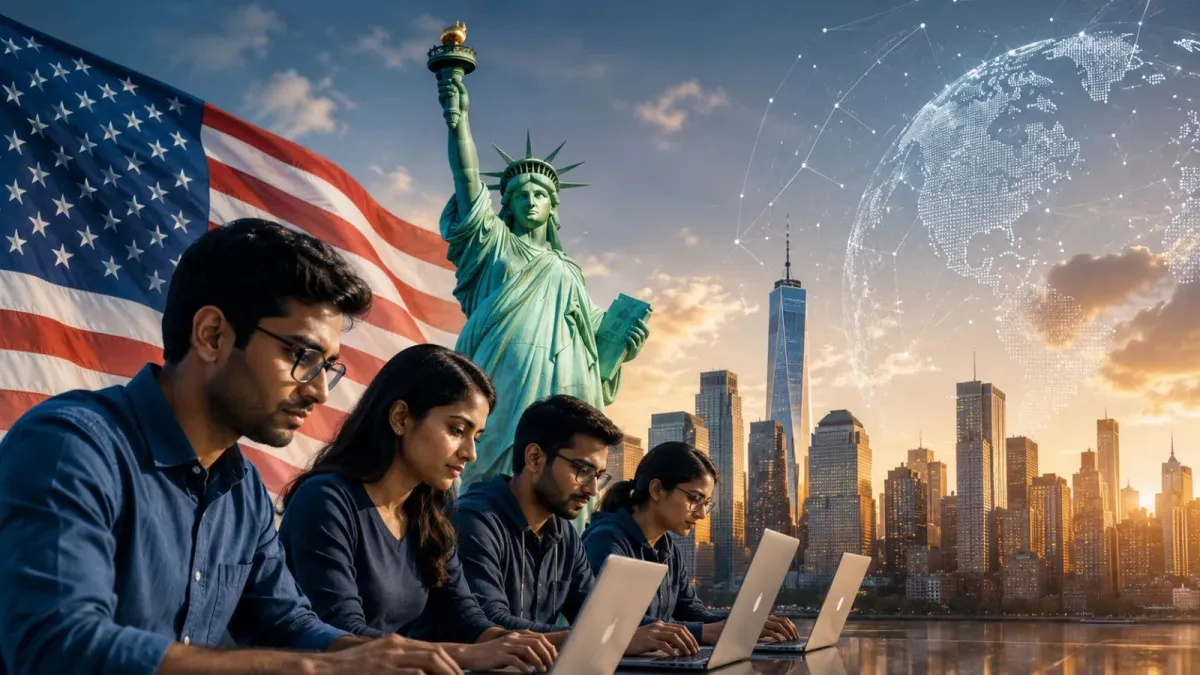
Somewhere in the United States right now, there is an Indian software engineer who has been living in the same city for fifteen years, working for the same company, paying taxes, buying a home, raising children in American schools — and waiting. Not for anything he has done wrong. Not because of any failure on his part. He is waiting because he was born in India, and because the American immigration system allocates green cards by country of birth using a cap that was last meaningfully reformed in 1990.
He is not alone. He is representative of what may be the most consequential and least publicly understood dimension of the Indian professional's experience in the United States.
The Mechanics of the Backlog
The United States issues approximately 140,000 employment-based green cards per year across five preference categories. No single country, regardless of how many of its nationals are waiting in the system, may receive more than seven per cent of that annual total. Seven per cent of 140,000 is approximately 9,800 green cards per year — for every country.
For most countries, this cap is not a meaningful constraint. Most countries do not send enough high-skilled workers to the United States each year to exhaust nine thousand green card slots. For those countries, the employment-based categories are effectively current: a person who files today may receive a green card within a year or two.
India is not most countries. India sends more H-1B visa holders to the United States than any other country in the world by a substantial margin — 71 per cent of all H-1B visas in 2024 went to Indian nationals. Each of those H-1B workers may eventually file for a green card. The number of Indian professionals filing for employment-based green cards every year is vastly larger than 9,800. The difference between the demand and the supply accumulates as a backlog. And that backlog has been accumulating for decades.
The June 2026 Visa Bulletin — the official monthly document that the US State Department publishes to show which green card applications can move forward — tells the story precisely. For India-born EB-2 applicants (professionals with advanced degrees or exceptional ability), the Final Action Date in June 2026 is July 1, 2012. This means that in June 2026, the US government is processing EB-2 India applications that were filed in July 2012. If you filed your EB-2 India petition in August 2012, your application has not yet been touched. You are still waiting. That is a fourteen-year queue. For EB-3 India (skilled workers and professionals), the Final Action Date is January 8, 2013.
New applicants entering the EB-2 India queue in 2026 can, based on current movement rates, expect to wait until the late 2030s or beyond before their priority date becomes current. Some estimates put the theoretical wait for a new Indian EB-2 filer today at over fifty years, though the actual wait depends on variables including legislative reform, administrative policy, and the behaviour of the backlog itself.
The State Department's June 2026 Visa Bulletin explicitly noted that high demand from India-born applicants in EB-1 and EB-2 categories had necessitated retrogression — moving the Final Action Date backward — to prevent exceeding the annual cap. Further retrogression, or making the categories entirely unavailable, may be necessary before the fiscal year ends.
The H-1B System in 2026
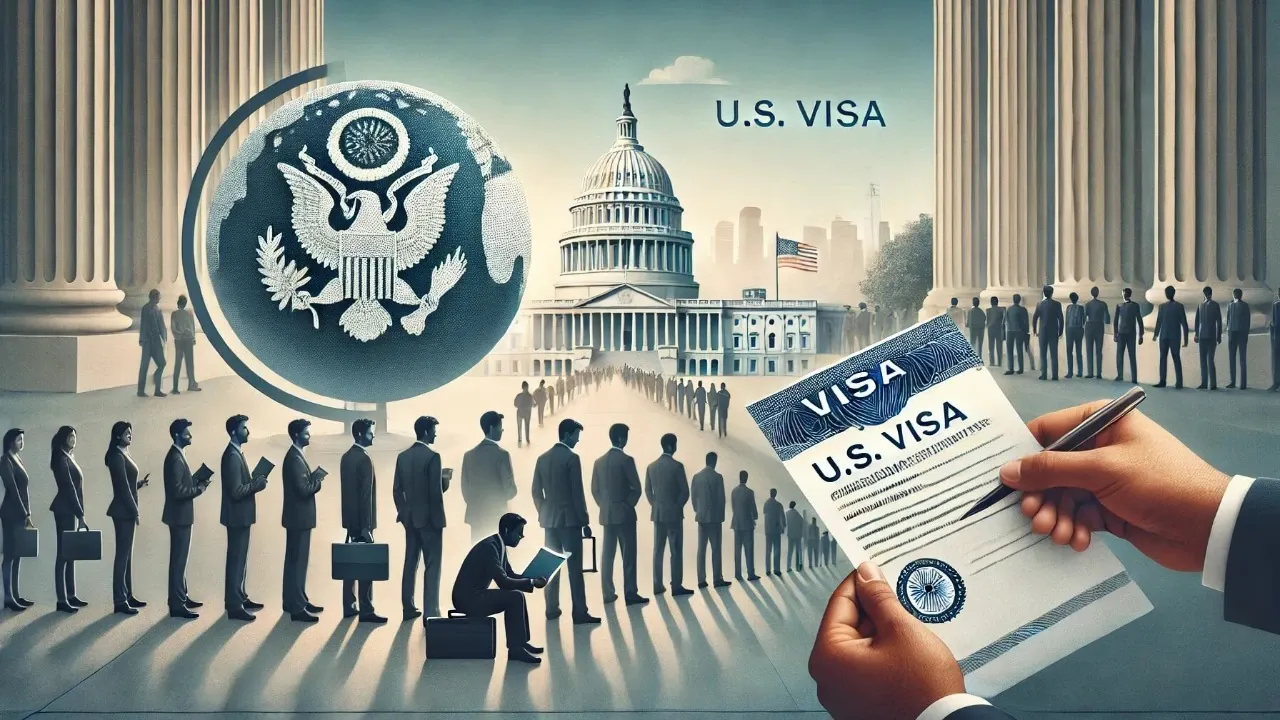
The H-1B visa is the mechanism through which most Indian professionals first enter the American workforce. It is a non-immigrant visa for specialty occupations requiring theoretical and practical application of a body of highly specialised knowledge. The cap is set at 65,000 new H-1B visas per fiscal year, with an additional 20,000 reserved for US Master's degree holders.
The demand for H-1B visas consistently exceeds the supply by a significant multiple. In recent years, the number of applications received in the first week of the filing period has been three to five times the available cap. The result is a lottery — applications are randomly selected from the eligible pool, meaning that a fully qualified candidate with a job offer and a degree may simply not be selected, for no reason other than chance.
The H-1B system in 2026 has been affected by significant policy changes under the Trump administration.
The most dramatic was a proposed fee of $100,000 per new H-1B application — an increase from the previous range of approximately $1,000 to $5,000. This fee created immediate disruption when announced, particularly for smaller technology companies and startups that rely on H-1B workers but do not have the balance sheets of major tech employers. A federal court vacated the fee following legal challenge, but further legal proceedings are expected to shape the policy's future. The uncertainty itself has had a chilling effect on hiring planning and visa sponsorship decisions.
Additional H-1B changes in 2026 include mandatory disclosure of all social media user IDs for H-1B and H-4 (dependent spouse) applicants, with a requirement that those accounts remain public during adjudication. USCIS has deployed AI systems to flag inconsistencies across applications, resumes, and public profiles, and the requirements for demonstrating that a position qualifies as a specialty occupation have been made significantly stricter. The Request for Evidence rate — the proportion of H-1B petitions that USCIS sends back for additional documentation rather than approving directly — has increased meaningfully.
What the Wait Actually Means for a Person's Life
The green card backlog is discussed most commonly as an immigration policy issue. It is also a profoundly personal one, and the human consequences deserve to be stated plainly.
An Indian professional who entered the United States on an H-1B visa in 2010, filed for a green card in 2012, and received it in 2026 has spent sixteen years in the United States with constrained mobility. During those sixteen years, he could not easily change employers — his H-1B status is employer-sponsored, and changing jobs requires transferring the petition and, in most cases, filing a new petition that must survive the USCIS approval process, though portability provisions under the AC21 Act provide some flexibility after 180 days of pending I-485. He could not start a company — self-employment is generally not permitted under H-1B terms. He could not accept certain types of freelance or consulting work. Every international trip required careful management of visa stamp renewals, and a visa denial at a consulate could strand him outside the United States.
His spouse, on an H-4 visa, may or may not have had work authorisation depending on the policy in effect during any given year. H-4 employment authorisation has been granted and then placed under review multiple times across different administrations, leaving H-4 holders in a state of intermittent, policy-dependent employment eligibility.
His children, if born in the United States, are US citizens. His children, if born in India and brought over as minors, are on H-4 status and face the risk of aging out — turning 21 and losing their dependent status — before the family's green card is approved.
These are not abstract policy consequences. They are the daily conditions of life for hundreds of thousands of Indian professionals in the United States.
The Reform That Has Not Come
The backlog's solution is structurally straightforward: increase the per-country cap, or eliminate it entirely and replace it with a first-in, first-out system that allocates green cards based on when a petition was filed rather than where the applicant was born. Several pieces of legislation have proposed exactly this, including the Fairness for High-Skilled Immigrants Act, which passed the House of Representatives with bipartisan support in 2020 and 2021 but stalled in the Senate. The legislation has been reintroduced in various forms but has not been enacted.
The political dynamics that prevent reform are not mysterious. Eliminating the per-country cap would mean, in the short term, that virtually all of the available employment-based green cards flow to India and China — the two countries with the largest backlogs — leaving applicants from other countries with a longer wait than they currently experience. Workers from the Philippines, Mexico, and other countries with their own backlogs would see their situations worsen. The coalition of affected countries creates political resistance that has, repeatedly, prevented the reform that would most directly address the Indian professional's situation.
In the absence of legislative reform, individual strategies have emerged. Downgrading from EB-2 to EB-3 — counterintuitive because EB-3 is technically a lower preference category — can actually accelerate the timeline because EB-3 India's Final Action Date is sometimes slightly ahead of EB-2 India's, a strategy known as porting down. Filing National Interest Waivers under EB-2 removes the employer sponsorship requirement and allows self-petition, but does not bypass the backlog. Applying for EB-1 as a person of extraordinary ability avoids the per-country cap more effectively for those who can meet its high standards.
For the overwhelming majority of Indian professionals in the queue — the engineer, the data scientist, the product manager who is qualified and employed and has done everything the system asked — none of these strategies eliminates the wait. They modulate it at the margins while the fundamental structural problem remains unaddressed.
What 2026 Looks Like
The June 2026 Visa Bulletin, the USCIS filing charts for July 2026, and the policy changes of the past eighteen months together paint a picture of an H-1B and green card system under particular pressure.
The $100,000 H-1B fee, though vacated by a court, signalled the administration's intent to make high-skilled immigration more expensive and more difficult. The social media disclosure requirements, the stricter specialty occupation standards, and the expanded biometric screening all add friction to a process that was already demanding. At the same time, EB-2 and EB-3 India categories face retrogression even as they process applications from 2012 and 2013.
For the Indian professional contemplating a move to the United States in 2026, or already in the United States and navigating the system, the honest summary is this: the H-1B remains accessible but has become more expensive, more scrutinised, and less predictable. The green card backlog has not improved. The legislative reform that would address it structurally has not materialised. And the policy environment has made the entire system less hospitable than it was five years ago.
None of this makes the United States an undesirable destination for talented Indian professionals — the opportunities remain significant, the salaries substantial, and the career development unmatched in many fields. But the immigration framework through which those opportunities are accessed is broken in ways that are specific to Indian nationals and that no amount of individual merit, professional achievement, or demonstrated contribution to American society can navigate around.
The wait is built into the system. Fixing it requires changing the system. And the system has not been changed.


