A Nationality-Specific Impact, By the Numbers
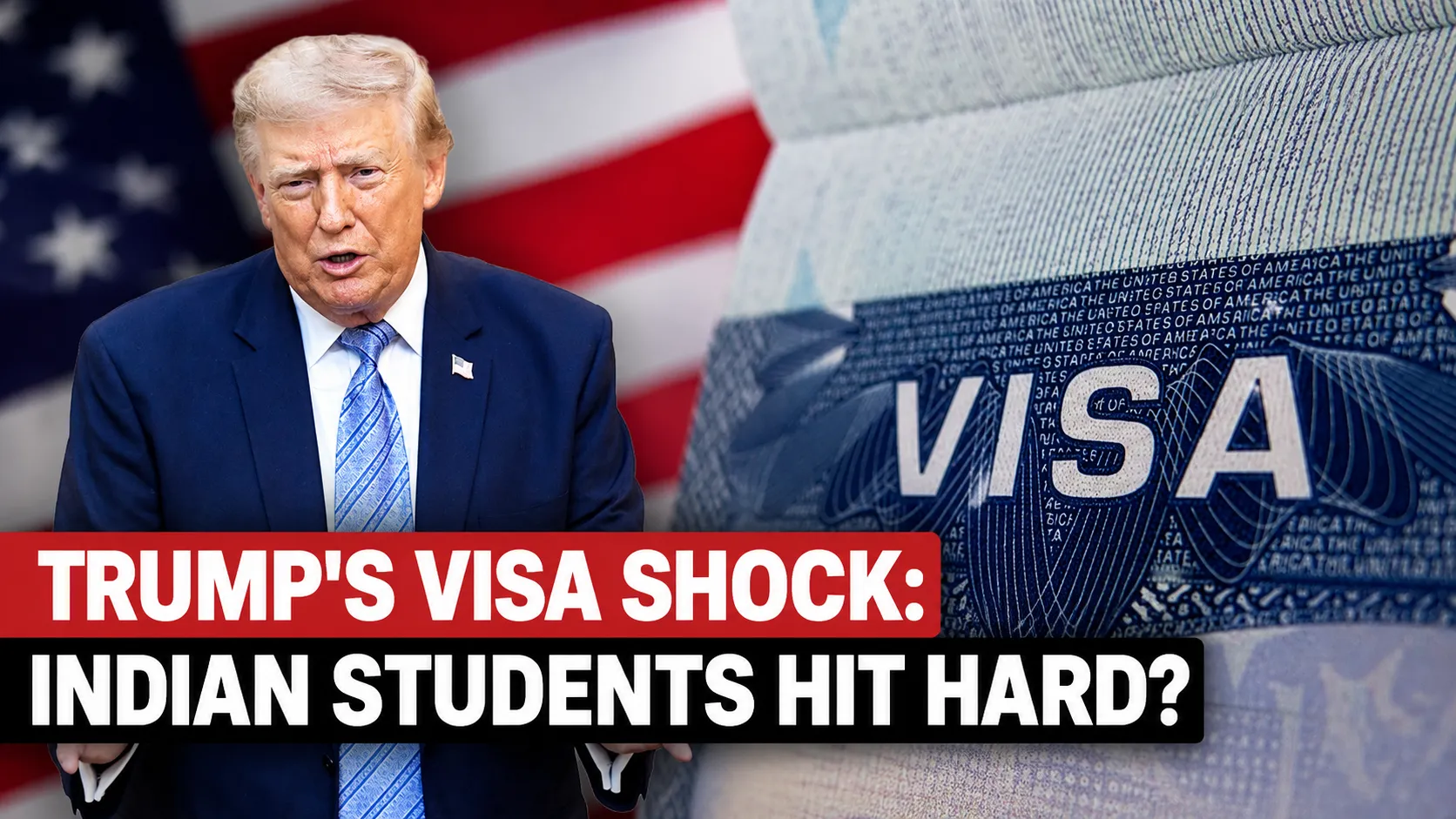
When the Department of Homeland Security published its final rule eliminating Duration of Status for international students this month, the policy itself was written in nationality-neutral language — it applies, on paper, to every F-1 and J-1 visa holder regardless of country of origin. But a joint analysis by Bloomberg journalists Myles Miller, Liam Knox, and Alicia A. Caldwell, syndicated in the United States through News India Times, concluded that the practical burden of the change will fall overwhelmingly on students from three countries: India, China, and South Korea. The reasoning is straightforward and rooted in enrollment math rather than politics — these three nationalities have long made up the largest cohorts of international students in the United States, and are disproportionately concentrated in exactly the kind of multi-year doctoral and STEM graduate programs most likely to bump up against, and exceed, the new four-year fixed admission cap.
India's Outsized Stake in the American Higher Education System
India's position at the center of this story is not new, but it has rarely been as precarious. Indian nationals have accounted for roughly 330,000 or more students enrolled in American academic institutions in recent counts, competing with China for the position of largest single source of international enrollment in the United States year over year. Indian students comprise close to 30 percent of all international students in the country during recent academic years, according to Open Doors Report data cited by multiple outlets tracking the sector. That scale means any policy change affecting international students as a category will, almost by mathematical necessity, land hardest on the Indian community simply because of its sheer size within the overall population — but the new rule compounds that baseline exposure with a second, more specific vulnerability tied to academic program length.
The STEM and Doctoral Concentration Problem
Indian students are heavily overrepresented, relative to their overall numbers, in engineering, computer science, and other STEM graduate programs — precisely the fields where a genuine PhD, including qualifying exams, original dissertation research, and defense, routinely runs five, six, or even seven years from matriculation to degree. Under the old Duration of Status framework, that timeline was simply absorbed as a normal, unremarkable feature of doctoral study; a student's lawful presence tracked their actual, ongoing enrollment for as long as the university certified it. Under the new fixed four-year cap, that same student will need to file a formal Extension of Stay application with US Citizenship and Immigration Services, complete with biometrics and a filing fee, well before the four-year mark arrives, or risk falling out of status entirely — with overstays beyond the fixed period potentially triggering three- or ten-year bans on returning to the United States.
Arriving on Top of an Already Damaged Pipeline
What makes the new rule especially consequential for Indian applicants is not simply its own substance, but the moment at which it arrives. It follows a year in which the pipeline connecting Indian students to American campuses had already been substantially damaged by a series of earlier disruptions. In the early months of the current administration, the State Department paused all student visa interviews worldwide, generating a backlog widely blamed for a 36 percent drop in student visa issuances during the summer of 2025. Separate reporting has documented F-1 visas issued specifically to Indian nationals falling 69 percent, to just 12,776, in the June-to-July window of 2025 compared with 41,336 during the same period the year before — one of the sharpest single-year declines in the modern history of the India-to-US student pipeline. Overall foreign student numbers in the United States sank 1.4 percent last fall, driven by a 17 percent drop in newly arriving international students, reversing roughly a decade of steady growth. A more recent survey covering spring 2026 enrollment showed even steeper declines, suggesting the fall 2026 semester — the same period into which the new fixed-term rule now lands — could see a further, deeper drop.
The OPT Threat Compounding the Duration-of-Status Shock
For Indian students specifically, the new admission rule does not operate in isolation — it lands alongside sustained pressure on Optional Practical Training, the post-graduation work authorization that has long functioned as the single biggest incentive drawing Indian students toward American STEM graduate programs in the first place. In May 2026, then-acting ICE Director Todd Lyons announced a broad fraud investigation into OPT, describing the program as having 'become a magnet for fraud' and identifying roughly 10,000 foreign students, a large share of them Indian nationals according to subsequent Indian press coverage, as employed at businesses flagged as suspect. Indian nationals make up close to half of all OPT participants nationally, meaning any further tightening or curtailment of the program — something the current administration has actively sought — would strike the Indian student population with a severity out of proportion to its share of the broader international student body.
Reading the Rule Alongside India's Own Domestic Signals
The impact on Indian students cannot be fully understood in isolation from what is happening simultaneously inside India's own higher education and outbound mobility ecosystem. Indian outlets have separately reported that Canada, once considered the most accessible alternative destination for Indian students deterred by American visa friction, slashed Indian student permits by roughly 31 percent, suggesting that the broader wave of tightening is not confined to the United States alone, even as it remains most acute there. That regional context matters because it undercuts a simple narrative in which frustrated Indian applicants simply redirect en masse toward friendlier destinations; instead, families are increasingly navigating a genuinely more restrictive global environment for outbound student mobility across multiple traditionally popular countries simultaneously.
The Human Toll Behind the Statistics
Behind every percentage point in the visa issuance decline sits an individual student and family whose plans, finances, and years of preparation are directly affected. Education consultants report a rising volume of consultations from Indian families asking not just how to apply, but how to build contingency plans around visa delays, extension filing costs, and the increasingly real possibility that a doctoral program begun under one set of rules could conclude under an entirely different, more restrictive framework. For families who have already committed significant financial resources — often including loans secured against family property — toward the goal of an American degree, the compounding uncertainty represents not an abstract policy debate but a direct, tangible financial and emotional burden that must now be actively managed rather than simply assumed away.
What This Means for the 'Long Game' Calculation
International education consultant Rajika Bhandari, who has closely tracked the shifting calculus facing Asian and particularly Indian STEM applicants, has framed the decision to study in the United States as fundamentally a matter of 'playing the long game' — weighing not just the value of the degree itself, but the multi-year pathway toward practical training, employment, and eventually a green card that a US education has traditionally offered. The new fixed-term rule inserts a concrete, quantifiable new variable directly into that long game: a hard four-year clock, an Extension of Stay filing requirement complete with cost and processing delay, and the real possibility of a multi-year reentry ban for anyone who miscalculates the timeline. Bhandari has cautioned that the practical weight of this shift has not yet been fully absorbed by Indian applicants and their families. 'The duration of stay change has probably not fully sunk in yet among the common Indian consumer, because it's so nuanced,' she said. 'But it will, and it has a profound impact.'
A Pressure Campaign, Not an Isolated Rule Change
Multiple analysts tracking the policy have framed the Duration of Status rule not as a standalone regulatory adjustment but as one component of a broader, sustained effort by the current administration to reshape the scale and structure of international enrollment across American higher education. That campaign has included the earlier visa interview pause, the OPT fraud investigation, tightened social media vetting for student visa applicants, and repeated public pressure on individual universities over enrollment practices and campus policy. Taken together, these measures amount to a narrowing of what had functioned, for decades, as one of the widest and most reliable pipelines connecting global talent — and billions of dollars in annual tuition revenue — to American universities and, eventually, the American economy.
The Competing Destinations Waiting to Capture Displaced Demand
Education consultants and Indian American community leaders have repeatedly warned that sustained uncertainty of this kind carries a real risk of permanently redirecting Indian student demand toward competitor destinations. Canada, Australia, Germany, and Singapore have each expanded post-study work rights and simplified immigration pathways in recent years, positioning themselves as more predictable alternatives precisely as the American system has grown more volatile. Universities in the United States, many of which have come to rely heavily on international tuition revenue as domestic enrollment growth slows nationally, face a genuine structural risk if a critical mass of prospective Indian applicants concludes that the American path is simply too uncertain to justify the cost and risk relative to these alternatives.
What Comes Next
With the rule's effective date set for September 15, 2026, and NAFSA and other advocacy organizations already signaling likely legal challenges, the coming months will likely determine whether this specific policy takes effect as written, is modified through litigation, or is delayed. For Indian students and families currently navigating admissions decisions, financial planning, and visa applications for the fall intake, the practical guidance from immigration attorneys and university international offices is consistent: confirm program timelines against the new four-year cap now, budget for Extension of Stay costs as a real and likely expense rather than a remote contingency, and treat the American higher education pathway as one requiring active, ongoing immigration management rather than a straightforward, multi-year formality that ends automatically with a diploma.
The Institutional Response From American Universities
American universities that host large Indian graduate student populations, particularly in engineering and computer science departments where Indian nationals frequently represent the single largest international cohort, have begun issuing their own guidance distinct from federal messaging. Several major research universities have set up dedicated advising tracks specifically for students affected by the four-year cap, recognizing that doctoral programs in fields like electrical engineering and computer science, disciplines in which Indian students are heavily concentrated, routinely require five to six years to complete. Graduate program directors at some institutions have begun discussing whether program structures themselves might need adjustment, including accelerated timeline options or restructured milestone requirements, purely to help students avoid running afoul of a federal admission cap that has nothing to do with academic capability and everything to do with immigration administration.
A Number the Whole Community Will Be Watching
As fall 2026 enrollment figures begin trickling in over the coming months, education researchers, Indian American community organizations, and US university administrators alike will be watching one number more closely than perhaps any other: the actual year-over-year change in new Indian graduate student enrollment, which will serve as the first real, empirical test of how much practical deterrent effect this specific combination of policy changes has produced. Early indicators, including the spring 2026 enrollment survey showing steeper-than-expected declines, suggest the number could be sobering, but the true scale of the disruption will not be fully knowable until the fall semester is well underway and final enrollment figures are compiled and published by organizations like the Institute of International Education. As one education consultant put it, the coming enrollment season will function as a genuine natural experiment in how much policy volatility a historically resilient, highly motivated applicant pool can absorb before beginning to meaningfully redirect elsewhere — and the answer will shape US-India educational ties for years beyond this single admissions cycle.
The Ripple Effect on Indian STEM Research Output
Beyond individual student outcomes, a sustained decline in Indian graduate enrollment carries implications for the broader American research enterprise itself. Indian nationals have long constituted a disproportionately large share of graduate researchers and teaching assistants in American engineering and computer science departments, and any meaningful pullback in that pipeline would be felt directly in university research labs, many of which depend heavily on international graduate students to staff federally funded research projects. Faculty members in affected departments have begun privately voicing concern that a multi-year decline in Indian doctoral enrollment could measurably slow research output in exactly the technical fields — artificial intelligence, semiconductor design, advanced manufacturing — that the United States has publicly identified as strategic national priorities, creating a somewhat paradoxical tension between immigration enforcement goals and broader technological competitiveness objectives.


