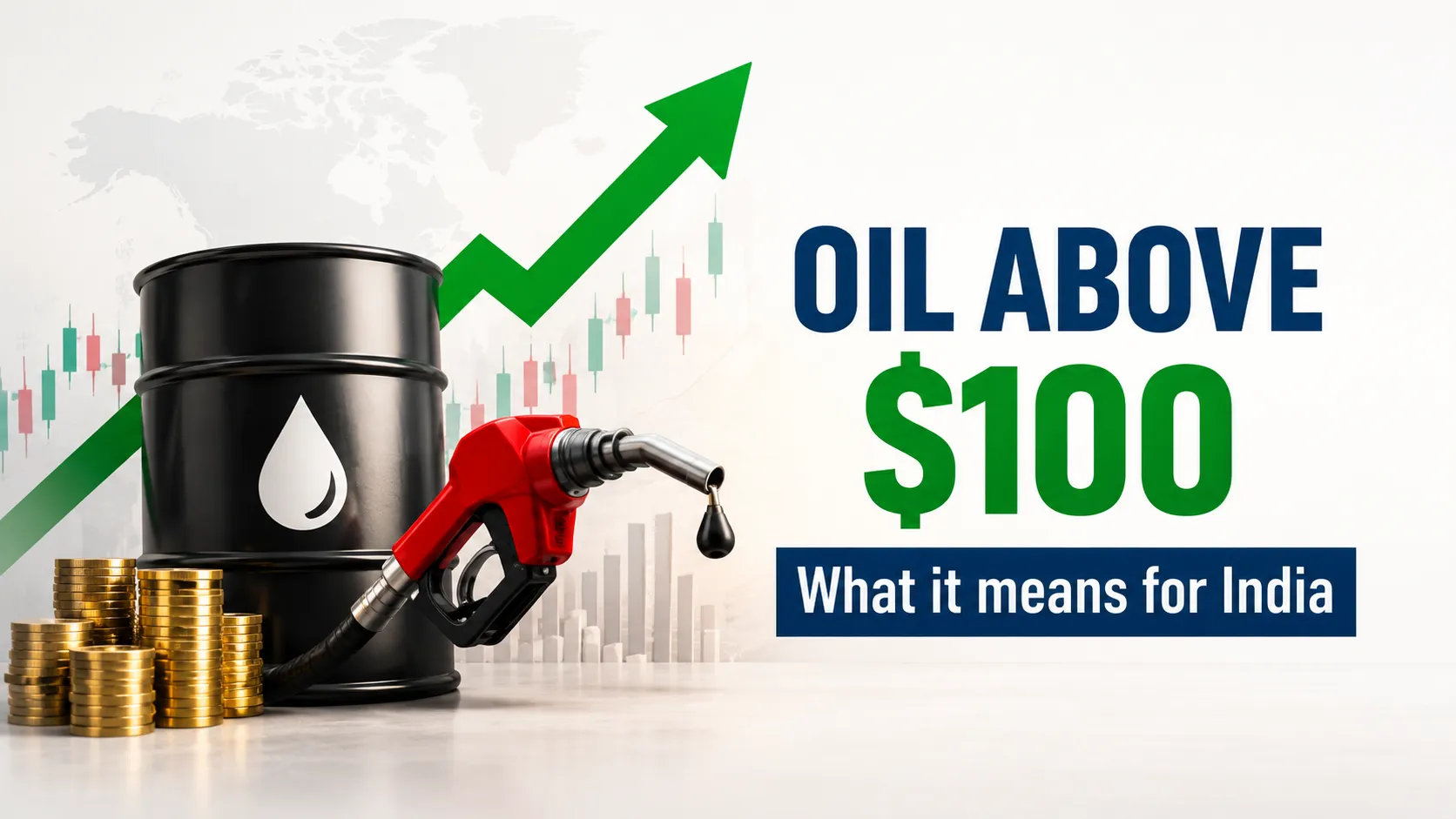
There is a number that traders, policymakers and finance ministries around the world watch with more anxiety than almost any other economic indicator: the price of a barrel of Brent crude oil. This week, that number crossed a threshold that had not been breached in a sustained, meaningful way for a considerable stretch — $100 a barrel — and the ripple effects are already being felt from the currency markets of Mumbai to the fuel pumps of small-town India.
The proximate trigger for this surge is not a supply disruption in the conventional sense, but an escalation of military hostilities between the United States and Iran, with reported strikes affecting shipping lanes and energy infrastructure across the Persian Gulf and the Red Sea corridor — two of the most critical arteries for global seaborne energy trade. When tensions rise in this specific geography, oil markets react almost instantaneously, because the region accounts for such an outsized share of the world's proven crude reserves and export capacity that even the perception of disruption, let alone actual supply loss, is enough to send prices sharply higher.
WHY THIS PARTICULAR CORRIDOR MATTERS SO MUCH
To understand why tensions in this specific part of the world move oil markets so dramatically, it helps to appreciate the sheer concentration of global energy infrastructure that passes through it. The Strait of Hormuz, at the mouth of the Persian Gulf, is transited by a substantial share of the world's seaborne crude oil exports on any given day, making it one of the most closely watched chokepoints in global energy security. Any credible threat to the free passage of tankers through this strait — whether through direct military action, mining of shipping lanes, or simply the elevated insurance and shipping risk that accompanies open hostilities in the region — immediately reprices global oil markets, regardless of whether actual physical supply has yet been affected.
The Red Sea corridor, meanwhhile, has taken on additional strategic significance in recent years as an alternate route connecting Gulf energy exports to European and other Western markets via the Suez Canal, bypassing longer voyages around the African continent. Disruption or heightened risk along this route similarly forces shipping companies and energy traders to reassess costs, insurance premiums, and delivery timelines, all of which feed into the price that refiners, and ultimately consumers, eventually pay.
INDIA'S PARTICULAR VULNERABILITY
For most large economies, an oil price shock of this nature is unwelcome but manageable. For India, it strikes at a particularly sensitive nerve, given the country's structural dependence on imported crude. India sources roughly four-fifths of its crude oil requirements from overseas, making it one of the most import-dependent large economies in the world when it comes to energy. This dependence means that swings in global crude prices translate almost directly and immediately into India's trade balance, its current account position, and ultimately into domestic inflation dynamics, in a way that is far more pronounced than for economies with greater domestic energy self-sufficiency.
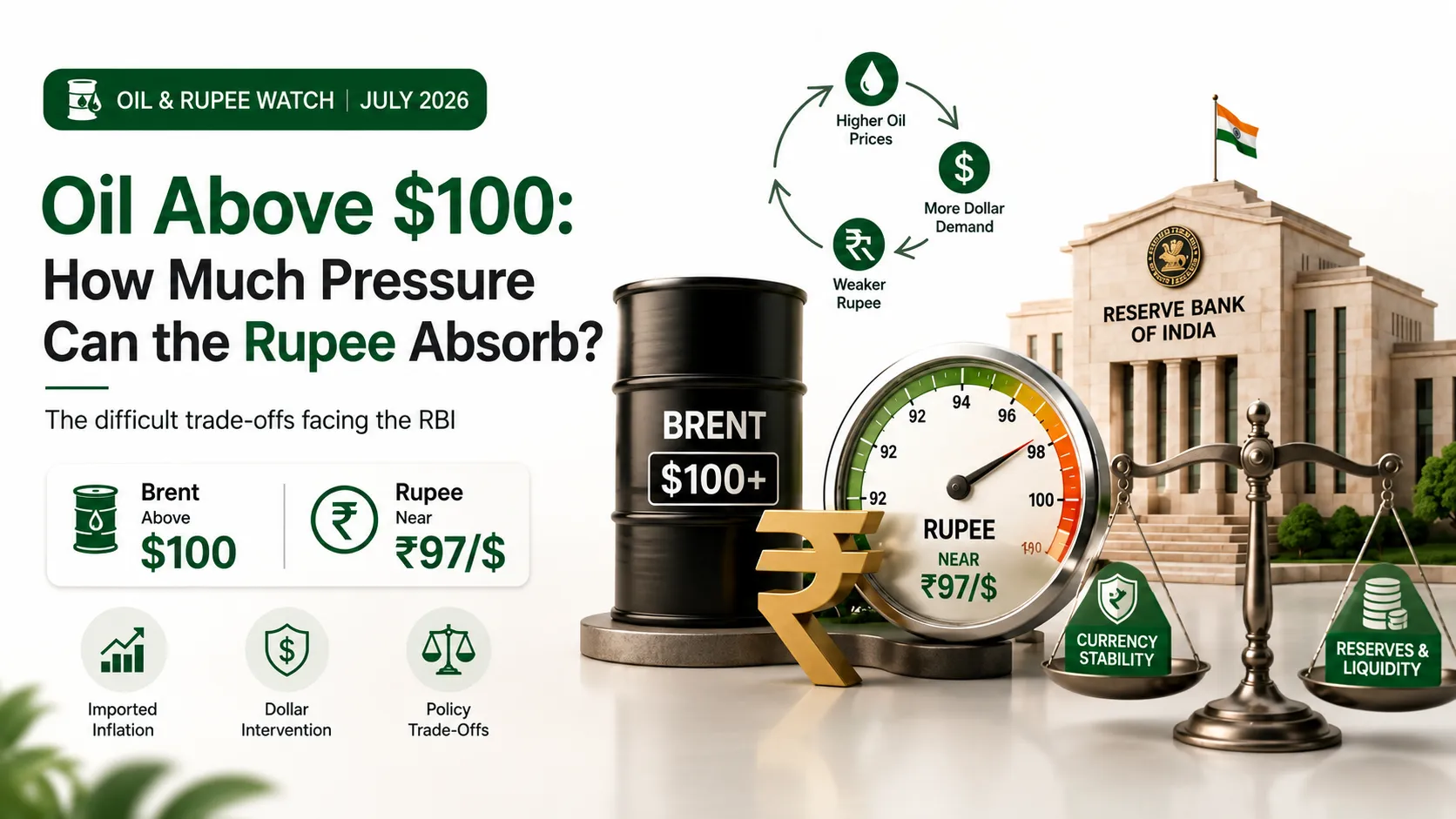
Every sustained dollar increase in the price of a barrel of crude adds meaningfully to India's annual oil import bill, given the sheer volume the country imports to meet its energy needs. This is not merely an abstract macroeconomic statistic — it has concrete, cascading effects. A larger import bill widens the trade deficit, which in turn puts pressure on the rupee as more dollars are needed to settle these import payments. A weaker rupee then makes the same volume of oil imports even more expensive in domestic currency terms, creating a feedback loop that can be difficult to break without either a reversal in global crude prices or significant policy intervention.
THE INFLATION TRANSMISSION MECHANISM
Perhaps the most consequential dimension of an oil price shock, from a policymaker's perspective, is how quickly and broadly it transmits into domestic inflation. Crude oil is not merely a consumer product in its refined form as petrol and diesel; it is a foundational input across vast swathes of the economy, from transportation and logistics to manufacturing, agriculture, and petrochemical-derived products that touch nearly every category of consumer goods. When crude prices rise sharply, the cost pressure does not remain contained to fuel pumps — it diffuses through transportation costs for virtually every good moved across the country, through fertiliser and agricultural input costs, and through the broader cost structure of manufacturing and services that rely, directly or indirectly, on energy-intensive processes.
The Reserve Bank of India has, over recent years, worked to keep headline and core inflation within its target band through a combination of interest rate policy and, at various points, coordination with the government on fuel taxation policy to buffer consumers from the full pass-through of global crude price volatility. A sustained oil shock of the magnitude currently being witnessed puts that hard-won inflation control at risk, forcing policymakers to weigh difficult trade-offs: absorbing some of the cost through reduced fuel taxation, which affects government revenue collection, versus allowing greater pass-through to retail fuel prices, which risks reigniting broader inflationary pressure across the economy.
WHAT HAPPENS AT THE PETROL PUMP
For ordinary Indian consumers, the most visible and immediate manifestation of a global oil shock is, of course, the price displayed at the neighbourhood petrol pump. India's fuel pricing mechanism, while nominally following a daily revision formula tied to international crude benchmarks and exchange rates, has historically also been influenced by government policy decisions around excise duty and state-level value-added tax rates on fuel, giving authorities some latitude in determining how quickly and how fully international price increases are passed through to consumers.
In the immediate aftermath of a sharp oil price spike, oil marketing companies — the state-run entities responsible for refining and retailing fuel across the country — often face a difficult balancing act between protecting their own margins, which can come under severe pressure if crude costs rise faster than they are able to pass through to retail prices, and the broader political and social sensitivity around fuel price increases, which have historically been a politically charged issue in India given their direct impact on household budgets and transportation costs for businesses of every size.
Government officials, when questioned about fuel pricing in the context of global oil shocks, have historically emphasised a preference for absorbing short-term volatility rather than immediately passing through every price swing to consumers, reserving price adjustments for situations where elevated crude prices appear likely to persist over a more extended period rather than reflecting a short-lived spike tied to a specific, potentially resolvable geopolitical event.
THE CURRENCY AND MARKETS CONNECTION
The oil price shock has not existed in isolation from India's broader financial markets. The Indian rupee has come under sustained pressure against the US dollar in recent sessions, a dynamic directly linked to the increased dollar demand from oil-importing companies needing to settle payments for costlier crude cargoes. This currency weakness has, in turn, been cited as one of the contributing factors behind the broader selloff in Indian equity markets, which have recorded multiple consecutive sessions of losses as investors reassess the inflationary and currency risk implications of sustained higher oil prices.
Equity markets tend to differentiate their response based on sector-specific oil price sensitivity. Oil marketing and refining companies can see their margins compressed if crude costs rise faster than they can adjust retail prices, while companies in energy-intensive sectors such as aviation, logistics, and certain manufacturing segments typically see input cost pressure that can weigh on near-term earnings expectations. Conversely, some domestic oil and gas exploration and production companies can see a boost to their realizations from higher crude prices, illustrating how a single macro shock can create winners and losers even within the same broad energy sector.
POLICY OPTIONS ON THE TABLE
Faced with a sustained oil price shock of this nature, Indian policymakers typically have several levers available, each with its own trade-offs. Excise duty cuts on petrol and diesel can cushion the impact on consumers and reduce inflationary pass-through, but at the direct cost of government revenue collection at a time when fiscal space may already be constrained by other spending priorities. Strategic petroleum reserve releases, while a smaller lever given the relatively modest size of India's strategic reserves compared to some other major economies, can provide limited near-term supply cushioning in acute crisis scenarios.
On the monetary policy front, the Reserve Bank of India faces its own set of difficult choices. An oil-driven inflation shock is generally considered by central banks globally to be a supply-side, cost-push phenomenon rather than a demand-driven one, and textbook central banking practice often counsels against aggressively tightening monetary policy in response to what may prove to be a transient, geopolitically-driven price spike rather than a sign of overheating domestic demand. However, if elevated oil prices persist long enough to become embedded in broader inflation expectations — affecting wage negotiations, contract pricing, and consumer behaviour more durably — the central bank may face pressure to respond with a more hawkish policy stance regardless of the shock's ultimately transient or persistent nature.
THE DIPLOMATIC AND ENERGY SECURITY DIMENSION
Beyond the immediate economic policy responses, the current oil shock has reignited longstanding conversations within Indian policy circles about the country's energy security strategy more broadly. India has, over recent years, pursued a diversification strategy for its crude oil imports, reducing its historical reliance on any single supplier region and building relationships with a broader range of exporting countries to reduce vulnerability to disruption in any one geography. The current Middle East-centred shock serves as a reminder of why this diversification strategy matters, even though the Gulf region remains, and is likely to remain for the foreseeable future, one of the largest single sources of India's crude imports given the sheer scale and cost-competitiveness of production in the region.
India has also continued to invest in expanding its strategic petroleum reserve capacity and in accelerating the transition toward renewable energy sources and electric vehicle adoption, both of which are frequently cited by policymakers as long-term structural responses to exactly this kind of import-dependency vulnerability, even though neither can meaningfully cushion the economy from a sharp, near-term price shock of the kind currently unfolding.
WHAT COMES NEXT
The path forward for oil prices, and consequently for India's broader macroeconomic trajectory, will depend heavily on how the underlying geopolitical situation between the United States and Iran evolves in the coming days and weeks. A de-escalation or diplomatic resolution could see crude prices retreat relatively quickly from current elevated levels, providing meaningful relief to India's currency, inflation, and equity market pressures simultaneously, given how tightly interlinked these three dimensions have proven to be in the current episode.
Conversely, a further escalation — particularly any development that meaningfully threatens the physical flow of oil through the Strait of Hormuz or the broader Gulf shipping corridor — could push prices considerably higher still, forcing Indian policymakers into more difficult trade-offs between inflation control, fiscal discipline, and currency stability than they have had to navigate in recent years. For now, markets, consumers, and policymakers alike find themselves in a familiar but uncomfortable position: watching a geopolitical conflict thousands of kilometres away determine the trajectory of prices, currencies, and monetary policy much closer to home.
A HISTORICAL PARALLEL WORTH REMEMBERING
Indian policymakers and market participants who have lived through previous oil shocks will recognise the current pattern of anxiety, even if the specific triggers differ each time. Previous episodes of Gulf-region tension have followed a broadly similar arc: an initial, sharp spike in crude prices as markets price in worst-case disruption scenarios, followed by a period of elevated but more stable prices as the actual physical impact on supply becomes clearer, and eventually — assuming no prolonged, large-scale disruption to actual production or shipping — a gradual normalisation as risk premiums built into prices unwind.
What distinguishes each episode is typically the duration and severity of the underlying conflict, and how quickly diplomatic or military resolution follows the initial escalation. Markets, in the earliest days of any such crisis, tend to price in the most severe plausible outcome, which is precisely why initial price spikes often prove larger than what the eventual, resolved situation would have justified in hindsight. This does not mean the current spike is guaranteed to reverse quickly — each geopolitical situation carries its own particular risks and escalation dynamics — but it does offer some historical context for why markets often overreact in the earliest phase of any such crisis before more measured pricing eventually takes hold.
For India specifically, the key metrics to watch in the coming days will be whether crude prices stabilise near current levels, continue climbing, or begin to retreat — each scenario carrying meaningfully different implications for the Reserve Bank's policy stance, the government's fiscal calculations around fuel taxation, and the broader trajectory of an economy that, despite this shock, continues to be described by many international observers as one of the more resilient large economies globally over a medium-term horizon.


