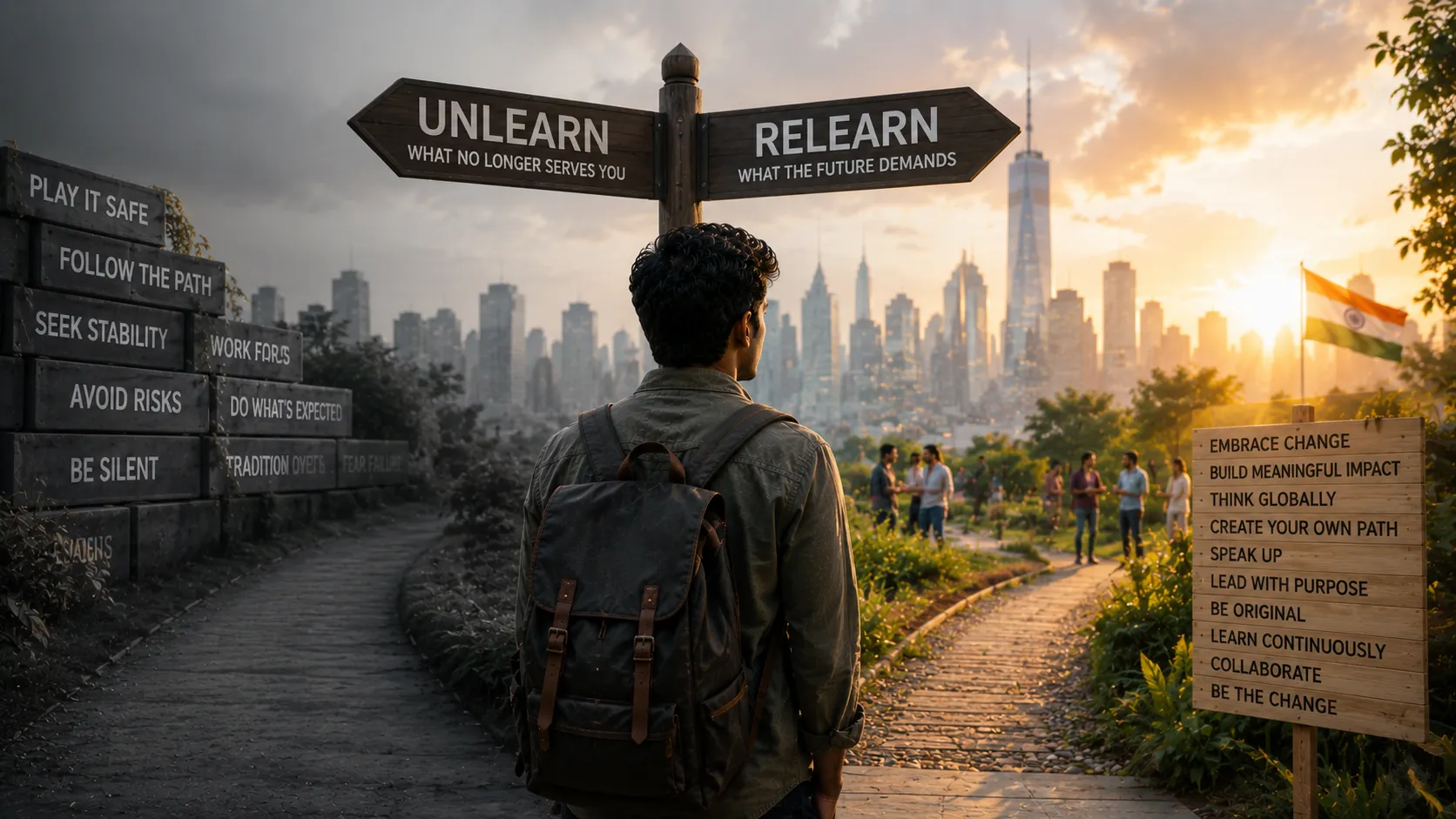
Learning is what the Indian diaspora does best. The community that produced engineers, doctors, academics, and executives across every continent did so by learning at an extraordinary rate — absorbing new systems, new languages, new professional norms, and new cultural contexts with a speed and completeness that has made it the most educationally credentialled diaspora in the world.
Unlearning is harder. And the next era requires it.
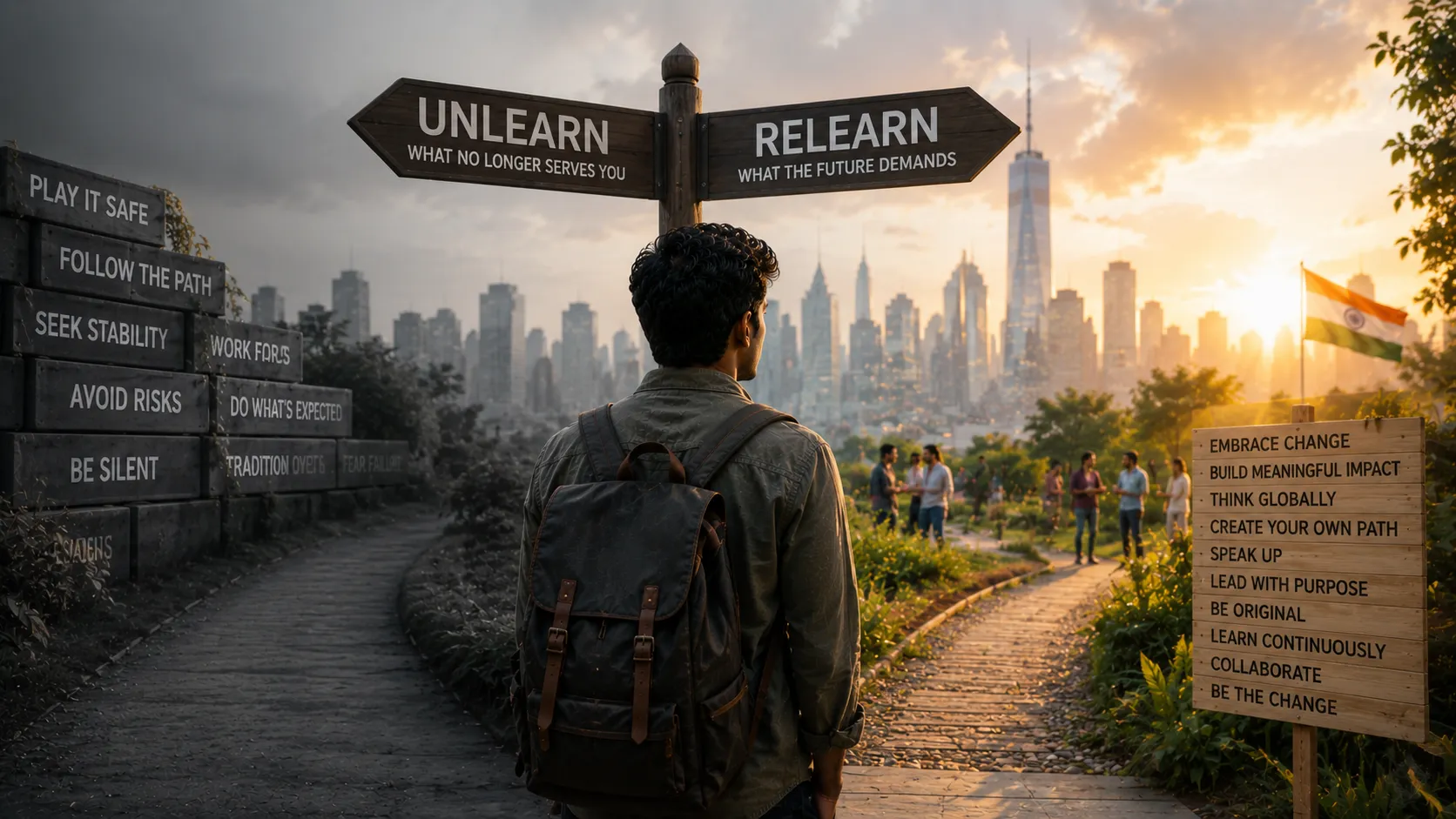
Unlearning is not the same as forgetting or rejecting. It is the deliberate recognition that a belief which was true and useful under one set of conditions may have stopped being true, or may have become actively limiting, under a different set of conditions. The Indian diaspora has accumulated a set of beliefs — about how to succeed, how to survive, how to relate to politics, to India, to other communities — that were formed in specific historical conditions and that served the community well. Some of them are now obstacles.
Here are five that need examining.
Unlearn: Silence Is Safety
The first generation of Indian immigrants learned, often through direct experience, that the safest posture for a minority in an unfamiliar country was to be useful and unobtrusive. To succeed at the job, not to challenge the system. To earn the privilege of presence through demonstrated value rather than asserted rights. This was not timidity. It was a rational adaptation to conditions in which speaking up could cost more than it gained.
Those conditions have changed.
In 2026, the Carnegie Endowment for International Peace's Indian American Attitudes Survey found that one in two Indian Americans reported personal discrimination since the start of 2025. One in four had been called a slur. Half encountered anti-Indian racist posts on social media very or somewhat often. When domestic political polarisation exports itself into diaspora communities, when white nationalists gather at city council meetings to protest the "massive takeover of Indians," silence is not a protective strategy. It is an absence in a conversation that is happening without the community's voice.
The belief that silence is safety made sense in a world where drawing attention carried genuine risk and where individual achievement was the most reliable path to acceptance. It is less useful in a world where the community's visibility has already made it a subject of national political discourse, where that discourse includes explicit hostility, and where the question is no longer whether to be seen but what to say when seen.
Silence does not protect anymore. Articulate, confident, publicly delivered self-advocacy does.
Unlearn: Credential Is Identity
The Indian diaspora has a particular and deep relationship with educational credentials. The IIT degree. The MD. The MBA from a named school. The professional certification. These are not merely resume line items. They are identity anchors — the things that tell a person who they are and that tell others what they are worth.
This relationship to credential served the community well when credentials were the most reliable signal available in unfamiliar professional environments, when the degree from a recognised institution communicated capability to employers who had no other way to evaluate a newcomer.
It is becoming a limitation in an age of artificial intelligence, in an age of skills-based hiring, in an age when the credential's predictive value for future performance is declining across every professional domain simultaneously.
The World Economic Forum's Future of Jobs Report 2025 found surging demand for analytical thinking, leadership, resilience, flexibility, and agility — the capacities that do not come with a degree and cannot be certified. India's own companies are moving toward skills-based hiring at nearly twice the global average rate. The credential is losing its role as the thing that defines what a person can do.
The person who ties their identity to a specific credential is a person whose identity is threatened every time the credential's market value shifts. The person who ties their identity to what they can learn, build, and adapt to is a person whose identity compounds over time rather than depreciating.
The shift required is not from valuing education to abandoning it. It is from credential as destination to credential as launchpad — from the degree as the thing you were working toward, to the degree as the point at which the actual work begins.
Unlearn: Politics Is Someone Else's Job
The first generation of Indian immigrants, in most host countries, treated politics as a spectator sport at best and a hazard at worst. Engagement with politics was not the path to safety or success. The path was education, professional achievement, and the quiet accumulation of economic standing that eventually produced influence without requiring the vulnerability of explicit political action.
This belief produced a community that votes in high numbers, donates to campaigns in significant amounts, and has watched with pride as Indian Americans entered the national political conversation in high-profile ways. It has been slower to produce the candidates, the officeholders, the legislative staffers, and the policy advocates who translate community preferences into institutional power.
The research on diaspora influence makes an uncomfortable point: the political influence of the Indian American community is currently concentrated in a small elite rather than distributed across the community as a whole. The capacity to influence foreign policy and domestic policy rests in a specific, resource-rich, well-connected segment. The wider community's preferences are expressed through voting and donation rather than through the more durable mechanisms of candidate recruitment, legislative staffing, and local office-holding.
The belief that politics is someone else's job has produced a community that is influenced by politics without sufficiently influencing it. The backlash of 2025 and 2026, the discrimination data, the Frisco city council incident — all of these are political phenomena that require political responses. Those responses need more than donors. They need people in the room where decisions are made.
Unlearn: Community Unity Requires Avoiding Internal Conflict
The Indian diaspora's instinct toward community harmony — the tendency to avoid public disagreement, to present a unified face, to keep internal conflicts within the community rather than naming them publicly — is an understandable product of communities that understood collective reputation to be a shared asset that individual dissent could damage.
It is also a belief that prevents the community from addressing the internal conflicts that most need addressing.
Most Indian diaspora organisations in host countries organise around state identities — Telugu associations, Punjabi societies, Tamil cultural organisations — rather than around a shared Indian identity. This fragmentation is real and reflects genuine linguistic, cultural, and regional distinctiveness. But it also weakens the community's ability to advocate collectively on issues that affect all of its members.
More significantly, the avoidance of internal conflict has allowed conversations about caste discrimination, class inequality within the community, religious plurality, and generational divergence to remain private rather than public. Younger members of the diaspora report disengaging from community institutions precisely because those institutions present a unified face that does not reflect the diversity of the community's actual experience.
Unity that is maintained by avoiding conflict is not unity. It is a performance of unity sustained by the exclusion of voices that would complicate the performance. The Indian diaspora community that can have honest public conversations about its internal diversity — including the uncomfortable ones — is a community that can build the genuine solidarity that complex challenges require.
Unlearn: India Is Either Homeland or Burden
The final belief that needs examining is the binary that governs many diaspora members' relationship to India: that India is either a homeland to be defended and celebrated or a burden to be escaped and transcended, with little room for a more complicated, more honest, more useful relationship in between.
The first framing produces a diaspora that advocates for India uncritically, defends its government regardless of policy direction, and treats any criticism of India as an attack on personal identity. The second produces a diaspora that left to get away from something and is not sure what to do with the fact that the something followed them in the form of cultural expectation, family obligation, and the gaze of a country that simultaneously takes pride in their success and resents their distance.
Neither framing is adequate to what India actually is in 2026: the world's most populous country, the fastest-growing major economy, the world's third-largest startup ecosystem, a country navigating a genuine and consequential transition to developed status, with all the tensions, contradictions, and genuine achievements that such a transition produces.
The domestic political polarisation that has fractured diaspora communities globally — exporting arguments about Indian politics into Indian American community organisations, into temple committees, into professional networks — is partly a product of this binary. When India is homeland, you defend it as you would defend yourself. When India is burden, you resent the demand. What neither framing allows is the relationship of an invested, honest, critical partner — proud of achievements, clear-eyed about failures, genuinely engaged with the future rather than performing a relationship with the past.
A diaspora that relates to India as a complicated partner is a diaspora that can actually contribute to its future rather than merely reflecting its politics. That contribution is the one that matters most in the era that is beginning.
What Unlearning Is Not
Unlearning is not the rejection of what was built. The beliefs named here were not wrong when they formed. They were the best available responses to the conditions that produced them — conditions of unfamiliarity, of minority vulnerability, of systems that did not yet recognise the community's presence.
The conditions have changed. The responses need to change with them.
Silence served when speaking up cost too much. Now it costs too much not to speak. Credential served when it was the most reliable signal of capability. Now capability is demonstrated differently. Political disengagement served when engagement carried risk. Now disengagement carries the greater risk.
Unlearning is what allows what has been built to keep growing. The foundation is real and it is strong. What is being asked is not to abandon it but to build from it differently — with the knowledge that the next era requires different things from a community that has already proved it can adapt to whatever it faces.
The Indian diaspora has learnt everything the last sixty years required of it. The next sixty require something harder: the willingness to let go of what is no longer true in order to hold on to what matters most.


