"We Were Hosting People With Plastic": The Corporate Couple Who Left Their Jobs to Build a ₹5 Lakh/Month Wooden Kitchenware Brand—and Prove That Slow, Handcrafted Products Can Still Win
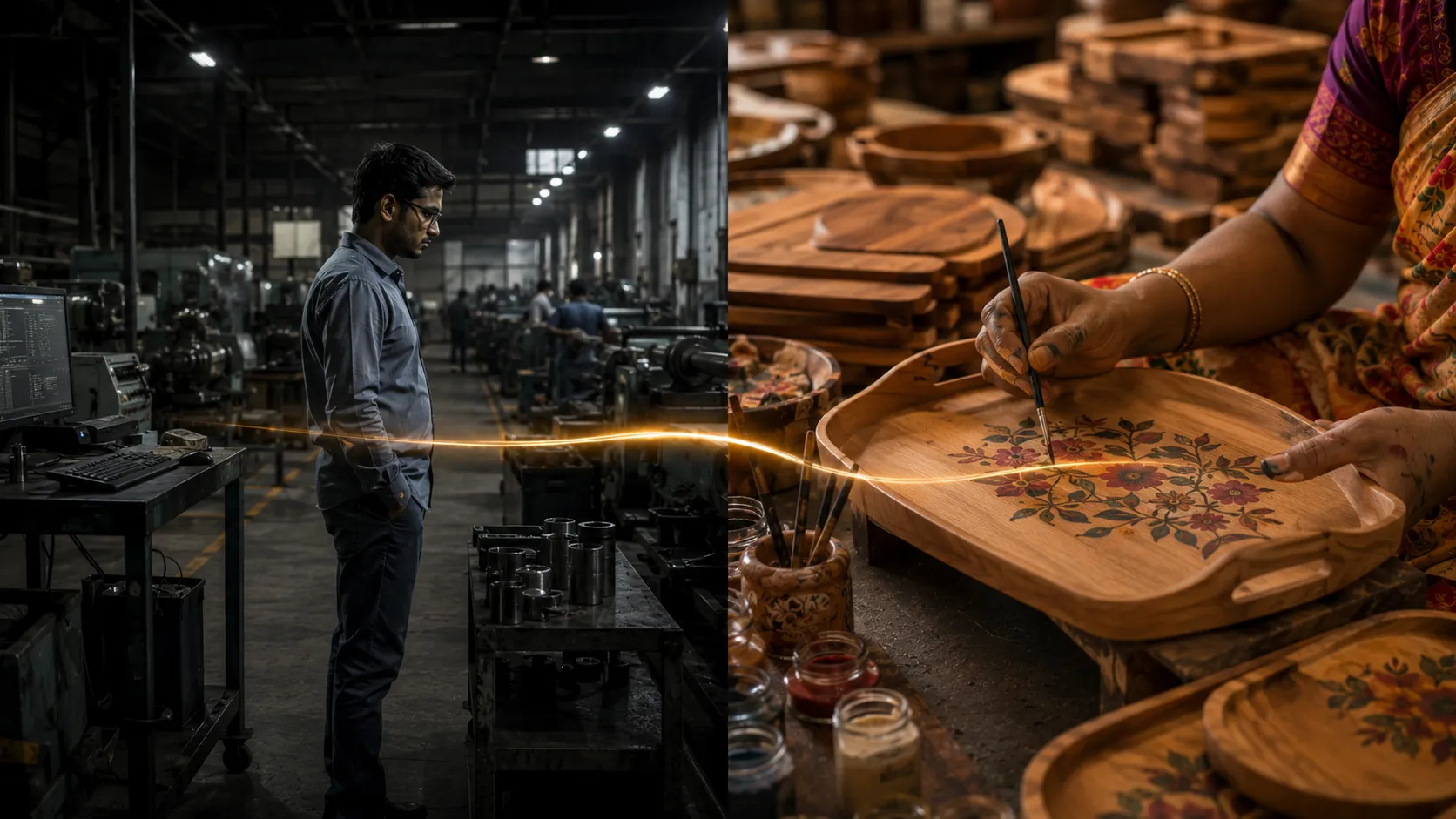
JAIPUR — May 26, 2026 — Punit Agarwal was 39 years old, a computer engineer by training who had spent the better part of his career in his father's metal fabrication business. The work was stable, profitable, and deeply monotonous. Every morning, he walked into the same factory, managed the same processes, and left with the same quiet dissatisfaction that had been accumulating for years. "That work is obviously very monotonous," he told The Better India. "It didn't let me explore creative avenues, or do something that I could put my heart into." He was not poor. He was not struggling. He was something that the Indian economy rarely acknowledges: a successful man who was quietly, persistently unfulfilled.
His wife, Chandni Gupta, was in a similar place, but from a different direction. She had spent 12 years in the corporate world—meetings, deadlines, the steady accumulation of a career that looked impressive on a resume but felt increasingly disconnected from the person she wanted to be. The couple were, by their own description, "big hosters"—they loved having people over, filling their home with friends and food and the kind of warmth that cannot be manufactured. But every time they hosted, the same thought nagged at them: the serving trays were plastic, the cutting boards were factory-made, and nothing on their table reflected the aesthetic sensibility they had developed over years of collecting art and admiring the craft traditions of their city.
Jaipur, after all, is not just any city. It is a living museum of Indian craft—woodwork, hand-painting, block printing, metalwork—where skills have been passed down through generations and the narrow lanes of Bagru still hum with the quiet rhythm of artisans shaping wood by hand. Punit and Chandni walked those lanes. They watched the artisans work. They saw the gap between what these craftsmen were capable of producing and what the market was offering, and they made a decision that would, in retrospect, seem obvious: they would build a brand that bridged the two. In 2022, they launched Aurum Crafts—the name derived from the Latin word for gold, chosen deliberately to reflect the value they saw in the craftsmanship they were about to build their lives around.
The Couple Who Left Everything
The decision to launch Aurum Crafts was not a sudden leap. It was a slow, deliberate unwinding of two lives that had been built on other people's expectations.
Punit, the computer engineer, had spent years in the family metal fabrication business—a world of machines, tolerances, and the repetitive satisfaction of making things that were functional but never beautiful. The business was successful enough to provide a comfortable living, but it offered no outlet for the creative energy that had been building inside him since childhood. "I wanted to build something that reflected creativity and culture," he told Indian Startup Times. "Engineering and finance gave me structure, but I wanted to build something that reflected creativity and culture." The statement is not the complaint of a failed businessman. It is the confession of a man who had achieved what he was supposed to achieve and discovered that it was not enough.
Chandni, meanwhile, had been climbing the corporate ladder for 12 years—a trajectory that her family had encouraged, her education had prepared her for, and her own ambition had sustained. But the ladder, she discovered, led to a view she did not particularly want. The work was demanding, the rewards were financial rather than emotional, and the cumulative effect of spending her days in an environment that valued efficiency above all else was a growing hunger for something slower, more tactile, more connected to the physical world. "Eventually, the time came where we wanted to do something that would focus on the creative aspects of our lives," she said. The two paths—his mechanical monotony, her corporate climb—converged on the same insight: the life they wanted was not waiting at the end of the careers they had built. It was waiting in the craft villages they had been driving past for years without ever really seeing.
The couple spent six months searching for the right name—an investment of time that, in retrospect, reveals everything about their approach to building the brand. They were not in a hurry. They were not chasing a trend or rushing to capture a market window. They were building something that they intended to last, and the name had to carry the weight of that intention. "Aurum"—Latin for gold—was chosen because it reflected what they believed the craftsmanship they were working with was actually worth. Not the price the market was paying for it, but the value it contained: the generations of skill, the hours of patient labour, and the irreplaceable quality of something made by human hands rather than machines.
The couple launched Aurum Crafts in 2022 with a D2C online business model, choosing to sell directly to consumers through their own channels and through online marketplaces like Amazon rather than through traditional retail. The decision was both practical and philosophical. Practically, it allowed them to reach customers without the expensive, relationship-intensive process of building a physical retail presence. Philosophically, it allowed them to control the story they were telling—to connect directly with the customers who would eventually become the brand's most loyal advocates, and to explain, product by product, why a handcrafted wooden serving tray was worth more than a factory-made plastic alternative.
The initial investment was modest—the couple's own savings, drawn from years of corporate salaries and family business profits. They did not raise venture capital. They did not take bank loans. They built the business the way the artisans they worked with built their products: slowly, carefully, and with a conviction that quality would eventually be rewarded. The first products were simple—wooden cheese platters, serving trays, cutting boards, and bowls—each one made from locally sourced wood from Jaipur and Jodhpur, each one hand-painted by artisans from the Bagru craft village who had been practising their skills for decades but had never been given a brand that could take their work beyond the local market.
The Artisan Economy
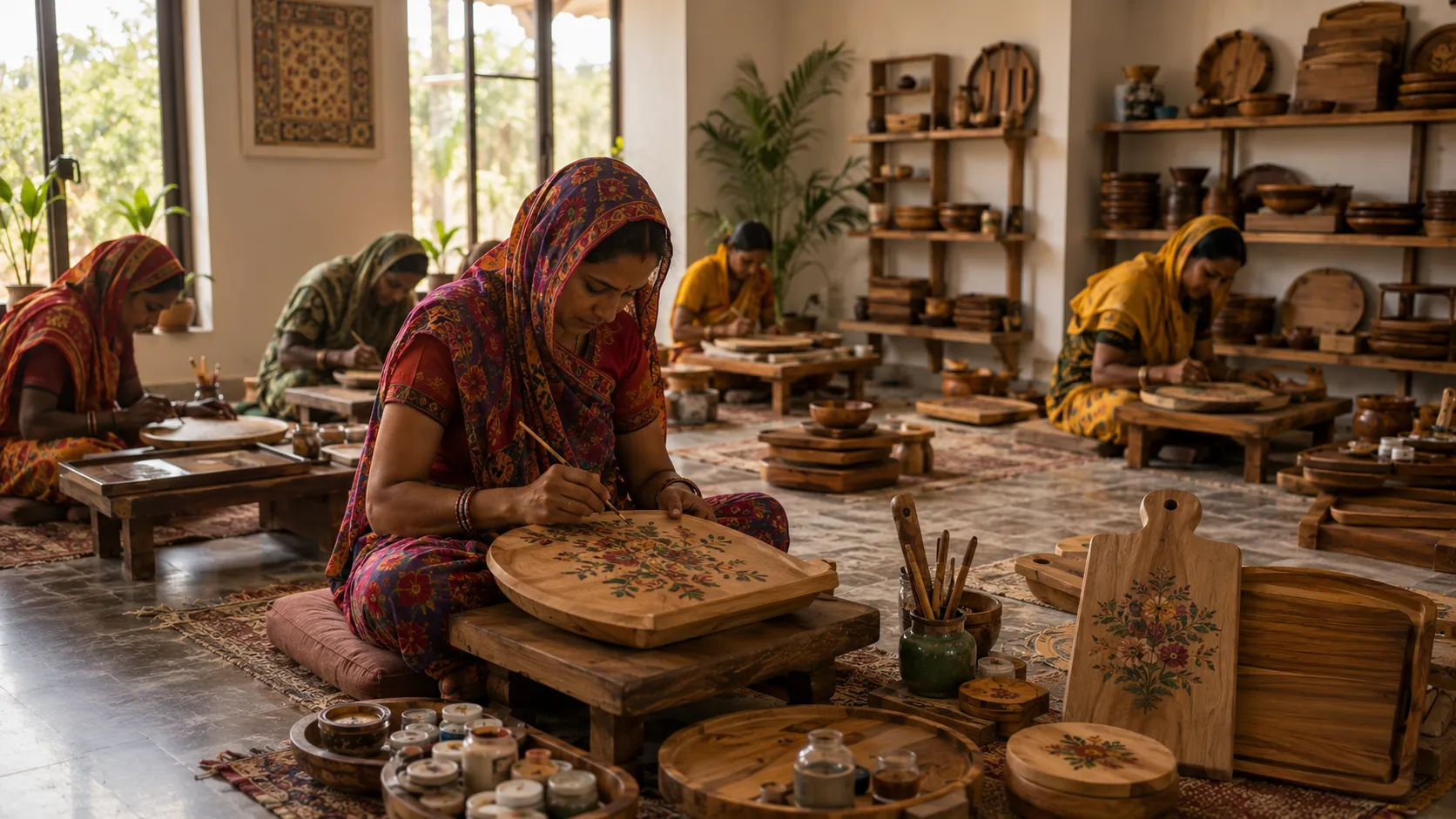
The most strategically significant dimension of Aurum Crafts is not the products or the revenue. It is the people who make the products. The company works directly with artisans from Bagru, the ancient craft village outside Jaipur where woodworking and hand-painting traditions have been passed down through generations. Many of these artisans are women—mothers, grandmothers, widows—who had been practising their skills for decades but had never been able to translate those skills into a stable income. The traditional market for their work was limited to local buyers, tourist shops, and the occasional export order, all of which paid prices that reflected the commodity value of the materials rather than the skill required to transform them.
Aurum Crafts changed that arithmetic. By building a brand that positioned handcrafted wooden kitchenware as premium, design-forward products rather than local souvenirs, the company was able to charge prices that allowed it to pay artisans fairly. "Fair pay and steady opportunities give them dignity—and that matters as much as the products we create," Punit told Indian Startup Times. The statement is not marketing. It is the operating model of the business. The artisan who paints a floral motif onto a wooden serving tray is not a cost to be minimised. She is the source of the value that the brand exists to capture, and the company that treats her as such earns a loyalty that no commercial contract can replicate.
The relationship between the company and its artisans is not a charity arrangement. It is a supply-chain partnership, structured around the same principles that govern every successful manufacturing business: quality control, on-time delivery, and fair compensation. The difference is that Aurum Crafts has chosen to build its supply chain around human skill rather than machine efficiency—a choice that is more expensive in the short term but that creates a product that no factory can replicate. A machine can cut a wooden board into a rectangle. A machine cannot paint a floral motif with the same hand that has been painting floral motifs for forty years, each stroke carrying the accumulated muscle memory of a lifetime spent at the craft.
The products reflect the philosophy. Each item—from the wooden cheese platters to the serving trays to the cutting boards and bowls—is made from locally sourced wood, shaped by hand or with minimal machine assistance, and then hand-painted with designs that draw on Rajasthan's centuries-old artistic traditions. The colours are natural, the finishes are food-safe, and the aesthetic is deliberately contemporary—traditional craftsmanship, applied to products that feel at home in a modern kitchen. "With our brand it was clear that working with handcrafted goods would give us that peace of mind that we're not further polluting the earth, and are keeping this craft industry alive by doing our small part," Chandni said. The part is small, but the ambition behind it is not.
The company has also integrated sustainability into its products in a way that is both symbolic and practical. Each product will soon include a seed card—a small, plantable card embedded with seeds that customers can grow, turning the act of purchasing a kitchen item into an act of environmental contribution. The seed card is not a marketing gimmick. It is a reflection of the same philosophy that drives every other decision the couple makes: that business should leave the world better than it found it, and that the most effective way to communicate that philosophy is not through advertising, but through the products themselves.
The Slow-Growth Model
The most remarkable thing about Aurum Crafts is not what it has achieved. It is what it has not. The company does not have a venture-capital round. It does not have a growth-at-all-costs mandate. It does not have a warehouse full of inventory waiting to be sold at a discount. It has a workshop, a network of artisans, a direct-to-consumer online presence, a presence on Amazon and other marketplaces, and a monthly revenue of approximately ₹5 lakh that has been growing steadily—not explosively, but sustainably—since the brand launched in 2022.
The growth model is deliberate. Punit and Chandni did not leave their corporate careers to build a business that would consume them the way their corporate careers had consumed them. They left to build a business that would sustain them—financially, creatively, and emotionally—and they have been careful not to sacrifice those priorities in pursuit of scale. The company is bootstrapped, which means that every rupee spent has to be earned first. The products are made slowly, which means that the company cannot flood the market with inventory the way a factory-based competitor could. The artisans are paid fairly, which means that the margins are thinner than they would be if the company were sourcing from a mass-production facility. Each of these decisions is a constraint on growth. Each of them is also a competitive advantage, because they produce a product that no factory-based competitor can replicate—and a brand that customers trust because the story behind it is real.
The couple's division of labour reflects the same philosophy of complementary partnership that has defined every successful family business since the concept was invented. Punit handles operations and sales—the mechanical, process-driven side of the business that his engineering training prepared him for. Chandni handles marketing and social media—the creative, relationship-driven side that her experience in corporate communications equipped her to manage. The partnership works not because the roles are gendered, but because each founder stays in their lane, and each lane is essential to the whole. Punit does not try to run the Instagram account. Chandni does not try to negotiate with wood suppliers. They trust each other's judgment in their respective domains, and that trust has allowed them to build a business that neither could have built alone.
The company is now planning to expand into ceramics and glassware, extending the handcrafted philosophy that has defined its wooden kitchenware into new materials and new product categories. The expansion will require investment—new supplier relationships, new manufacturing techniques, new quality-control processes—but the couple are approaching it with the same deliberate patience they have brought to every other decision in the company's history. They are not in a hurry. They are building something that will take years, perhaps decades, to reach its full potential—and they are building it at a pace that the industrial economy, with its quarterly earnings targets and its relentless pressure to cut costs, would find incomprehensible. "Be prepared for obstacles," Punit told Indian Startup Times. "Confidence and clarity will carry you through." The advice is generic, but the journey behind it is not. The couple who left their corporate careers to build a handcrafted kitchenware brand have been through the obstacles—the suppliers who did not deliver, the customers who did not understand why a wooden serving tray cost more than a plastic one, and the quiet, persistent doubt that accompanies every entrepreneur who has bet their savings on an idea that the market has not yet validated. They are still standing. The products are still selling. The artisans are still painting. The seed cards are being prepared. The gold is still being mined—not from the earth, but from the craft traditions that the industrial economy has spent a century trying to bury.
What This Signals
The Aurum Crafts story is not primarily about wooden kitchenware. It is about the collision of two structural forces that are reshaping the Indian consumer economy—and about the couple who have positioned themselves at the intersection of both.
The first force is the return of craft. For decades, the Indian consumer market was defined by a single, crushing assumption: that industrial production was superior to handmade production in every dimension that mattered. The factory-made product was cheaper, more consistent, and more widely available than the artisan-made alternative, and the consumer who chose the latter was either eccentric or wealthy. That assumption is now breaking. The same consumers who have rejected factory-made food, factory-made furniture, and factory-made fashion are now looking at their kitchen shelves and asking the same questions: where did this come from, who made it, and what did they use to make it? The handcrafted wooden serving tray that carries the story of the artisan who painted it is not just a product. It is an argument—that the things we use every day should be beautiful, and that the people who make them should be paid fairly for their skill.
The second force is the migration of talent from corporate careers to creative entrepreneurship. Punit and Chandni are part of a generation of Indian professionals who achieved what they were supposed to achieve—the engineering degrees, the corporate jobs, the family businesses—and discovered that the achievement was hollow. The life they wanted was not waiting at the end of the careers they had built. It was waiting in the craft villages they had been driving past for years without ever really seeing. The decision to leave those careers—to walk away from the salaries, the stability, and the social approval that accompanied them—was not an act of rebellion. It was an act of clarity. The couple who left the metal fabrication factory and the corporate office to build a brand around hand-painted wooden kitchenware did not abandon their skills. They redirected them, applying the same discipline, the same attention to quality, and the same capacity for hard work that had made them successful in their previous careers to a business that was built on creativity rather than efficiency.
Punit Agarwal and Chandni Gupta are no longer the computer engineer who found his work monotonous and the corporate professional who wanted something more creative. They are the founders of Aurum Crafts, the employers of artisans who had never been paid fairly before, and the quiet, persistent embodiment of a truth that the Indian economy has spent decades learning: that the most valuable things cannot be mass-produced. The wooden cheese platters, the hand-painted serving trays, and the cutting boards that carry the mark of the hands that made them are not just products. They are proof that the slow, the handmade, and the beautiful can still compete with the fast, the factory-made, and the cheap. The gold that the company is named for is not a metal. It is the craftsmanship that the industrial economy tried to bury, and the couple who refused to let it die.


