
She Was 23. The Offer Was ₹1 Crore. She Said No. This Is What She Built Instead.
In 2006, Vineeta Singh was completing her MBA at IIM Ahmedabad, one of the most competitive business schools in India. She had already earned a degree in electrical engineering from IIT Madras. She had internship experience from Deutsche Bank. And she had, on the table, a job offer from an investment bank worth ₹1 crore per year — a number that, for most people in India at that time, represented financial security far beyond what most would ever access.
She turned it down.
Not because she was certain it was the right decision. She has said publicly that she had real doubts. But she had made herself a rule: she would have no regrets. And she knew, with the clarity of someone who had decided before the offer arrived, that if she took the job, she would spend the rest of her life wondering what she might have built.
What she built is SUGAR Cosmetics — a brand that has upended the Indian beauty industry's assumptions about what Indian women want, what Indian women look like, and what a brand built for them should sound like. A brand now valued at approximately ₹4,000 crore, with a presence in more than 45,000 retail outlets across 130-plus cities, backed by major institutional investors, and preparing for a public market listing. A brand built alongside her husband, Kaushik Mukherjee, whom she met at IIM Ahmedabad — two people who failed together twice, learned together through those failures, and built together the third time something that has lasted.
That is the story. And it begins not with success but with the decision to try when success was far from guaranteed.
Two Failures Before the One That Worked
Before SUGAR, Vineeta and Kaushik failed. Not once. Twice.
In 2010, they launched a fashion e-commerce company. It did not survive. The funding was not there, the experience was not there, and the market timing was not in their favour. In 2011, they tried a consulting firm. It failed too, for lack of clients.
Most people stop at one failure. The couple went twice into uncertainty and twice came back with more information than they had before. Each failure was expensive — in money, in time, in the social cost of having built something that did not work. Each failure was also, in retrospect, the specific education they needed.
In 2012, they tried a third time. FAB Bag was a beauty subscription service — a monthly curated box of cosmetics products delivered to subscribers for ₹599. It was not a cosmetics brand. It was a distribution and curation platform. But it gave them something that no investor meeting or market research report could have produced: direct, ongoing access to the preferences, pain points, and purchasing behaviour of more than 100,000 Indian women who paid monthly for beauty products.
Those 100,000 women taught Vineeta and Kaushik something specific. International beauty brands dominated the Indian market. And international beauty brands were making products primarily for skin tones, climate conditions, and aesthetic preferences that were not Indian. The foundation shades did not match Indian complexions. The lip colours that performed in European light looked different in Indian sun. The humidity of an Indian summer undid the claims of formulations designed for temperate conditions. The bold, maximalist aesthetics of a significant segment of Indian women had no brand speaking to them — no brand that said you are right to want this, and here is a product that was built for you.
SUGAR launched in 2015 to be that brand.
The Brand with Attitude — Built on One Honest Insight
The founding product insight of SUGAR Cosmetics is disarmingly simple: make makeup that works on Indian skin, in Indian weather, for Indian women who refuse to be told to look a particular way.
Vineeta has described the product brief she and Kaushik gave themselves with precision. It was not going to be a dainty, pastel kind of brand. It was going to be makeup with attitude. For bold, independent Indian women who were tired of being sold products that either did not work on their skin or did not reflect their self-image.
The Smudge Me Not liquid lipstick became the brand's first cult product — a long-lasting formula specifically engineered to withstand Indian humidity and the conditions of daily Indian life. It was not an adaptation of an international formula. It was built for the specific problem that Indian women had identified through the FAB Bag relationship: a lipstick that stayed through a Mumbai monsoon, through a Delhi summer, through the kind of active day that most international brands' fragile formulations could not survive.
The brand grew almost without marketing in its early phases. Products spread through word of mouth because they solved real problems in ways that the existing options did not. Revenue of ₹3 crore in FY17 grew to ₹100 crore-plus before the growth really accelerated. By FY23, the brand had crossed ₹500 crore in annual revenue — a compound annual growth rate of nearly 60 per cent over six years.
The capital stack that funded that growth reflects the institutional conviction that the brand earned: RB Investments, A91 Partners, India Quotient, Elevation Capital, L Catterton — a combination of domestic and international institutional investors who tracked the brand's trajectory through the FAB Bag phase and backed it through the SUGAR phase.
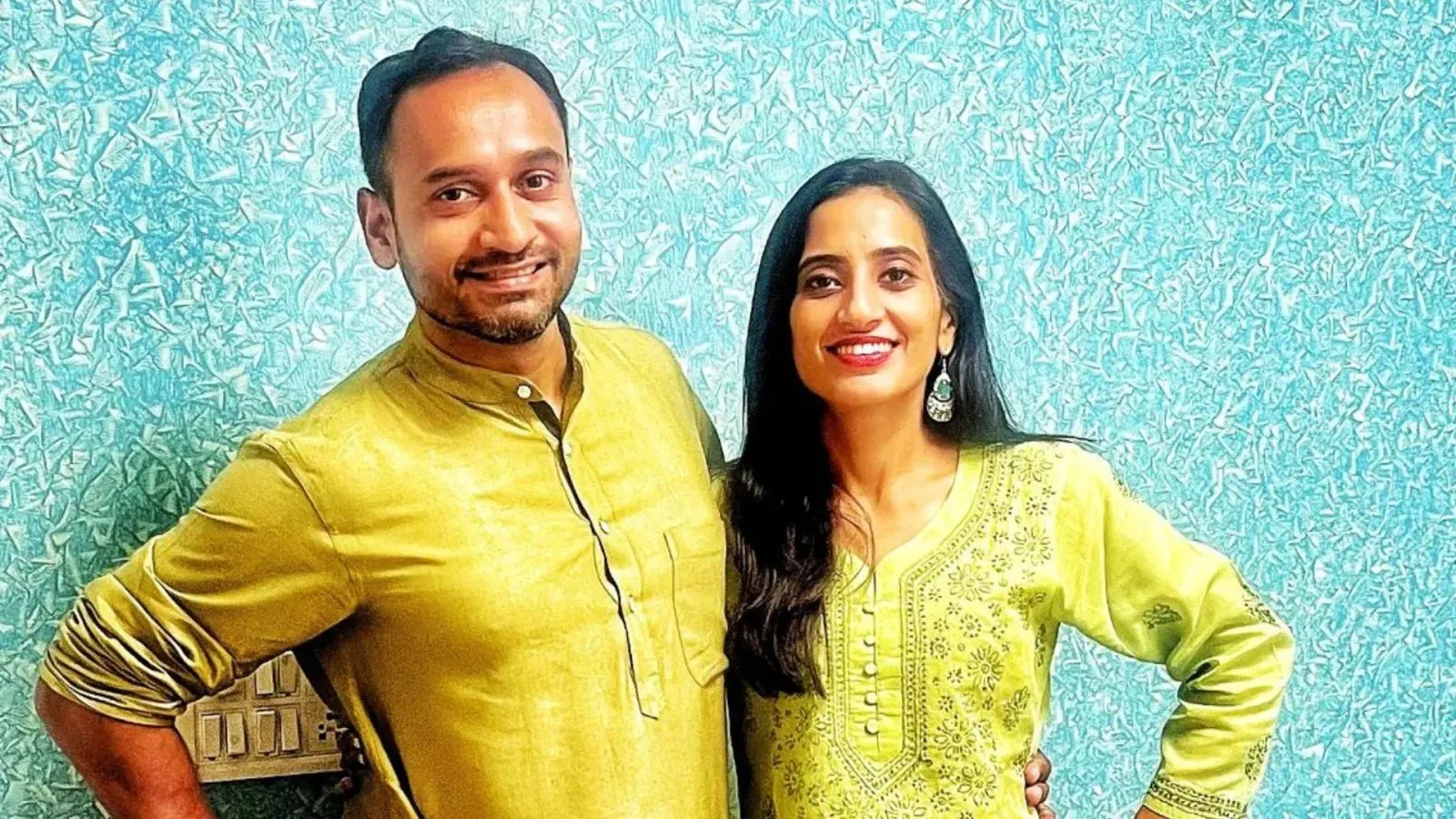
The Partnership That Built It
The Vineeta-Kaushik professional partnership is the structural foundation of the brand in ways that an org chart does not fully capture.
Vineeta is the CEO — the public face, the Shark Tank judge, the brand's most visible spokesperson. She brings the consumer understanding, the storytelling capability, and the sheer personal credibility that comes from being someone who has run every mile of the startup journey.
Kaushik is the COO — the operational backbone whose background at Goldman Sachs, McKinsey, and through multiple entrepreneurial ventures makes him the person who builds the systems that allow the brand vision to be executed at scale. He is a BITS Pilani graduate, an IIM Ahmedabad MBA, a triathlete and Ironman competitor — a detail that matters not as biography but as evidence of the discipline and endurance that show up in how he runs the operational side of a business.
Vineeta has spoken about the specific challenges of building SUGAR in a fundraising environment that was not always neutral. Some investors, she has said, were only willing to engage with SUGAR if Kaushik joined full-time — a condition that embedded a gender bias in the investment conversation that had nothing to do with the quality of the company or the capability of the team. She navigated that too. And SUGAR was built.
The personal detail that grounds the whole story is this: Vineeta and Kaushik met at IIM Ahmedabad. They built their professional lives together before they married in 2011. The business relationship and the personal relationship are not separate things. They have been building together since they first started working together, and the failures and the successes have both been shared.
The IPO That Is Coming — and What Needs to Happen First
SUGAR's path to a public market listing is not a straight line, and Vineeta has been honest about that.
FY25 was difficult. Revenue declined from the FY24 level to approximately ₹415 crore, and the company reported a net loss of approximately ₹108 crore. The IPO target that Vineeta had articulated in early 2024 — a two to three year timeline, contingent on consistent profitability and revenue above ₹1,000 crore — was pushed back in light of the FY25 performance. The honest acknowledgement of that setback, and the recalibration of the timeline, is itself evidence of a leadership approach that treats the market with respect rather than spinning unfavourable outcomes into positive narratives.
The offline retail expansion — 45,000-plus retail outlets across 130-plus cities — is the foundation of the brand's scale and also the source of some of its margin pressure. Building and maintaining a physical retail presence across India at this breadth requires distribution infrastructure, credit cycles, and working capital that a purely digital brand does not face. The return to profitable growth that the IPO requires is fundamentally about managing that offline expansion in a way that generates the kind of sustainable margin that public market investors will support.
SUGAR Play, the brand's line targeting younger consumers, represents the category extension that gives the brand a growth engine beyond its core proposition. The digital-first distribution channels — the website, the app that crossed a million downloads, the marketplace presence across Nykaa, Myntra, and Amazon — provide the data and the customer relationship depth that the offline network cannot replicate.
What This Brand Actually Built
SUGAR Cosmetics is a commercial enterprise with a valuation, a funding history, and an IPO in preparation. But the thing it actually built — the thing that explains why the valuation reached ₹4,000 crore from nothing in a decade — is something that finance alone does not capture.
It built permission. Permission for a generation of Indian women to want bold, maximalist, unapologetically expressive makeup. Permission to expect products that worked for their specific skin. Permission to see themselves represented in a beauty brand that did not ask them to conform to a standard inherited from somewhere else. The smudge-proof formula was a product decision. The attitude was a cultural statement. And the two together created a brand that meant something to millions of people in a way that a product category alone never produces.
Vineeta turned down ₹1 crore at 23 because she wanted to build something she could not build as someone else's employee. What she built, with Kaushik, across two failures and one extraordinary success, is a brand that is simultaneously a cosmetics company and an argument — about who Indian beauty is for, what it looks like, and what it is allowed to be.
The ₹4,000 crore valuation is the market's answer to that argument. The 100,000 women who subscribed to FAB Bag were the first audience for it. The 45,000 retail outlets are where it lives now.


