In a moment that Indian space industry insiders are already calling the dawn of a new era, Hyderabad-based Skyroot Aerospace successfully launched Vikram-1, India's first fully privately developed orbital rocket, on July 18, 2026, in a test flight named Mission Aagaman — Sanskrit for "arrival." The four-stage, seven-storey-tall small-satellite launcher lifted off carrying multiple technology demonstration payloads into low Earth orbit, marking the first time an Indian private company has independently executed a complete orbital space mission, from rocket design and manufacturing through to launch and satellite deployment, without relying on a state-run vehicle to carry its payload into space.
The scale of the technical achievement is significant even by global standards for a first orbital attempt by a private space company. Vikram-1 is capable of hauling approximately 350 kilograms of payload to low Earth orbit, and its first three stages run on solid propellant while its fourth and final stage uses liquid propulsion — a hybrid architecture that reflects years of incremental technology validation by Skyroot, beginning with the sub-orbital Vikram-S rocket that first flew in November 2022 under the appropriately named Mission Prarambh, meaning "the beginning." That earlier sub-orbital flight, which reached a peak altitude of roughly 89.5 kilometres, served as a crucial technology demonstrator, validating the company's signature all-carbon composite rocket structure and its use of 3D-printed solid rocket motors — innovations that have now been carried through, refined, and scaled up into the considerably more complex Vikram-1 orbital vehicle.
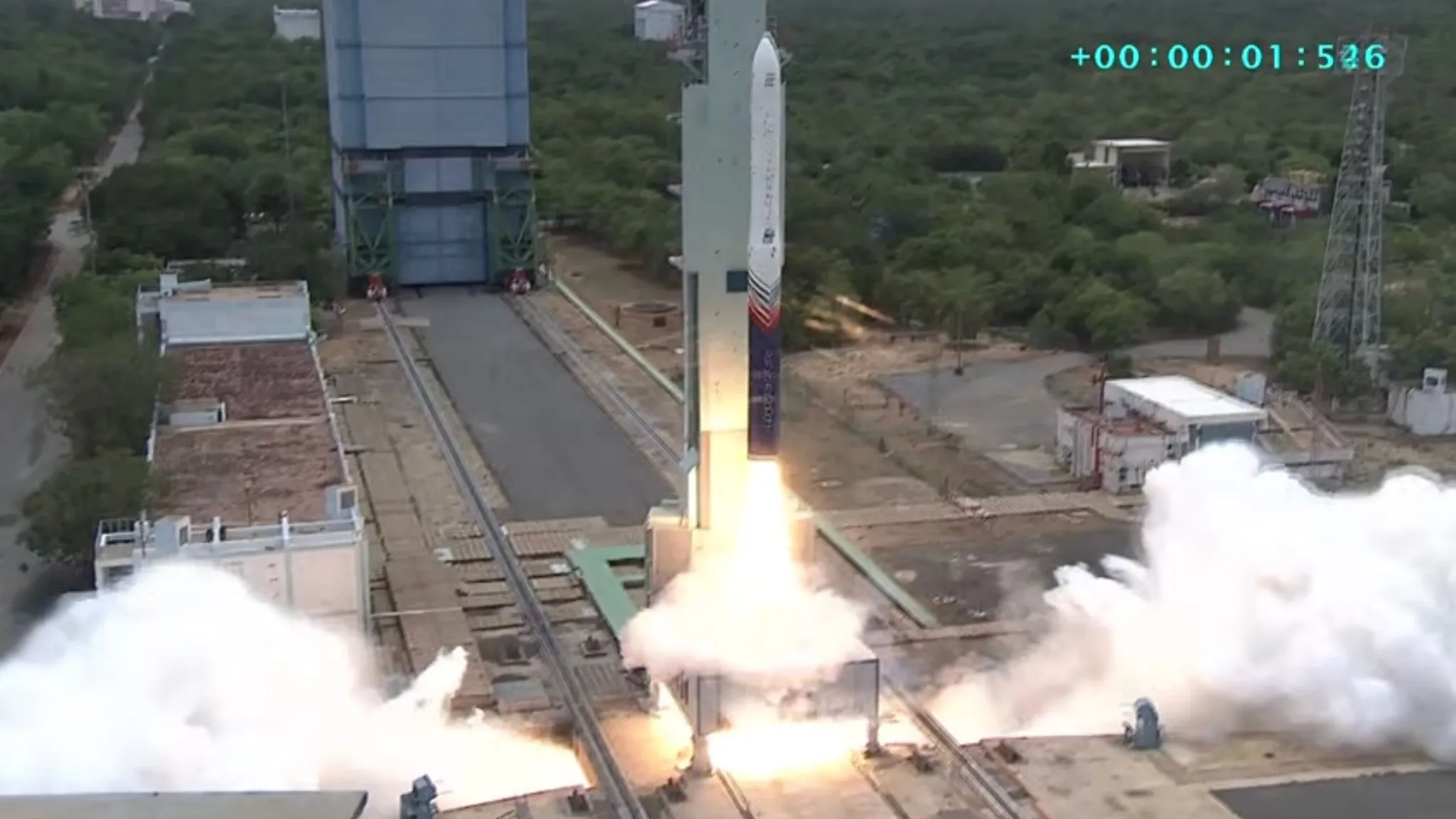
Mission director confirmation of the launch's success drew audible cheers from the Skyroot team gathered to watch the flight, with the company declaring the Vikram-1 Aagaman mission a grand success shortly after satellite deployment was confirmed. Lieutenant General AK Bhatt (retired), Director General of the Indian Space Association, described the achievement in strikingly emphatic terms, calling the successful orbital launch a defining milestone for India's space journey and noting that by executing the nation's first fully private orbital flight, Skyroot has shattered legacy boundaries and demonstrated that the country's domestic private space industry is now capable of handling end-to-end space missions independently, rather than merely supplying components or subsystems into missions still ultimately overseen by the state-run Indian Space Research Organisation.
Skyroot's co-founder and chief executive, Pawan Kumar Chandana, who previously worked at ISRO before striking out to build Skyroot alongside fellow co-founder Naga Bharath Daka, framed the achievement squarely in commercial terms rather than purely as a technological milestone. Chandana pointed to structural supply constraints in the global small-satellite launch market, noting that demand for satellite-enabled services continues to grow steadily even as the supply side of dedicated small-launch capacity remains deeply constrained — precisely the market gap Skyroot has spent years positioning Vikram-1 to fill. With this successful debut, the company now becomes one of a still-small handful of private launch providers worldwide capable of offering dedicated, responsive small-satellite launch services, joining an exclusive global category long dominated by American and, more recently, Chinese commercial launch providers.
The rocket itself carries symbolic as well as technical weight. Named after Vikram Sarabhai, widely regarded as the father of India's space programme, Vikram-1 was built around an all-carbon composite structure and powered by in-house developed propulsion systems, including 3D-printed engines and high-thrust solid-fuel rocket boosters — engineering choices that Skyroot has consistently framed as central to its competitive positioning on cost and launch turnaround time relative to both established and emerging global small-launch competitors. Its payload roster for the debut mission was itself a showcase of India's broader emerging space ecosystem: Grahaa Space's SOLARAS S3 satellite, Cosmoserve Space's Embrace, a robotic arm designed to capture orbital debris, a technology demonstration payload from Germany's DCUBED, and Skyroot's own SCOPE satellite all rode aboard the mission, alongside two symbolic payloads — a floral-shaped artwork titled "Cosmic Bloom" and an 18-karat gold micro-rocket bearing microscopic sculptures of scientists CV Raman, Vikram Sarabhai and APJ Abdul Kalam, each smaller than a grain of rice.
The commercial and strategic implications of this launch extend well beyond Skyroot itself, feeding into a broader narrative of India's space sector opening up to genuine private-sector competition following the government's 2020 decision to end ISRO's decades-long monopoly over the country's space activities. That policy shift catalysed a wave of new private space companies, ranging from launch vehicle developers like Skyroot and its rival Agnikul Cosmos, to satellite manufacturers, ground infrastructure providers and space-data analytics firms, all now operating within a sector that Indian policymakers have repeatedly identified as a priority area for both economic growth and strategic technological self-reliance. A successful, fully private orbital launch — rather than one conducted with substantial ISRO operational involvement — represents the clearest possible proof point yet that this policy liberalisation is translating into genuine, independently executed technical capability rather than remaining confined to component supply and subsystem contracts.
For India's broader space economy, which policymakers and industry bodies have set ambitious growth targets for over the coming decade, Vikram-1's successful debut arrives at a moment of accelerating momentum. The global small-satellite launch market has been expanding rapidly, driven by the proliferation of satellite constellations for communications, Earth observation, and increasingly, in-orbit servicing and debris removal — exactly the kind of specialised, high-frequency, dedicated launch demand that large, expensive orbital rockets designed primarily for heavier payloads have historically struggled to serve efficiently. Skyroot's positioning, built specifically around rapid integration, minimal launch infrastructure requirements, and the ability to serve both dedicated single-customer launches and multi-payload rideshare missions, is designed precisely to capture this underserved segment of the market — a segment that industry analysts expect to grow substantially over the remainder of the decade as small satellite constellations proliferate across commercial, scientific and defence applications worldwide.
Looking ahead, Skyroot's near-term priorities will centre on converting this successful debut flight into a sustained commercial launch cadence, translating the technical validation achieved through Mission Aagaman into signed customer contracts and a repeatable, reliable launch operation. Industry observers note that a single successful test flight, however historically significant, represents only the first step toward building the kind of consistent, insurable, commercially bankable launch service that satellite operators require before committing meaningful volumes of business to a new provider. Even so, for India's space industry — and for the broader narrative of Indian private enterprise entering deep-technology sectors long assumed to be the exclusive preserve of government agencies and a handful of global superpowers — Vikram-1's successful debut stands as one of the most consequential technological milestones the country has achieved in 2026, and a clear signal that India's ambitions in space are no longer confined to what ISRO alone can build and launch.
The broader competitive context surrounding this launch is worth dwelling on further. India's private space sector has, over the past several years, attracted a steadily growing pool of venture capital and strategic investment, with Skyroot itself having raised significant funding rounds from a mix of domestic and international investors betting on the long-term commercial potential of indigenous Indian launch capability. Rival Indian launch vehicle developer Agnikul Cosmos has pursued a parallel, though technically distinct, approach centred on 3D-printed single-piece rocket engines, and the successful debut of Vikram-1 is widely expected to intensify competitive pressure — and investor interest — across this small but rapidly maturing cohort of Indian private launch companies. Globally, the small-satellite launch sector has already seen the emergence of well-funded competitors in the United States, Europe and China, meaning Skyroot's technical achievement, while historically significant for India, still positions the company as a relatively new entrant into an increasingly crowded and competitive global market segment.
Government and regulatory support has played a meaningful role in enabling this milestone as well. The Indian National Space Promotion and Authorisation Centre, established specifically to facilitate and regulate private-sector participation in India's space activities following the 2020 policy liberalisation, has worked closely with companies like Skyroot to provide access to testing facilities, regulatory clearances, and in some cases direct technical collaboration with ISRO's own scientists and engineers — a hybrid public-private model that industry participants credit with accelerating India's private space sector's development considerably faster than might have been possible under a purely commercial, arms-length regulatory approach. Continued policy support of this nature is widely seen as essential to sustaining the momentum generated by Vikram-1's successful debut, particularly as Skyroot and its peers now shift focus toward the considerably harder challenge of building a repeatable, commercially viable launch cadence rather than a single, historically significant test flight.
Prime Minister Narendra Modi's government has repeatedly cited the opening of India's space sector to private participation as a flagship example of its broader economic liberalisation and self-reliance agenda, and Vikram-1's successful orbital debut is likely to feature prominently in official messaging around India's technological achievements over the coming months. For a country that has long taken justified pride in ISRO's cost-efficient, high-reliability track record — from the Mars Orbiter Mission to the Chandrayaan lunar missions — the emergence of a credible, independently capable private orbital launch industry adds an entirely new dimension to India's space narrative, one centred not on national prestige missions alone but on the considerably more commercially oriented proposition of India as a competitive, cost-effective destination for global small-satellite launch business in the years ahead.
The economics underpinning this emerging commercial opportunity are significant. Global satellite operators building out large constellations for broadband internet connectivity, Earth observation, and defence and intelligence applications increasingly require frequent, flexible, and cost-effective access to low Earth orbit — a demand profile that traditional, larger orbital launch vehicles, often booked years in advance and optimised for heavier payloads, have struggled to serve efficiently. Skyroot's stated ambition to offer rapid-turnaround, minimal-infrastructure launch services tailored specifically to this smaller payload segment positions the company to compete for exactly this category of demand, provided it can now demonstrate the launch cadence, reliability track record, and pricing competitiveness that satellite operators require before committing meaningful volumes of business to a still-young provider. Industry estimates of the global small-satellite launch market's growth trajectory over the remainder of this decade have consistently pointed toward substantial expansion, giving Skyroot and its domestic and international competitors alike a large and growing addressable opportunity to pursue in the years immediately following this historic first flight.
Financial markets and India's venture capital community have responded to the launch's success with visible enthusiasm, with several investors and industry commentators describing Vikram-1's debut as a watershed moment likely to catalyse fresh capital inflows into India's broader deep-technology and space-technology startup ecosystem. Historically, sectors requiring long, capital-intensive development timelines before reaching a commercially validating milestone — as orbital rocketry unambiguously does — have struggled to attract the same depth of venture funding in India as more conventional software and consumer internet startups, given venture investors' typical preference for shorter paths to revenue and profitability. A successful, internationally newsworthy technical milestone of this nature is widely expected to help shift that calculus, at least at the margin, by demonstrating to both domestic and international investors that Indian deep-technology companies are capable of delivering on genuinely difficult, multi-year engineering roadmaps rather than merely iterating on already-proven business models within India's large domestic consumer market. Mission Aagaman, in that sense, may ultimately be remembered as much for the capital it unlocks for India's wider deep-tech ambitions as for the satellites it placed into orbit.
Educational and workforce development implications also flow from this milestone. Skyroot's engineering team, drawn substantially from India's premier technical institutes as well as from ISRO's own alumni network, has demonstrated over the course of Vikram-1's development that a private Indian company can attract and retain the specialised aerospace engineering talent required to compete at the frontier of orbital rocketry — a workforce development validation that industry observers expect will encourage a new generation of Indian engineering graduates to consider careers in the country's private space sector, rather than viewing ISRO or emigration to established aerospace hubs abroad as the only viable paths for pursuing meaningful, cutting-edge space-sector careers domestically, at home in India's own rapidly growing and increasingly credible private launch industry.