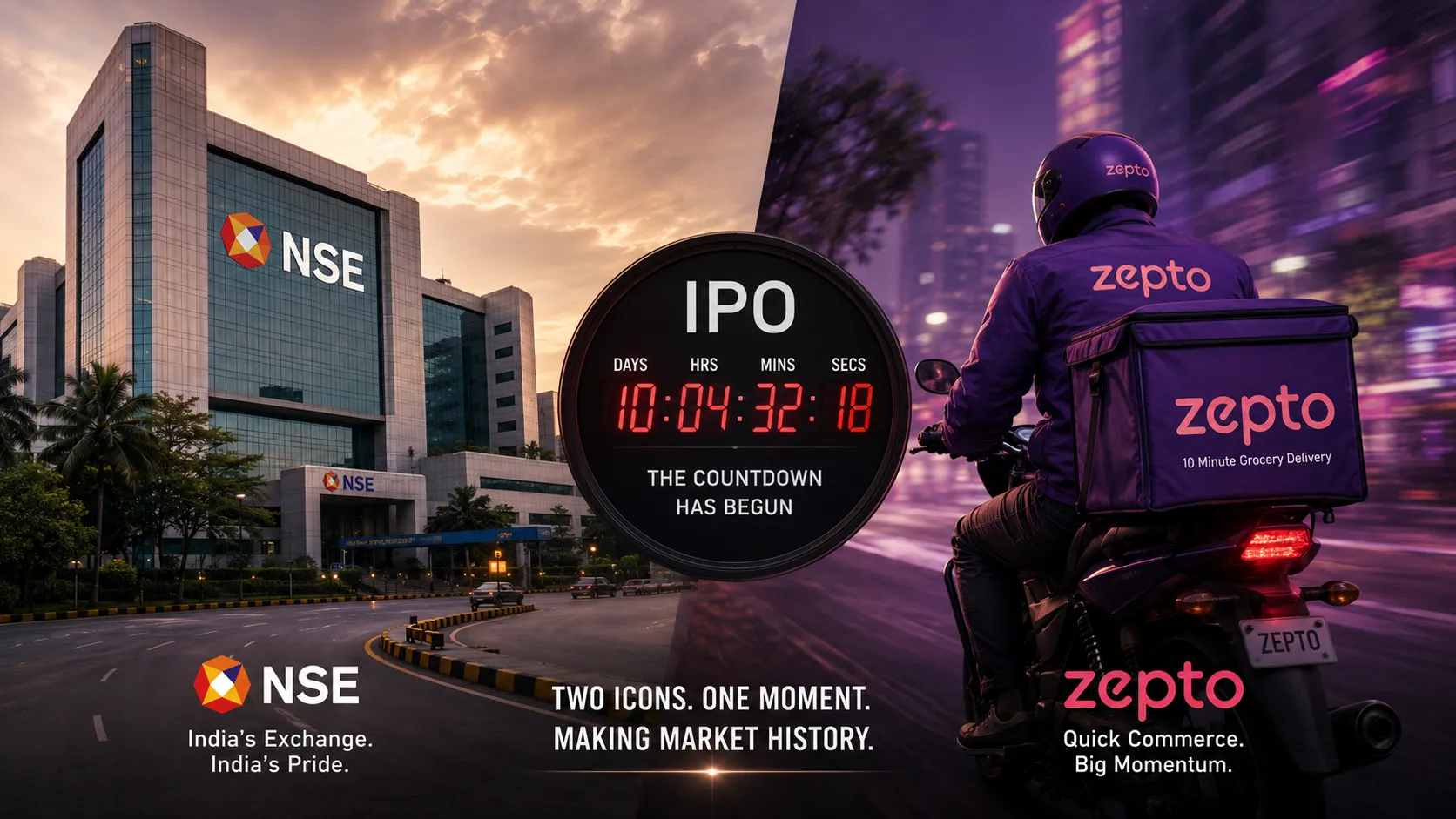
After years of regulatory delays, NSE has finally filed its DRHP for a ₹30,000 crore IPO. Zepto has followed with an updated DRHP for its ₹8,010 crore fresh issue, aiming for a July listing. The Indian IPO pipeline is waking up — and two of the most anticipated offerings in years are finally within sight.
The file had been sitting in draft for nearly a decade. On June 17, 2026, it finally moved.
India's largest stock exchange, the National Stock Exchange of India (NSE), filed its Draft Red Herring Prospectus (DRHP) with the Securities and Exchange Board of India (SEBI), marking a major milestone for the country's capital markets. The long-awaited IPO, expected to raise approximately ₹30,000 crore, could become the biggest public offering in Indian history.
Just nine days earlier, on June 8, quick-commerce giant Zepto filed its updated DRHP, targeting a fresh issue of ₹8,010 crore alongside an offer for sale by existing investors. The company is eyeing a July listing.
Two of the most anticipated IPOs in years are finally moving closer. And the Indian primary market — which has seen a subdued first half of 2026 — is about to wake up.
Part 1: NSE — A Decade in the Making
The Longest Waiting Room in Indian Finance
The NSE IPO has been nearly a decade in the making. The exchange first filed its IPO papers with SEBI in 2016, aiming for a ₹10,000 crore offering. But the listing was put on hold amid regulatory investigations and proceedings, including the high-profile co-location and dark fibre cases, where certain brokers were accused of receiving preferential access to the exchange's trading systems.
For years, the IPO was "just around the corner." Then it was "delayed indefinitely." Then it was "back on track." Then it was "stalled again."
The turning point came in January 2026, when NSE received a No Objection Certificate (NOC) from SEBI, clearing the way for its much-awaited listing. The regulator's clearance was significant because it was delinked from the settlement of pending co-location-related cases, allowing the exchange to move ahead with the IPO process despite unresolved legal matters. The exchange's board formally approved the IPO on February 6, 2026.
On June 17, the 614-page DRHP was finally filed with SEBI and the BSE.

The Offer: Entirely an OFS
The NSE IPO is structured entirely as an offer for sale (OFS) of up to 14.89 crore equity shares, representing approximately 6% of NSE's paid-up capital. There is no fresh issue component, meaning the exchange itself will not receive any proceeds. All proceeds will go to the selling shareholders.
Based on NSE's estimated unlisted market valuation of around ₹5 lakh crore, market participants expect the issue size to be approximately ₹30,000 crore, surpassing Hyundai Motor India's ₹27,000 crore IPO in 2024 to become India's largest public offering. In the grey market, the IPO is pegged at roughly ₹29,780 crore.
Who Is Selling?
The selling shareholders include some of India's largest financial institutions:
State Bank of India — the largest selling shareholder, offering up to 24.75 million shares
MS Strategic (Mauritius) Limited — a Morgan Stanley fund, divesting up to 16 million shares
Canada Pension Plan Investment Board — selling up to 11.87 million shares
Aranda Investments (Mauritius) Pte. Ltd. — a Temasek affiliate, selling up to 11.24 million shares
Bank of Baroda — around 11 million shares
Stock Holding Corporation of India Ltd. — around 11 million shares
General Insurance Corporation of India (GIC Re) — up to 10.65 million shares
The New India Assurance Company Ltd. — up to 10.5 million shares
National Insurance Company Ltd. — around 6 million shares
United India Insurance Company Ltd. — around 6 million shares
Notably, Life Insurance Corporation of India (LIC) , the exchange's single-largest shareholder with a 10.72% stake, is not selling any stake in this offering. Premji Invest (2.35%) and Radhakishan Damani (1.58%) are also not selling.

A $2.6 Billion Windfall
The IPO is set to create a significant windfall for early investors. According to Reuters calculations, the top 10 investors offering shares are set for a windfall worth approximately $2.6 billion, based on acquisition prices disclosed in the draft prospectus.
State Bank of India alone will lock in gains of about 47 billion rupees ($497.67 million), while MS Strategic (Mauritius) will make about 29.34 billion rupees, Singapore's Temasek stands to make 20.67 billion rupees, and the Canada Pension Plan Investment Board will gain 18.71 billion rupees.
The exchange is likely to begin IPO roadshows over the next two months, with both domestic mutual funds and global funds showing early interest in anchoring the issue.
Financial Performance
NSE's financials remain robust despite regulatory headwinds. The exchange reported:
Revenue from operations: ₹16,601 crore in FY26, up from ₹14,780 crore in FY24
Net profit (PAT): ₹10,302 crore in FY26, compared to ₹8,305 crore in FY24
Dividends: ₹35 per share in both FY25 and FY26
However, PAT declined approximately 15% year-on-year from ₹12,188 crore in FY25 to ₹10,302 crore in FY26, partly reflecting the impact of SEBI's regulatory tightening of equity derivatives.
NSE's Unique Registered Investors base has grown at a compounded annual rate of 26.9%, from 30.87 million in March 2020 to 129.1 million in March 2026, spanning over 99% of Indian postal codes. The exchange remains the largest equity derivatives exchange globally, with over 36.99 billion contracts traded in FY2026.
The Co-Location Overhang
The co-location case continues to remain a key overhang. NSE filed a settlement application with SEBI in June 2025 and subsequently offered to pay ₹1,387.39 crore to resolve the matter. Media reports suggested that SEBI's High-Powered Advisory Committee recommended a settlement amount of around ₹1,880 crore, including disgorgement, interest, and other charges. The recommendation is understood to be pending consideration.
Under current market regulations, an Indian stock exchange cannot list its shares on its own platform, which means NSE will list its shares on rival BSE — mirroring the arrangement under which BSE shares are currently listed on NSE.
Part 2: Zepto — The Quick-Commerce Bellwether
Filing the Updated DRHP
Just nine days after NSE's filing, Zepto — the Bengaluru-based quick-commerce unicorn — filed its updated DRHP with SEBI on June 8, 2026.
The IPO comprises a fresh issue of ₹8,010 crore alongside an offer for sale of up to 113,466,566 equity shares by existing investors. The company is poised to become the first dedicated quick-commerce entity to debut on domestic stock exchanges.
Founders Aadit Palicha and Kaivalya Vohra are not diluting any stake in the offering. The Bengaluru-headquartered unicorn confidentially filed its IPO papers with SEBI in December 2025 and secured regulatory approval in May 2026.
The Selling Shareholders
The offer-for-sale includes shares from existing institutional backers:
Nexus Ventures VI Holdings, LLC — up to 57,357,141 shares
Nexus Ventures VII Holdings, LLC — up to 30,398,907 shares
Contrary ZEP Holdings LLC — up to 7,801,378 shares
Razor Ventures Zepto LLC — up to 9,364,174 shares
Kaiser Foundation Hospitals — up to 4,385,912 shares
Kaiser Permanente Group Trust — up to 4,159,054 shares
Dark Store Expansion
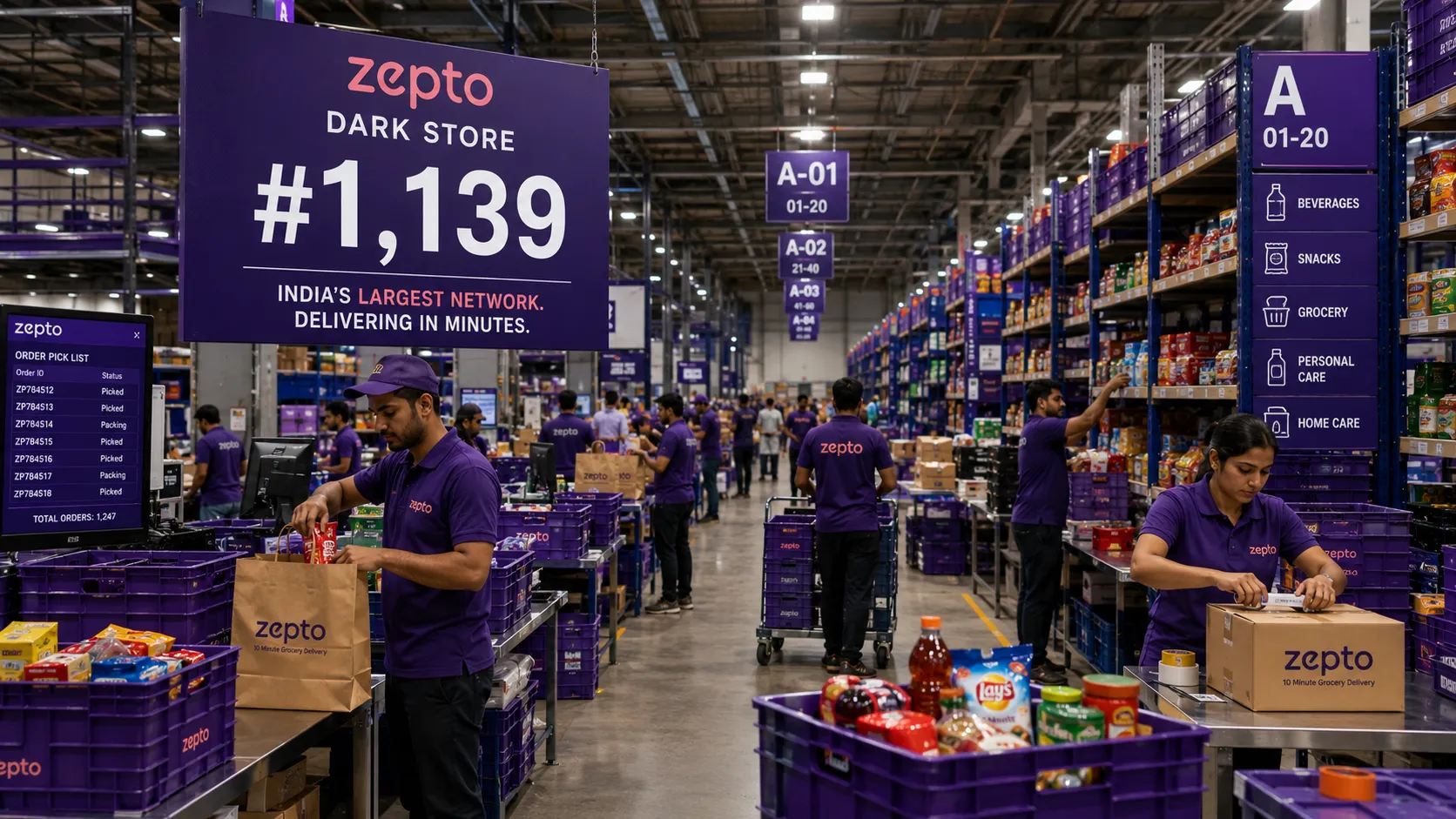
Zepto intends to use the net proceeds from the fresh issue primarily to expand its dark store network. The specific allocations include:
Expansion of dark store network through setting up new dark stores in existing and new geographies — ₹1,628.9 crore
Lease rentals for existing dark stores — ₹1,734.9 crore
Technology and cloud infrastructure — ₹1,324.7 crore
Marketing and business promotion — ₹5.20 crore via subsidiary Zepto Marketplace Private Limited
As of March 31, 2026, Zepto operated 1,139 dark stores across multiple cities, supporting a catalogue of over 46,000 stock-keeping units at the local fulfilment level. The company also reported 4.79 crore annual transacting users, reflecting 25% year-on-year growth.
The ED Summons
The DRHP also disclosed a significant regulatory overhang. The Enforcement Directorate issued summons to both founders, Aadit Palicha and Kaivalya Vohra, under the Foreign Exchange Management Act (FEMA), just two months before the filing of the IPO papers.
The ED summons, dated April 8, 2026, sought a detailed set of documents including foreign investments, audited balance sheets going back to FY2020-2021, owned immovable properties, shareholding patterns, income tax returns, and a note on the business model.
Kaivalya Vohra appeared before the ED on April 17 and April 22. Aadit Palicha appeared on April 20 and again on May 15. Both have since provided the requested documents. As of the UDRHP filing date, the matter remains ongoing.
The disclosure is notable for two reasons. One, the timing — summons in April, appearances through May, DRHP filed June 8. Two, the placement — this is not tucked into the litigation section; Zepto's own bankers and lawyers have flagged it as a named risk factor.
More Regulatory Overhangs
The ED summons are not the only regulatory concern:
The Competition Commission of India has an active inquiry into predatory pricing and anti-competitive discounting in quick commerce, with Zepto squarely named
The All India Consumer Products Distributors Federation separately wrote to SEBI seeking to block quick commerce IPOs, citing deep discounting and cash-burn-led market capture
The Maharashtra FDA previously suspended the food business license of Kiranakart Technologies, Zepto's predecessor entity, following violations at a Dharavi storage facility
Zepto is also listing under Regulation 6(2) of SEBI ICDR Regulations — the route for companies that do not meet standard profitability norms, the same path taken by Zomato and Swiggy before it.
The Financials: Growth and Losses
Zepto's financials tell a story of extraordinary growth alongside widening losses:
Revenue from operations:
FY24: ₹4,454.52 crore
FY25: ₹11,109.94 crore
FY26: ₹22,623.58 crore — more than double the previous year
Net loss:
FY24: ₹1,214.79 crore
FY25: ₹4,699.71 crore
FY26: ₹5,905.19 crore
Q4 FY26 — Zepto narrowed its net loss to ₹1,538.67 crore from ₹1,831.91 crore in Q4 FY25. Revenue from operations grew 75.26% year-on-year to ₹7,497.64 crore.
The Quick-Commerce Landscape
Zepto is the last major quick-commerce player to go public. Blinkit is already listed under Eternal, and Instamart is listed under Swiggy. Zepto's listing will complete the public market triumvirate of India's quick-commerce giants.
The company has raised $1.2 billion across 12-15 funding rounds, leaving limited room for further stake dilution. The IPO is essential for providing liquidity to early investors and securing fresh capital for the company's aggressive expansion plans.
Customers, meanwhile, are set to benefit. The fresh capital will mean more stores, faster deliveries, and wider coverage. As one industry observer put it: "Customers will feast as Zepto pours fuel into the quick-commerce fire".
The Bottom Line
Two of the most anticipated IPOs in years are finally moving closer. NSE, after nearly a decade of regulatory delays, has filed its DRHP for what could be India's largest-ever public offering. Zepto, the quick-commerce bellwether, has filed its updated DRHP and is targeting a July listing.
The NSE IPO will unlock value for existing shareholders, providing transparent price discovery and liquidity through a listed market for the exchange's shares. The Zepto IPO will be the first standalone quick-commerce listing in India, marking a significant moment for the consumer delivery landscape.
For retail investors, the question is no longer if these IPOs will happen — but when the subscription windows will open. The answer, if current timelines hold, is soon.


