
There Are Two Indian-American Economic Success Stories. One Gets Celebrated. The Other Gets Overlooked. Both Are Extraordinary.
The story that gets told about Indian-American economic achievement centres on the corner office — the IIT engineer who became a Silicon Valley executive who became a CEO. Sundar Pichai. Satya Nadella. The metrics of educational excellence and corporate ascent. This story is real, documented, and remarkable.
There is a second story. It starts not in an engineering college or a corporate headquarters but in a struggling motel in a declining American neighbourhood in the 1970s. It involves not a recruiter from a technology company but a Gujarati immigrant who heard from a cousin that you could buy a small American motel cheaply, live on the premises, save on operating costs, and build equity over time. It involves not a career ladder but a community network — the specific information sharing, the communal savings, the informal capital markets that allowed wave after wave of Gujarati families to enter the American lodging industry.
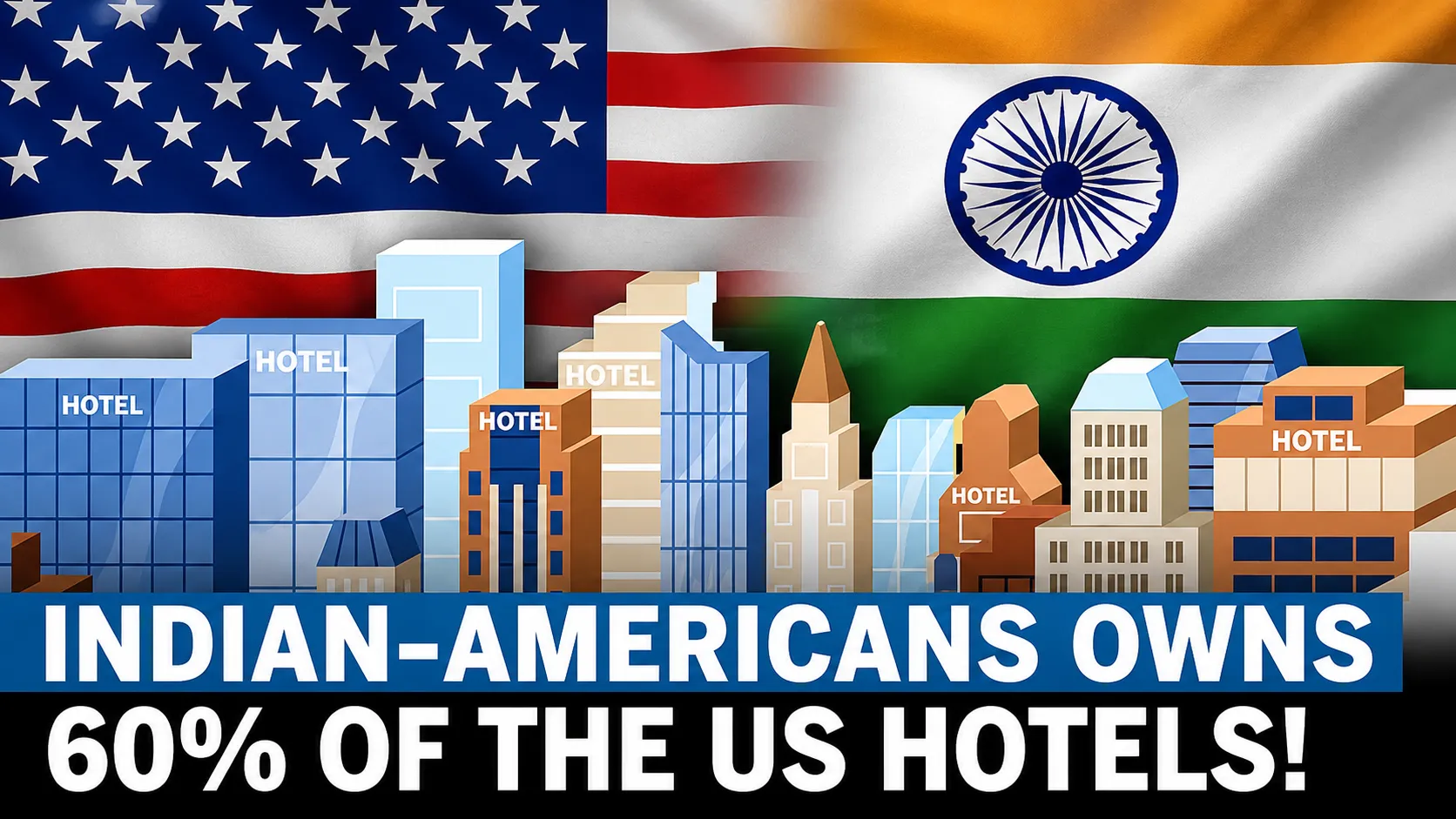
Today, the members of the Asian American Hotel Owners Association own 60 per cent of all hotels and motels in the United States — 36,000-plus properties generating an estimated $40 billion in annual revenue and employing more than 600,000 people. They own 3.1 million guestrooms. In Texas, Oklahoma, Arkansas, and Louisiana, Indian-origin hoteliers own 90 per cent of all hotels. The economy segment, nationally, is 65 per cent Indian-American owned.
This is not a niche story about a community that found a niche. It is the most complete economic colonisation of a single industry by an immigrant community in American history.
The Motel Story — How It Started and Why It Spread
The lodging industry's transformation from a predominantly white, family-run, locally rooted business into one where the majority of owners are of Indian origin is a story that began in the early 1970s and accelerated through the decade.
The original insight was specific and practical: American motels, particularly in the budget segment, were often struggling businesses whose operating economics depended heavily on labour costs. A family that could live on the premises — reducing the need for on-site management staff — and that was willing to operate with minimal wages and long hours could make the economics work at purchase prices that cash-strapped American sellers were willing to accept.
The Gujarati community's specific cultural attributes — the combination of frugality, community trust, entrepreneurial orientation, and the willingness to mobilise communal capital for individual members' opportunities — made the model spread rapidly through family and community networks. A Gujarati immigrant who bought a motel and made it work told his relatives. His relatives told theirs. The information traveled through the community at a speed that no marketing campaign could have replicated, because it was carried by people whose credibility was personal rather than professional.
Banks refused to lend to many of these early hoteliers — the discrimination that AAHOA was explicitly founded in 1989 to combat. The community responded by developing informal credit mechanisms: rotating savings groups, loans from established community members to newer arrivals, the network of trust that substitutes for institutional credit when institutional credit is unavailable. These informal mechanisms were the early-stage financing infrastructure for an industry that would eventually employ hundreds of thousands of Americans.
Elie Maalouf, CEO of IHG Hotels and Resorts — one of the world's largest hotel chains — described the phenomenon as plainly as any corporate leader has: nearly 60 per cent of hotels in the US are owned by people of Indian origin. They are the single biggest force in America's hotel industry. The largest proportion of owners for IHG and its large competitors are people of Indian origin in North America.
The Patel Phenomenon — Why the Name Became a Brand
Approximately 70 per cent of Indian-American hotel owners are Gujarati, and a majority of them share the surname Patel or Amin. This concentration is not coincidental. Patel is one of the most common surnames in the Gujarati community, and the community networks through which hotel ownership spread were geographically and demographically concentrated enough that the surname became, in the American lodging industry, effectively synonymous with the practice.
The phrase "Patel Motel Cartel" — coined as a pejorative by those who resented the community's success — has been reclaimed by the community itself as a description of something to be proud of: the systematic, community-organised domination of an industry segment through collective effort, shared knowledge, and mutual support.
The second and third generations of the Patel hotel families are transforming what the first generation built. The original "accidental hoteliers" — people who entered hospitality not because they loved the industry but because they saw an opportunity — have, in many cases, passed the business to children who grew up in it, who studied hotel management, who have developed the professional credentials and the management sophistication that the industry's evolution now requires. The AAHOA's current membership increasingly includes second-generation and third-generation operators who are developing upscale properties, acquiring branded franchises from Marriott and Hilton, and engaging in the policy and regulatory advocacy that the industry's institutional future requires.
The Fortune 500 Story — a Different Kind of Achievement, Built on Similar Values
The 11 Indian-origin Fortune 500 CEOs represent a fundamentally different career path than the hotel owners. They arrived in America through the skilled immigration pipeline of the 1965 Immigration Act. They attended elite universities. They joined large corporations and climbed the professional ladder over decades. Their success came through institutional advancement rather than entrepreneurial initiative.
And yet the two stories share more than they appear to.
Both the Gujarati hotelier who bought a motel in 1973 and the IIT engineer who joined Google in 2004 arrived in America with the same cultural orientation: the belief that sustained work, family investment, and the willingness to delay gratification would eventually produce economic security and opportunity for the next generation. Both faced discrimination — the hotelier from banks and insurance companies, the engineer from the professional gatekeepers who doubted whether someone with an Indian accent could lead an American company. Both built institutions — the hotelier through community networks and AAHOA, the engineer through corporate advancement and eventually the creation of companies of their own.
The hotel owners built America's lodging infrastructure from the bottom up, beginning with the properties that other owners had given up on. The Fortune 500 CEOs built America's technology and financial infrastructure from the inside, climbing to the positions where they could shape the direction of institutions they had spent careers building within.
Both of these are expressions of the same underlying ambition and the same underlying strategy: find the opportunity that others have overlooked or undervalued, work harder and smarter than the competition, build the networks that amplify individual effort into collective power, and create something that outlasts the individual who built it.
The Economic Contribution That Both Paths Produce
The aggregate economic contribution of Indian-Americans through both paths is large enough that it demands to be stated directly.
The hotel industry contribution is the more concrete and the less celebrated. $40 billion in annual revenue. 600,000-plus direct jobs — people employed at reception desks and in housekeeping departments and in maintenance and management roles at properties owned by Indian-Americans across every American state. 3.1 million guestrooms available to American travellers at prices that range from budget to luxury, in markets that range from urban centres to rural highway junctions. The AAHOA study conducted with Oxford Economics found that Indian-American hotel ownership contributes hundreds of billions of dollars to the US GDP over the study period.
The Fortune 500 contribution is less quantifiable in aggregate but is expressed in the companies that Indian-origin CEOs have shaped. Google's pivots toward AI and cloud infrastructure under Sundar Pichai. Microsoft's cultural and strategic transformation under Satya Nadella. Micron's positioning as a critical AI chip supplier under Sanjay Mehrotra. IBM's AI-led restructuring. Adobe's creative cloud transformation. These are not minor adjustments to the trajectory of large companies. They are the decisions that have shaped the direction of the American technology economy.
What the Two Stories Say About the Community Together
The Indian-American community that owns 60 per cent of America's hotels and leads 11 of its Fortune 500 companies is not one community with one story. It is a community with at least two very different stories that share a common cultural substrate — the emphasis on family, education, hard work, and community — and that have produced economic outcomes through very different mechanisms.
The hotelier story is about community capital, informal networks, the willingness to do work that others found unattractive, and the building of institutional power through an industry that the mainstream economy had written off. The corporate story is about individual excellence, credentialled advancement, and the leverage of institutional positions to drive transformative change.
Both stories end with the same conclusion: a community that constitutes 1.5 per cent of the American population has built an economic footprint that is profoundly disproportionate to its demographic size, through mechanisms that reflect both the specific cultural inheritance its members carry and the specific opportunities that America offered them.
The motel in the struggling neighbourhood. The engineering degree from Berkeley. The AAHOA convention that brought thousands of hoteliers together to fight discrimination. The IPO that made a CEO a billionaire. Different starting points, different paths, different outcomes in every specific detail.
The same story, ultimately, about what happens when ambition meets opportunity and refuses to accept either discrimination or limitation as a permanent condition.


