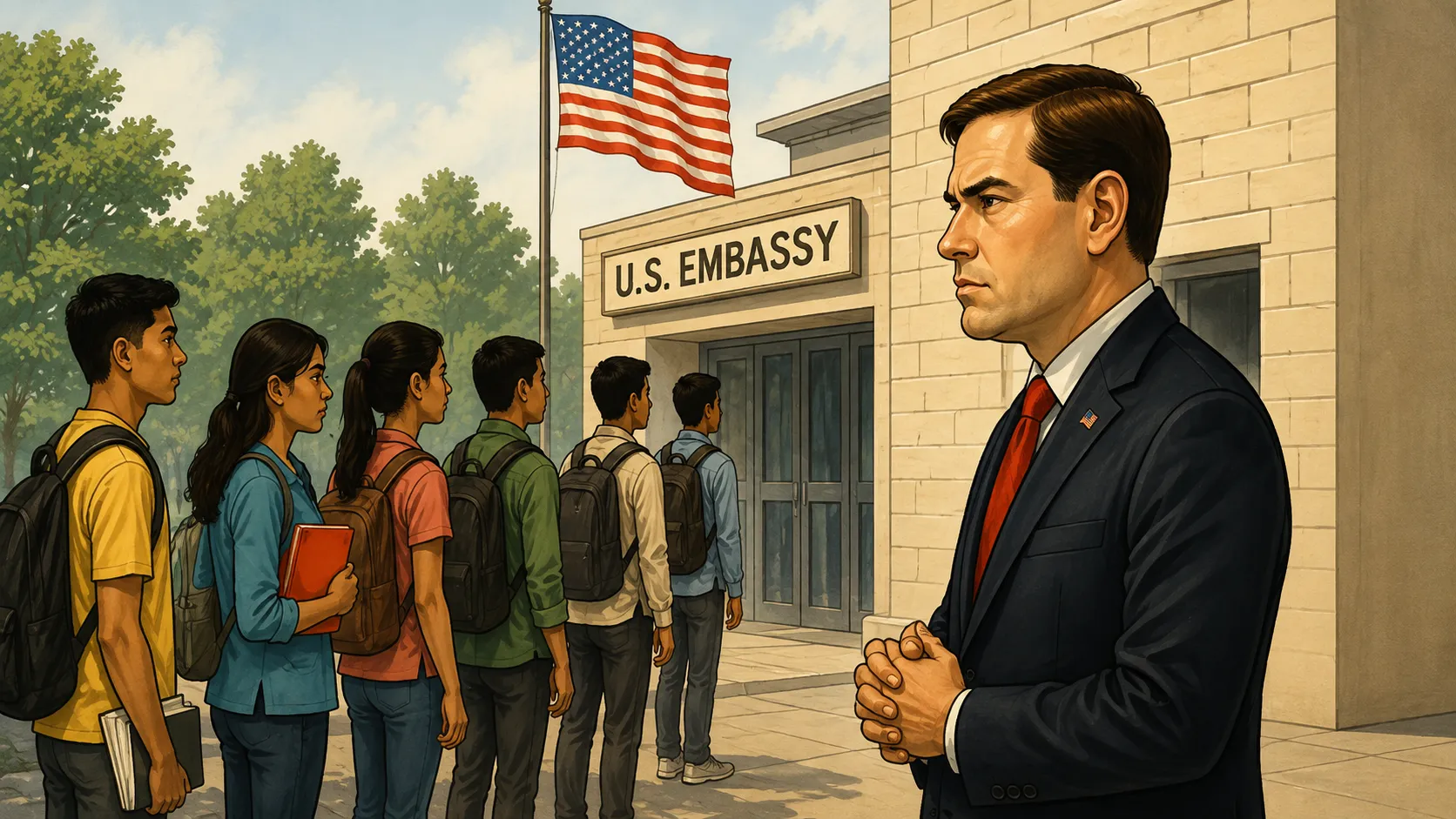
In India, some of the biggest jobs in technology come to the graduate, not the other way around. Students at the Indian Institute of Technology — the country's most prestigious engineering institution, and a name that has become almost synonymous globally with rigorous, highly sought-after technical talent — are recruited directly by both Indian companies and American firms competing for the world's top talent in fields expected to dominate the coming decades, from artificial intelligence to robotics. For a generation, that recruitment pipeline has fed a well-worn path toward Silicon Valley. This year, for the first time in a generation, significant numbers of IIT's most talented graduates are choosing not to walk it.
A $100,000 Decision
The immediate trigger is financial and specific: a $100,000 fee for the H-1B skilled immigrant work visa, introduced via executive order by the Trump administration. For students who once treated an eventual H-1B-sponsored move to the United States as a near-automatic next step after a few years working in an Indian office for a multinational employer, that fee transforms what was once a relatively low-friction transition into a genuinely significant financial and administrative hurdle — one that employers, not employees, technically bear, but one that reshapes hiring incentives throughout the entire pipeline feeding into H-1B sponsorship.
The scale of what's at stake for India specifically is difficult to overstate. Out of the 400,000 H-1B visas approved in the 2024 financial year, 71 percent of grantees were born in India, according to Department of Homeland Security data, with China a distant second at under 12 percent. Among the largest H-1B sponsoring employers are exactly the kind of global technology giants — Amazon, Meta and Google — that have historically recruited most aggressively from institutions like IIT. A visa programme this concentrated in a single source country, facing a fee increase this significant, was always going to produce a measurable behavioural response from the population it affects most.
What Career Counsellors Are Actually Seeing
The clearest evidence of that behavioural shift comes not from aggregate visa statistics, which take time to reflect policy changes, but from the people sitting across the table from graduating students as they make real, immediate career decisions. Ajaykumar Udayraj Yadav, a materials science and engineering doctoral candidate working on energy storage systems, volunteers at the Office of Career Services at IIT's New Delhi campus — giving him a genuinely close vantage point on how this year's graduating cohort is actually responding, rather than how policy analysts might predict they would respond in the abstract.
His account is direct: roughly 20 students are graduating from his department, and nearly 10 to 15 of them have received a postdoctoral offer from the United States. But given how they are watching the situation develop, in his words, these students are unwilling to take them up. This is not a story about American employers withdrawing offers — the offers are still arriving, at roughly the same volume as before. It is a story about Indian graduates themselves declining opportunities that, a generation earlier, would have been treated as the clear, obvious choice.

Where the Talent Is Going Instead
Perhaps the most significant part of this shift is not that students are declining US opportunities, but where they are choosing to go instead. According to Yadav, the trend among Indian students is shifting away from the United States and toward European countries specifically — Germany, the Netherlands and Norway — chosen for their high English fluency and, critically, a quicker and more reliable path to citizenship than the increasingly uncertain and expensive American pathway currently offers. As Yadav put it, describing his own personal calculus: the dream would be to secure a great job within India itself, but if someone does raise the prospect of going abroad, he personally now regards Europe as a better option compared to the United States — a striking reversal from what would, for most of the preceding two decades, have been an almost unquestioned assumption that the US represented the default, most desirable destination for India's top technical talent.
Asian destinations have also risen in the consideration set for graduating engineers, with countries like South Korea — home to major technology employers such as Samsung — gaining increased attention as an alternative to the traditional US pathway. Yadav notably framed this broader shift not purely as a loss for Indian talent, but also as a genuine opportunity for India itself to find ways to retain the graduates who might otherwise have left the country entirely, rather than simply redirecting their outward migration toward a different foreign destination.
Why This Particular Pipeline Matters So Much
To understand why this shift carries outsized significance, it helps to understand exactly how unusual IIT's position within India's technology talent pipeline actually is. In India, some of the biggest technology jobs come directly to graduates, rather than requiring graduates to seek them out — IIT students are recruited both by Indian companies and by American firms specifically competing to secure some of the world's most sought-after technical talent, particularly in fields widely expected to shape the next decade of technological development, including artificial intelligence and robotics. Many IIT graduates have also historically continued their studies directly in the United States, a pattern reinforced by India having overtaken China last year as the single largest source of foreign students in America.
This means the current shift is not simply about a marginal cohort of engineers reconsidering career options — it concerns exactly the population that has, for a generation, represented the highest-value, most sought-after segment of India's technical talent pipeline into the US technology industry. When this specific population begins visibly and measurably redirecting toward European and Asian alternatives, the signal carries weight well beyond any single graduating class.
The Broader Policy Reaction
The reaction to the fee hike within India's technology and immigration policy community has not been uniformly negative — a genuinely interesting nuance within the broader story. Some voices, including V. Kamakoti, director of IIT Madras, have offered a notably different framing, describing the fee hike as something closer to a blessing in disguise, and suggesting the shift could ultimately benefit India by encouraging more of its top talent to build careers domestically rather than exporting that talent to American technology companies. This more optimistic framing sits in genuine tension with the concerns raised by career counsellors like Yadav, who see real, immediate distress among graduating students facing a considerably narrower and more expensive set of international career options than the cohorts that preceded them.
Analysts warned more starkly that the policy risks driving genuine economic harm to the United States itself: one analyst assessment cited alongside coverage of the fee hike argued the decision will cause US businesses to offshore work and drive innovation and entrepreneurship outside the country altogether — a framing that positions the $100,000 fee not merely as a cost shifted onto individual visa applicants or their sponsoring employers, but as a policy with potential second-order consequences for where cutting-edge technology development itself ultimately happens.
A Generational Inflection Point
Whatever the ultimate balance of costs and benefits proves to be, what is happening inside IIT's career services offices this year represents something genuinely new: a visible, real-time redirection of exactly the talent population that has, for a generation, treated an eventual move to Silicon Valley as close to inevitable. Whether this redirection toward Europe and Asia represents a temporary response to a specific policy shock, or the beginning of a more durable, structural reshaping of where the world's most talented young engineers choose to build their careers, will only become clear over the coming several years of graduating IIT cohorts — but for this year's class, weighing real offers against a $100,000 fee and an increasingly uncertain path to long-term US residency, the decision is already being made, one declined postdoctoral offer at a time.

The Downstream Effect on OPT and the Student Pipeline
The H-1B fee hike does not operate in isolation from the broader pathway that has historically fed it. Optional Practical Training, which allows international students to work in the US for up to a year after graduation — extended to three years for students in STEM fields — has long functioned as the critical bridge between an Indian student's degree and their eventual transition to H-1B sponsorship. According to the most recent Open Doors report, more than 3.63 lakh Indian students were studying at American institutions during the 2024-25 academic year, making India the single largest source of international students in the US, ahead of China, with nearly one-third of all international students in the country now coming from India specifically. Participation in the OPT programme among Indian students had been rising sharply, up 47 percent in a single year, with around 40 percent of all Indian students in the US relying on the programme.
That entire structure now faces its own layer of uncertainty, with reports emerging of a potential separate fee — also discussed in the range of $100,000 — that could apply specifically to OPT work authorisation, layered on top of the existing H-1B fee increase. For Indian families who have already committed crores of rupees to overseas education, education consultants have warned that an additional fee of this scale would fundamentally alter the financial equation that has justified that investment in the first place, particularly for the many students who rely on OPT-era earnings specifically to begin repaying the education loans that funded their US degree.
A Two-Tier Reaction Within India's Own Policy Community
The domestic Indian reaction to these cascading changes has split along genuinely interesting lines. Groups representing overseas Indian professional interests, including GOPIO, have warned publicly that the H-1B fee hike will harm the US economy and stifle innovation — a framing that positions the policy as ultimately self-defeating for American competitiveness, rather than narrowly protective of American workers. At the same time, voices within India's own higher education establishment, including IIT Madras director V. Kamakoti's notably optimistic "blessing in disguise" framing, suggest a genuine, unresolved debate within India itself about whether this moment should be read primarily as a loss to be mourned, or an opportunity to finally build the kind of domestic career pathways that could retain more of the country's top engineering talent at home, rather than continuing to export it to wherever visa policy happens to be most favourable in any given year.
What Indian Employers Stand to Gain
If even a fraction of the graduating engineers now reconsidering US offers choose instead to build their careers within India, the beneficiaries would likely include exactly the kind of Indian technology companies that have historically struggled to compete with US firms for the country's very top engineering talent, given the substantial compensation and prestige gap that has long favoured Silicon Valley employers. India's own AI, semiconductor and deep-tech sectors — each identified by government policy as strategic priorities — have faced persistent talent constraints precisely because their most promising potential hires have so often been drawn abroad by the H-1B pathway this fee hike now complicates. Whether Indian employers can move quickly enough to capture this shifting talent flow with genuinely competitive offers, before graduates instead redirect toward the European and Asian alternatives Yadav describes, may prove to be one of the more consequential open questions shaping India's own domestic technology competitiveness over the next several years — and one this year's graduating IIT cohort, whichever direction they ultimately choose, is already helping answer, class by graduating class, offer by declined offer, in career-services offices that a generation ago would rarely have imagined this particular conversation taking place at all, as India's most celebrated engineering talent quietly rewrites what an obvious career choice actually looks like for the graduating classes still to come.


