
A Nametag That Accidentally Predicted the Future
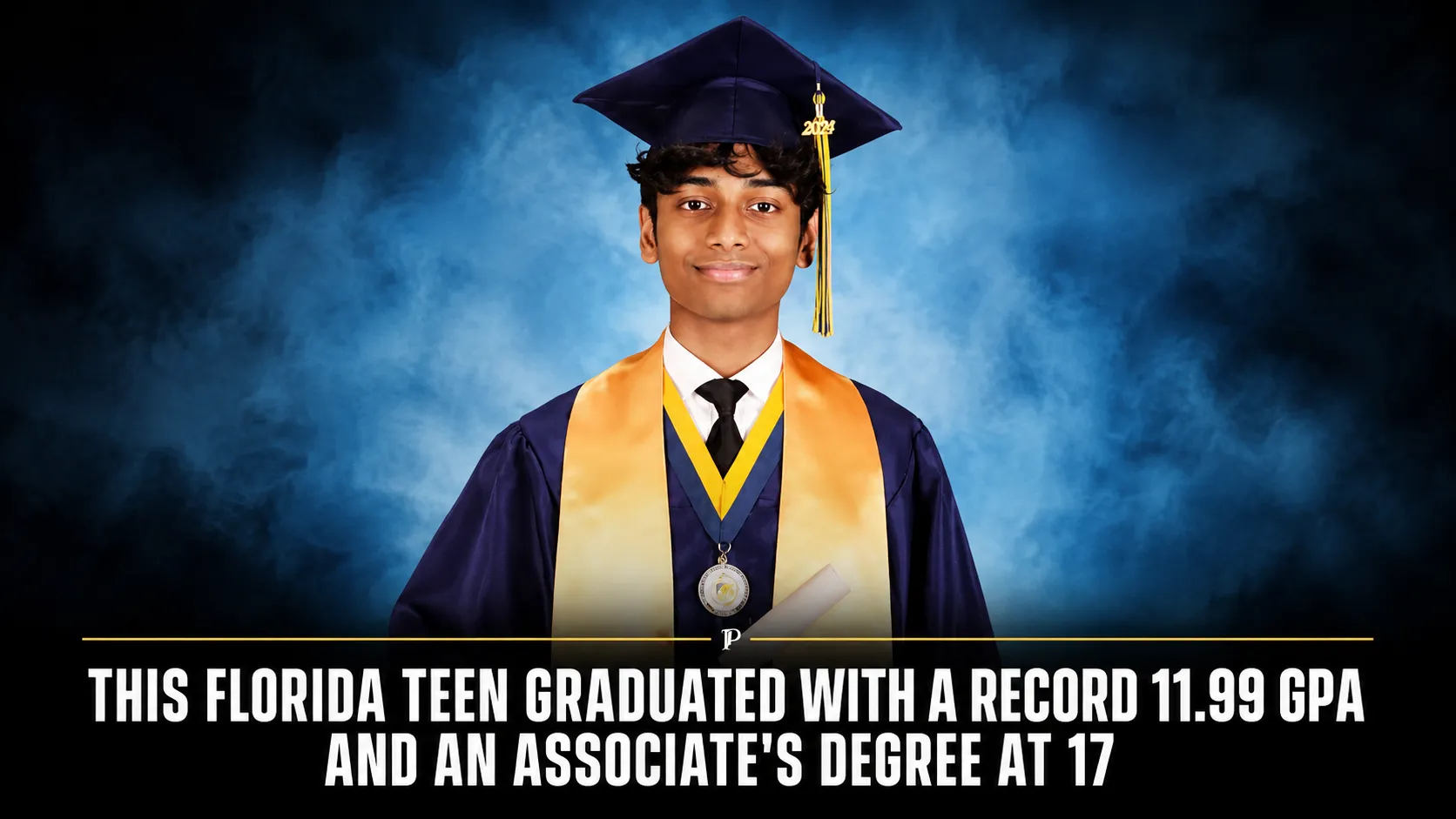
The origin story Vaibhav Bhaskar tells about his own record-breaking academic career begins, improbably, with a fifth-grade classroom exercise that had nothing to do with grades at all. His teacher had asked every student to come up with an alliteration matching their first name — the kind of playful nickname exercise common in American elementary schools, along the lines of 'Brilliant Bob' or 'Kind Kelly.' Bhaskar, by his own account, was completely stuck. His teacher, searching for something that fit, suggested 'Valedictorian Vaibhav.' He did not fully understand what the word meant at the time, but he wrote it down on his nametag anyway. He would spend the next seven years of his academic life quietly turning that half-understood nickname into a literal, documented reality.
A Whiteboard, Five Goals, and a Sophomore's Fixation
The turning point from casual ambition to deliberate, structured pursuit came during his sophomore year at Steinbrenner High School in Lutz, Florida, when Bhaskar wrote five specific goals on a whiteboard in his bedroom — a list that included, explicitly, becoming valedictorian and breaking the state's grade point average record. Learning that the existing record stood at 11.84, set by Gaither High School graduate Dylan Mazard in 2022, became what Bhaskar has described as a genuine fixation. Speaking to Florida's public radio program 'Florida Matters Live & Local,' Bhaskar reflected on how arbitrary that kind of ceiling really is. 'Maybe who knows if the previous record was a 12.84, maybe I could add a 12.99, and it goes to show that we've really placed these limitations on our goals, but I believe that no goal is truly out of reach,' he said.
The Mechanics Behind an Almost Unbelievable Number
To anyone unfamiliar with how American weighted grade point averages actually function, an 11.99 GPA sounds less like an academic achievement and more like a typo. Most people instinctively think of GPA on a standard 4.0 scale, where a perfect 4.0 represents straight A's across the board. But many US school districts, including Hillsborough County in Florida where Bhaskar was enrolled, calculate weighted GPAs that award additional bonus points for Advanced Placement, International Baccalaureate, honors, and dual-enrollment college courses — classes considered more academically rigorous than standard coursework. Crucially, at the time Bhaskar attended Steinbrenner High School, Hillsborough County's system placed no cap on how many bonus-weighted courses a student could stack, meaning a sufficiently ambitious student could, in theory, push their weighted average far beyond the conventional 4.0 ceiling simply by accumulating enough advanced-level classes.
Bhaskar exploited that absence of a ceiling with remarkable thoroughness. Reported course counts put his total at 44 Advanced Placement and dual-enrollment classes across his four years of high school — 20 AP courses combined with 24 dual-enrollment courses taken through Hillsborough Community College and the University of Florida's online program. Florida's minimum graduation requirement is 24 credits. Bhaskar graduated with 70, nearly three times the required load, and had accumulated enough transferable college credit along the way to qualify for an associate degree before he had even received his high school diploma.
'I Kind of Exhausted All of My School's Curriculum'
Bhaskar has been candid, in multiple interviews since his graduation, about the specific mindset that allowed him to sustain that workload without treating it as pure grinding drudgery. Speaking to the Tampa Bay Times, he described a moment partway through high school where the ceiling of his own school's official offerings simply stopped being sufficient for his ambitions. 'I kind of exhausted all of my school's curriculum and saw what I could do beyond that,' he told the paper — a comment that captures both the scale of his academic appetite and the specific structural opportunity Hillsborough County's uncapped dual-enrollment system happened to provide at exactly the moment he was ready to take advantage of it.
More Than a Grind: Balance, Investment Clubs, and Nonprofits
Despite the sheer volume of coursework, Bhaskar has consistently pushed back against any characterization of his high school years as a narrow, single-minded academic grind. On Florida Matters Live & Local, he emphasized that his GPA functioned less as the central goal of his high school experience and more as what he called a 'byproduct' of a broader work ethic that extended well beyond the classroom. He founded an investment club at Steinbrenner High School, reflecting an early, serious interest in finance and economics that would later shape his choice of college major. He also served as chief financial officer of Back on Track America, a student-led nonprofit organization focused on collecting donations for homeless shelters, and captained his school's mock trial team — extracurricular commitments that required him to forfeit his junior-year lunch periods in order to fit everything into an already packed schedule.
A Record That Rewrote the Rulebook
Bhaskar's 11.99 GPA did not simply break the previous state record of 11.84 — it did so decisively enough to force Hillsborough County Public Schools into an immediate policy reckoning. School officials, while publicly commending Bhaskar's individual achievement, used his record-setting result as the direct catalyst for overhauling how the district calculates weighted GPAs going forward. Under the district's revised policy, which will apply starting with the graduating class of 2027, Hillsborough County will transition to a capped Honors Point Average system, placing a firm ceiling on how high a weighted GPA can climb regardless of how many advanced courses a student stacks. The district explained its reasoning in terms of fairness and comparability, noting that its previous uncapped system had forced college admissions officers around the country to manually recalculate 'unusually high' Hillsborough County GPAs to bring them in line with grading conventions used elsewhere in Florida and the nation.
A Record That Cannot Be Repeated — By Design
The practical effect of the policy change is striking: Bhaskar's 11.99 will stand not merely as the current record, but very likely as the permanent, unbeatable ceiling for Hillsborough County, since the specific uncapped grading mechanism that made a number that high mathematically possible will no longer exist for any student who follows him. Far from resenting this outcome, Bhaskar has expressed public support for the district's decision, framing it as a sensible correction to a system that had begun inadvertently incentivizing students to prioritize sheer course volume over genuine academic depth or personal wellbeing, purely in pursuit of an admissions-office-friendly number.
Duke, and a Major Chosen Years in Advance
Bhaskar's next chapter is already set: he is headed to Duke University in the fall of 2026, where he plans to pursue a double major in economics and public policy, with some reporting also noting an interest in finance specifically. His decision to focus on economics and finance was not a last-minute choice driven by admissions strategy, but rather a natural extension of interests he had already begun cultivating in high school through his investment club and his broader engagement with financial literacy work through his nonprofit involvement. Multiple outlets have reported that Bhaskar specifically cited Duke's academic environment and program fit as his primary reasons for choosing the university over other options, rather than simply defaulting to the most prestigious name on his list of admissions offers.
Why Bhaskar's Story Resonated Nationally
What elevated Bhaskar's achievement from a regional Tampa Bay curiosity into a story picked up by national and international outlets, from the New York Post to Newser, UPI, IBTimes UK, and Bored Panda, was the almost cinematic completeness of the narrative: an immigrant-origin student who set an audacious, almost absurd-sounding goal as a teenager, executed against it with disciplined, multi-year patience, achieved it so completely that he broke a state record by more than a tenth of a point, and in doing so, permanently changed the system that had made his own achievement possible for anyone who might try to follow in his footsteps. For the Indian American community specifically, Bhaskar's story lands as a particularly resonant example of a familiar cultural narrative — relentless academic ambition paired with genuine breadth of interest — playing out at a moment when Indian American students are simultaneously making national headlines in venues ranging from the 3M Young Scientist Challenge to elite university scholarship competitions.
A Family Achievement as Much as an Individual One
Like many high-achieving Indian American students, Bhaskar's record has been widely understood within his own community not simply as a personal triumph but as a reflection of a broader family and cultural framework around education that has repeatedly produced standout academic performers across the Indian diaspora. While Bhaskar's own public comments have focused overwhelmingly on his personal goal-setting process rather than external pressure, his story fits a familiar pattern within Indian American families in which academic excellence is treated as both an individual aspiration and a collective family investment, reinforced through structured routines, high expectations, and consistent parental engagement with the mechanics of the American education system, including strategic decisions about which advanced courses and dual-enrollment opportunities to pursue.
The National Media Cycle That Followed
The speed and breadth with which Bhaskar's story traveled through national and international media reflects the particular appeal of what one might call a clean, fully resolved achievement narrative in an otherwise turbulent news environment. Unlike many other stories involving Indian American students currently making headlines — visa denials, policy anxiety, online backlash — Bhaskar's story offered readers an uncomplicated, feel-good outcome: a clearly defined goal, a documented multi-year effort, an unambiguous, record-setting result, and a happy ending in the form of a coveted Duke University acceptance. That narrative completeness likely explains why outlets ranging from local Tampa Bay public radio to national tabloids and international publications like IBTimes UK all found reason to cover the same underlying story within days of each other.
A Lesson Bhaskar Wants Other Students to Take From His Record
Perhaps the most important thread running through Bhaskar's own public reflections on his achievement is his consistent insistence that the specific number — 11.99 — matters far less than the underlying discipline and goal-setting process that produced it. Asked to distill what he learned from four years of relentless course-stacking and extracurricular commitment, Bhaskar has repeatedly returned to a single word: balance. 'Once I got that mindset that, okay, I'm gonna be at the top, I just took advantage of every opportunity I could,' he said. 'I took all the hardest classes. I kind of exhausted all of my school's curriculum, and saw what I could do beyond that.' For a school district that has now closed the specific loophole that made his record possible, and for a national audience still marveling at a number that sounds almost mathematically implausible, Bhaskar's own framing offers a simpler, more durable takeaway than the GPA itself: patience, clearly defined goals, and a willingness to keep pushing past whatever ceiling a system happens to place in front of you. Whatever direction his own path takes from here, Bhaskar's record — and the policy change it directly provoked — will remain a permanent, documented fixture of Florida's academic history.
How Other States Are Watching Florida's Policy Response
Hillsborough County's decision to cap its weighted GPA system in direct response to Bhaskar's record has attracted attention from school administrators in other states grappling with similar uncapped grading structures, several of which have quietly begun reviewing their own policies to assess whether a comparable record-chasing dynamic could eventually produce a similarly headline-grabbing, system-breaking result within their own districts. Education policy researchers have noted that Bhaskar's case offers a rare, concrete, real-world illustration of how an individual student's extraordinary achievement can directly catalyze systemic policy change at the institutional level, a dynamic more commonly discussed in the abstract than actually observed playing out in real time within a single academic year. In the meantime, his name remains etched into Florida academic history as both a record-holder and, quite literally, the reason the record can never be broken again in quite the same way.
The Question of Whether Numbers Like This Serve Students Well


