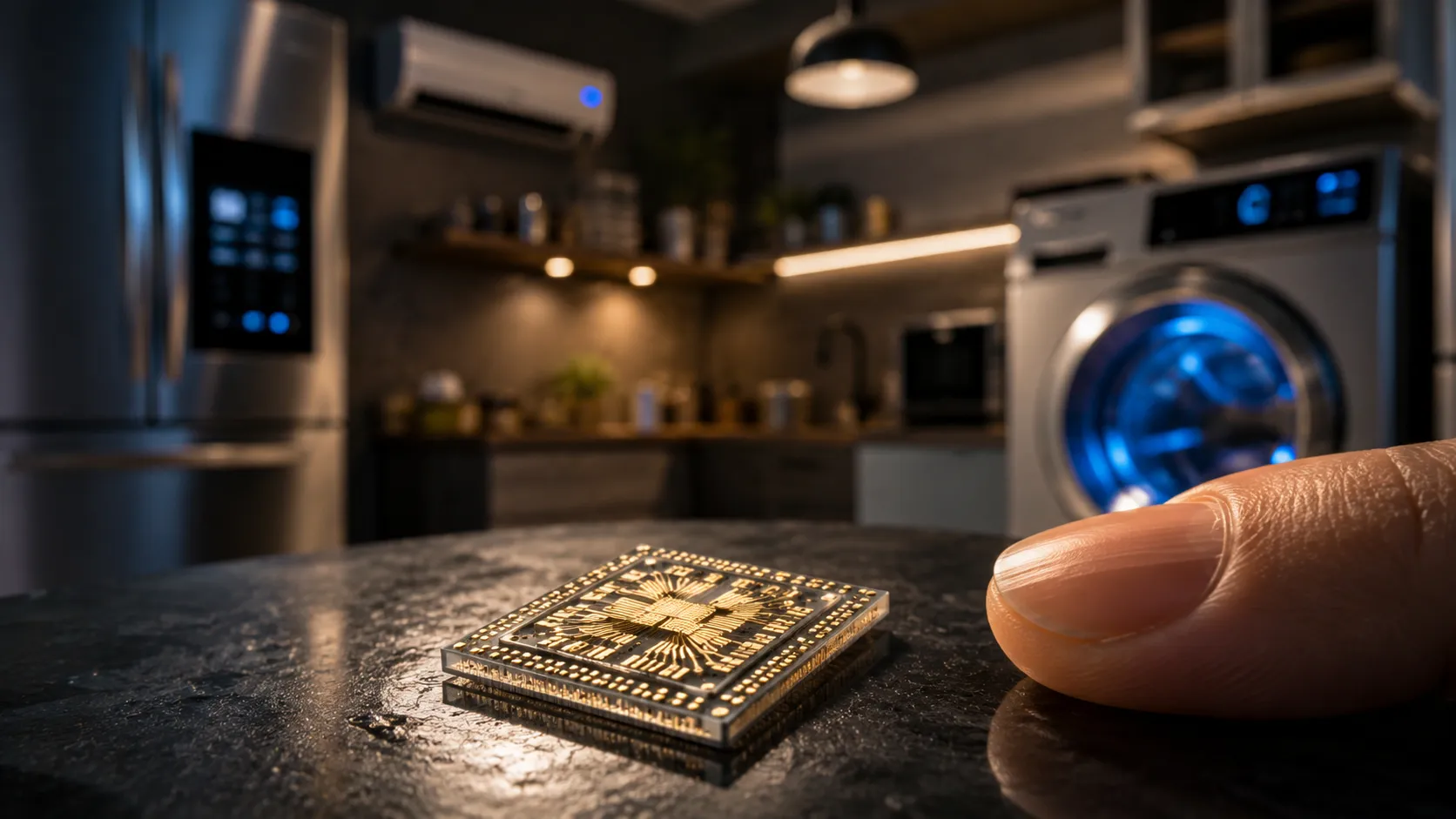
The Bengaluru Chip That Wants to Power Every Smart Appliance on Earth: Inside the $13 Million Bet That India Can Build the Brains of the Physical AI Revolution
BENGALURU — May 24, 2026 — Ramamurthy Sivakumar has been building chips for longer than most of India's semiconductor startups have existed. He was designing processors when the country's chip ecosystem was still a government monopoly, when the idea of an Indian fabless semiconductor company competing globally was considered a fantasy, and when the phrase "AI-native silicon" had not yet been coined. He spent years inside Intel, where he learned what it takes to architect a processor that ships in the hundreds of millions of units. He watched the mobile revolution transform the semiconductor industry. And then, in 2023, he decided that the next great transformation—the one that would define the rest of his career—was not in data centres or smartphones. It was in the physical world. In the appliances, the electric vehicles, the industrial systems that were about to become intelligent—and that had no chips designed specifically for them.
"Siva," as he is known, co-founded HrdWyr with Guruswamy Ganesh, another industry veteran who understood that the era of general-purpose computing was giving way to something more specific. "The real power of AI will be unlocked as we enter the era of Physical AI, where advanced intelligence seamlessly integrates with real-world systems," Sivakumar said. "This inflection point demands a fundamental rethinking of how computing systems are conceived, architected, and deployed." On May 12, 2026, that rethinking was validated in the most concrete way possible. HrdWyr announced a $13 million Series A funding round led by Ideaspring Capital, with participation from Singularity AMC, Avatar Growth Capital, and existing investor Persistent Systems. The round—modest by Silicon Valley standards, significant by Indian semiconductor standards—will fund the company's push to put AI-native chips into the appliances, vehicles, and industrial machines that constitute the vast, unglamorous, and almost entirely un-digitised physical economy.
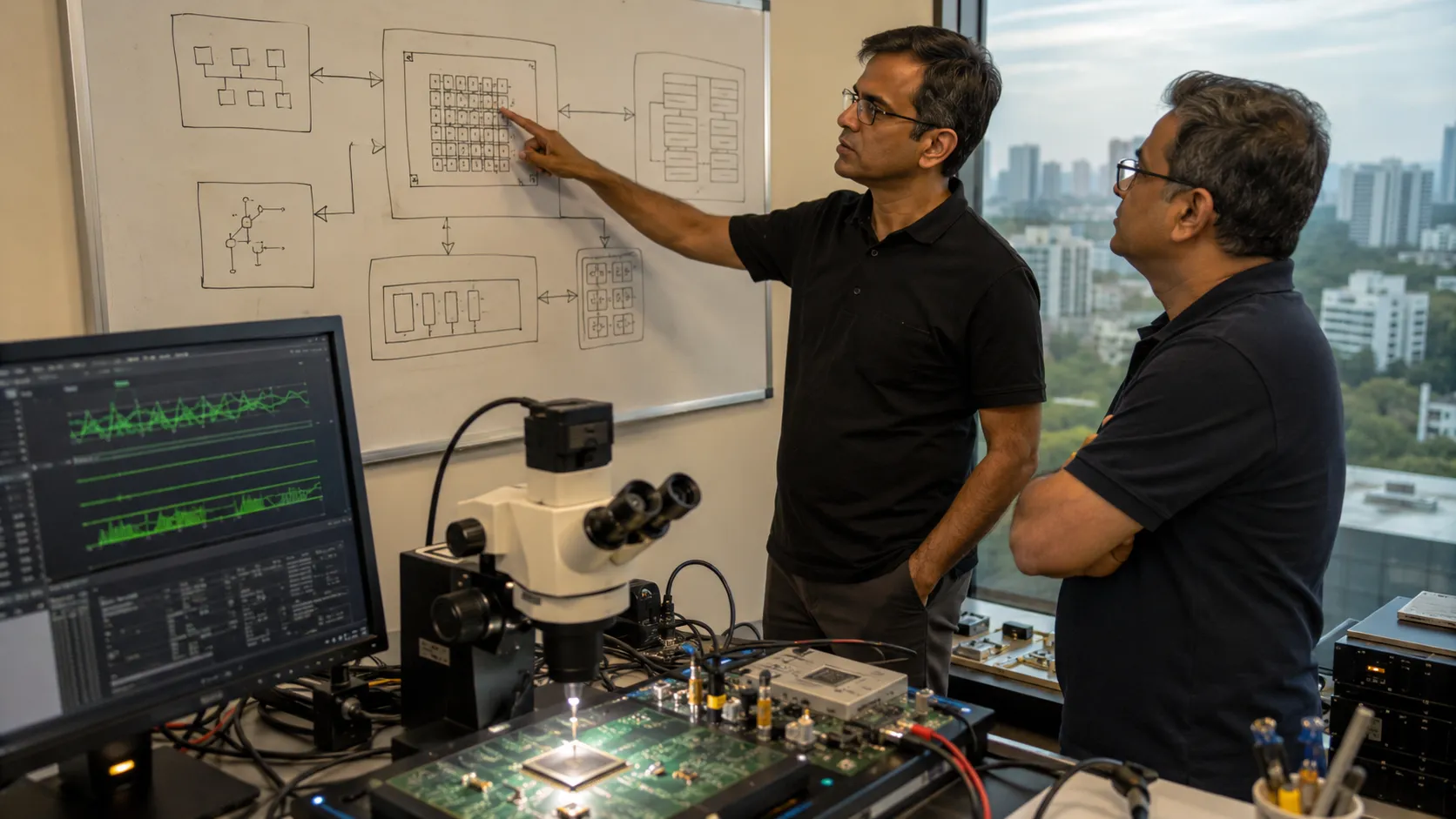
The Chip That General-Purpose Silicon Forgot
To understand what HrdWyr is building, one must first understand what it is not building. It is not building a competitor to Nvidia's GPUs. It is not building a challenger to Intel's server processors. It is not building the kind of chip that powers a smartphone or a laptop or a hyperscale data centre. It is building chips for the devices that have been left behind by the AI revolution—the air conditioner, the refrigerator, the electric scooter, the industrial motor—that collectively represent a market measured in the tens of billions of units and that currently run on processors designed for an earlier era.
The semiconductor industry has spent the past decade obsessed with scale. The most valuable chip companies on Earth—Nvidia, AMD, Intel—build processors that are general-purpose, massively powerful, and optimised for the data centres where AI models are trained. Those chips are extraordinary. They are also expensive, power-hungry, and designed for a world in which data travels to the cloud, is processed, and returns. They are not designed for a world in which the air conditioner in your living room needs to detect that the room is empty and adjust its cooling accordingly, without ever sending data to a server. They are not designed for a world in which the electric scooter on a Delhi street needs to optimise its battery consumption in real time, using AI that runs directly on the vehicle, with no connection to the cloud.
That world—the world of edge AI, of physical AI, of intelligence that lives where the data is generated—is arriving. And the chips that will power it, Sivakumar believes, cannot be repurposed from the data centre. They must be built from the ground up for the specific demands of the edge: low power, low cost, real-time responsiveness, and the ability to run AI inference on-device without ever touching the cloud.
"The real power of AI will be unlocked as we enter the era of Physical AI," Sivakumar said at the funding announcement. The statement is not marketing. It is the company's founding thesis. HrdWyr's AI-native System-on-Chips, or AISoCs, are purpose-built for specific industries—consumer electronics, electric vehicles, industrial systems, data centres—and are designed to process data at the point of generation. The architecture integrates AI directly into the chip, allowing devices to sense, learn, and respond in real time. No cloud required. No latency. No dependence on a network connection that may or may not be available.
The differentiation from traditional chip companies is structural. Most semiconductor startups license an existing architecture—ARM, RISC-V, x86—and build a chip around it. HrdWyr is a full-stack fabless semiconductor product company, which means it designs the entire chip from the ground up, including the AI acceleration hardware, the processor cores, the memory architecture, and the software stack that runs on top. The approach is more capital-intensive and more technically demanding than the licensing model. But it also produces chips that are optimised for specific use cases rather than generic processors that must serve a thousand different masters.
The boAt Validation
The most significant external validation of HrdWyr's approach arrived not from a venture capitalist but from a consumer brand. The company recently announced a strategic collaboration with boAt, the Indian audio and wearable electronics giant that has built one of the country's most successful consumer technology brands. The partnership marks an early test of HrdWyr's thesis: that Indian original equipment manufacturers, or OEMs, are hungry for domestically designed chips that can reduce their dependence on foreign suppliers, shorten their product launch cycles, and give them control over the silicon that powers their devices.
The boAt partnership is significant because it represents something that has never existed at scale in India: a domestic consumer electronics brand sourcing chips from a domestic semiconductor startup. For decades, Indian OEMs have been entirely dependent on foreign chip suppliers—Qualcomm for smartphones, MediaTek for tablets, a handful of American and Chinese companies for everything else. The dependence has made them vulnerable to supply-chain disruptions, price volatility, and the strategic priorities of suppliers who may not consider the Indian market a top-tier customer. A domestic alternative, even for a subset of products, changes the calculus.
Rajiv Gupta, partner at Avatar Growth Capital, one of the investors in the Series A round, framed the opportunity in explicitly supply-chain terms. HrdWyr, he said, "enables Indian OEMs to de-risk supply chains, shorten product launch cycles, strengthen data sovereignty, and unlock new usage intelligence." Each of those capabilities—de-risking, speed, sovereignty, intelligence—is valuable individually. Combined, they represent a structural shift in how Indian consumer electronics companies can compete.
The boAt deal is the first of what HrdWyr hopes will be many such partnerships. The company is targeting the white goods sector—air conditioners, refrigerators, washing machines—as well as electric vehicles and data centres, each of which represents a market where the volume of chips required is enormous and the current suppliers are almost entirely foreign. The thesis is that Indian OEMs, once they have a credible domestic alternative, will prefer it—not out of patriotism, but out of commercial self-interest. A chip designed in Bengaluru, by engineers who understand the specific requirements of the Indian market, can be customised in ways that an off-the-shelf chip from a foreign supplier cannot. The Indian air conditioner market, for example, has unique demands—voltage fluctuations, dust, ambient temperatures that routinely exceed 45 degrees Celsius—that a generic chip designed for global markets may not handle optimally. A chip designed specifically for those conditions has a performance advantage that no amount of marketing can replicate.
The Physical AI Thesis
The term "Physical AI" has become one of the most heavily funded concepts in the technology industry over the past eighteen months, but its meaning is often obscured by the hype. At its core, Physical AI refers to artificial intelligence that operates in the real world—in robots, in vehicles, in appliances, in industrial machinery—rather than in the disembodied realm of chatbots and image generators. It is AI that senses, decides, and acts in physical space. And it requires a fundamentally different kind of computing than the cloud-based AI that has dominated the industry's attention.
Cloud AI is about scale. The models are enormous, the training runs consume megawatts of power, and the inference is performed in data centres that are connected to the user by high-speed fibre. Physical AI is about responsiveness. The model must be small enough to run on a chip that costs a few dollars and consumes a few watts. The inference must happen in milliseconds, not seconds. The connection to the cloud may be intermittent or nonexistent. The chip must be reliable, durable, and capable of operating in environments—the engine compartment of an electric scooter, the control board of a washing machine, the motor housing of an industrial robot—that are hostile to sensitive electronics.
HrdWyr's AISoCs are designed for precisely those environments. The chips are built on the conviction that conventional general-purpose architectures "can no longer meet today's data-intensive demands at the edge." They are engineered for "superior power efficiency, minimal latency, and streamlined system design." The specifications are not the kind that generate headlines—there are no petaflops to brag about, no benchmark scores to compare against Nvidia's latest GPU. But in the world of edge AI, the metrics that matter are different: cost per unit, power consumption, thermal tolerance, real-time responsiveness. A chip that can make an air conditioner 15 percent more energy-efficient by intelligently adjusting its compressor based on occupancy patterns is more valuable to an OEM than a chip that can run a large language model in the cloud.
The market that HrdWyr is targeting is vast and fragmented. The global market for edge AI chips is projected to grow from roughly $20 billion in 2025 to more than $80 billion by 2032, driven by the proliferation of smart appliances, electric vehicles, industrial automation, and the broader digitisation of the physical economy. Most of that market is currently served by incumbent semiconductor companies—STMicroelectronics, Texas Instruments, NXP, Renesas—that build competent but generic chips for a wide range of applications. HrdWyr's bet is that the AI era will demand chips that are more specialised, more integrated, and more intelligent than the general-purpose microcontrollers that currently dominate the edge.
The Ideaspring Thesis
The lead investor in HrdWyr's Series A round is Ideaspring Capital, a Bengaluru-based venture firm that has carved out a distinctive niche in Indian venture capital: backing product-focused, IP-led deep-tech startups. The firm was an early believer in the thesis that India could produce globally competitive semiconductor companies—a thesis that, until very recently, was considered speculative at best.
Naganand Doraswamy, managing partner and founder of Ideaspring Capital, articulated the investment thesis with unusual directness. HrdWyr, he said, "is building a family of AI chips addressing power management and efficiency across multiple sectors, including white goods, EVs and data centres. This is very important to Ideaspring's thesis of building products from India for the world and also becoming self-reliant in semiconductors."
The phrase "self-reliant in semiconductors" carries political weight in India. The country has spent decades trying to build a domestic semiconductor industry, with limited success. The government has launched multiple incentive programmes, including the $10 billion India Semiconductor Mission, to attract chip fabrication plants and design houses. The ambition is to reduce India's近乎 total dependence on imported semiconductors—a dependence that costs the country tens of billions of dollars annually and leaves its technology industries vulnerable to supply-chain disruptions. The CHIPS Act-style incentives have attracted commitments from global giants like Micron and Tata Electronics, but the domestic fabless ecosystem—companies that design chips in India, even if they manufacture them abroad—has remained thin.
HrdWyr is part of a small but growing cohort of Indian fabless semiconductor startups that are trying to change that. The company operates as a full-stack semiconductor product company, differentiated from traditional IP licensing or services-led models. It designs its chips in Bengaluru. It partners with global foundries to manufacture them. It sells them to OEMs in India and, eventually, around the world. The model is capital-efficient—fabless companies do not need to build billion-dollar fabrication plants—but it requires deep technical expertise, patient capital, and a market that is willing to buy from an Indian supplier rather than an established global incumbent.
The presence of Persistent Systems—a publicly listed Indian technology company with a market capitalisation exceeding $8 billion—among the investors is a signal that the Indian technology establishment is beginning to take domestic semiconductor startups seriously. Dr. Anand Deshpande, founder, chairman, and managing director of Persistent Systems, framed the investment in structural terms: "AI-led transformation is driving a fundamental shift in how the technology stack is built, with increasing convergence between semiconductors, data, and intelligent software systems. Innovations in chip design will play a critical role in enabling next-generation enterprise and industrial applications."
The Bengaluru Semiconductor Cluster
HrdWyr is not operating in isolation. Bengaluru has quietly become the centre of India's emerging fabless semiconductor ecosystem, home to a growing cluster of chip design startups that are building products for global markets. The city's advantages are well-known: a deep pool of engineering talent from institutions like the Indian Institute of Science, a mature technology services industry that has produced generations of chip designers, and a venture capital ecosystem that is increasingly willing to back hardware startups.
The broader context is a semiconductor industry that is being reshaped by geopolitical forces. The U.S.-China technology conflict has exposed the vulnerability of global chip supply chains. The CHIPS Act in the United States and similar initiatives in Europe, Japan, and India have poured hundreds of billions of dollars into domestic semiconductor manufacturing and design. The result is a structural shift that is creating opportunities for chip startups in countries that were previously not part of the global semiconductor conversation.
India's ambition in this space is not modest. The country aims to capture a significant share of the global semiconductor market by the end of the decade, and startups like HrdWyr—alongside Mindgrove Technologies in Chennai, Signalchip in Bengaluru, and a growing roster of fabless design houses—are the early expressions of that ambition. The $13 million Series A is not a large round by global semiconductor standards. But it is a bet—placed by investors who understand that the semiconductor industry is built incrementally, chip by chip, design win by design win—that HrdWyr can establish itself as a credible supplier in the markets it is targeting.
The boAt partnership is the first test. The Series A capital will fund the next phase of product development and customer acquisition. The market—the tens of billions of devices that will need AI-native chips over the next decade—is the destination. The chip that Sivakumar and his team are building in Bengaluru is not a threat to Nvidia. It is something more specific, more local, and more ambitious in its own way: a bet that the intelligence that powers the physical world can be built in India, for India, and eventually for the world. The $13 million is a seed. The chip is the proof. The appliances are waiting.


