The Week India's Students, Its State, and Its VCs All Bet on the Same Thing: Deep Tech
BENGALURU — May 25, 2026 — Sometime in the past seven days, a handful of events occurred across India that, taken individually, would each be a modest news item. A venture capital firm you have probably never heard of announced a $100 million fund. A government board approved 22 research grants. A campus report noted that student founders are pivoting from consumer apps to quantum computing. Apple released a few short films about Indian college coders. None of these would, on their own, stop the scroll.
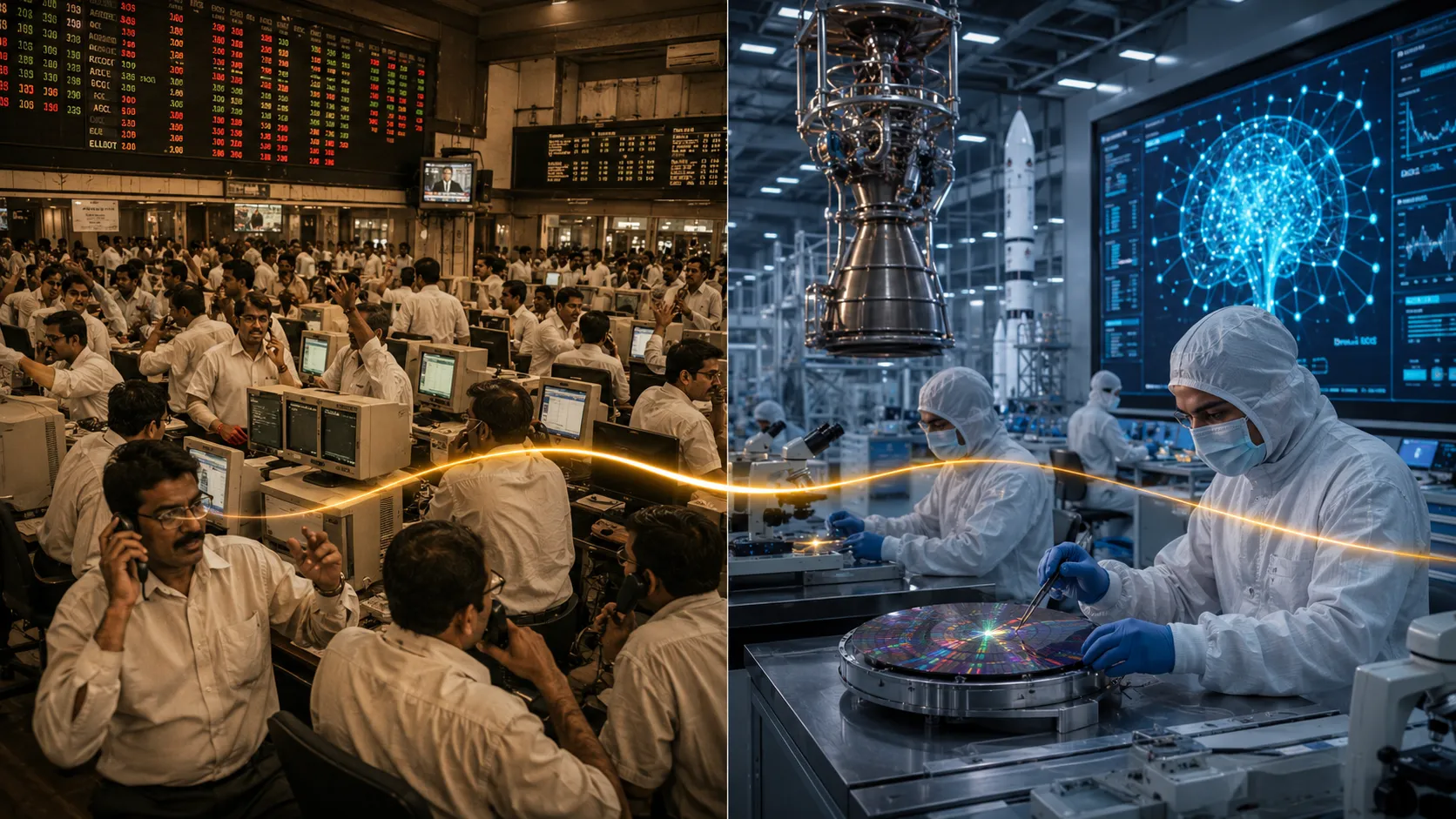
Taken together, they mark something that has been building for years and that is now, unmistakably, arriving: India's startup ecosystem is pivoting from the shallow end of consumer internet to the deep end of hard technology—and the capital, the policy, and the talent pipeline are all, for the first time, aligning behind the same thesis.
On May 22, Shastra VC—a Bengaluru-based venture firm previously known as Veda VC—announced the launch of a $100 million fund targeting early-stage deeptech startups across artificial intelligence, climate technology, space, defence, and renewable sciences. The fund will write cheques of $500,000 to $3 million each. The firm has already deployed nearly $55 million across its first two funds and has backed startups like Simplismart, Alt Carbon, Sisir Radar, and Avammune. The announcement came the same week that a report by Campus Fund revealed that deep tech has become the single largest category among student-led startups in India for the first time, accounting for 16.87 percent of the student startup funnel—a 13.5 percentage-point swing in four years. Deep tech was not even in the top five categories when the first report was published.
The Shastra VC fund is not an isolated data point. It is part of a broader reallocation of Indian venture capital from consumer internet—food delivery, ride-hailing, social media—toward sectors that require patience, technical expertise, and a tolerance for long gestation periods. "As India's deeptech ecosystem gathers momentum across sectors like artificial intelligence, spacetech, defence, and climate innovation, investment firms are increasingly looking beyond conventional startup models toward science-led and IP-driven ventures," the firm said at launch.
The same week, the Technology Development Board—an organisation under the Department of Science and Technology—announced it had funded 22 deeptech projects across 14 startups, five MSMEs, and three listed companies as a second-level fund manager for the Research Development and Innovation Fund, or RDIF. The ₹1 lakh crore RDIF aims to propel India's deeptech ecosystem to parity with the best in the world, funding up to half of project costs through equity, debt, or a combination of both.
The RDIF's structure is significant because it represents something India has never attempted at scale: a government equity co-investment model inspired by Israel's Yozma programme of the 1990s. Before Yozma, Israel had a single venture capital fund and roughly 51 startups. Within a decade, the ecosystem had exploded to 80 funds. Out of that crucible emerged foundational deeptech companies like Waze and Mellanox. The first RDIF disbursal, made in record time, has been described as India's potential "Yozma moment"—the moment when state capital acts as a catalyst for private investment in frontier technology.
The chosen projects illustrate the breadth of the ambition. QNu Labs, a quantum communications startup, has developed a security-as-a-service platform that is being deployed across India's defence, telecom, financial services, and healthcare sectors. Tejas Networks, a publicly listed optical and broadband networking company, is the primary domestic technology supplier for BSNL's nationwide 4G and 5G network rollout. Eyestem Research is advancing regenerative medicine with a cell therapy for incurable retinal diseases, having recently secured regulatory approval for Phase 2 human trials.
The Student Pipeline Nobody Predicted
The most significant leading indicator of India's deeptech pivot is not a fund or a policy. It is a statistic buried in the fifth edition of the State of Student Entrepreneurship in India report, published by Campus Fund on May 22.
In the report's first edition, published four years ago, deep tech did not appear among the top five categories of student-led startups. The funnel was dominated by edtech, services, and consumer applications—the kind of businesses that could be built from a hostel room with a laptop and an internet connection. In the latest edition, drawing on a dataset of more than 7,300 startups evaluated through 2025—a 52 percent jump over the previous year and more than nine times the size of the inaugural cohort—deep tech has surged to 16.87 percent, overtaking every other category.
The shift is being driven by PhDs. The number of PhD founders entering the student startup pipeline has risen sevenfold, from 35 in 2020–21 to 237 in 2024–25—a generation of founders who are moving from lab bench to cap table rather than into corporate careers. "Five years ago we asked whether students could build venture-scale companies," said Richa Bajpai, Founder and CEO of Campus Fund. "We don't ask that question anymore."
The categories losing ground tell an equally pointed story. EdTech's share of the pipeline has fallen by more than a third. Services has collapsed by 52 percent. Campus Fund attributes both declines to large language models absorbing arbitrage-led, execution-dependent business models at near-zero marginal cost—making the pivot toward harder, more defensible technology a rational response, not merely an aspiration.
The pipeline is also flattening geographically. In the report's first edition, nearly 60 percent of the funnel came from four cities—Delhi, Bengaluru, Mumbai, and Hyderabad. That figure has now dropped below 40 percent. Delhi has overtaken Bengaluru in student startup volume for the first time. Karnataka, Delhi, Maharashtra, and Tamil Nadu are now within 2.5 percentage points of each other. The map of Indian entrepreneurship, historically concentrated in a few technology corridors, is dispersing.
That geographic flattening is both an opportunity and a warning. The opportunity is that talent is everywhere now—in Tier-2 and Tier-3 cities, in non-metro colleges, in regions that were invisible on the startup map a generation ago. The warning is that most of the capital, the mentors, the labs, and the infrastructure remain concentrated in the places the pipeline is leaving behind. Bajpai's question—whether the infrastructure can keep pace—is not rhetorical.
The Space Signal
No sector illustrates the convergence of these forces more vividly than space. In a matter of weeks during May 2026, Indian space startups unveiled a string of breakthroughs that signalled a dramatic shift in the country's commercial space ambitions. Skyroot Aerospace became India's first space-tech unicorn, valued at $1.1 billion, with its Vikram-1 orbital rocket on the launch pad. Pixxel announced plans to develop AI-powered orbital data centres in partnership with Sarvam AI, alongside new hyperspectral imaging contracts from the United States. Agnikul Cosmos successfully conducted a cluster firing of four 3D-printed rocket engines. Dhruva Space secured ₹105 crore in RDIF backing for "Project Garud," aimed at developing India's private-sector 500-kilogram class satellite capability for constellation-scale missions.
Individually, each announcement represented a technological leap. Collectively, they signalled something larger: India's private space ecosystem is evolving from supporting ISRO into an independent strategic and commercial force. "The whole space environment in India had a transformative change when the Government decided to open space to private players," said Lt Gen A K Bhatt, Director General of the Indian Space Association. Pixxel founder Awais Ahmed described the shift more bluntly: Indian startups are building "full-stack capabilities: satellites, software, analytics, manufacturing, and AI-led infrastructure versus just components or services for someone else's value chain."
The space sector's acceleration is being powered by the same forces that are reshaping student entrepreneurship and venture capital: government policy opening closed sectors, private capital following the signal, and a generation of founders who are building IP-led businesses from the ground up. The RDIF projects, the Shastra VC fund, the Campus Fund pipeline, and the space startups are not separate stories. They are facets of the same structural shift.
The Apple Validation
The cultural validation of India's student-founder ecosystem arrived this week from an unexpected quarter. Ahead of its annual Worldwide Developers Conference in June, Apple released a series of short films in India highlighting how college students are building startups, apps, and digital businesses directly from campuses and hostel rooms. The films follow students balancing coding, presentations, assignments, and product development while navigating everyday college life.
The timing is notable. This year, 350 winners from 37 countries were selected for Apple's Swift Student Challenge, with 50 Distinguished Winners invited to Apple Park during WWDC week. Earlier this month, Apple highlighted Pune-based developer Gayatri Goundadkar as one of the Distinguished Winners. Her app, designed to help users with tremors create digital art more comfortably, was inspired by her grandmother's experience with ageing and limited motor control.
The Apple films reflect a wider shift: entrepreneurship is no longer confined to established technology corridors or incubators. Lower barriers to app development, wider access to AI tools, and the rise of creator-led digital businesses have enabled students to experiment with products far earlier than previous generations. Hostels and college campuses are increasingly becoming testing grounds for apps, services, and side businesses. "The workflows shown in the films also mirror how AI tools are becoming embedded into student work cultures," the Economic Times noted. "Coding assistants, AI-driven design platforms, presentation tools, and collaborative software now sit alongside traditional coursework and development."
The Indian developer ecosystem has been steadily gaining visibility within Apple's global community, particularly among younger coders building apps focused on accessibility, productivity, healthcare, and education. The films are a recognition—by one of the world's most valuable companies—that India's student founders are building at a level that warrants global attention.
The Alignment
The most significant fact about India's deeptech moment is not any single announcement. It is the alignment. In the same week, the state deployed capital through the RDIF, private venture capital deployed capital through Shastra VC and others, a campus report documented the pipeline shifting toward deep tech, and one of the world's largest technology companies validated Indian student founders with a global spotlight. The capital, the policy, the talent, and the cultural recognition are all pointing in the same direction.
The alignment is fragile. The 78.89 percent of student deep-tech activity concentrated in applied AI and cross-domain work leaves frontier categories—quantum computing, neuromorphic computing, and photonics—at under 2 percent of the pipeline. The sevenfold rise in PhD founders, while encouraging, starts from a low base. The infrastructure for deep-tech research—labs, fabrication facilities, testing ranges—remains concentrated in a handful of institutions and cities. The capital available for Indian deeptech, while growing, is dwarfed by the hundreds of billions being deployed in the United States and China.
But the direction of travel is unmistakable. India's first startup wave was built on services—IT outsourcing, business process management, the arbitrage between Indian talent and Western demand. The second wave was built on consumer internet—the Flipkarts, the Zomatos, the Olas, the Byju'ses that digitised Indian consumption. The third wave, if the signals of the past week are accurate, will be built on deep technology—the kind of companies that own intellectual property, that require patient capital, and that compete on scientific merit rather than marketing spend.
The ₹1 lakh crore RDIF is a bet that India can replicate Israel's Yozma moment. The $100 million Shastra VC fund is a bet that private capital can follow the state's lead. The 7,300 student startups in the Campus Fund pipeline are a bet that the next generation of Indian founders will build in sectors that did not exist when the current generation started their careers. The Apple films are a bet that India's student founders are ready for the global stage.
None of these bets is guaranteed. Deep tech is hard. It takes longer, costs more, and fails more often than consumer internet. The pipeline from PhD lab to venture-scale company is long and narrow, and most of the startups that enter it will not survive. But the bets are now being placed—by the state, by venture capital, by students, and by global technology companies—and they are being placed simultaneously. The week that India's students, its state, and its VCs all bet on the same thing may, in retrospect, be remembered as the moment the country's startup ecosystem grew up.


