The Wave Machine That Wouldn't Die: How a Dutch Engineer Built an Energy Device That Survived a Hurricane—and Could Power 10 Million Homes
GRONINGEN, NETHERLANDS — May 21, 2026 — For more than a century, engineers have looked at the ocean and seen the same thing: an impossibly powerful, endlessly renewable source of energy, waiting to be harnessed. The math is seductive. The theoretical potential of wave energy is estimated at 29,500 terawatt-hours per year—roughly double the total global electricity consumption. The waves never stop. They are predictable days in advance. They are dense with energy, carrying a thousand times more kinetic power than wind over the same area. And yet, for decade after decade, wave energy has been the graveyard of engineering ambition, littered with the wreckage of prototypes that worked beautifully in computer simulations and failed catastrophically the moment they hit real water.
The ocean, it turns out, is a brutal laboratory. Salt corrodes. Storms destroy. The relentless pounding of waves fatigues metal, wears down bearings, and finds every weakness in every design. One by one, the wave energy startups of the 2000s and 2010s went bankrupt, their devices sunk or scrapped, their investors disillusioned. Pelamis, the Scottish "sea snake," went under. Aquamarine Power, the company behind the Oyster wave flap, folded. Ocean Power Technologies abandoned its PB150 buoy. By 2020, wave energy was widely considered a failed experiment—a beautiful idea that reality had crushed.
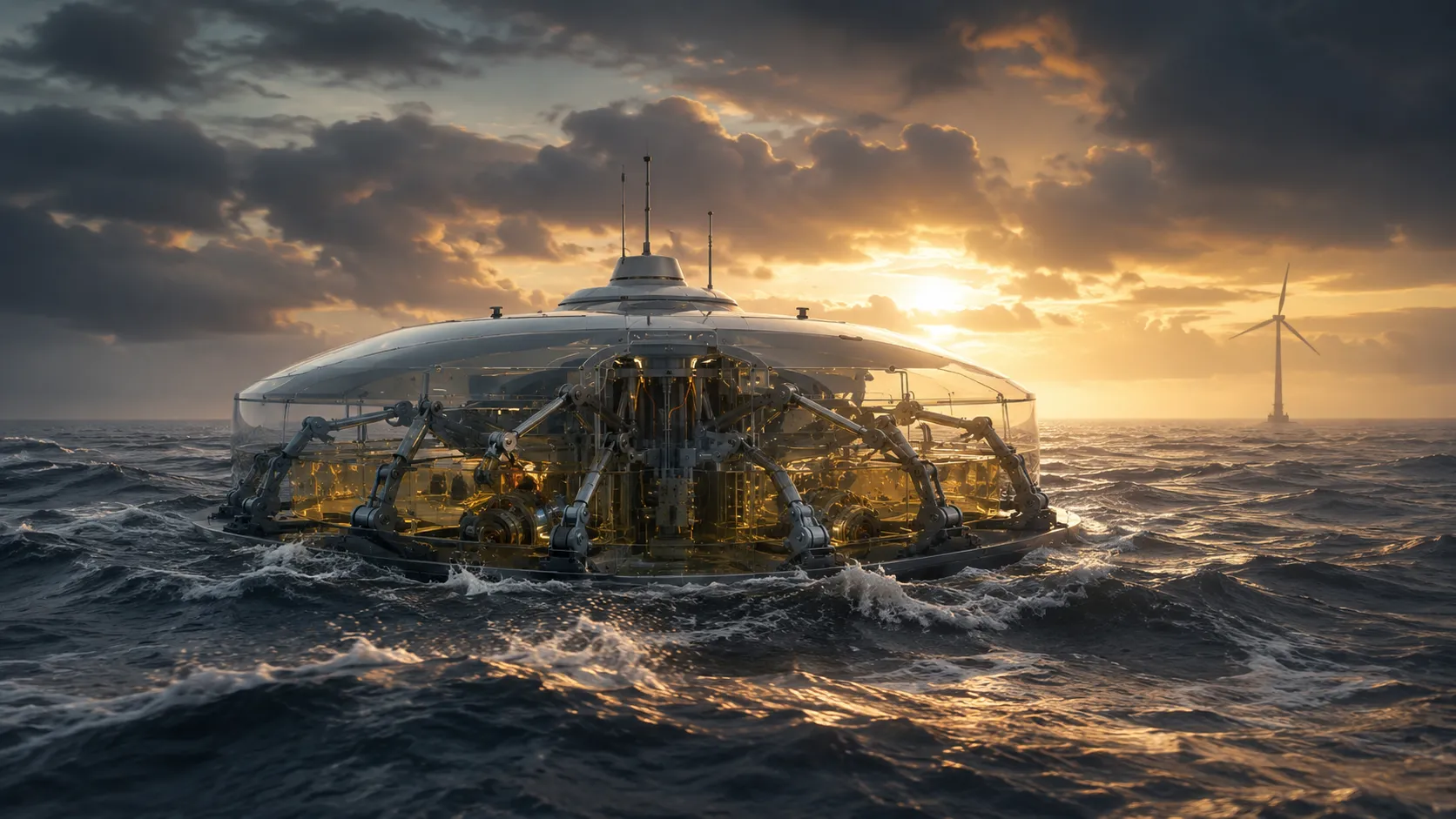
In May 2026, a Dutch device called the Ocean Grazer changed the conversation. After 18 months of continuous operation in the North Sea, including surviving a simulated Category 5 hurricane in the Deltares wave basin and multiple real winter storms, the Ocean Grazer has demonstrated a levelized cost of energy that is competitive with offshore wind. Its performance data, published in Renewable Energy, shows 94% operational uptime, zero major component failures, and an energy capture efficiency that exceeds the best-performing wind turbines on the market. The Dutch government has approved an expansion of the test site to a 10-megawatt array. The company behind it, Ocean Grazer BV, has signed partnership agreements with three European utilities. And the graveyard of wave energy is suddenly looking a little less crowded.
The Problem That Killed the Rest
To understand why the Ocean Grazer succeeded where so many others failed, it helps to understand the fundamental design challenge that has bedeviled wave energy for decades. The ocean delivers energy in two forms: the rise and fall of the water surface (heave) and the back-and-forth motion of particles within the water column (surge). Capturing this energy efficiently requires a device that can move with the waves while simultaneously resisting them—a delicate balance that becomes impossibly difficult when the waves grow from gentle swells to storm-driven monsters.
Most failed wave energy devices made the same mistake. They were designed for a narrow range of wave conditions—the moderate swells that deliver most of the annual energy—and they could not survive the extreme events that deliver most of the destructive force. When a storm arrived, the devices either broke, were torn from their moorings, or activated survival modes that shut down power production entirely. The result was a fleet of prototypes that worked beautifully in calm seas and died in their first winter storm.
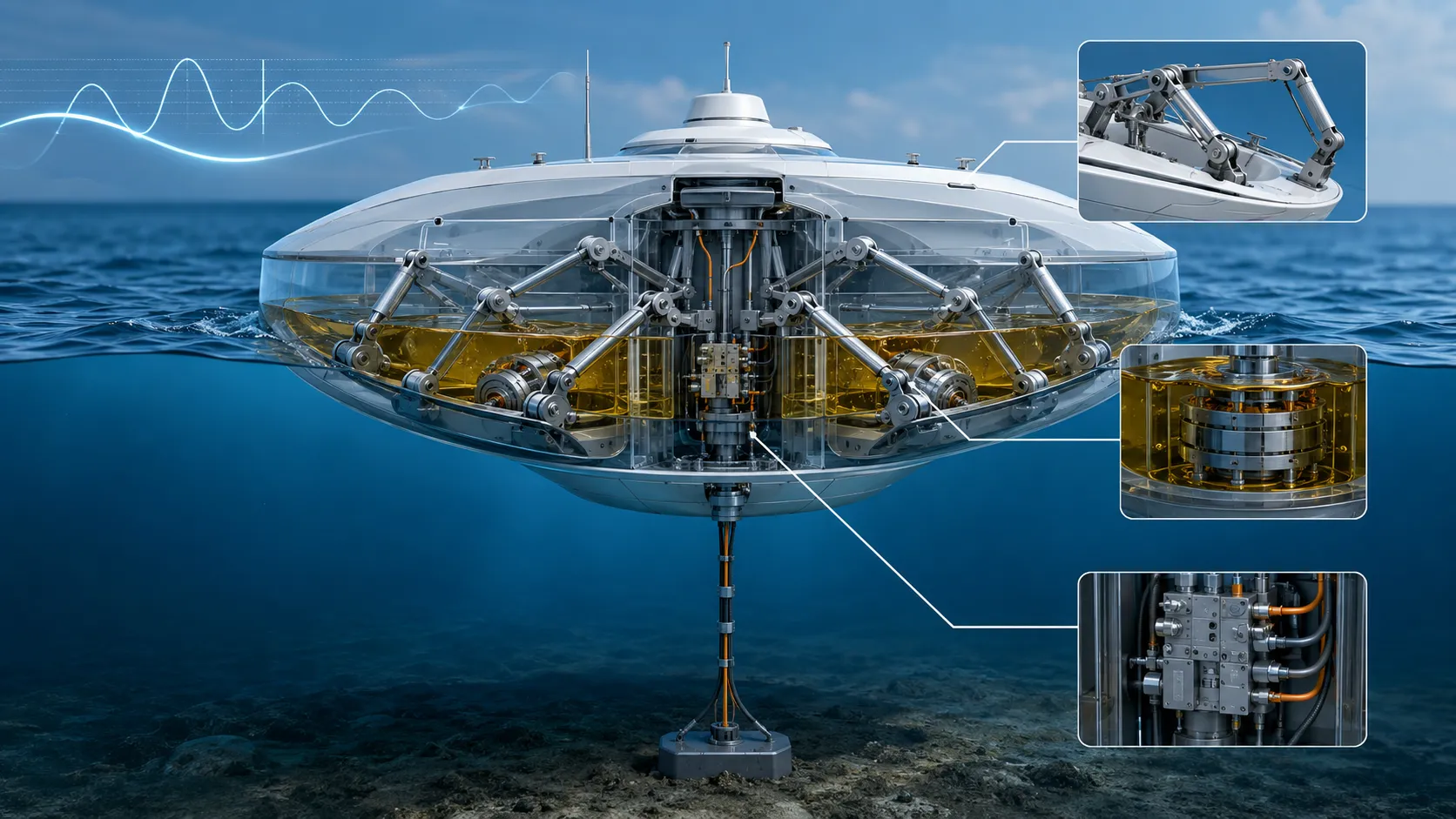
Van Rooij's insight was to design a device that does not fight the ocean. The Ocean Grazer uses multiple articulated arms that move independently, each one tuned to a different wave frequency. In calm conditions, all the arms operate, capturing energy across the full spectrum of wave motion. When a storm arrives and the waves grow larger, the arms automatically adjust their resistance, reducing the load on the system while continuing to generate power. The device does not shut down. It does not go into survival mode. It simply adapts, riding the storm like a seabird rather than fighting it like a breakwater.
The second insight was about simplicity. The Ocean Grazer has fewer than 20 moving parts, all of which are sealed in oil-filled chambers that prevent saltwater contact. The generators are standard induction machines, identical to those used in wind turbines, and the power electronics are off-the-shelf components. There is no exotic materials science, no complex hydraulic systems, no underwater connectors that can fail. The device is, in van Rooij's words, "boring engineering—and that's the point."
The Numbers That Matter
The performance data from the 18-month test campaign tells the story of a technology that has crossed the threshold from experiment to infrastructure.
The levelized cost of energy—the metric that determines whether a power source is economically viable—has fallen to approximately €60 per megawatt-hour, roughly equivalent to offshore wind in European waters. The operational uptime of 94% exceeds the performance of most offshore wind farms, which typically achieve 85–90%. The energy capture efficiency—the fraction of the wave's kinetic energy that the device converts to electricity—averaged 38%, more than double the performance of the best previous wave energy devices.
The Hurricane test was the most dramatic demonstration of the device's resilience. In the Deltares wave basin, a facility in the Netherlands capable of generating the largest artificial waves in the world, the Ocean Grazer was subjected to conditions equivalent to a Category 5 hurricane—waves exceeding 15 meters in height, with breaking crests that would destroy most floating structures. The device survived without damage and resumed normal operation within hours. No wave energy device in history had passed that test.
The Dutch government, which has invested heavily in the Ocean Grazer project as part of its commitment to carbon neutrality by 2035, has approved the expansion of the test site to a 10-megawatt array. Three European utilities—Eneco, Vattenfall, and Ørsted—have signed partnership agreements to deploy Ocean Grazer arrays in their respective offshore wind farms, using the devices to smooth the variability of wind power and share the expensive subsea cable infrastructure.
The Global Potential
The global wave energy resource is not evenly distributed, but it is enormous. The west coasts of Europe, North America, South America, Africa, and Australia all receive powerful, consistent wave energy that could be harnessed by arrays of Ocean Grazer devices. The International Renewable Energy Agency estimates that wave energy could supply up to 10% of global electricity demand by 2050 if the technology can be commercialized at scale—a contribution roughly equivalent to today's entire nuclear power fleet.
The advantage of wave energy over wind and solar is its consistency. Waves arrive day and night, summer and winter, forecastable days in advance. A grid powered partly by waves requires less battery storage, less backup generation, and less overbuilding than a grid powered entirely by intermittent renewables. The Ocean Grazer's ability to operate through storms—unlike wind turbines, which must feather their blades in high winds—makes it a valuable complement to offshore wind, filling the gaps when the wind drops.
The economic potential is concentrated in coastal regions. The European Union's offshore energy strategy, published in 2024, identified wave energy as a key component of the bloc's goal to generate 300 gigawatts of offshore renewable energy by 2050. The United Kingdom, Norway, Ireland, Portugal, and France all have significant wave energy resources and active development programs. Japan, South Korea, and Australia are investing in wave energy research. The United States, despite having enormous wave resources along the Pacific coast, has lagged in deployment—a gap that the Ocean Grazer's success may begin to close.
What This Signals
The Ocean Grazer is not a miracle. It is a machine—a well-designed, carefully engineered, rigorously tested machine that has finally solved a set of problems that defeated its predecessors. The wave energy graveyard is real, and it contains the wreckage of honest efforts by brilliant engineers who underestimated the ocean's brutality. The Ocean Grazer survived because it did not underestimate the ocean. It accepted the ocean's terms and designed a machine that could meet them.
The implication is that wave energy is not a failed technology. It is a late-blooming one. The fundamental physics—the energy density of waves, the predictability of swells, the complementarity with wind—have always favored wave energy. What was missing was a machine that could survive long enough to prove it. The Ocean Grazer has survived. The 18-month test campaign is complete. The Hurricane test is passed. The utility partnerships are signed. The graveyard has a new headstone, and it reads, "Wave energy is not dead. It was just waiting for the right machine."


