The Two Dropouts Who Spent a Decade Building a Battery Nobody Believed In: How Gegadyne Energy Just Launched a Lithium-Free Power Pack That Charges in Minutes—and Is Already on European Factory Floors
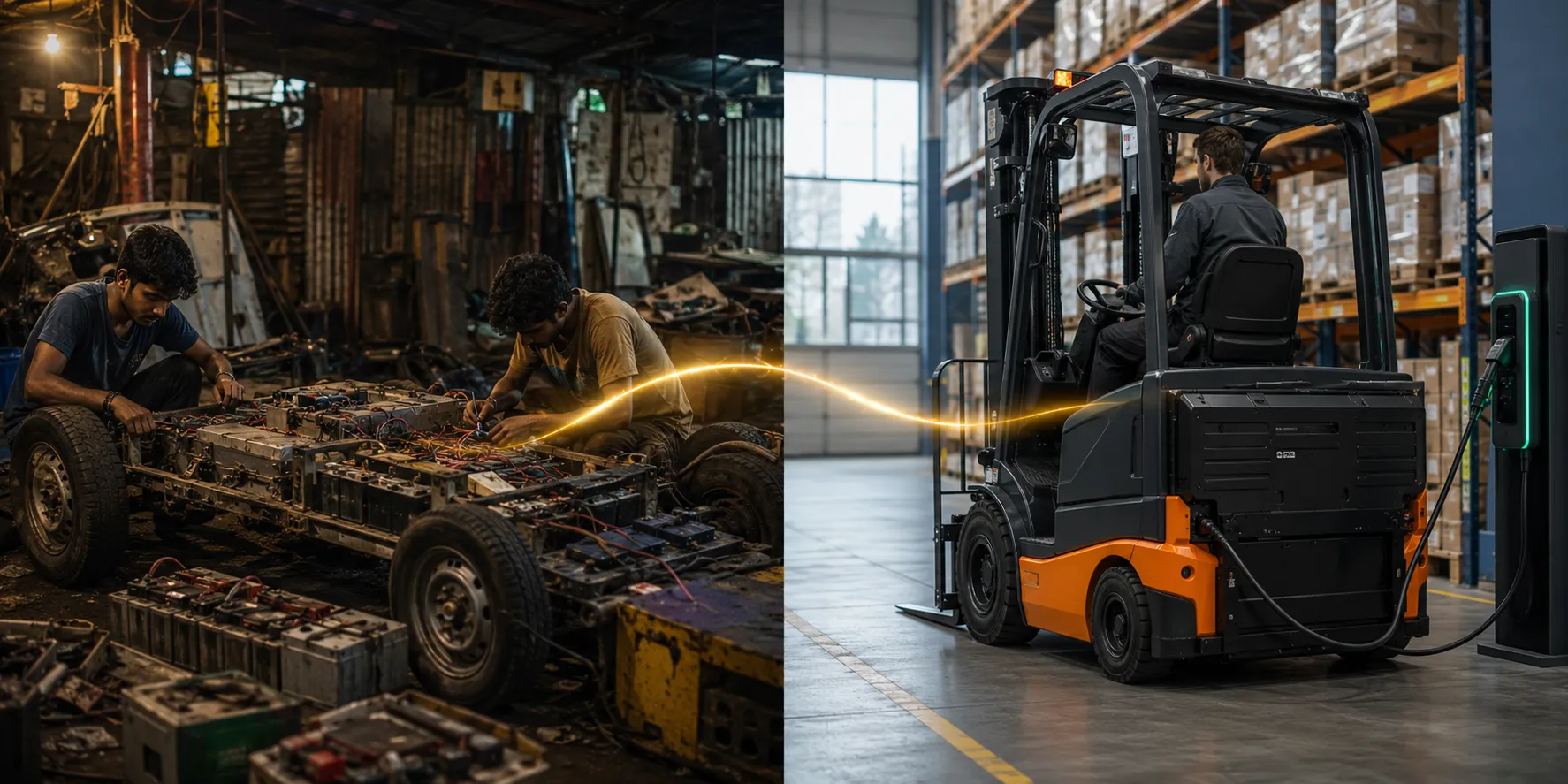
MUMBAI — May 25, 2026 — In 2014, two mechatronics engineering students at Mumbai's Narsee Monjee Institute of Management Studies set out to build an electric vehicle for their final-year project. Jubin Varghese was a car enthusiast. Ameya Gadiwan was a hard-tech tinkerer. Together, they combed through Mumbai's junkyards, collecting spare parts, convinced that they could assemble a working EV from the discarded remnants of the internal-combustion age. They built the chassis. They built the drivetrain. And then they discovered that the battery required to power their creation would cost three times as much as everything else combined. They dropped out of college soon after and started Gegadyne Energy in 2015. They began with lead-acid batteries, which were cheap but charged painfully slowly. They switched to lithium-ion, which charged faster but degraded with every cycle. They experimented with supercapacitors—quick to charge, long-lasting, but low on energy density. Nothing worked. "There was scope to build incremental battery tech instead of creating something from scratch," Varghese said. "Since India doesn't have an established battery supply chain, we decided to work on materials that are widely available in nature."
Eleven years later, on May 16, 2026, Gegadyne Energy announced the commercial launch of its Multi-Ion Battery Technology—a lithium-free, sodium-potassium dual-ion chemistry that is one of the few advanced battery platforms in the Indian market built on original science rather than licensed intellectual property from global technology holders. The batteries are already deployed with leading European and Indian original equipment manufacturers, marking their entry into commercial operations at scale. The platform supports ultra-fast charging alongside opportunity charging between shifts—eliminating the need for dedicated battery rooms, battery swaps, or ventilation infrastructure. Cycle life stands at more than 5,000 warranted cycles, backed by a seven-year warranty that the company describes as the longest in the industry. The battery packs are designed and manufactured end-to-end in India. And the chemistry is free of lithium, cobalt, and nickel—the three minerals that define the geopolitics, the environmental cost, and the supply-chain vulnerability of every lithium-ion cell on Earth.
The two college dropouts who started with nothing but junkyard parts and a conviction that batteries could be better have built something that the global battery industry spent decades dismissing as impossible: a lithium-free, ultra-fast-charging, long-life battery that is already powering forklifts in European warehouses. The Multi-Ion platform is not a laboratory prototype or a venture-funded science project. It is a commercial product, backed by a publicly listed Indian company—V-Guard Industries, which has steadily increased its stake to 30.35 percent—and validated by customers who are using it in the most demanding industrial environments on Earth.
The Chemistry That Shouldn't Work
To understand what Gegadyne has built, one must first understand the fundamental problem that has bedevilled every battery chemist for decades—and the counterintuitive solution the company's founders stumbled upon while trying to fix something else.
The world runs on lithium. Every electric vehicle, every smartphone, every grid-scale storage installation depends on lithium-ion chemistry, in which a single charge carrier—the lithium ion—shuttles between a metal-oxide cathode and a graphite anode, storing and releasing energy with each cycle. The chemistry works brilliantly. It also has structural limitations that are inherent to its design. Lithium ions are small, light, and fast, which gives lithium-ion batteries their excellent energy density. But the materials required to host those ions—cobalt, nickel, manganese—are expensive, environmentally destructive to mine, and concentrated in a handful of countries that are increasingly willing to weaponise their control over the supply chain. The cells degrade with every charge cycle, losing capacity as the electrode materials crack and the electrolyte decomposes. Fast charging generates heat that accelerates the degradation. And the batteries, when they fail, can catch fire with a ferocity that is difficult to extinguish.
For decades, the battery industry has pursued incremental improvements to the lithium-ion platform—better cathodes, better anodes, better electrolytes—while treating the fundamental chemistry as fixed. The assumption, rarely stated but universally held, was that lithium was irreplaceable. The element was uniquely suited to energy storage, and any alternative chemistry would necessarily be heavier, slower, and less capable. The assumption was so deeply embedded that most battery startups did not challenge it. They built their businesses around better ways to manufacture lithium-ion cells, or better software to manage them, or better business models to finance them. Almost no one tried to replace lithium itself.
Varghese and Gadiwan did not set out to replace lithium. They set out to build a better battery, and the path they followed—through lead-acid, through lithium-ion, through supercapacitors—led them, incrementally, to a chemistry that did not depend on lithium at all. The Multi-Ion platform is built on a proprietary sodium-potassium intercalation chemistry—a dual-ion architecture in which multiple charge carriers work in parallel, rather than a single ion shuttling between two electrodes. The approach is fundamentally different from conventional battery design. Instead of relying on one ion species to do all the work, the Multi-Ion platform deploys sodium and potassium ions simultaneously, each one carrying charge through a different pathway in the electrode structure. The result is a battery that charges faster, lasts longer, and operates more safely than either lead-acid or lithium-ion alternatives—and that does so at a lower total lifetime cost.
The chemistry is lithium-free, cobalt-free, and nickel-free. The raw materials—sodium and potassium—are among the most abundant elements on Earth. Sodium is present in seawater, in salt flats, and in the common table salt that costs pennies per kilogram. Potassium is a primary nutrient in agricultural fertiliser, produced at a scale of tens of millions of tonnes annually. Neither element is subject to the geopolitical constraints, the supply-chain bottlenecks, or the price volatility that define the lithium market. A battery built on sodium and potassium is a battery built on a supply chain that is abundant, diversified, and largely immune to the shocks that periodically cripple the lithium-ion industry.
The trade-off, as with all alternative battery chemistries, is energy density. Multi-Ion batteries are heavier per kilowatt-hour than the best lithium-ion cells, which makes them less suitable for long-range passenger cars where every kilogram matters. But in the industrial and traction applications that Gegadyne is targeting—forklifts, pallet jacks, order pickers, material-handling equipment—energy density is secondary to cycle life, charging speed, and total cost of ownership. The forklift that operates in a warehouse does not need to travel 500 kilometres on a single charge. It needs to run continuously through a shift, charge during breaks, and keep running for years without the battery degrading. Multi-Ion is engineered for exactly that use case, and its specifications reflect the priorities of the industrial customer rather than the consumer.
The Industrial Bet
The most strategically significant decision Gegadyne has made is not the chemistry. It is the market. The company has chosen to launch its technology in the industrial and traction sectors—forklifts, pallet jacks, material-handling equipment—rather than in the electric vehicle market that has consumed most of the world's battery investment.
The logic is straightforward. The industrial battery market is large, growing, and underserved by the lithium-ion industry. The material-handling equipment market alone—the forklifts, order pickers, and pallet jacks that move goods through every warehouse, factory, and distribution centre on Earth—is estimated at more than $30 billion annually, and the vast majority of that equipment still runs on lead-acid batteries that were designed in the early 20th century. Lead-acid batteries are cheap but heavy, slow to charge, short-lived, and require dedicated battery rooms with ventilation systems to manage the hydrogen gas they emit during charging. They are the weakest link in the modern supply chain—a technology that has barely changed in a century, powering the most advanced logistics systems ever built.
Lithium-ion batteries are better, but they are expensive, and their performance advantages over lead-acid—higher energy density, faster charging—are less compelling in the industrial context, where the equipment is heavy enough that the weight of the battery is not a constraint, and where charging can be scheduled during shift breaks rather than requiring the ultra-fast charging that consumer EVs demand. The industrial customer who replaces a lead-acid forklift battery with a lithium-ion alternative pays a significant premium for performance improvements that may not translate into lower total cost of ownership.
Multi-Ion is designed to offer a better value proposition than either alternative. It charges faster than lead-acid—fast enough to support opportunity charging during shift breaks, eliminating the need for battery swaps and dedicated charging rooms. It lasts longer than lithium-ion—more than 5,000 warranted cycles, backed by a seven-year warranty that is the longest in the industry. It operates safely across a temperature range that would destroy a lithium cell—from minus 40 degrees Celsius in cold storage facilities to 60 degrees on an open warehouse floor in peak summer. And it costs less, on a total-lifetime basis, than either lead-acid or lithium-ion, because the lower upfront cost of the raw materials, combined with the longer cycle life and the reduced infrastructure requirements, produces a lower total cost of ownership over the seven-year warranty period.
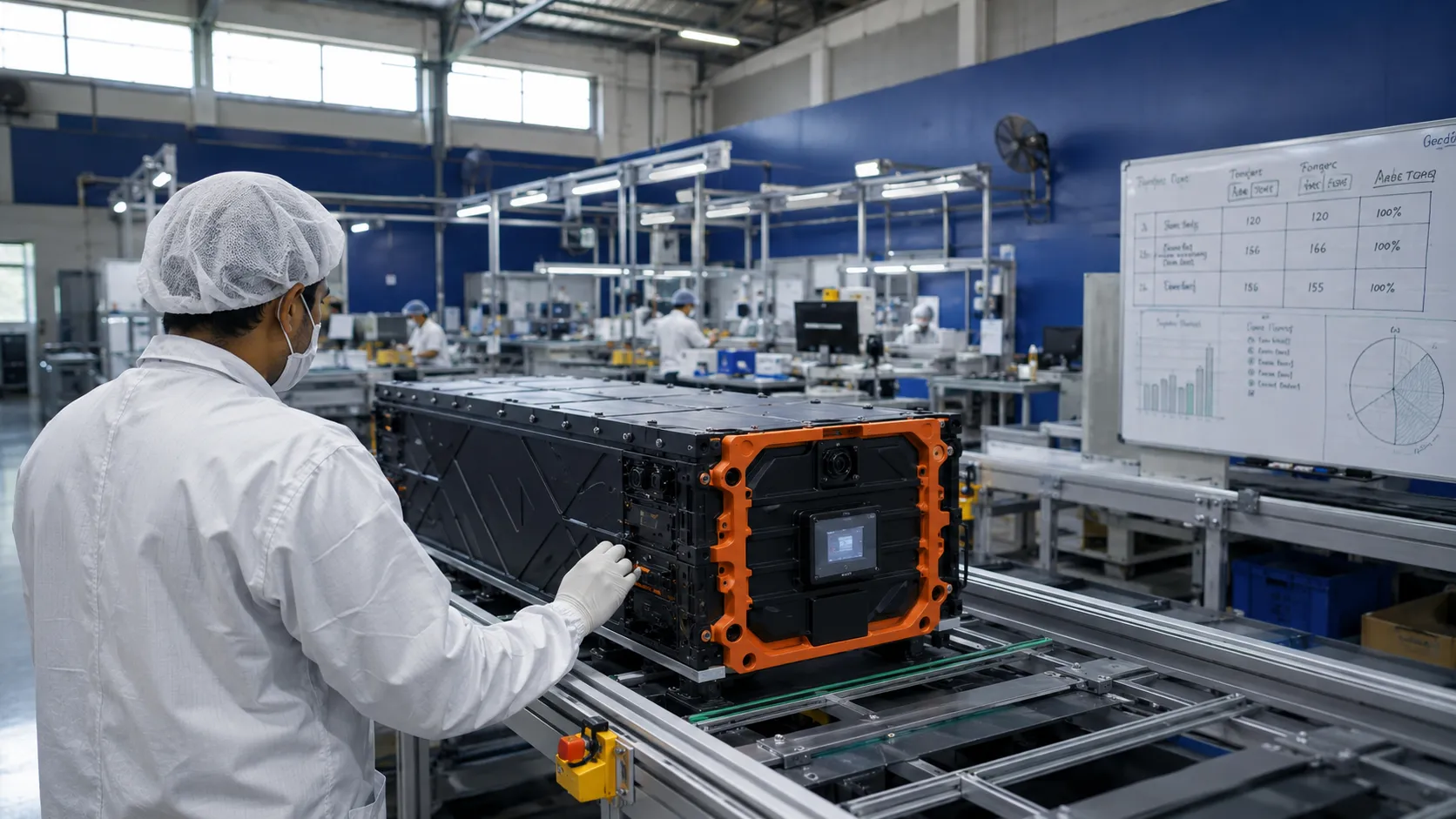
The specifications reflect the market the company is targeting. Battery pack voltages range from 24V to 84V, with nominal capacities up to 1,020 Ah, covering Class 1 counterbalance forklifts, Class 2 order pickers and reach trucks, and Class 3 pallet jacks, stackers, and tugs. A dedicated cold-storage variant with an anti-freeze formulation is optimised for extreme low-temperature environments. The battery packs carry an IP67 ingress protection rating—dust-tight and waterproof to one metre of immersion—and an integrated Battery Management System with IoT connectivity for remote monitoring. The product is not a cell. It is a vertically integrated system: cells, packs, battery management, chargers, all designed and manufactured end-to-end in India.
The launch targets material handling and industrial power sectors, where the company positions Multi-Ion as a direct alternative to conventional lead-acid and imported lithium-ion chemistries. The technology is already deployed with leading European and Indian OEMs, marking its entry into commercial operations at scale. The European customer base is particularly significant—a validation that the technology meets the standards of the world's most demanding industrial markets, and that the manufacturing quality is sufficient to satisfy customers who have access to every battery technology on Earth.
The company's commercial offering is a full-stack system, not just a cell. The product stack includes patented cell chemistry, battery packs customised to customer requirements, an intelligent Battery Management System with advanced cell monitoring and balancing, integrated chargers, and an IoT module for remote monitoring. The chargers are designed to be positioned anywhere in the facility—the batteries charge inside the truck, eliminating the need for dedicated battery rooms, battery swaps, or ventilation infrastructure. The integration of hardware, software, and connectivity creates a platform effect that is difficult for competitors to replicate: a customer who adopts the Gegadyne system is not just buying a battery, but a complete energy management solution.
The V-Guard Endorsement
The single most important external validation of Gegadyne's technology arrived not from a venture capitalist, but from a publicly listed Indian manufacturer of electrical appliances. V-Guard Industries, a ₹30,000 crore market-cap company that makes voltage stabilisers, water heaters, and kitchen appliances, first invested $5 million (₹36.5 crore) in Gegadyne in 2021. In March 2026, the company increased its investment by an additional ₹25 crore, raising its stake to 30.35 percent on a fully diluted basis—a level of commitment that suggests V-Guard views Gegadyne not as a speculative bet, but as a strategic partner.
V-Guard does not invest in battery startups casually. The company is one of India's largest electrical appliance manufacturers, with a distribution network that reaches every corner of the country, and its investment in Gegadyne is a bet that the Multi-Ion technology can be scaled across a range of applications that extend well beyond industrial traction. The investment also provides Gegadyne with access to V-Guard's manufacturing expertise, its supply-chain relationships, and its distribution infrastructure—resources that no venture-backed startup could build on its own.
The broader context is an Indian battery industry that is at an inflection point. The government's Production Linked Incentive scheme for advanced chemistry cells has attracted commitments from Tata, Reliance, and Ola Electric to build lithium-ion gigafactories. The India Semiconductor Mission and the National Quantum Mission have signalled the government's willingness to invest in strategic technologies. The battery sector, which is essential to both the electric vehicle transition and the grid-scale storage buildout, is receiving policy attention and capital at a scale that is unprecedented in Indian manufacturing. Gegadyne, with its lithium-free chemistry and its vertically integrated manufacturing, is positioned at the intersection of the policy push, the market demand, and the technological innovation that will define the next decade of Indian industry.
The company has raised approximately $7.76 million in total funding, according to PitchBook, from investors including Astir Ventures, BlueLotus Ventures, V-Guard Industries, and Mumbai Angels. The capital has been deployed judiciously—the company has not raised the kind of large, dilutive rounds that have defined the venture-backed battery sector, and it has focused on building manufacturing capacity and customer relationships rather than chasing valuation markups. The discipline reflects the founders' backgrounds: two college dropouts who learned, in the junkyards of Mumbai, that the only thing that matters is whether the product works.
The eleven-year journey from a failed final-year project to a commercial battery deployed with European OEMs is not the story of a sudden breakthrough. It is the story of two founders who refused to accept that the lithium-ion architecture was the only viable path, who spent years experimenting with materials that were abundant and affordable, and who built, incrementally, a chemistry that no one believed could work—until it did. The Multi-Ion platform is not a threat to the lithium-ion industry. It is an alternative for the applications where lithium-ion is either too expensive, too fragile, or too dependent on supply chains that India does not control. The forklifts that move goods through European warehouses, the pallet jacks that operate in Indian cold storage facilities, and the order pickers that keep the global supply chain running are the first markets. The two dropouts who started with junkyard parts and a conviction that batteries could be better are no longer students. They are the founders of one of the few Indian battery companies to have built a commercial product on original science—and the market they are targeting is large enough to support a very substantial business.
What This Signals
The Gegadyne Energy story is not primarily about a battery. It is about the collision of three structural shifts that are reshaping the global energy storage industry—and about the founders who positioned themselves at the intersection of all three before anyone else saw the pattern.
The first shift is the geopolitical vulnerability of the lithium supply chain. The world's lithium is concentrated in Australia, Chile, and China—the latter of which refines the majority of the world's battery-grade lithium and manufactures the majority of its cathodes. The countries that depend on lithium for their electric vehicle and grid-storage ambitions—India prominent among them—are building their futures on a supply chain they do not control. The second shift is the maturing of alternative battery chemistries. Sodium-ion, potassium-ion, and dual-ion architectures that were dismissed as laboratory curiosities a decade ago are now being commercialised by companies that have spent years solving the electrochemistry, the manufacturing, and the systems-integration challenges. The third shift is the expansion of the battery market beyond electric vehicles. The industrial sector—forklifts, pallet jacks, material-handling equipment—is electrifying rapidly, driven by the same economics that are pushing automakers toward EVs, and the batteries that serve this market have different requirements than the batteries that power passenger cars. The company that builds the best battery for the industrial customer will capture a market that is measured in the tens of billions of dollars.
Gegadyne is positioned at the intersection of all three shifts. Its Multi-Ion platform is lithium-free, which insulates it from the geopolitical vulnerabilities of the lithium supply chain. Its chemistry is built on original science, protected by patents, and validated by commercial deployment with European OEMs. Its target market—industrial traction—is large, underserved by the lithium-ion industry, and ideally suited to the specific performance characteristics of the Multi-Ion architecture: ultra-fast charging, extreme cycle life, wide temperature tolerance, and lower total lifetime cost. The company is not competing with CATL or BYD for the passenger EV market. It is building a different product for a different customer, and the customer is buying.
Jubin Varghese and Ameya Gadiwan are no longer the two dropouts who built an EV from junkyard parts and could not afford the battery. They are the founders of one of the few Indian battery companies to have built a commercial product on original science, backed by a publicly listed strategic investor, and deployed with customers in Europe. The eleven years between the junkyard and the commercial launch were not a straight line. They were a long, difficult, incremental journey through lead-acid, lithium-ion, supercapacitors, and eventually, the proprietary chemistry that became Multi-Ion. The battery that charges in minutes and lasts for years is not a prototype in a laboratory. It is a product on a factory floor, powering the machines that move the global economy. The two dropouts who believed that batteries could be better have been proven right. The chemistry that shouldn't work is working. The market is just beginning to notice.


