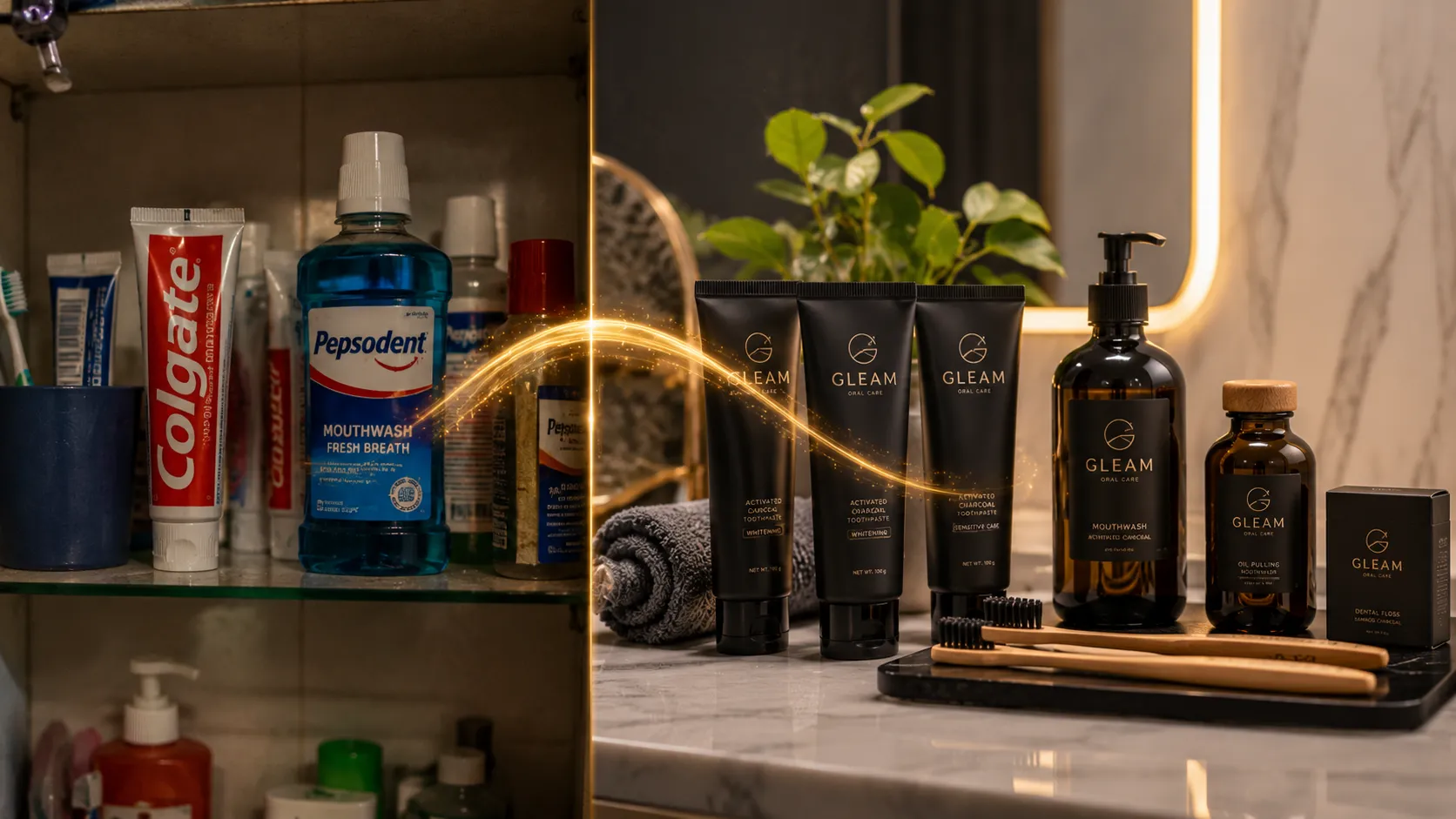
The Toothpaste Rebel: How a 22-Year-Old Is Building a ₹500 Crore D2C Oral‑Care Empire—and Taking On Colgate, Pepsodent, and a Century of Inertia
MUMBAI — May 31, 2026 — In the summer of 2023, a 19‑year‑old college dropout stood in a small, rented laboratory in Mumbai's SEEPZ industrial zone, holding a beaker of a murky, charcoal‑black liquid that he believed would change the way India brushed its teeth. His friends thought he was insane. His family—a middle‑class Marwari household that had indulged his entrepreneurial experiments since he had started a dropshipping business at 15—was supportive but anxious. His potential investors, the handful of angel networks he had approached, were polite but dismissive. The oral‑care market was a fortress, they told him. It was dominated by Colgate and Pepsodent, which together controlled over 60 percent of the Indian toothpaste market, and by Hindustan Unilever, which controlled much of the rest. The barriers to entry—the manufacturing scale, the distribution networks, the advertising budgets—were insurmountable for a startup. The idea that a teenager with a beaker of charcoal toothpaste could compete with the giants was, depending on whom you asked, either naïve or delusional.
Three years later, Vivaan Sheth is 22 years old. His company, Gleam Oral Care, has just crossed ₹500 crore in annualised revenue, with a product line that spans toothpaste, mouthwash, dental floss, toothbrushes, and a rapidly growing range of teeth‑whitening products. Its flagship charcoal toothpaste, which contains activated coconut charcoal, hydroxyapatite—a naturally occurring mineral that remineralises tooth enamel—and a proprietary blend of essential oils, is the best‑selling toothpaste on every major e‑commerce platform in India. The company has raised approximately ₹400 crore from a consortium of investors led by Sequoia Capital, Fireside Ventures, and the family office of a major Indian industrialist, at a valuation that is estimated at approximately ₹2,500 crore. It has launched a range of products in 12 countries, including the United States, the United Kingdom, and the United Arab Emirates. It employs over 600 people, operates its own manufacturing facility in Gujarat, and has recently signed a distribution agreement with a major retail chain that will place its products in over 5,000 physical stores across India by the end of 2026. And it is being watched, with a mixture of alarm and grudging respect, by the multinational conglomerates that once dismissed its founder as a naïve teenager.
"The oral‑care market has been asleep for a century. Colgate and Pepsodent have been selling the same basic products to the same customers for decades, and they have had no reason to innovate because they have had no competition. The D2C revolution has finally arrived in oral care, and the incumbents are not prepared for it." — Consumer‑brands investor, speaking anonymously to TIGI
The Charcoal Revolution
The single most important product decision that Vivaan Sheth made was to bet on charcoal toothpaste. The decision was not, at first, a strategic masterstroke. It was a personal frustration. Sheth, like millions of Indians, had grown up using the same mass‑market toothpaste brands that his parents and grandparents had used, and he had never questioned whether those products were the best that science could offer. Then, during a trip to the United States in 2022, he encountered the D2C oral‑care brands that were beginning to emerge in the American market—the Quips, the Bursts, the Native—and he realised that the Indian market, for all its size and sophistication, had been left behind. The toothpaste that Indians were using was essentially the same product that had been sold for decades, with the same basic ingredients, the same generic packaging, and the same marketing messages. The Indian oral‑care market was a fortress, but it was a fortress that had not been updated in a generation.
The charcoal formulation that Sheth developed in his rented SEEPZ laboratory was based on a simple insight: Indian consumers were increasingly sceptical of the chemical ingredients that filled the mass‑market toothpaste brands—the sodium lauryl sulfate, the triclosan, the artificial sweeteners and colours—and they were looking for alternatives that were natural, effective, and transparently labelled. The activated coconut charcoal that was the centrepiece of the Gleam toothpaste was not, in itself, a revolutionary ingredient—it had been used in traditional Indian oral‑care practices for centuries—but it had never been commercialised at scale by a modern, design‑forward, digitally native brand. The hydroxyapatite that Sheth added to the formulation was the functional ingredient—the substance that actually remineralised tooth enamel and reduced sensitivity—and it was an ingredient that most Indian consumers had never heard of because the mass‑market brands had never marketed it. The combination—charcoal for the marketing, hydroxyapatite for the efficacy—was potent, and it resonated with a consumer base that was ready for an alternative.
The charcoal revolution that Gleam ignited has now spread across the Indian oral‑care market. Colgate and Pepsodent have launched their own charcoal‑infused toothpaste variants, a tacit acknowledgment that the D2C upstart had identified a consumer trend that the incumbents had missed. The incumbents' responses have been, by most accounts, effective—their distribution networks and their brand recognition give them an advantage that no startup can match—but the Gleam brand has established a beachhead that the incumbents cannot dislodge. The consumer who has switched to Gleam, who has experienced the charcoal formulation and the hydroxyapatite efficacy, and who has developed a loyalty to the brand's aesthetic and its values, is a consumer who is unlikely to return to Colgate. The brand loyalty is the moat, and the moat is deepening with every tube of toothpaste that Gleam sells.

The Manufacturing Gamble
The most audacious decision that Sheth made was not the product formulation. It was the manufacturing. In 2024, with the company's revenue at approximately ₹50 crore and its capital reserves still modest, Sheth decided to build his own manufacturing facility rather than continue to outsource production to a contract manufacturer. The decision was, by the conventional wisdom of the D2C startup playbook, irrational. The D2C brand that outsources its manufacturing can scale faster, with less capital, and with less risk—and the contract manufacturers who serve the oral‑care industry are experienced, capable, and hungry for business. The D2C brand that builds its own factory is committing to a capital expenditure that will consume years of cash flow, and it is betting that the quality, the control, and the unit economics of in‑house manufacturing will eventually justify the investment.
Sheth's bet was based on a conviction that the contract‑manufacturing model was fundamentally unsuitable for the kind of brand he was building. The contract manufacturer is incentivised to minimise costs, to maximise throughput, and to treat every client's product as essentially the same. The Gleam formulation, with its charcoal, its hydroxyapatite, and its proprietary essential‑oil blend, was not the same as the mass‑market toothpaste that the contract manufacturers were accustomed to producing. The quality control that the Gleam brand required—the particle size of the charcoal, the concentration of the hydroxyapatite, the stability of the essential‑oil blend—was more demanding than the contract manufacturers were willing to accommodate. The only way to guarantee the quality, Sheth concluded, was to build the factory himself.
The factory, which is located in an industrial park near Vadodara, Gujarat, was completed in late 2025 and began production in January 2026. It employs approximately 200 workers, operates three production lines, and has a capacity of approximately 50 million tubes of toothpaste per year—enough to meet the company's current demand and to support its expansion into international markets. The factory's capital cost, approximately ₹120 crore, was financed through a combination of the company's Series B funding and a loan from the State Bank of India. The factory's unit economics, by the company's own estimates, are approximately 25 percent better than the contract‑manufacturing alternative—a margin advantage that will compound as the factory scales. The manufacturing gamble has, so far, paid off—and it has given Gleam a supply‑chain independence that its D2C competitors, most of whom are still dependent on contract manufacturers, cannot match.
The International Ambition
The most strategically significant dimension of the Gleam story is not the domestic Indian market, which is large enough to sustain a substantial business for years to come. It is the international market, which Sheth has been pursuing with an intensity that belies his age. The company's products are now available in 12 countries, including the United States—the most competitive and demanding oral‑care market in the world—and the early results are promising. The Gleam charcoal toothpaste, which is sold through Amazon in the U.S. and the U.K., has achieved an average customer rating of 4.5 stars across both platforms, and its repeat‑purchase rate is comparable to the rates of the leading D2C oral‑care brands in the American market. The international expansion is being managed by a small team of executives who were recruited from the consumer‑goods industry, and it is being financed primarily by the company's Series C funding. The international ambition is not a vanity project. It is a recognition that the oral‑care market is global, that the D2C model that has worked in India can work elsewhere, and that the first Indian oral‑care brand to establish a global presence will have a structural advantage over the domestic competitors who are still focused on the home market.
The international expansion has also been supported by a strategic partnership with a major e‑commerce logistics provider, which has given Gleam access to a global fulfilment network that would otherwise have been beyond its reach. The partnership allows the company to ship products to customers in over 100 countries, with delivery times that are competitive with the domestic D2C brands in each market, and at a cost that is manageable within the company's margin structure. The partnership is not exclusive—the logistics provider works with multiple D2C brands—but it is essential, and it has enabled Gleam to scale internationally without the massive capital investment that building its own global fulfilment network would require.
What This Signals
The Gleam Oral Care story is not primarily about a toothpaste brand. It is a story about the structural transformation of the Indian consumer‑goods market—a shift from a market that was defined by the dominance of a handful of large, legacy brands to a market that is being reshaped by a generation of digitally native, design‑forward, manufacturing‑enabled D2C startups, and from a consumer who was content to use the same products that had been on the shelf for decades to a consumer who is actively seeking alternatives that are better, more transparent, and more aligned with their values. The 22‑year‑old who stood in a rented laboratory with a beaker of charcoal toothpaste was not merely building a brand. He was betting that the Indian consumer was ready for something different—and the consumer, it turns out, was ready. The ₹500 crore revenue, the ₹2,500 crore valuation, the 12‑country footprint—these are the returns on that bet, and the bet is still being placed.


